The market for natural sweeteners continues to create opportunities for food brands, distributors, retailers, and importers. Among the available options, coconut sugar granules offer an interesting combination of a familiar sweetener format and the distinctive character of coconut-derived sugar. However, launching a coconut sugar product under your own brand involves more than putting a logo on a bag. Buyers need to consider product specifications, granule size, packaging, labeling, quality control, production capacity, and export requirements. That is where private label coconut sugar granules can make the sourcing process more flexible.
With a private label arrangement, a business can source coconut sugar granules from an experienced producer while selling the finished product under its own brand. This approach can be useful for distributors, specialty food companies, retailers, wholesalers, and businesses developing their own natural sweetener range.
In this guide, we will explain how private label coconut sugar granules work, what buyers should discuss with a supplier, how custom packaging fits into the process, and what to consider when choosing an Indonesian supplier for an international private label project.
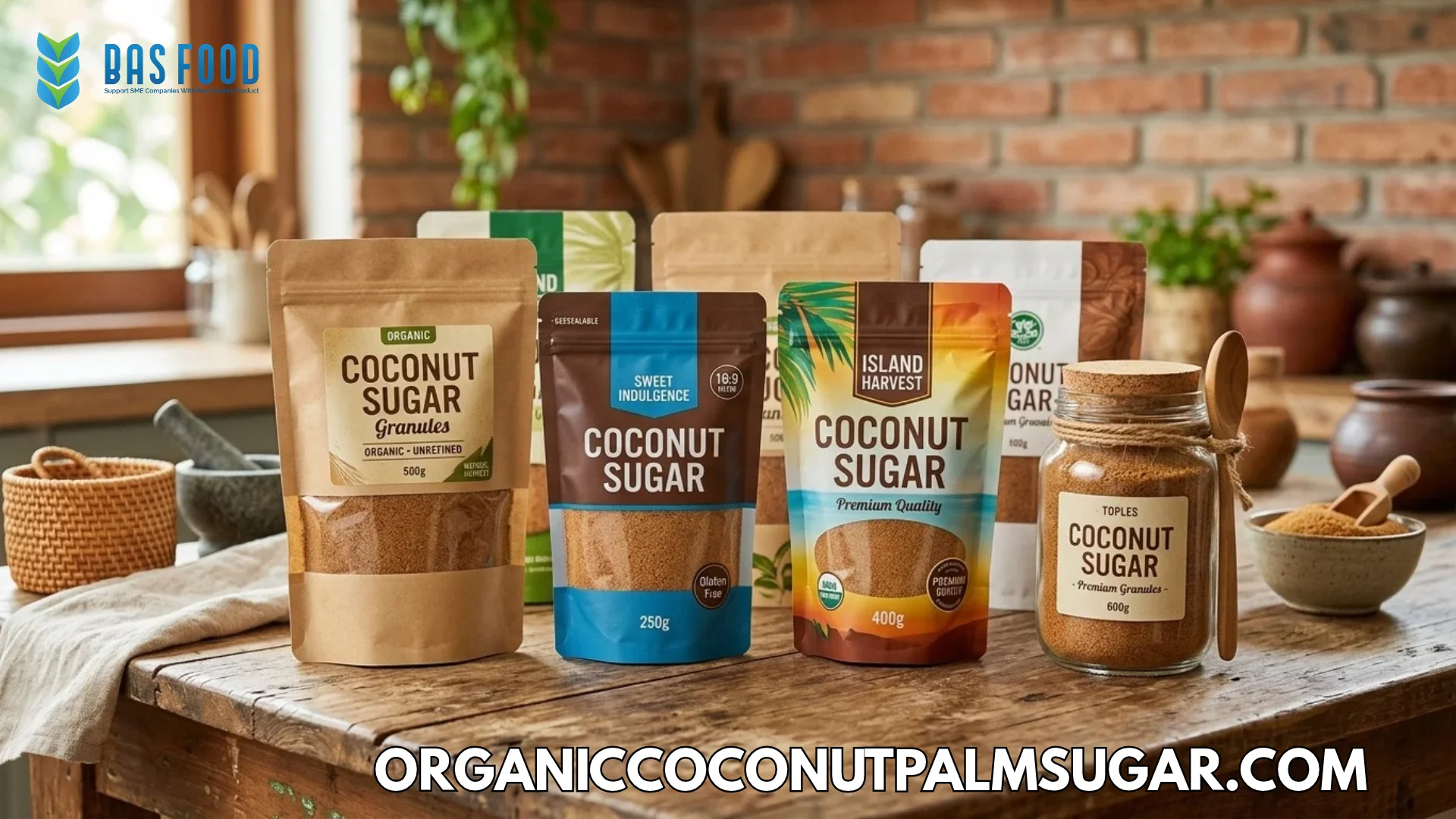
What Are Private Label Coconut Sugar Granules?
Private label coconut sugar granules are coconut sugar granules produced by a manufacturer or supplier for sale under another company’s brand. Instead of selling the product using the manufacturer’s consumer-facing brand, the buyer can market it using its own business or product name.
The production arrangement can vary depending on the supplier and project. In some cases, the buyer purchases a standard coconut sugar granule product and requests custom packaging. In other projects, the buyer may request specific product characteristics, packaging formats, labeling requirements, or other adjustments.
This model allows businesses to focus on their brand, sales channels, and customers while working with a supplier that handles product production.
For example, a food distributor may want to create its own coconut sugar brand for retail stores. Rather than building a sugar processing facility, the distributor can work with a private label supplier and discuss product specifications, packaging, order volume, and branding.
Why Businesses Choose a Private Label Model
Building a food brand from scratch can require significant resources. A company needs to develop the product, arrange production, create packaging, manage quality, and prepare the product for distribution.
A private label model can reduce some of these operational challenges because the production side is handled by an established supplier. The buyer can then concentrate more heavily on brand positioning, marketing, distribution, and customer relationships.
This can be particularly useful for businesses that already have a distribution network. For example, a wholesaler that sells natural food ingredients may want to add coconut sugar to its portfolio under its own brand.
Similarly, a retailer can create a custom brand for its customers without investing in its own sugar processing equipment. The exact arrangement depends on the supplier’s capabilities and the buyer’s requirements.
Private labeling can therefore create a bridge between manufacturing and branding. The supplier focuses on producing the ingredient, while the buyer develops the commercial identity around the finished product.
Who Can Benefit From Private Label Coconut Sugar?
Private label coconut sugar can suit several types of B2B buyers. Food distributors are one example because they can create a branded product while using their existing sales channels.
Retailers can also use private labeling to develop exclusive products. Instead of selling the same packaging found across different stores, a retailer can create its own product identity.
Other potential buyers include:
- Natural food brands
- Organic product distributors
- Specialty grocery companies
- Ingredient wholesalers
- Online food retailers
- Foodservice distributors
- Beverage ingredient companies
- Bakery ingredient businesses
- Importers
- Regional food brands
The ideal private label arrangement depends on the buyer’s market, sales volume, packaging requirements, and customer expectations.
For this reason, buyers should define their business model before approaching a supplier. A retail brand may need different packaging from an industrial ingredient distributor. Likewise, an online retailer may need smaller consumer packs while a food manufacturer may require larger bulk formats.
Choosing the Right Coconut Sugar Granule Format
Not every coconut sugar granule product is necessarily suitable for every private label project. Particle size can influence how the product looks, flows, dissolves, and performs in different applications.
A buyer should therefore discuss granule specifications before approving the product. If the coconut sugar will be sold directly to consumers, appearance and ease of use may be especially important.
For food manufacturing, however, the technical requirements may be different. The buyer may need a particular granule size or product consistency to suit a formulation or production process.
Instead of assuming that one granule format works for every project, buyers should ask the supplier about available specifications and request samples.
The sample can then be evaluated for appearance, texture, flavor, aroma, flow characteristics, and performance in the intended application.
Private Label vs OEM: What Is the Difference?
The terms private label and OEM are sometimes used interchangeably, but they can describe different levels of customization.
A private label supplier may provide an existing product that is sold under the buyer’s brand. The buyer may customize the packaging, label, and certain commercial elements while using the supplier’s established product specification.
An OEM manufacturer, on the other hand, may provide a broader production service depending on its capabilities. The buyer may have more involvement in product specifications, formulation, packaging, or other manufacturing requirements.
For coconut sugar granules, the exact meaning of OEM can vary between suppliers. Therefore, buyers should not rely only on the terminology.
Instead, ask the supplier directly:
- What product specifications can be customized?
- Can the packaging be customized?
- Can the label design be supplied by the buyer?
- What packaging formats are available?
- Can the supplier support different product specifications?
- What quality documents are available?
- What are the production and order requirements?
Clear communication is much more useful than simply asking whether a supplier offers “OEM.”
Building a Strong Custom Brand
A custom brand needs more than attractive packaging. The product inside the package must match the brand promise.
For example, if a brand positions itself around natural food ingredients, the product specification, packaging information, sourcing story, and quality communication should support that positioning.
This is why private label buyers should establish their product requirements before designing the final packaging.
Start with the product itself. Determine the required coconut sugar granule format, quality expectations, packaging size, storage requirements, and target market.
Next, develop the branding and packaging around those requirements. This reduces the risk of creating packaging that promises characteristics the supplier does not provide.
A good private label project connects three elements: product specification, brand message, and customer expectation.
Custom Packaging for Coconut Sugar Granules
Packaging is one of the most visible parts of a private label product. It is also an important part of protecting the product during storage and transportation.
Private label buyers can discuss packaging options with their supplier based on the target market. Retail products may require consumer-friendly bags or pouches, while foodservice or industrial buyers may need larger packaging formats.
The packaging should also provide suitable protection against moisture and normal handling conditions. Coconut sugar is a dry sweetener, so moisture management can be important for maintaining product quality.
Buyers should discuss:
- Packaging material
- Pack size
- Inner and outer packaging
- Label requirements
- Batch information
- Storage instructions
- Shipping protection
- Carton or pallet configuration
The final packaging specification should be agreed with the supplier before production.
Designing the Label for International Markets
Private label buyers selling coconut sugar internationally need to pay attention to the labeling requirements of their destination market.
Label requirements can vary between countries. Depending on the market and product, the label may need information such as product name, net weight, ingredient information, origin, batch identification, storage instructions, importer details, or other required information.
Because requirements differ by jurisdiction, buyers should confirm the applicable rules for their target market.
The supplier can provide product information, but the buyer should also take responsibility for ensuring that the final commercial label meets the requirements of its destination market.
This is particularly important for businesses selling in several countries. A single label may not automatically satisfy every market.
Quality Control for Private Label Products
Private label buyers are putting their own brand name on the product. Therefore, quality control becomes an important part of the business relationship.
The buyer should understand how the supplier manages product consistency from production through packaging. This can include raw material handling, processing controls, finished product inspection, packaging checks, and batch identification.
Before starting regular orders, buyers should establish the key product specifications.
These may include:
- Appearance
- Color
- Aroma
- Flavor
- Granule characteristics
- Moisture requirements
- Food safety requirements
- Packaging specifications
- Storage requirements
- Other customer-specific requirements
The exact specification should depend on the intended market and application.
Once the specifications are agreed, both buyer and supplier have a clearer reference for future production.
Why Samples Matter Before Private Label Production
A sample should normally be part of the evaluation process before a large private label order.
The sample allows the buyer to check the actual product rather than relying only on product descriptions. Buyers can assess the granules, color, aroma, taste, texture, packaging concept, and performance.
If the product will be used as a consumer sweetener, the buyer can evaluate how easily it pours, measures, and dissolves. If it will be used by food manufacturers, the buyer can test it in the intended formulation.
Sample approval also gives both parties an opportunity to discuss adjustments.
Once the buyer approves the product, the supplier can use the agreed sample and specification as a reference for subsequent production.
Minimum Order Quantities and Private Label Projects
Minimum order quantity, often called MOQ, is an important commercial consideration for private label projects.
Private labeling usually involves additional work compared with purchasing a standard product. Custom packaging, labels, printing, production planning, and other requirements can affect the minimum order.
However, MOQ policies vary from one coconut sugar supplier to another. Buyers should therefore ask for the supplier’s current requirements instead of assuming that every private label project has the same minimum order.
Businesses that are testing a new market may want to start with a manageable quantity. Larger established brands may require significantly more volume.
The best approach is to explain the expected sales volume and target market to the supplier. The supplier can then determine whether the project fits its production and packaging capabilities.
How to Choose a Private Label Supplier
Choosing a private label supplier requires more than comparing prices.
The supplier should be able to understand your product requirements and communicate clearly about production, packaging, quality, documentation, and logistics.
Before entering a long-term agreement, buyers can review several factors.
First, check whether the supplier can produce the required coconut sugar granule format. Second, evaluate samples. Third, discuss quality control and batch consistency. Fourth, review packaging options.
Finally, assess communication. A supplier that responds clearly to technical and commercial questions can make international sourcing easier.
A useful supplier checklist includes:
- Product specification
- Sample availability
- Quality control
- Food safety practices
- Packaging options
- Private label capabilities
- Production capacity
- Order requirements
- Export documentation
- Communication and response time
Working With an OEM Manufacturer
Businesses looking for a more customized project may prefer to work with an OEM manufacturer.
The advantage of an OEM arrangement can be greater flexibility, depending on what the manufacturer is equipped to handle. However, buyers should clearly define what they want to customize.
For coconut sugar granules, customization may focus on product specifications, packaging, labeling, or a combination of these elements.
The buyer should provide a clear product brief. This can include the target market, intended use, packaging format, preferred product characteristics, expected volume, and documentation requirements.
A detailed product brief reduces misunderstandings and helps the manufacturer determine whether the requested project is practical.
Why Indonesia Is Interesting for Coconut Sugar Sourcing
Indonesia has a strong agricultural base and a long history of coconut production. This makes Indonesia a relevant origin for buyers looking for coconut-derived ingredients.
For international buyers, working with an Indonesian supplier can provide access to coconut sugar products while also creating opportunities to develop branded products for overseas markets.
However, buyers should evaluate suppliers individually. Country of origin is only one part of the sourcing decision.
Product specifications, quality management, production consistency, packaging, communication, and export experience remain important.
For that reason, international buyers should request samples and supplier information before committing to a private label program.
Working With CV Bonafide Anugerah Sentosa
Businesses looking for an Indonesian coconut sugar exporter supplier can include CV Bonafide Anugerah Sentosa in their sourcing research.
For a private label project, buyers should communicate their requirements clearly. This can include the coconut sugar granule format, packaging size, branding requirements, target market, estimated order volume, and relevant documentation.
A clear product brief helps both sides understand what is needed before moving toward production.
Buyers can also use the sample evaluation stage to confirm whether the product matches their expectations before committing to larger private label orders.
As with any international sourcing relationship, the final specifications, packaging, commercial terms, and documentation should be agreed between the buyer and supplier before production.
From Product Sample to Finished Brand
A private label project normally develops through several stages. The first stage is defining the product requirements.
Next comes supplier selection and sample evaluation. Once the buyer approves the product, both sides can move toward packaging and label preparation.
After that, the buyer and supplier can confirm the production details, packaging specifications, order quantity, and delivery requirements.
The final stage is production and shipment.
A simple workflow looks like this:
Product brief → Supplier discussion → Sample → Product approval → Packaging design → Specification approval → Production → Quality check → Shipment
Having a clear process helps reduce avoidable mistakes.
It also gives the buyer more control over the final product because important decisions are made before production begins.
Building a Long-Term Private Label Coconut Sugar Business
A successful private label project should not end with the first shipment.
Once the product enters the market, the buyer can collect feedback from customers and monitor product performance. This information can help identify opportunities for packaging improvements, new pack sizes, or additional product formats.
At the same time, the supplier relationship should remain active. Buyers can discuss future volume forecasts, packaging changes, quality feedback, and new market requirements.
Long-term communication can help both sides plan more effectively.
For a growing brand, a reliable coconut sugar supplier can become an important part of the supply chain. The supplier provides production support while the buyer builds the brand, distribution network, and customer base.
Final Thoughts: Turn Coconut Sugar Into Your Own Brand
Private label coconut sugar granules offer businesses an opportunity to build their own sweetener brand without establishing their own sugar production facility.
The process starts with choosing the right product and supplier. From there, buyers need to evaluate samples, define specifications, discuss packaging, develop the brand, and establish clear quality requirements.
For international buyers, supplier selection is particularly important. A capable coconut sugar exporter supplier should be able to communicate clearly about product specifications, packaging, production, quality, and export requirements.
Whether you are an importer launching a new retail brand, a distributor expanding your product range, or a retailer developing a custom brand, private labeling can provide a practical route into the coconut sugar market.
The most important step is to treat the project as a partnership between branding and manufacturing. Your brand may appear on the package, but the quality of the product inside will ultimately shape how customers experience it.