The global food industry continues to create opportunities for businesses that want to offer distinctive ingredients under their own brands. From specialty food retailers to beverage manufacturers and ingredient distributors, many companies are looking for products that combine appealing flavor, reliable quality, and flexible branding options. In particular, coconut sugar syrup private label options are gaining attention in this market.
For businesses that want to enter this category without building their own production facilities, coconut sugar syrup private label can be an attractive business model. It allows a company to market coconut sugar syrup under its own brand while working with an experienced producer or supplier for product sourcing and manufacturing arrangements.
However, launching a private label product involves more than placing a logo on a bottle. Buyers need to consider product specifications, packaging, labeling, quality control, documentation, and export requirements. This guide explains how the process works and what importers, distributors, and food brands should consider before choosing a private label partner.
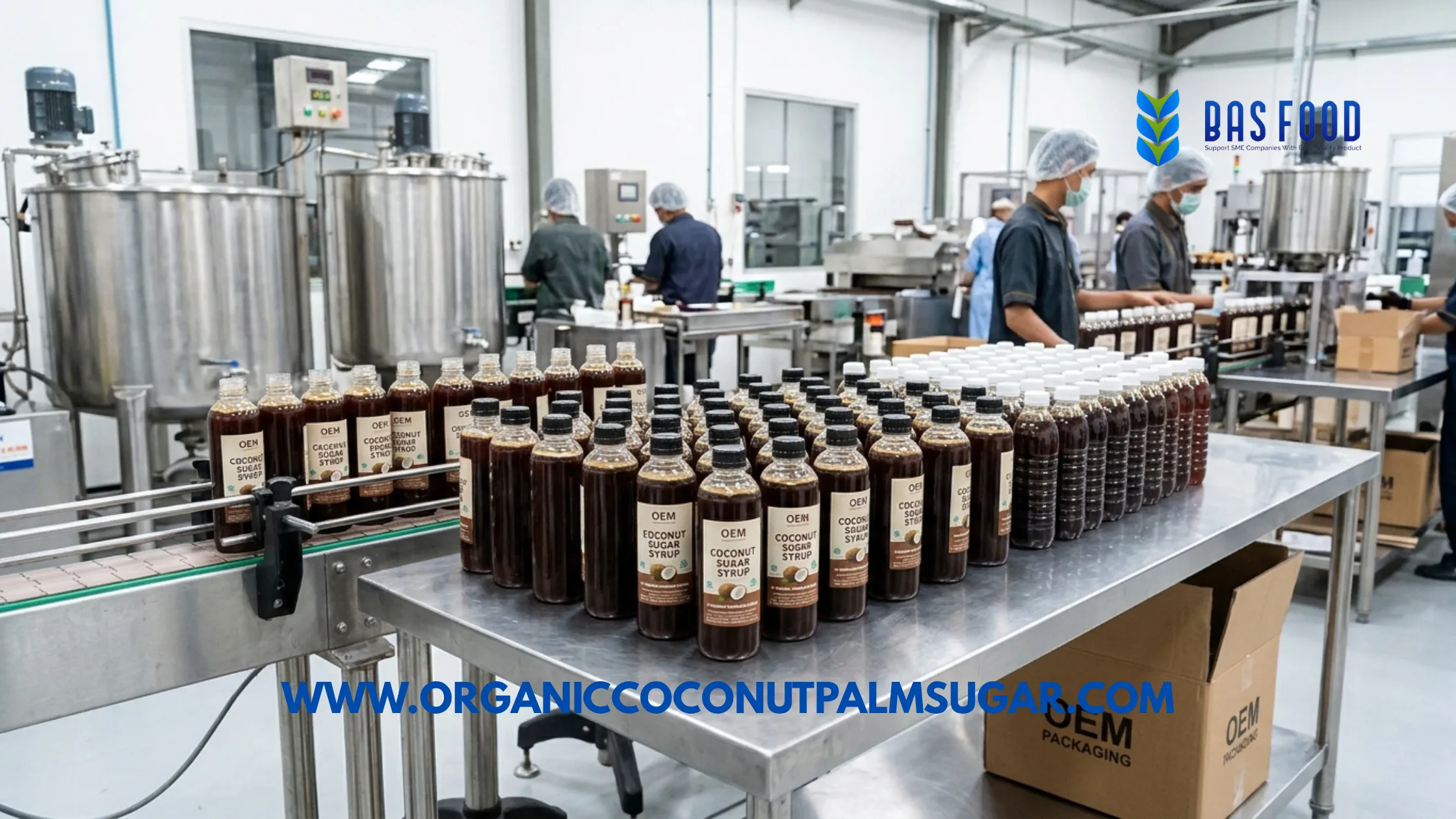
What Is Coconut Sugar Syrup Private Label?
Coconut sugar syrup private label refers to a business arrangement in which a manufacturer or supplier provides coconut sugar syrup for another company to sell under its own brand. Depending on the agreement, the supplier may handle product preparation, filling, packaging coordination, and labeling based on the buyer’s requirements.
This model gives distributors and food businesses an opportunity to develop a branded product without investing in their own syrup production facilities. Instead, they can focus on brand development, marketing, sales channels, and customer relationships.
Coconut sugar syrup is generally produced by concentrating the sap collected from coconut palm flowers. The process creates a thick, sweet liquid with a characteristic caramel-like flavor. Its taste and color can vary depending on the raw material, production method, and concentration.
For private label buyers, understanding the product is the first step. They should identify the intended application, target market, preferred packaging, and quality requirements before discussing a manufacturing or supply arrangement.
Why Choose a Private Label Model for Coconut Sugar Syrup?
Developing a food product from the ground up can require significant investment. A business may need production equipment, technical staff, quality systems, packaging facilities, and reliable access to raw materials. These requirements can make launching a new product challenging, particularly for smaller brands and distributors.
A private label arrangement offers another route. By working with an established supplier, a business can focus more of its resources on market development while sourcing the product from an external partner. This can also help companies expand their product portfolios without building a new manufacturing operation.
Another advantage is brand ownership. Businesses can develop their own packaging identity, product positioning, and marketing message. For example, a specialty food distributor might introduce coconut sugar syrup as a natural-tasting liquid sweetener for home cooking, while a food ingredient company could position it as an ingredient for beverage and bakery manufacturers.
Nevertheless, private labeling does not automatically guarantee lower costs or faster market entry. Buyers still need to evaluate minimum order quantities, packaging costs, production schedules, regulatory requirements, and the supplier’s ability to meet agreed specifications.
OEM Liquid Sweetener: Understanding the Manufacturing Arrangement
OEM liquid sweetener is an important term for businesses exploring private label coconut sugar syrup. OEM, or Original Equipment Manufacturer, generally describes an arrangement in which one company produces a product that another company sells under its own brand.
In a coconut sugar syrup project, the buyer and supplier first agree on the product requirements. These may include the raw material, flavor profile, color expectations, consistency, product specifications, packaging format, and labeling details. The supplier then confirms which requirements can be supported by its production and packaging capabilities.
The exact scope of an OEM arrangement can vary. Some suppliers may provide an existing product with the buyer’s branding, while others may be able to discuss adjustments to packaging or selected product characteristics. Buyers should not assume that every supplier offers full formulation development, custom processing, or every packaging format.
Before proceeding, request a clear written specification. Depending on the product and application, this may cover:
- Ingredient declaration and raw material origin.
- Color, flavor, and consistency.
- Brix or soluble-solids specification.
- Moisture content and, where relevant, water activity.
- Microbiological requirements.
- Packaging material and filling format.
- Storage instructions and validated shelf life.
- Batch identification and traceability information.
It is important to understand that Brix, moisture content, and water activity measure different product characteristics. A Brix result alone cannot establish microbiological safety or prove shelf life. Therefore, buyers should request appropriate product data and supporting quality documentation.
Custom Labeling: Turning a Food Ingredient into Your Brand
Custom labeling allows a buyer to present coconut sugar syrup under its own brand identity. This is especially useful for distributors, specialty food retailers, and companies that want to build a recognizable product range.
A product label does more than display a company logo. It communicates essential information to customers and helps the product meet the requirements of its intended market. Depending on the destination country and product category, labeling may need to include the product name, ingredient list, net quantity, manufacturer or responsible business details, country of origin, batch code, storage instructions, and date marking.
For export markets, label requirements can differ significantly. A product intended for the United States may need to follow different rules from one sold in the European Union, Singapore, or the Middle East. Language, allergen declarations, nutrition information, and importer details may also need special attention.
Buyers should prepare their label artwork early and have it reviewed for compliance before printing. The supplier can help coordinate product and packaging information, but the brand owner and importer should confirm the applicable legal requirements in the destination market.
A good custom labeling process should cover:
- Brand name and logo placement.
- Product description and net weight.
- Ingredient and nutrition information, where required.
- Country-of-origin details.
- Storage and handling instructions.
- Batch coding and date marking.
- Barcode and importer information, when applicable.
Clear communication between the buyer, supplier, designer, and regulatory team can prevent costly label revisions and packaging delays.
Packaging Options for Private Label Coconut Sugar Syrup
Packaging plays an important role in the presentation, protection, and distribution of coconut sugar syrup. The right format depends on the target customer, sales channel, order volume, and handling requirements.
For retail brands, bottles may be suitable because they are familiar and convenient for household use. Different bottle sizes can support different market segments, although the available options depend on the supplier’s filling and packaging capabilities.
For food service and industrial buyers, larger containers may be more practical. Food-grade jerry cans, pails, drums, or other bulk liquid packaging formats can be considered where the supplier supports them. These options may suit restaurants, beverage manufacturers, bakeries, and ingredient distributors that use syrup in larger quantities.
However, packaging suitability should never be judged by appearance alone. Buyers should confirm that the container, inner surface, closure, and seal are appropriate for the product and intended storage conditions. They should also consider leakage protection, transport handling, and compatibility with filling equipment.
Before confirming a private label order, discuss these points with the supplier:
- Which packaging formats are available?
- What net weights or volumes can be supplied?
- Can the packaging carry custom labels?
- Are the materials suitable for food contact?
- How are containers sealed and protected during transport?
- Can the packaging withstand the expected export handling conditions?
The answers help buyers select packaging that supports both product protection and brand presentation.
Quality Control: What Buyers Should Check Before Ordering
Product consistency is essential when building a private label food brand. Customers expect the product they purchase today to have a similar quality profile to the product they purchased previously. For this reason, buyers should establish clear specifications before placing commercial orders.
For coconut sugar syrup, quality evaluation may include appearance, aroma, flavor, viscosity, soluble-solids content, moisture-related parameters, and microbiological criteria. The appropriate tests depend on the product specification, intended use, and food safety requirements in the target market.
A sample evaluation is a practical starting point. Buyers can assess whether the syrup suits their intended application, such as beverages, sauces, bakery products, or household use. If the syrup will be used in a manufacturing process, testing should also consider how it performs when mixed, heated, or stored with other ingredients.
In addition, ask about the supplier’s quality management practices. Useful information may include raw material controls, production hygiene, batch records, traceability procedures, testing arrangements, and complaint handling.
Do not rely only on product appearance or a supplier’s general description. A dark color, thick texture, or sweet taste does not prove that a product meets a particular food safety standard. Buyers should request relevant documents and verify claims against the agreed specification.
Private Label Food Ingredients for Different Market Segments
The market for private label food ingredients includes businesses with different needs. Coconut sugar syrup can be positioned for several applications, provided that its specifications are suitable for the intended product.
Retail and specialty food brands may sell coconut sugar syrup as a liquid sweetener for consumers who enjoy experimenting with alternative sweeteners in everyday recipes. In this segment, packaging design, product information, and brand positioning can strongly influence purchasing decisions.
Beverage manufacturers and cafés may explore the syrup for coffee, tea, smoothies, and specialty drinks. Its caramel-like flavor can add a distinctive taste, although manufacturers should test sweetness, color, viscosity, and compatibility with their beverage formulations.
Bakery and confectionery businesses may evaluate coconut sugar syrup for cakes, fillings, sauces, and selected sweet products. Since syrup contains both dissolved sugar solids and water, it cannot always replace dry sugar at a one-to-one ratio. Recipe adjustments and product testing are necessary.
Food ingredient distributors may focus on supplying larger quantities to manufacturers, restaurants, and food service businesses. In this case, consistent specifications, suitable bulk packaging, dependable documentation, and clear communication are particularly important.
Understanding the customer segment helps buyers choose the right product presentation and packaging strategy. It also makes marketing messages more relevant and practical.
How to Choose a Reliable Coconut Sugar Supplier
Selecting a dependable coconut sugar supplier is one of the most important decisions in a private label project. A supplier should be able to explain the product clearly, communicate its capabilities, and provide relevant information to support the buyer’s purchasing decision.
Start by reviewing the supplier’s product knowledge. Can the company explain how coconut sugar syrup is produced? Can it provide a product specification, ingredient information, and available quality documents? Does it understand the packaging and documentation requirements associated with export orders?
Next, evaluate communication and order coordination. Private label projects involve several details, including artwork approval, packaging selection, order confirmation, production planning, and shipment preparation. A supplier that communicates clearly can help buyers identify potential issues before they affect the order.
Buyers should also discuss commercial requirements early. These include minimum order quantity, pricing structure, sample availability, production lead time, payment terms, and shipping arrangements. These details should be confirmed in writing rather than assumed.
A practical supplier evaluation checklist includes:
- Experience in coconut sugar or related products.
- Clear product specifications and ingredient information.
- Relevant quality and food safety documentation.
- Transparent packaging and labeling capabilities.
- Batch traceability and quality control procedures.
- Clear communication about MOQ and lead time.
- Experience coordinating export shipments.
A supplier should also be honest about its limitations. For example, a company may offer custom labeling but not custom formulation. Understanding this distinction helps buyers choose an arrangement that matches their business goals.
Working with CV Bonafide Anugerah Sentosa
For businesses exploring Indonesian coconut sugar products, CV Bonafide Anugerah Sentosa is an exporter and supplier of coconut sugar and other coconut-derived products. The company serves international buyers looking for Indonesian agricultural commodities and food ingredients.
When considering a coconut sugar syrup private label project, buyers can discuss their product requirements, target market, preferred packaging, and branding needs with the company. This initial conversation helps establish whether the requested product and packaging arrangement can be supported.
As a coconut sugar exporter supplier, CV Bonafide Anugerah Sentosa understands the importance of clear product information and communication with international buyers. Importers and distributors should share their destination market, intended application, and required documentation so that the product can be evaluated against their purchasing criteria.
Businesses searching for a coconut sugar supplier should prepare a detailed inquiry rather than requesting a quotation based only on product name. Include the expected order quantity, packaging preference, label requirements, and any technical specifications. This makes it easier to discuss the available options and identify the next steps.
Build Your Own Coconut Sugar Syrup Brand with the Right Partner
Coconut sugar syrup private label offers an opportunity for distributors, retailers, and food manufacturers to introduce a distinctive liquid sweetener under their own brand. Instead of building production facilities from the beginning, businesses can work with a supplier to coordinate product sourcing, packaging, labeling, and export arrangements.
However, a strong private label product depends on more than attractive branding. Buyers need clear product specifications, appropriate packaging, reliable quality control, accurate labels, and a supplier that communicates openly throughout the process.
If you are planning to launch a coconut sugar syrup brand, begin by defining your target market and product requirements. Then discuss your preferred packaging, custom labeling, order quantity, and documentation needs with a potential supplier.
CV Bonafide Anugerah Sentosa welcomes inquiries from international buyers interested in Indonesian coconut sugar and related products. Contact the company to discuss your sourcing requirements and explore whether a private label arrangement is suitable for your business.