Buying coconut sugar granules for commercial production is not a decision that should be based on a product photo or a price quotation alone. For importers, food manufacturers, distributors, and ingredient buyers, the actual product matters. That is why requesting coconut sugar granule samples can be one of the most useful steps before placing a larger order. A sample gives buyers the chance to see, handle, and test the product before committing to commercial quantities. It can reveal details that are difficult to judge from a specification sheet alone, including appearance, particle consistency, aroma, flavor, handling, and suitability for a specific application.
However, sampling should be more than simply asking a supplier to send a small package. A useful sampling process should have a clear purpose. Buyers should know what they want to test, how they will evaluate the sample, and which results matter for their production process.
In this guide, we will explain how B2B buyers can use coconut sugar granule samples effectively, what to check during testing, what questions to ask suppliers, and how to move from sample approval to a commercial order.
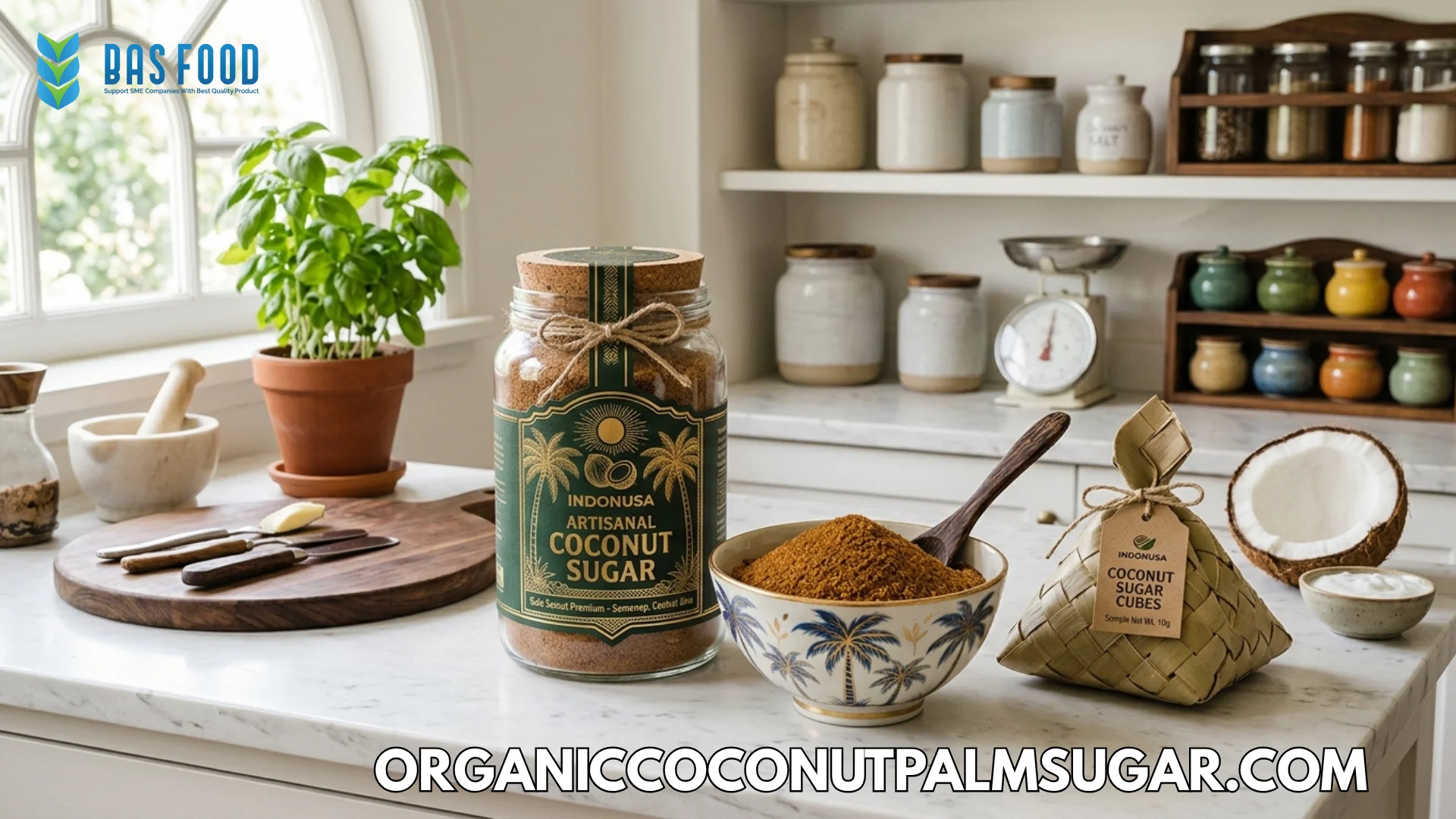
Why Coconut Sugar Granule Samples Matter for B2B Buyers
A sample is essentially a small-scale introduction to the actual product. While a supplier’s product description can provide useful information, it cannot always show how the coconut sugar granules will behave in your own operation.
For example, a buyer may need a particular particle size for a dry mix. A bakery manufacturer may want the granules to blend evenly with flour and other ingredients. A beverage company may need the sugar to dissolve or disperse appropriately during formulation. Therefore, the same coconut sugar granule product may need to meet different practical expectations depending on its application.
This is why coconut sugar granule samples are important during the sourcing process. They allow buyers to evaluate the product under real or controlled conditions before making a larger commitment.
Samples Reduce Sourcing Uncertainty
International B2B purchases can involve significant costs. The buyer may need to arrange transportation, customs clearance, warehousing, production planning, and inventory management.
Because of this, discovering a product issue after receiving a commercial shipment can be much more difficult than discovering it during the sample stage.
A sample does not eliminate every sourcing risk. However, it provides an opportunity to identify potential issues earlier.
For example, buyers can check whether:
- The granule size matches the required specification
- The appearance fits the intended product
- The flavor works with the formulation
- The product handles well
- The packaging protects the sample
- The product performs as expected during testing
In short, a sample turns part of the sourcing decision from an assumption into a practical evaluation.
What Are Coconut Sugar Granule Samples?
Coconut sugar granule samples are small quantities of coconut sugar granules provided to a potential buyer for evaluation before a commercial purchase.
The sample can be used for product inspection, internal testing, formulation trials, quality testing, or comparison with other suppliers.
The exact sample quantity does not need to be the same for every buyer. A product developer conducting an initial kitchen-scale trial may need only a small amount, while an industrial food manufacturer may require enough material to conduct several laboratory or production tests.
A Sample Should Represent the Commercial Product
One of the most important questions is whether the sample represents the product that will be supplied commercially.
Buyers should ask the supplier whether the sample is made according to the same specification intended for the commercial order.
This is particularly important when the buyer has specific requirements for:
- Particle size
- Moisture
- Color
- Flavor
- Packaging
- Processing
- Application
If a supplier sends a special sample that differs from its normal commercial product, the test result may not accurately represent the future shipment.
Therefore, buyers should discuss the intended commercial specification before requesting the sample.
Samples Can Also Support Product Development
Sampling is not only useful for purchasing departments.
Product development teams can use samples to test new recipes and formulations.
For example, a food manufacturer may want to investigate how coconut sugar granules perform in:
- Cookies
- Cakes
- Granola
- Cereal
- Chocolate
- Snack products
- Beverage mixes
- Dessert products
- Dry food blends
This makes the sample a practical bridge between supplier sourcing and product development.
What to Check When Receiving a Product Sample
When your product sample arrives, do not immediately decide whether you like it or dislike it.
Instead, create a structured evaluation process.
Start by checking the package and product condition when the sample arrives. Record the supplier name, product name, sample date, batch information if available, and specification provided by the supplier.
This basic record can make later comparisons much easier.
Start With a Visual Inspection
The first evaluation is often visual.
Look at the general appearance of the coconut sugar granules. Consider whether the color appears consistent with the agreed specification.
Then examine the particle structure.
Are the granules relatively uniform?
Do you see excessive fine particles?
Are there large pieces or clumps?
Does the sample appear dry and free-flowing under the expected storage conditions?
These observations do not replace laboratory testing. However, they can provide an early indication of whether the sample matches expectations.
Check Aroma and Flavor
Coconut sugar has a distinctive sweet flavor profile. Depending on the product and processing method, buyers may notice differences in aroma, caramel-like notes, sweetness, or other sensory characteristics.
For food manufacturers, sensory testing can be important because the ingredient becomes part of the final product.
However, sensory evaluation should be performed using a consistent method whenever possible.
If several suppliers are being compared, test their samples under similar conditions. This creates a more useful comparison than testing each sample in a different way.
Particle Size: One of the Most Important Sample Checks
Particle size can have a significant effect on how coconut sugar granules behave during processing.
A manufacturer may have equipment designed for a particular ingredient size. A bakery formula may also require a certain granule profile to achieve the desired mixing and distribution.
Therefore, buyers should not simply ask whether a supplier offers “granules.” They should discuss the required particle size or mesh specification.
Why Particle Consistency Matters
Imagine a manufacturer developing a dry beverage mix.
If the ingredient contains a wide range of particle sizes, the material may not blend in exactly the same way as a more consistent product.
Similarly, large particles and fine particles can behave differently during mixing, storage, and processing.
This is why buyers should evaluate both the general particle size and its consistency.
During quality testing, buyers can use appropriate sieving or particle-size analysis methods depending on their internal quality system.
The supplier’s specification should then be compared with the actual sample result.
Match Particle Size to the Application
There is no universally perfect particle size.
The appropriate specification depends on what the buyer is making.
For example:
- Bakery applications may have different requirements from beverage mixes.
- Granola manufacturers may prefer different granules from chocolate producers.
- Dry mixes may require specific particle distribution for even blending.
- Retail products may prioritize appearance and consumer experience.
Therefore, discuss the application with your coconut sugar supplier before deciding which sample specification to test.
Moisture and Handling: Small Details With Big Effects
Moisture is another important consideration when evaluating coconut sugar granules.
Coconut sugar is hygroscopic, which means it can interact with moisture from its surrounding environment. As a result, storage and packaging conditions can affect the physical condition of the product.
During sample evaluation, buyers should pay attention to how the granules handle.
Do they remain reasonably free-flowing under the expected storage conditions?
Do they show signs of clumping?
Does the product change after exposure to normal handling conditions?
These observations can help buyers understand whether the sample behaves as expected.
Laboratory Testing Can Provide More Reliable Data
Visual inspection alone cannot establish a complete moisture specification.
For commercial purchasing, buyers may use laboratory testing based on their internal quality requirements.
The exact test method and acceptable range should be agreed between the buyer and supplier.
This is especially important for manufacturers that require a consistent ingredient specification across multiple production batches.
A supplier should be able to discuss the moisture specification and explain how it manages moisture during processing, packaging, and storage.
Use Samples for Real Application Testing
One of the strongest reasons to request coconut sugar granule samples is to test the product in the actual application.
A sample may look excellent when examined on its own but behave differently when added to a formulation.
For example, a food manufacturer may need to determine how the granules mix with flour, dissolve in a liquid, distribute through a dry blend, or affect the color and flavor of a finished product.
Test the Sample in Your Own Formula
Whenever practical, use the sample in the same formulation that you plan to manufacture commercially.
For example, if you want to use coconut sugar in cookies, test it in your cookie formula.
If you are developing a beverage mix, use the sample in the intended beverage formulation.
If you manufacture granola, evaluate the ingredient in the granola production process.
This provides more useful information than testing the ingredient alone.
Record the Results
Keep notes during the trial.
Record information such as:
- Ingredient ratio
- Mixing time
- Processing temperature
- Appearance
- Flavor
- Texture
- Handling
- Final product performance
- Any formulation adjustments
These records can help your purchasing and product development teams communicate more effectively with the supplier.
They can also become useful references when comparing future samples.
Compare Coconut Sugar Granule Samples From Different Suppliers
If your company is searching for a new supplier, it can be useful to compare samples from several potential suppliers.
However, the comparison should be structured.
Do not choose one supplier simply because its sample looks darker, lighter, sweeter, or more attractive without considering your actual product requirements.
Avoid Comparing Different Specifications
A common mistake is comparing samples that are not actually equivalent.
For example, one supplier may provide fine granules while another provides coarse granules.
The comparison would not be fair.
Before testing, confirm that the suppliers are offering comparable specifications.
This is where good supplier communication becomes valuable.
How Quality Testing Supports Supplier Evaluation
Samples become even more valuable when they are connected to a formal supplier evaluation process.
Instead of simply asking, “Do we like this sample?”, establish clear acceptance criteria.
For example, your company may define requirements for particle size, moisture, appearance, flavor, packaging, and application performance.
Then test each supplier against the same requirements.
Separate Mandatory Requirements From Preferences
Not every product characteristic has the same importance.
Some requirements may be mandatory.
For example, a specific particle size may be essential because of your production equipment.
Other characteristics may be preferences rather than strict requirements.
Separating these two categories helps buyers make clearer decisions.
It also gives suppliers better information when discussing potential adjustments.
Keep Sample Records
Record the supplier, sample identification, specification, test date, and test results.
If the sample passes, keep the approved specification as a reference.
When the commercial order arrives, the buyer can compare the shipment against the agreed requirements.
This creates a stronger quality-control process.
From Approved Sample to Commercial Order
A successful sample test does not mean the purchasing process is finished.
Instead, it marks the point where the buyer can begin discussing the commercial order in greater detail.
The supplier and buyer should confirm the product specification before production begins.
This may include particle size, moisture requirement, packaging, labeling, quantity, and other agreed details.
Make the Approved Specification Clear
One of the most useful steps is to keep the approved product specification in writing.
Do not rely entirely on verbal communication.
A written specification can help both parties understand what has been approved.
It also becomes a reference if questions arise during future orders.
Discuss Commercial Packaging
The sample package may not be the same as the final commercial package.
For example, a small sample may use convenient packaging for courier delivery, while a commercial shipment requires a different packaging format.
Therefore, ask your coconut sugar exporter supplier about the packaging planned for larger orders.
Discuss:
- Package size
- Packaging material
- Sealing
- Labels
- Batch identification
- Outer packaging
- Palletization where applicable
- Export handling
The exact solution should be based on the product, destination, logistics process, and buyer requirements.
What International Buyers Should Consider When Sampling From Indonesia
Indonesia is an important origin for coconut-derived products, so international buyers may consider Indonesian suppliers when sourcing coconut sugar granules.
For overseas buyers, however, the sampling process can involve additional logistics.
The sample must travel from the supplier to the buyer, often across international borders.
Therefore, buyers should provide accurate delivery information and discuss the sample shipment process with the supplier.
Sampling Is Also a Test of the Supplier’s Service
A sample shipment can provide useful information about communication and logistics.
Pay attention to whether the supplier:
- Confirms the sample specification
- Provides shipment information
- Communicates clearly
- Uses suitable sample packaging
- Answers questions promptly
- Provides relevant documentation
This does not mean every minor shipping delay is a major issue.
International courier shipments can experience delays for many reasons.
Instead, observe how the supplier handles the situation and communicates with you.
For an importer, this can provide useful insight into how the supplier may manage future international orders.
Working With CV Bonafide Anugerah Sentosa
For buyers looking for an Indonesian source, CV Bonafide Anugerah Sentosa can be considered as part of the sourcing process.
Potential buyers can discuss their requirements directly and request information about available coconut sugar granule specifications, applications, packaging, and commercial supply.
As with any supplier, buyers should evaluate the actual product against their own requirements.
Make Your Sample Request Specific
Instead of sending a message that simply says, “Please send coconut sugar samples,” provide useful details.
For example, explain:
- Your intended application
- Required particle size
- Expected purchase volume
- Preferred packaging
- Destination country
- Quality requirements
- Testing requirements
This allows the supplier to provide a more relevant product sample.
It can also reduce the chance of receiving a sample that does not match your intended application.
Use the Sample as the Start of a Conversation
The best sample process is not only about passing or failing a test.
It also creates an opportunity for technical communication.
If the sample does not meet your exact requirements, explain the issue to the supplier.
For example, perhaps the granules are too fine for your process, or the packaging needs to change.
A supplier may then be able to explain which specifications are available and whether another product option is more suitable.
Conclusion: A Small Sample Can Support a Better Buying Decision
For B2B buyers, coconut sugar granule samples are more than small packages of product. They are a practical tool for understanding whether a supplier’s product fits a real commercial application.
A well-planned sampling process allows buyers to examine particle size, appearance, flavor, handling, moisture-related characteristics, packaging, and application performance. It also creates an opportunity to evaluate supplier communication before moving into a larger order.
At the same time, buyers should remember that a sample is only one part of the sourcing process. A successful purchase also requires clear specifications, quality control, appropriate packaging, reliable communication, and suitable export arrangements.
Whether you are working with CV Bonafide Anugerah Sentosa or another coconut sugar supplier, start with clear requirements and test the product before making a major commitment.
For international buyers, a reliable coconut sugar exporter supplier should be able to discuss the product specification, sample process, quality requirements, packaging, and commercial supply in a clear way.
In the end, the goal of sampling is simple: know the product before you scale the purchase.