As food manufacturers, distributors, and ingredient importers expand their product ranges, the demand for distinctive liquid sweeteners continues to create new business opportunities. Coconut sugar syrup is one option attracting attention because it offers a characteristic caramel-like flavor and can be used in various food and beverage applications.
However, sourcing this ingredient in large quantities requires more than finding an attractive price. Buyers need a dependable bulk coconut sugar syrup supplier that can provide clear product specifications, suitable packaging, consistent quality, and reliable export coordination.
Whether you operate a food manufacturing business, distribute specialty ingredients, or supply the food service industry, choosing the right supplier can influence your production costs and product quality. This guide explains what to consider when sourcing bulk coconut sugar syrup, how wholesale arrangements work, and how to evaluate a potential B2B partner.
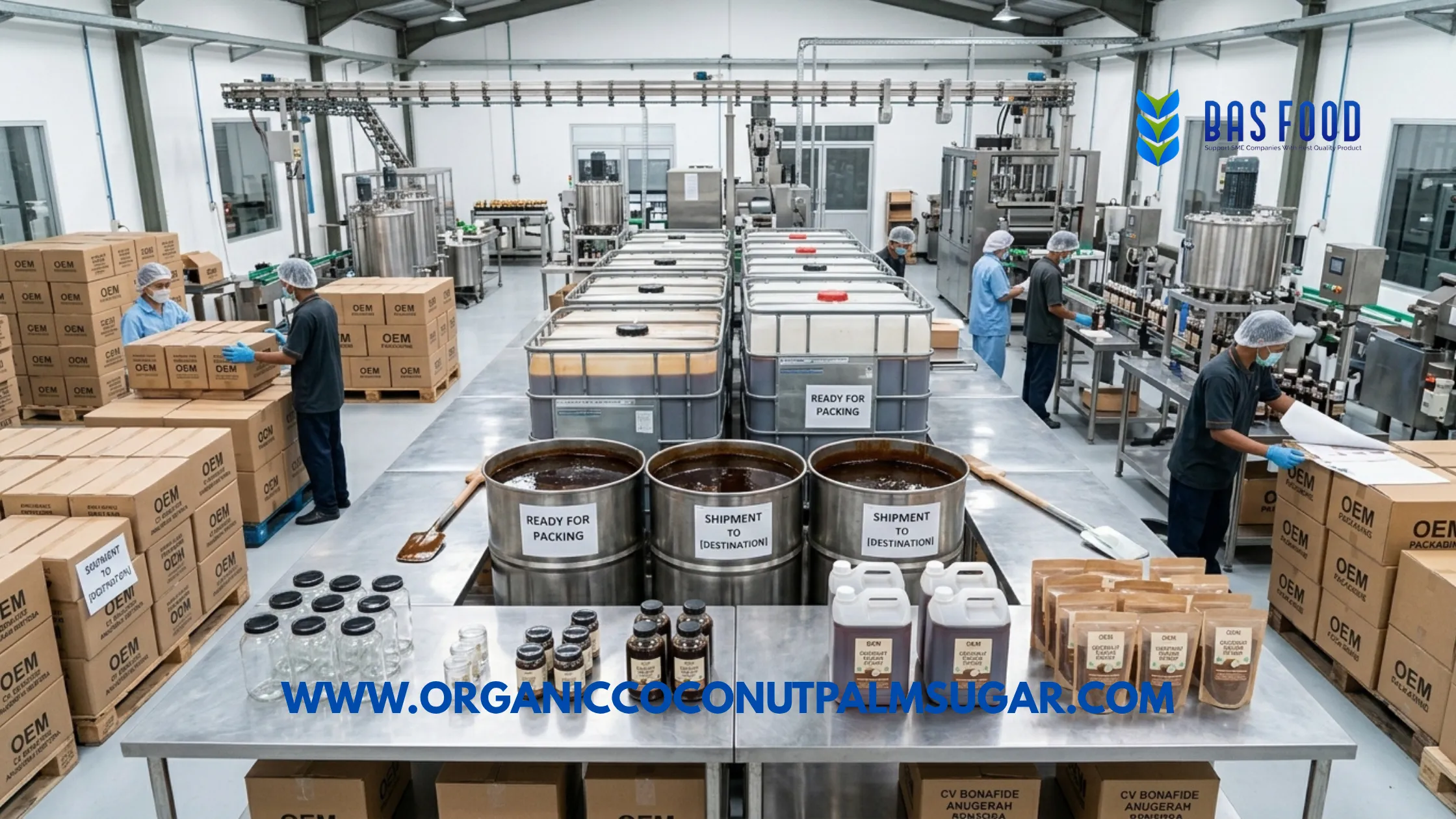
What Is Bulk Coconut Sugar Syrup?
Coconut sugar syrup is a liquid sweetener generally made by concentrating sap collected from coconut palm flowers. Through a controlled heating process, the sap becomes a thicker liquid with a naturally sweet taste and a characteristic caramel-like flavor. Its final color, consistency, and flavor can vary depending on the raw material and production method.
When businesses purchase this product in bulk, they usually source larger quantities for resale, food manufacturing, food service, or industrial use. Instead of purchasing small retail bottles, buyers may need larger containers that suit their storage facilities, production lines, and distribution systems.
A bulk coconut sugar syrup supplier serves businesses that require a dependable source of liquid sweetener for commercial operations. These buyers may include beverage manufacturers, bakeries, confectionery producers, ingredient distributors, restaurants, and private label brands.
The right product specification depends on its intended use. For example, a beverage manufacturer may focus on sweetness, flavor, color, and ease of mixing. Meanwhile, a bakery may pay closer attention to viscosity, moisture contribution, and how the syrup performs during heating.
Why Food Businesses Choose Wholesale Coconut Sugar Syrup
Buying wholesale coconut sugar syrup can help businesses manage ingredient purchasing more efficiently. Larger orders may reduce the need for frequent small purchases and simplify stock planning, especially for manufacturers that use the ingredient regularly.
Wholesale purchasing can also support more consistent production planning. When buyers agree on product specifications and supply arrangements in advance, they can establish clearer expectations for incoming ingredients. This is particularly useful for manufacturers that need to maintain a similar flavor profile across different production batches.
Another reason businesses consider coconut sugar syrup is its distinctive flavor. Its caramel-like notes can complement beverages, sauces, bakery products, desserts, and selected confectionery applications. As a result, manufacturers can explore it as an ingredient in products that need a different sweetness profile from conventional liquid sweeteners.
Nevertheless, bulk purchasing should follow actual demand. Ordering more than a business can use within the product’s validated shelf life may create unnecessary storage costs and increase the risk of quality deterioration. Buyers should compare order quantities with production forecasts, warehouse capacity, and stock rotation plans before confirming a purchase.
Bulk Liquid Sweetener Applications Across the Food Industry
The demand for bulk liquid sweetener ingredients comes from businesses that need practical ways to add sweetness and flavor to manufactured foods. Coconut sugar syrup can be evaluated for several applications, although its suitability depends on the product formulation and technical specifications.
Beverage manufacturing is one potential market. Producers may test coconut sugar syrup in coffee drinks, tea beverages, smoothies, flavored milk alternatives, and specialty drinks. Its flavor can complement coffee and other ingredients, while its liquid form may simplify dosing compared with some solid sweeteners.
Bakery and dessert production offers another area of application. Manufacturers can experiment with the syrup in cakes, muffins, fillings, dessert sauces, and selected sweet products. However, the syrup contributes both sugar solids and water, so it does not always replace dry sugar at a one-to-one ratio. Formulation adjustments are important to maintain the desired texture and moisture level.
Sauces and dressings may also benefit from the syrup’s sweet flavor. Food manufacturers can test it in marinades, dipping sauces, glazes, and selected dressing formulations. Its contribution to color, sweetness, viscosity, and overall flavor should be assessed through product trials.
For food service and ingredient distribution, bulk containers may offer a practical purchasing format. Restaurants, cafés, catering companies, and distributors can evaluate the product based on their usage volume, handling facilities, and customer requirements.
In every application, buyers should conduct suitable product trials before using coconut sugar syrup in full-scale production. A successful result in one recipe does not automatically mean the syrup will perform identically in another formulation.
What to Look for in a Reliable Bulk Coconut Sugar Syrup Supplier
Choosing a dependable supplier is essential for businesses that rely on regular ingredient deliveries. A low quotation may look attractive at first, but it should not be the only factor in the purchasing decision.
Start by checking the supplier’s product knowledge. A reliable B2B supplier should be able to explain the raw material, general production process, product characteristics, available specifications, and packaging options. Clear answers help buyers understand whether the product fits their manufacturing or distribution requirements.
Next, request a product specification sheet. Depending on the product, useful information may include:
- Product name and ingredient declaration.
- Raw material and country of origin.
- Appearance, color, flavor, and consistency.
- Brix or soluble-solids specification.
- Moisture content and, where relevant, water activity.
- Microbiological requirements and test results.
- Packaging type and net weight.
- Storage conditions and validated shelf life.
- Batch identification and traceability information.
These details help buyers compare suppliers based on measurable product characteristics rather than general marketing descriptions.
It is also important to understand the difference between Brix, moisture content, and water activity. Brix indicates soluble-solids concentration as measured by an appropriate method. Moisture content measures the amount of water in the product, while water activity relates to the availability of water for chemical and microbial activity. These measurements are not interchangeable, and Brix alone cannot prove product safety or shelf stability.
Packaging Options for Wholesale Coconut Sugar Syrup
Packaging affects product protection, handling, storage, and transportation. Therefore, buyers should select a format that matches their order volume and operational requirements.
For smaller commercial orders, food-grade bottles or jerry cans may be practical, depending on the supplier’s available packaging options. These formats can suit distributors, restaurants, cafés, and businesses that need manageable container sizes.
Larger buyers may consider food-grade pails, drums, or other bulk liquid containers if the supplier can provide them. Such packaging may be more suitable for industrial users that transfer syrup into production equipment or use it in large batches.
Before confirming a packaging format, buyers should check the following:
- Food-contact suitability: Confirm that the packaging material is appropriate for the product and intended conditions.
- Closure and seal: Check how the container prevents leakage and protects the contents.
- Handling requirements: Consider container weight, stacking, lifting, and transfer procedures.
- Transport protection: Review whether the packaging can withstand expected handling during domestic and international transportation.
- Storage conditions: Confirm that the container is suitable for the recommended storage environment.
Packaging should also support practical warehouse management. Clear product identification, batch coding, and net quantity information help receiving teams organize stock and maintain traceability.
Product Quality and Consistency: Key Factors for Bulk Buyers
For manufacturers and distributors, consistent product quality is just as important as supply availability. Differences in color, flavor, viscosity, or concentration can affect the final food product and create additional work for production teams.
Before placing a large order, request a representative sample and compare it with the agreed specification. Evaluate the syrup under conditions that reflect its intended use. For example, beverage manufacturers can test its mixing behavior, while bakeries can assess its effect on sweetness, moisture, color, and texture.
Buyers should also discuss how the supplier manages production batches. Useful questions include whether the supplier maintains batch records, performs routine quality checks, identifies non-conforming products, and investigates customer complaints.
Do not assume that a thick syrup is automatically more concentrated or that a darker syrup is necessarily better. Appearance and viscosity can be influenced by several factors, including temperature, concentration, and product composition. Technical measurements are needed to support specific quality claims.
A good purchasing agreement should define the product specification and acceptance criteria clearly. It should also explain how both parties will handle products that do not meet the agreed requirements.
Storage, Shelf Life, and Inventory Management
Bulk coconut sugar syrup requires suitable storage to maintain its intended quality. Buyers should follow the supplier’s product-specific storage instructions and keep containers in a clean, dry area away from direct sunlight, excessive heat, and contamination.
Temperature can affect viscosity. In cooler conditions, syrup may become thicker, while warmer conditions can make it flow more easily. These changes do not necessarily indicate spoilage. However, unusual odor, visible mold, unexpected fermentation signs, damaged seals, or contamination should prompt the buyer to isolate the affected product and seek a food safety assessment.
Shelf life should always be based on product-specific validation. It can depend on the syrup’s formulation, concentration, processing conditions, microbiological quality, packaging, and storage environment. Buyers should request the declared shelf life and supporting information rather than applying a general shelf-life estimate to every coconut sugar syrup product.
Inventory management is equally important. Commercial buyers can use the first-in, first-out (FIFO) method or, where date control is more appropriate, first-expired, first-out (FEFO). These systems help prevent older stock from remaining unused while newer deliveries are consumed first.
For large orders, consider warehouse capacity, expected monthly consumption, delivery schedules, and available storage space. A well-planned purchasing schedule can reduce unnecessary stock accumulation and support more reliable production.
Export Considerations When Sourcing Coconut Sugar Syrup
International buyers need to evaluate more than product quality and price. Export transactions also involve documentation, customs procedures, transportation, and destination-market requirements.
A professional coconut sugar exporter supplier should be able to discuss the documents relevant to the transaction. Depending on the destination and shipment arrangement, these may include a commercial invoice, packing list, bill of lading, certificate of origin, and other documents requested by the importer or relevant authorities.
Food import regulations differ between countries. Buyers should confirm the applicable requirements for ingredient declarations, food safety documentation, labeling, packaging, and product registration before shipment. Some markets may request additional certificates, laboratory reports, or declarations.
Transportation planning also matters because coconut sugar syrup is a liquid food ingredient. Buyers and suppliers should agree on suitable packaging, loading procedures, container protection, and expected transit conditions. The shipping method should match the product’s characteristics and the supplier’s storage recommendations.
It is useful to share the destination port, preferred shipping terms, estimated order quantity, and required documents when requesting an export quotation. This information helps the supplier assess the order more accurately.
How to Compare Bulk Coconut Sugar Syrup Suppliers
Comparing quotations is easier when buyers use the same evaluation criteria for each potential supplier. Looking only at the price per kilogram or container may overlook important differences in specifications, packaging, and delivery terms.
A practical comparison should include product quality, sample results, packaging suitability, minimum order quantity, production lead time, documentation, and communication. Buyers should also clarify whether the quoted price includes labeling, packaging, inland transport, or other services.
Ask suppliers about their ability to handle repeat orders. A supplier may provide a suitable first shipment, but long-term business relationships require clear specifications, consistent communication, and realistic supply planning.
Consider these questions during supplier evaluation:
- Can the supplier provide a complete product specification?
- Are samples available for evaluation?
- Can the supplier explain its quality control and traceability procedures?
- Which bulk packaging formats can it support?
- What are the MOQ and estimated lead time?
- Which export documents can it provide?
- How does it handle quality complaints or shipment issues?
A supplier that answers these questions clearly gives buyers a better basis for making a purchasing decision. It also helps both parties identify possible limitations before entering a commercial agreement.
Sourcing from CV Bonafide Anugerah Sentosa
For international businesses interested in Indonesian coconut sugar products, CV Bonafide Anugerah Sentosa is an exporter and supplier of coconut sugar and other coconut-derived products. The company works with buyers seeking Indonesian agricultural commodities for international markets.
Businesses looking for a bulk coconut sugar syrup supplier can contact the company to discuss their product requirements, intended applications, packaging preferences, and export destinations. Sharing these details at the beginning of the inquiry helps establish whether the requested product and supply arrangement can be supported.
As a coconut sugar supplier, the company recognizes the importance of clear communication between exporters and international buyers. Importers should provide their expected order volume, target market, preferred packaging, and technical requirements so that the available options can be discussed in a practical way.
When contacting CV Bonafide Anugerah Sentosa, buyers can prepare the following information:
- Company name and destination country.
- Intended product application.
- Estimated order quantity and purchasing frequency.
- Preferred packaging format and net weight.
- Required product specifications.
- Labeling and documentation requirements.
- Preferred shipping destination or port.
This information helps make the quotation and sourcing discussion more specific. Buyers can then review the available product details and decide whether the proposed arrangement meets their business needs.
Build a More Reliable Supply Strategy for Your Business
Finding the right bulk coconut sugar syrup supplier is an important step for businesses that want to develop or expand their liquid sweetener product range. The best sourcing decision considers product specifications, packaging, quality control, storage, export documentation, and long-term supply planning.
Wholesale coconut sugar syrup can serve different food industry segments, from beverage and bakery manufacturers to restaurants and ingredient distributors. However, each application has its own technical requirements, so product samples and clear specifications should guide the purchasing process.
Rather than choosing a supplier based on price alone, evaluate the company’s product knowledge, documentation, communication, and ability to meet agreed requirements. A well-defined purchasing arrangement can help reduce uncertainty and support better planning for future orders.
If your business is looking for an Indonesian coconut sugar supplier, contact CV Bonafide Anugerah Sentosa to discuss your sourcing needs, expected order volume, and export requirements. A clear inquiry is the first step toward finding a suitable supply arrangement for your market.