When buyers look for coconut sugar, they often think about granules or powder first. However, another important format deserves attention: moulded coconut sugar. This traditional form turns coconut sugar into compact shapes that are easy to handle, portion, package, and use in different food applications. For importers, wholesalers, food manufacturers, retailers, and specialty food businesses, moulded coconut sugar can offer a practical alternative to loose granules. Its solid shape also creates opportunities for product differentiation, especially when buyers want a more traditional presentation or a specific size and shape.
But what exactly is moulded coconut sugar? How is it made? What role does coconut sap play? And what should international buyers check before placing a bulk order?
This guide explores the product from production and quality control to packaging, sourcing, and supplier selection.
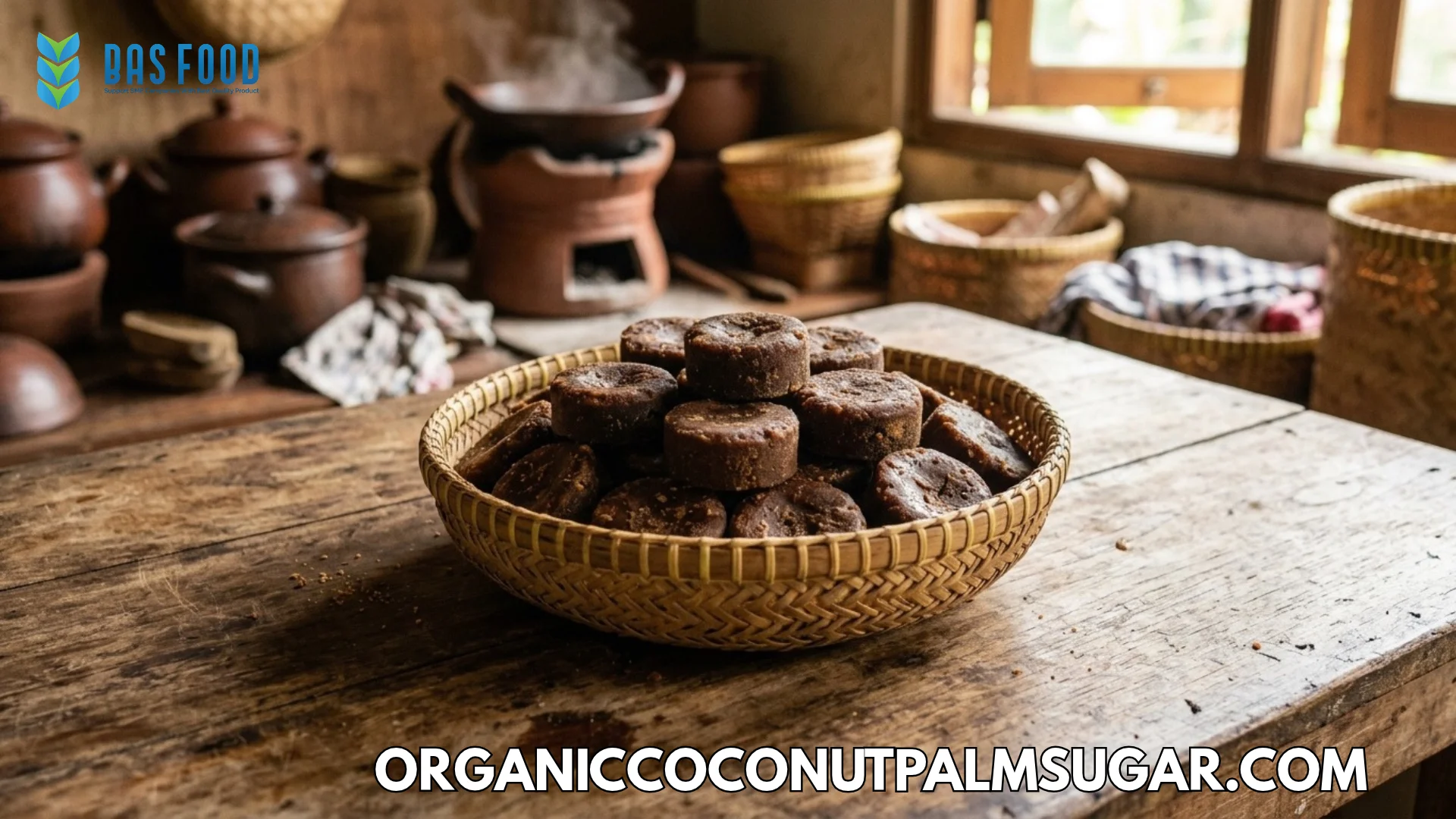
What Is Moulded Coconut Sugar?
Moulded coconut sugar is coconut sugar formed into a specific solid shape using a moulding process. Instead of remaining loose like granules, the sugar becomes a compact product that can be produced in different shapes and sizes depending on the production method and buyer requirements.
The basic raw material comes from coconut sap collected from coconut flower blossoms. The sap contains natural sugars and other components that give coconut sugar its characteristic color, aroma, and flavor. Producers process the sap before forming the resulting sugar into moulded pieces.
The final shape can vary. Depending on the supplier and production method, moulded coconut sugar may appear as small discs, blocks, rounds, tablets, or other practical forms. Therefore, buyers should not assume that one shape represents the entire product category.
For B2B purchasing, the shape is only one part of the specification. Buyers should also consider product weight, dimensions, texture, moisture, color, packaging, shelf life, and intended application.
From Coconut Sap to Moulded Sugar
The production journey starts with coconut sap. Farmers collect the sap from coconut flower stalks and deliver it for further processing. Proper handling at this stage matters because the condition of the raw sap can influence the characteristics of the finished sugar.
During coconut sugar processing, producers generally heat the sap to reduce its water content and concentrate the sugars. The process continues until the material reaches a suitable consistency for forming. The exact processing method can differ between producers, so buyers should ask suppliers about their production practices when technical consistency is important.
Once the sugar reaches the appropriate consistency, producers can transfer it into moulds. The mould determines the physical shape of the final product. After cooling and setting, the pieces can be removed from the moulds and prepared for packaging.
Understanding Moulded Sugar Production
Moulded sugar production requires more than simply putting sugar into a shape. Producers need to control the consistency of the material so that it can fill the mould properly and produce a stable finished piece.
Temperature, moisture, handling, mould design, cooling, and storage can all influence the final product. As a result, production control becomes particularly important for B2B orders where buyers expect similar appearance and handling characteristics from batch to batch.
For export buyers, this is why a product sample is useful. A sample allows the buyer to inspect the actual physical characteristics before discussing a larger shipment.
How Moulded Coconut Sugar Differs From Granules
One of the easiest ways to understand moulded coconut sugar is to compare it with granulated coconut sugar. Granules are loose particles, while moulded products are compact pieces formed into a defined shape.
Granules can be convenient for manufacturers that need to weigh, blend, dissolve, or distribute sugar throughout a formulation. Moulded products, on the other hand, can work well when the physical presentation of the sugar matters.
For example, a food business may want a compact sugar format for retail packaging, traditional food products, hospitality use, or portioned applications. A moulded format can also create a different visual identity compared with loose granules.
However, neither format is automatically better for every application. The right choice depends on how the buyer plans to use, package, transport, and sell the product.
Moulded Sugar vs Powder and Granules
Powder, granules, and moulded sugar serve different purchasing needs. Powder offers a very fine format, while granules provide individual particles with a defined size range. Moulded sugar provides a solid piece with a specific shape and weight.
For industrial food manufacturing, granules may be easier to feed into certain production systems. In contrast, moulded coconut sugar may be more suitable when the physical form is part of the product concept.
Therefore, buyers should begin with the application rather than simply choosing a format based on appearance. Ask how the sugar will be used, how it will be packed, and whether the product needs to dissolve, blend, portion, or remain in a solid form.
Why Buyers Choose Moulded Coconut Sugar
One reason buyers consider moulded coconut sugar is product presentation. A shaped sugar product can look more distinctive than loose sugar, which can be useful for specialty food brands and retail products.
The format can also support portion control. If each piece has a consistent target weight, businesses can design packaging or serving systems around individual units. However, the actual weight tolerance should always be agreed with the supplier rather than assumed.
Another consideration is handling. Compact pieces can be easier to count and package in certain applications. They can also reduce the need for loose granules when the product is sold as an individual unit.
For wholesalers and importers, moulded coconut sugar can therefore represent another product category within a wider coconut sugar portfolio.
Traditional Appearance With Commercial Potential
Moulded sugar has a strong connection with traditional food practices in many producing regions. That traditional appearance can become part of the product story when presented accurately.
At the same time, modern B2B buyers need more than a traditional story. They need reliable specifications, appropriate packaging, consistent quality, clear communication, and export-ready documentation.
That combination is important. A product can have a traditional production background while still being prepared for professional international sourcing.
Key Quality Factors for Moulded Coconut Sugar
When buying moulded coconut sugar, appearance is only the starting point. Buyers should evaluate several characteristics before approving a supplier.
1. Shape and Size
The first factor is the physical form. Buyers should define the preferred shape, approximate dimensions, and target weight when these characteristics are important for the final product.
If a buyer needs a particular mould design, the supplier should confirm whether the requested shape is available or whether a custom mould is required.
2. Color
Coconut sugar naturally has a brown to darker brown appearance, but the exact color can vary according to raw material and processing conditions.
Instead of relying only on a product photograph, buyers should request a physical sample and, where necessary, define acceptable color characteristics in the product specification.
3. Texture
Texture matters because moulded sugar should have a physical structure that matches its intended use. Depending on the product, buyers may look for pieces that remain compact during normal handling without becoming unnecessarily difficult to break or use.
The preferred texture should be discussed during sample approval.
4. Moisture
Moisture is another important consideration. Excess moisture can influence texture, storage behavior, packaging, and product stability.
For this reason, buyers should ask the supplier about the moisture specification and testing method rather than relying on a generic industry assumption.
5. Aroma and Flavor
Coconut sugar is valued for its characteristic sweet flavor and caramel-like notes. However, the exact sensory profile can vary.
A sample comparison is useful when flavor is important to the final application. Buyers can compare samples from different suppliers and determine whether the product matches their formulation or market expectations.
Packaging Moulded Coconut Sugar for Export
Export packaging needs to protect the product throughout handling, storage, and transportation. Moulded coconut sugar can experience physical pressure during shipping, so packaging should help reduce breakage and protect the product from moisture and contamination.
The appropriate packaging depends on the product size, destination, shipping conditions, buyer requirements, and sales channel. Retail-ready packaging and bulk packaging may require completely different approaches.
For example, a wholesaler may need larger inner and outer packaging for distribution, while a private-label brand may need individually packed pieces with customized labels.
Bulk and Retail Packaging
Bulk packaging can be appropriate for importers and food manufacturers that repack the product after arrival. Retail packaging, meanwhile, can support businesses that want to sell the product directly to consumers.
Before ordering, buyers should discuss:
- Inner packaging
- Outer cartons or bags
- Product weight per package
- Number of pieces per package
- Protection against moisture
- Label requirements
- Pallet requirements, if applicable
- Export shipping conditions
Packaging specifications should be confirmed before production begins.
Choosing a Moulded Coconut Sugar Supplier
Finding a suitable coconut sugar supplier requires more than comparing prices. A low product price does not necessarily represent the lowest overall sourcing cost if the product has inconsistent quality, unsuitable packaging, or poor communication.
A reliable supplier should be able to explain the product clearly and provide information relevant to the buyer’s application. Product samples, specifications, packaging options, and production details are useful starting points.
International buyers should also discuss lead times, order quantities, payment terms, shipping arrangements, and export documentation before finalizing a purchase.
Sourcing Moulded Coconut Sugar From Indonesia
Indonesia is an important origin for coconut-based agricultural products, and its coconut-growing regions support a wide range of coconut derivative products.
For international buyers, sourcing from Indonesia can provide access to suppliers familiar with coconut-based ingredients and traditional coconut sugar production. However, buyers still need to evaluate each supplier individually.
A good sourcing process starts with clear specifications. The buyer should explain the required shape, size, packaging, application, estimated order volume, destination market, and any applicable product requirements.
The supplier can then determine whether its existing production process matches the request or whether additional preparation is necessary.
The Role of CV Bonafide Anugerah Sentosa
CV Bonafide Anugerah Sentosa is involved in supplying coconut sugar and other coconut-derived products for international markets. For buyers considering moulded coconut sugar, working with an experienced coconut sugar exporter supplier can help simplify communication around product specifications, samples, packaging, and export arrangements.
However, every order should still be based on agreed specifications and approved samples. This approach gives both the buyer and supplier a clear reference before production moves forward.
For businesses searching for a coconut sugar supplier, the key is to find a partner that understands the required product format and can communicate clearly about production and export requirements.
How to Order Moulded Coconut Sugar for Bulk Supply
The sourcing process does not need to be complicated. In fact, a clear step-by-step approach can prevent many common problems.
First, define the product. Specify the desired shape, size, approximate weight, packaging format, and application. Next, request a sample and product information. Then, review the sample based on your actual requirements.
After approval, discuss commercial terms and production planning. The supplier should confirm the agreed specifications so both sides have the same reference.
Is Moulded Coconut Sugar Suitable for Your Business?
Moulded coconut sugar can be a practical choice for businesses that value a solid, shaped sugar format. It may fit specialty retail, traditional food products, hospitality applications, gift-style food products, and other concepts where physical presentation matters.
However, businesses that need rapid blending or automated ingredient dosing may find loose granules more convenient. Therefore, the correct format depends on the production system and final product.
The best approach is to start with your application. Ask how the sugar will be handled, packaged, sold, and consumed. Then select the format that supports those requirements.
Conclusion
Moulded coconut sugar combines a traditional coconut sugar format with opportunities for modern B2B food businesses. Its solid shape can provide a different presentation from granules or powder, while custom moulding may support specific product concepts.
The production process begins with coconut sap and continues through controlled coconut sugar processing and moulding. Because physical characteristics can vary, buyers should always work from clear specifications and approved samples.
For importers, wholesalers, retailers, and food manufacturers, supplier selection is equally important. A capable coconut sugar supplier should be able to communicate clearly about product specifications, samples, packaging, production, and export arrangements.
For businesses exploring Indonesian sourcing, CV Bonafide Anugerah Sentosa can be considered as part of the supplier evaluation process. As with any B2B purchase, buyers should confirm the exact product specification, packaging, commercial terms, and documentation before placing an order.
Ultimately, successful sourcing is not only about finding moulded coconut sugar. It is about finding the right product format, matching it with your application, and building a clear supply process from the first sample to the final shipment.