The global food industry is constantly searching for ingredients that combine distinctive flavor, practical applications, and dependable supply. Coconut sugar syrup has attracted attention from food manufacturers, beverage companies, distributors, and importers because of its rich sweetness and characteristic caramel-like taste. If you are looking to source coconut sugar syrup Indonesia is recognised as a leading supplier and producer. Made by concentrating coconut palm sap, this liquid sweetener offers an interesting option for businesses developing traditional and modern food products.
Indonesia is an important country to explore when looking to source coconut sugar syrup Indonesia. Its coconut-growing regions and established coconut-based industries create opportunities for international buyers seeking suppliers of coconut-derived ingredients. However, finding the right supplier requires more than comparing quotations. Buyers need to understand product specifications, manufacturing practices, packaging, export readiness, and supplier reliability.
This guide explains how to source Indonesian coconut syrup, what to check before placing an order, and how to build a dependable import relationship with an Indonesian supplier such as CV Bonafide Anugerah Sentosa.
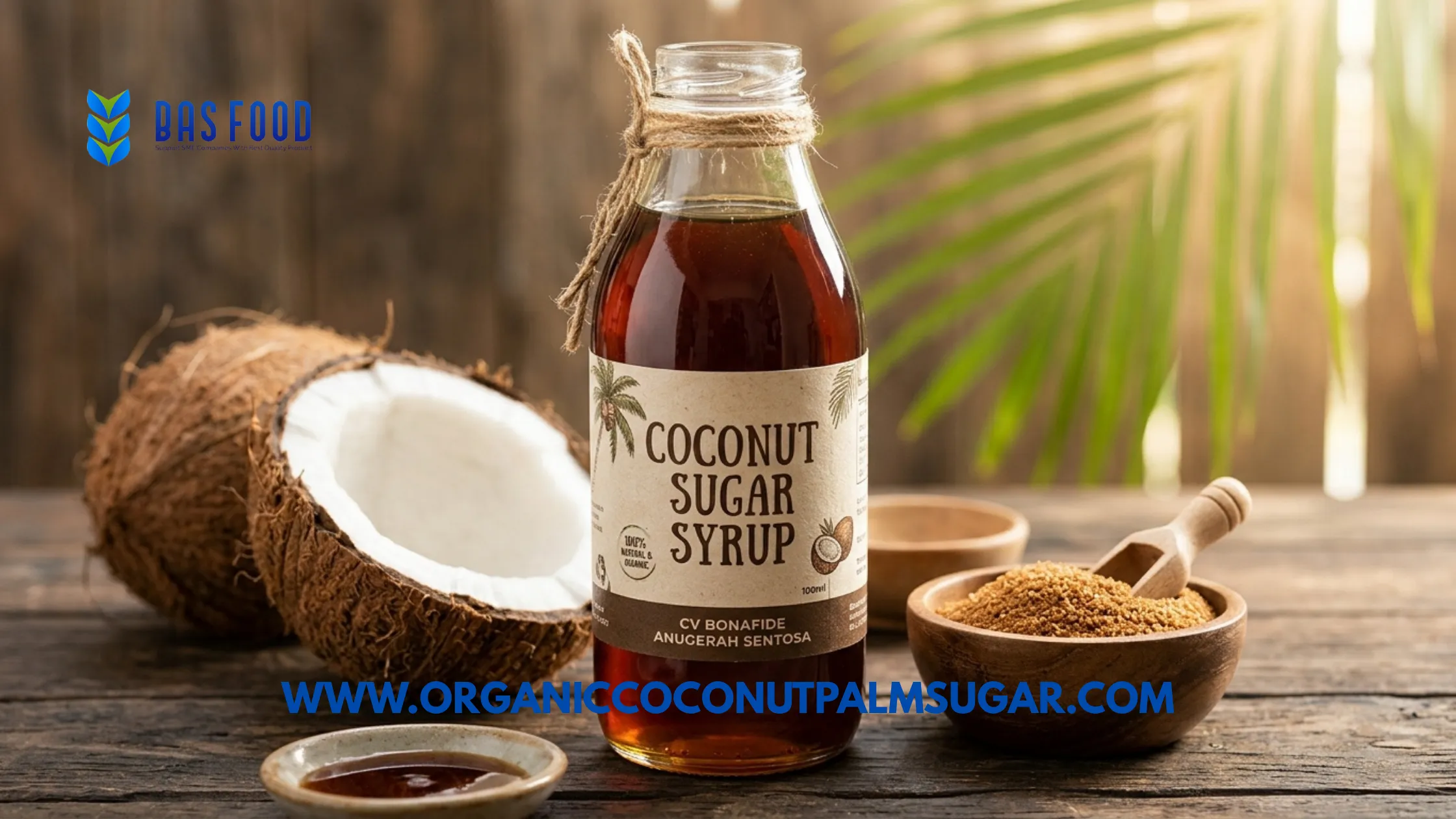
Understanding Indonesian Coconut Syrup and Its Production
Indonesian coconut syrup is a liquid sweetener made by concentrating sap collected from coconut palm flowers. The fresh sap contains natural sugars and water. Producers heat it under controlled conditions to evaporate part of the water and create a thicker, sweeter liquid.
The production process generally begins with sap collection. Because fresh coconut sap can ferment if it is not handled properly, collection, handling, and processing practices matter. Producers then inspect the raw material and concentrate it through heating. Depending on the process, filtration may follow to remove unwanted particles before the syrup is packed.
The final product can vary in color, flavor, thickness, and concentration. These differences may come from the raw material, processing conditions, concentration level, and handling practices. Therefore, buyers should not assume that every coconut sugar syrup has identical characteristics.
It is also important to understand the difference between coconut sugar syrup and granulated coconut sugar. Both can come from coconut sap, but syrup remains a liquid product while granulated sugar is processed into a dry form. Their handling, storage, packaging, and formulation requirements are different.
For manufacturers, this distinction matters because syrup contributes both dissolved sugar solids and water to a recipe. It cannot automatically replace dry sugar at a one-to-one ratio. Product developers should conduct formulation trials to determine the right quantity and processing adjustments.
Identify Your Product Requirements Before Import Sourcing
Successful import sourcing begins with a clear understanding of the product your business needs. Before contacting suppliers, define the intended application and the characteristics required for your production process.
For example, a beverage manufacturer may focus on sweetness, flavor, solubility, and consistency. A sauce producer may pay closer attention to viscosity, color, and how the syrup behaves during heating. Meanwhile, a distributor may prioritize packaging formats, product documentation, and shelf-life information.
A useful product brief should include the following details:
- Product identity: Confirm that the product is coconut sugar syrup made from coconut palm sap.
- Color and flavor: Describe the preferred appearance and flavor profile.
- Brix or soluble solids: Request the supplier’s available concentration information and measurement method.
- Viscosity: Explain whether the syrup needs to flow easily or have a thicker consistency.
- Moisture and water activity: Request relevant data where these parameters matter to product stability.
- Packaging: Specify the preferred container type and net weight.
- Intended application: Explain whether the syrup will be used in beverages, bakery products, sauces, or other foods.
- Destination market: Identify the country where the product will be imported and sold.
These details help suppliers understand the request and prepare more relevant quotations. They also make it easier to compare offers from different companies.
Remember that Brix, moisture content, and water activity measure different things. Brix provides an indication of soluble solids, while moisture content measures water in the product and water activity relates to how available that water is for microbial and chemical processes. Buyers should not use one measurement as a substitute for another.
Supplier Verification: How to Check an Indonesian Supplier
Supplier verification is one of the most important steps when buying food ingredients internationally. A competitive price means little if the supplier cannot provide the required product, maintain agreed specifications, or coordinate shipments properly.
Start by checking the supplier’s business identity and product experience. Review its company website, product information, business contact details, and export activities. Ask direct questions about the product’s origin, raw material, production process, and available specifications.
Next, request supporting information. Depending on the supplier and product, this may include a product specification sheet, ingredient declaration, laboratory analysis, packaging details, and relevant food safety documentation. If your destination market requires specific certificates or documents, confirm whether the supplier can provide them before placing an order.
Samples are also valuable. They allow your technical or purchasing team to evaluate the syrup before committing to a commercial shipment. Check its aroma, color, taste, viscosity, and performance in your intended application.
A practical supplier verification checklist includes:
- Confirm the company’s legal and business identity.
- Verify that the supplier can provide the requested coconut sugar syrup.
- Ask for confirmation of the raw material and country of origin.
- Review available product specifications and test reports.
- Request a sample when appropriate.
- Discuss packaging, order quantity, and shipping arrangements.
- Confirm export documentation and destination-market requirements.
- Agree on product specifications and commercial terms in writing.
Good verification is not about creating unnecessary barriers. It helps both parties understand expectations and reduces the risk of problems during the transaction.
Quality Factors to Evaluate Before Buying
Quality assessment should cover more than the syrup’s appearance. For B2B buyers, the product must meet the requirements of its intended application and remain suitable throughout handling, storage, and distribution.
Color and aroma are useful initial indicators. Coconut sugar syrup commonly has a brown color and a cooked-sugar or caramel-like aroma. However, natural variations can occur. Buyers should agree on an acceptable product profile rather than expecting every batch to look exactly the same without a defined specification.
Viscosity is another important characteristic. A thicker syrup may behave differently during pumping, filling, mixing, or dispensing. Temperature and concentration can affect viscosity, so buyers should evaluate the product under conditions similar to their actual production process.
Concentration and stability also deserve attention. Brix can help buyers understand the soluble-solids level, but it does not independently prove shelf stability or microbial safety. Moisture content, water activity, processing hygiene, packaging, and storage conditions may all influence product stability.
Finally, ask about batch consistency and quality checks. A supplier should be able to explain how it evaluates incoming raw materials and finished syrup. Where specific numerical limits matter, include them in the agreed specification and request suitable test evidence.
Packaging Options and Storage for International Shipments
Packaging affects product protection, handling, storage, and transportation costs. Since coconut sugar syrup is a liquid food ingredient, buyers should select containers that are suitable for food contact and compatible with the product.
Depending on the supplier’s capabilities and order requirements, possible packaging formats may include bottles, jerry cans, food-grade pails, or larger drums. Bulk liquid formats may also be considered for suitable commercial operations. These are examples of packaging options to discuss, not a guarantee that every supplier offers all formats.
Before confirming packaging, ask about the container material, closure system, sealing method, net weight, and compatibility with the syrup. Buyers should also consider whether the packaging can withstand the expected storage and transportation conditions.
For export shipments, packaging should prevent leakage and reduce the risk of contamination. Strong outer cartons, suitable pallet arrangements, and careful container loading can help protect the goods during handling.
Storage instructions must come from the product’s actual specifications and validation. Do not assume that a high Brix level or sealed container automatically guarantees a particular shelf life. Buyers should request the manufacturer’s recommended storage conditions, shelf-life information, and any relevant handling instructions before importing.
Import Sourcing: Documents and Shipping Considerations
Once the product and supplier have been evaluated, the next step is to organize the import process. International food ingredient shipments require coordination between the supplier, importer, freight forwarder, customs broker, and relevant authorities.
Common commercial shipping documents include:
- Commercial invoice
- Packing list
- Bill of lading
- Certificate of origin, where required
- Product specification or technical documents, where applicable
- Food safety or health-related documents required by the destination market
The exact requirements depend on the importing country, product classification, and applicable regulations. Therefore, buyers should confirm current requirements with their customs broker and local food authorities before shipment.
Customs classification is particularly important. The correct tariff classification can affect import duties, taxes, and documentation. Buyers should not rely on a general product description alone to determine the applicable code.
Shipping arrangements also deserve attention. Discuss the shipment volume, container type, loading method, expected transit conditions, and delivery terms. If the product has specific temperature or handling requirements, these should be communicated to the logistics provider.
A written agreement covering product specifications, packaging, quantity, delivery terms, and inspection arrangements can help prevent misunderstandings. Clear communication before shipment is usually easier and less costly than resolving a problem after the goods arrive.
How to Compare Coconut Sugar Syrup Suppliers
When comparing suppliers, avoid choosing based on the lowest price alone. A lower quotation may not include the same concentration, packaging, documentation, or delivery terms as another offer.
Instead, compare quotations using consistent product requirements. Check whether each supplier is offering the same raw material, product specification, net weight, packaging format, and shipping basis. If the specifications differ, the prices may not be directly comparable.
It is also useful to calculate the total landed cost. This includes the product price and other expenses such as freight, insurance, customs duties, taxes, port charges, customs clearance, and local transportation. The final cost per usable unit may be more important than the initial quotation.
Supplier communication should form part of the evaluation too. Does the company answer questions clearly? Can it explain product variations? Does it provide realistic information about availability and shipping schedules? These factors can make a real difference in long-term sourcing relationships.
For larger or recurring orders, buyers should also discuss how the supplier handles changes in demand, specification updates, and quality concerns. A reliable business relationship depends on clear expectations and practical communication from both sides.
CV Bonafide Anugerah Sentosa: Your Indonesian Coconut Sugar Sourcing Partner
For international businesses exploring Indonesian coconut products, CV Bonafide Anugerah Sentosa is an exporter of coconut sugar and other coconut-derived products, as well as a supplier of additional commodities.
As a coconut sugar exporter supplier, the company provides an opportunity for importers and distributors to discuss their sourcing needs with an Indonesian business. Buyers can explain their intended applications, preferred specifications, packaging expectations, and destination markets to help determine whether a product arrangement is suitable.
Businesses looking for a coconut sugar supplier should always confirm the exact product they require. Coconut sugar syrup is different from granulated coconut sugar, moulded coconut sugar, and other coconut-derived ingredients. Buyers should clearly identify the syrup format and confirm current availability before proceeding.
CV Bonafide Anugerah Sentosa encourages clear product discussions so that buyers can understand the available options and relevant commercial conditions. International customers should confirm current product specifications, samples, packaging, order quantities, documentation, and shipping arrangements directly with the company.
This approach helps establish a practical foundation for import sourcing. Rather than relying on assumptions, both buyer and supplier can work from an agreed product brief and clear expectations.
Start Sourcing Indonesian Coconut Sugar Syrup with Confidence
Indonesia offers international buyers an opportunity to explore coconut-based ingredients for a wide range of food applications. However, successful sourcing depends on careful product selection, supplier verification, quality evaluation, and export planning.
When you source coconut sugar syrup Indonesia, begin with a clear product specification. Confirm the raw material, concentration, flavor, viscosity, packaging, and intended application. Then evaluate suppliers based on their product knowledge, documentation, communication, and ability to meet your commercial requirements.
Whether you are a food manufacturer, ingredient distributor, importer, or private-label business, a well-planned sourcing process can help reduce procurement risks and support a more dependable supply chain.
CV Bonafide Anugerah Sentosa welcomes inquiries from international buyers interested in Indonesian coconut sugar and related products. Contact the company to discuss your requirements, confirm current product options, and explore a suitable sourcing arrangement.