Finding a supplier is easy. Finding one that can consistently meet your product requirements, quality expectations, and delivery needs is a different story. For food manufacturers, importers, distributors, and private-label businesses, coconut sugar syrup supplier evaluation is crucial when choosing the right supplier, as it can have a direct impact on product quality and supply chain performance.
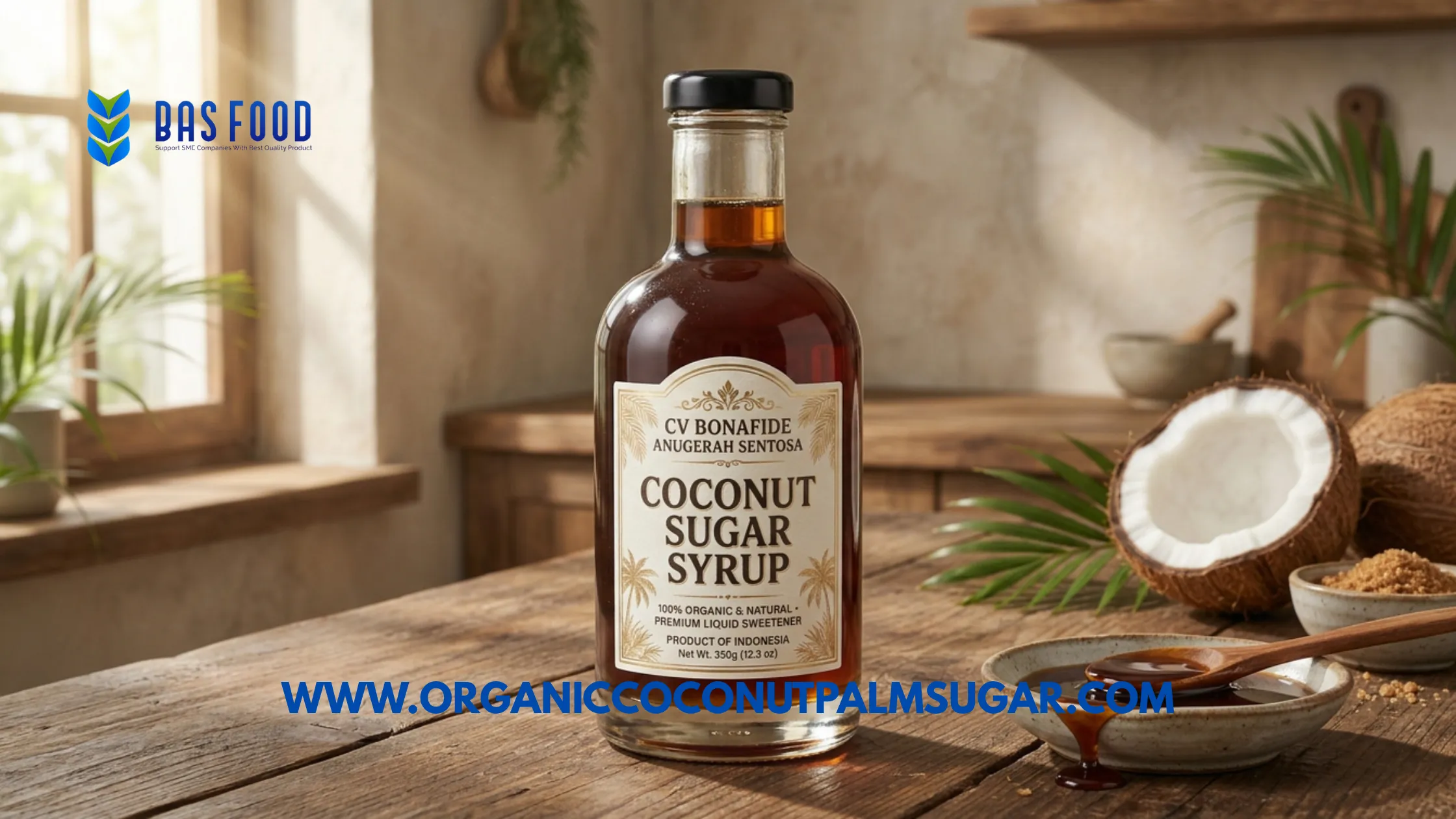
Coconut sugar syrup is a liquid sweetener made by concentrating sap from coconut palm flowers. Its caramel-like flavor and liquid form make it suitable for various food applications, including beverages, sauces, bakery products, and desserts. However, not every supplier offers the same product characteristics, production controls, packaging options, or export services.
That is why coconut sugar syrup supplier evaluation should be a structured process rather than a quick comparison of quotations. Buyers need to look beyond price and examine product specifications, manufacturing practices, quality assurance, documentation, and communication.
This guide provides a practical framework to help international buyers evaluate suppliers, conduct a supplier audit, and make better sourcing decisions. It also explains how businesses can assess potential Indonesian suppliers, including CV Bonafide Anugerah Sentosa.
Why Coconut Sugar Syrup Supplier Evaluation Matters
A supplier does more than provide an ingredient. It becomes part of your production and purchasing process. If the supplier delivers inconsistent syrup, changes specifications without notice, or fails to coordinate shipments properly, your business may face production delays, additional costs, or customer complaints.
For example, a beverage manufacturer may depend on a specific sweetness level and viscosity to maintain a consistent recipe. If a new batch has a different concentration, the manufacturer may need to adjust the formulation. Similarly, a sauce producer may find that changes in syrup color or flavor affect the appearance and taste of the finished product.
A proper evaluation helps identify these risks before a commercial order takes place. It also gives buyers a clear way to compare suppliers using the same criteria. Instead of choosing a company simply because it offers the lowest price, businesses can consider the overall value and reliability of the supply arrangement.
Most importantly, a structured evaluation creates clear expectations. Both parties understand the product requirements, quality standards, packaging details, and delivery responsibilities before the transaction begins.
Start with Product Knowledge and Specification Review
Before evaluating a supplier, understand the product you intend to purchase. Coconut sugar syrup is produced by concentrating coconut palm sap through heating. The final liquid contains dissolved sugars and water, with characteristics that depend on the raw material and production process.
Buyers should not assume that every coconut sugar syrup has the same color, flavor, thickness, or concentration. Differences in sap quality, processing conditions, and concentration can influence the finished product. Therefore, a supplier should be able to explain the product it offers and provide relevant specifications.
A useful product specification review should cover:
- Product identity: Confirm that the product is coconut sugar syrup made from coconut palm sap.
- Ingredients: Check the ingredient declaration and whether any additional ingredients are used.
- Color and appearance: Define the acceptable color range and visual characteristics.
- Flavor and aroma: Establish the expected sweetness and characteristic aroma.
- Brix or soluble solids: Request the stated concentration and measurement method.
- Viscosity: Confirm the expected flow characteristics and testing conditions.
- Moisture content: Request data when it is relevant to your product requirements.
- Water activity: Review this separately from moisture content when product stability is important.
- Packaging: Confirm the container type, net weight, closure, and labeling details.
These parameters help buyers determine whether the syrup suits their application. For example, a beverage manufacturer may prioritize ease of mixing, while a sauce producer may focus more on viscosity and flavor balance.
It is important to understand that Brix, moisture content, and water activity are not interchangeable. Brix indicates soluble solids, moisture content measures water in the product, and water activity relates to how available that water is for microbial and chemical processes. A supplier should not use one measurement as proof of all three characteristics.
Assess Manufacturing Practices Through a Supplier Audit
A supplier audit helps buyers understand how a company manages its production and business operations. The level of audit can vary depending on order size, risk, destination-market requirements, and the buyer’s internal procedures.
An initial audit may begin with a document review and a discussion with the supplier. Buyers can ask about raw material sourcing, sap handling, production steps, equipment, cleaning procedures, and finished-product inspection. These questions help reveal whether the supplier understands the importance of controlling each production stage.
For coconut sugar syrup, raw material handling deserves particular attention. Fresh coconut sap is perishable and can ferment if it is not handled appropriately. Buyers should therefore ask how the supplier manages collection, transport, processing time, and raw material inspection.
The production process should also be clear. Ask how the supplier concentrates the sap, manages heating, filters the syrup where applicable, and transfers the finished product into packaging. The purpose is not to demand one universal production method, but to understand whether the actual process is suitable for the product specification.
Depending on the buyer’s requirements, an audit may include:
- Review of company and production information.
- Assessment of raw material sourcing and handling.
- Review of processing and hygiene procedures.
- Inspection of equipment and production areas, where possible.
- Review of quality control records.
- Assessment of packaging and storage practices.
- Review of traceability and complaint-handling procedures.
A physical factory visit may provide additional confidence, but it is not the only way to begin an evaluation. Remote meetings, document reviews, sample testing, and third-party inspections may also support the process. Buyers should choose an audit method that matches the commercial risk and applicable requirements.
Examine Quality Assurance and Testing Procedures
Strong quality assurance helps a supplier maintain product consistency and identify problems before goods reach the buyer. It should cover more than checking the finished syrup at the end of production.
Start by asking how the supplier evaluates incoming coconut sap. Fresh raw material can vary, so the supplier should have a process for deciding whether it is suitable for production. Buyers can also ask how the company monitors processing conditions and checks the finished syrup.
Finished-product testing should match the product specification and intended use. Depending on the buyer’s needs, relevant tests may include Brix, moisture content, water activity, pH, viscosity, microbiological parameters, and other quality characteristics.
However, not every test is necessary for every purchase. The right testing plan depends on the product, its formulation, the intended market, and the applicable food safety requirements. Buyers should agree on the relevant parameters rather than request an arbitrary list of laboratory tests.
Ask for available laboratory reports and confirm the testing method, date, sample identification, and laboratory details. If a numerical limit is important to your production process, include it in the agreed specification and establish how the supplier will verify compliance.
Quality assurance should also include procedures for handling non-conforming products. Ask what happens if a batch falls outside the agreed specification, how the supplier investigates the issue, and how corrective actions are recorded.
Evaluate Traceability and Food Safety Documentation
Traceability allows businesses to connect a finished product with relevant information about its production and origin. For importers and manufacturers, this can be important when investigating complaints, managing product recalls, or meeting customer requirements.
Ask the supplier how it identifies production batches and records relevant information. A batch identification system should make it possible to trace the product through appropriate stages of sourcing, processing, packaging, and dispatch.
You should also review the documents available for the product. Depending on the supplier and destination market, these may include:
- Product specification sheet.
- Ingredient declaration.
- Certificate of analysis, where available.
- Relevant food safety certificates or audit reports.
- Manufacturing and packaging information.
- Country-of-origin documentation.
- Commercial export documents.
- Additional documents required by the importing country.
Do not assume that every supplier holds every certification or that a certificate automatically covers all products and production sites. Check the issuing body, validity period, scope, and facility details. If your business requires a specific certification, verify that it applies to the product and facility involved in your order.
Importers should also check the food safety and labeling rules of their destination market. Requirements can vary between countries, so consult the relevant authorities or a qualified local compliance professional before shipping.
Request Samples and Conduct Application Tests
Documents provide useful information, but a product sample allows your team to evaluate the syrup directly. This step is particularly important when the ingredient will become part of an established commercial recipe.
Start with a sensory assessment. Check the color, aroma, sweetness, flavor, and general appearance. Compare the sample with your product requirements and any reference sample used by your technical team.
Next, test the syrup in the intended application. A beverage manufacturer can evaluate how the syrup mixes and affects the drink’s flavor. A bakery business can test its influence on sweetness, color, moisture, and texture. Sauce manufacturers can assess flavor balance, flow, and performance during heating.
Remember that coconut sugar syrup adds both dissolved sugar solids and water to a formulation. It is not automatically a direct one-to-one replacement for dry sugar. Your product development team may need to adjust the recipe to achieve the desired sweetness, texture, and moisture balance.
For larger orders, consider a production trial using a representative quantity. A successful kitchen or laboratory test does not always guarantee identical performance at factory scale. Testing under realistic processing conditions can help identify issues before commercial production begins.
Compare Packaging, Storage, and Shipping Capabilities
Packaging is another important part of coconut sugar syrup supplier evaluation. Since the product is liquid, its container must protect it from leakage, contamination, and damage during handling and transportation.
Depending on the supplier’s capabilities, possible packaging formats may include bottles, jerry cans, food-grade pails, or drums. Larger bulk formats may also be considered for suitable operations. These are examples to discuss with the supplier, not a guarantee that every option is available.
Ask for details about the packaging material, closure system, sealing method, net weight, and compatibility with the syrup. Food-contact suitability should be confirmed for the exact material and intended conditions of use.
Storage requirements also deserve attention. Ask the supplier for product-specific storage instructions and supporting shelf-life information. A high Brix value or sealed container does not independently prove microbial safety or guarantee a particular shelf life.
For export shipments, discuss carton protection, pallet configuration, container loading, and transport conditions. If the product has special handling requirements, communicate them to the freight forwarder before shipment.
A supplier should provide realistic information about its packaging and shipping arrangements. Buyers should confirm the details in writing to avoid differences between the quotation, purchase order, and actual shipment.
Review Export Experience and Communication
A supplier may produce a suitable product but still need to demonstrate that it can manage international orders effectively. Export readiness includes documentation, shipment coordination, commercial communication, and an understanding of destination-market requirements.
Ask whether the supplier has experience handling international inquiries and export shipments. Discuss the documents it can provide, the shipping arrangements it can coordinate, and the information it needs from the importer.
Common export documents may include a commercial invoice, packing list, and bill of lading. A certificate of origin or additional food-related documents may also be required, depending on the destination country and product classification. Buyers should confirm requirements with their customs broker and local authorities.
Communication is just as important as documentation. A good supplier should respond clearly to questions, explain product limitations, and provide realistic updates about availability and shipment schedules.
During the evaluation, pay attention to how the company handles details. Does it confirm specifications accurately? Does it distinguish between confirmed product options and possibilities that still need checking? Does it explain when information is not yet available?
Clear communication helps prevent misunderstandings and supports a stronger business relationship.
Consider Total Cost, Not Just the Quoted Price
Price comparison is an important part of supplier selection, but the initial product price does not always represent the actual cost of importing coconut sugar syrup.
Buyers should calculate the total landed cost. This may include the product price, packaging, inland transport, export handling, freight, insurance, customs duties, taxes, port charges, customs clearance, and local delivery.
Also consider the cost of product inconsistency. If a syrup requires frequent formulation adjustments or causes production problems, the apparent savings from a lower quotation may disappear.
For recurring orders, discuss how the supplier handles changes in raw material conditions, specifications, and availability. Agree on how price changes will be communicated and how both parties will approve any changes to the product.
A good commercial arrangement balances competitive pricing with product suitability, quality assurance, reliable communication, and realistic delivery expectations.
CV Bonafide Anugerah Sentosa: A Partner to Evaluate for Coconut Sugar Sourcing
For businesses exploring Indonesian coconut products, CV Bonafide Anugerah Sentosa is an exporter of coconut sugar and other coconut-derived products, as well as a supplier of additional commodities.
As a coconut sugar exporter supplier, the company provides an opportunity for international buyers to discuss their sourcing needs with an Indonesian business. Importers and distributors can explain their intended applications, product specifications, packaging expectations, and destination markets.
Businesses looking for a coconut sugar supplier should identify the exact product they require. Coconut sugar syrup is different from granulated coconut sugar, moulded coconut sugar, and other coconut-derived ingredients. Buyers should confirm current syrup availability and request the relevant product information before proceeding.
A practical evaluation should cover the same areas discussed throughout this guide: product identity, specifications, samples, quality assurance, packaging, documentation, and export arrangements. Buyers should confirm all commercial and technical details directly with the company rather than assuming that every product option or service is automatically available.
By beginning with clear requirements and open communication, both parties can determine whether the proposed supply arrangement is suitable for a long-term business relationship.
Make Supplier Selection a Strategic Business Decision
Choosing a coconut sugar syrup supplier is not simply a purchasing task. It is a decision that can affect production planning, finished-product consistency, customer satisfaction, and supply chain performance.
A structured coconut sugar syrup supplier evaluation helps buyers understand what a supplier can actually provide. Review the product specification, assess manufacturing practices, examine quality assurance procedures, request samples, and confirm export capabilities. Use a sourcing checklist to compare suppliers against the same requirements.
Most importantly, base your decision on evidence. Clear specifications, relevant test results, transparent communication, and written commercial agreements provide a stronger foundation than attractive claims or low prices alone.
Whether you are an importer, distributor, beverage producer, or food manufacturer, careful supplier selection can help create a more dependable sourcing process. CV Bonafide Anugerah Sentosa welcomes inquiries from international buyers interested in Indonesian coconut sugar and related products. Contact the company to discuss your requirements and confirm suitable product options.