What makes coconut sugar syrup thick, sweet, and consistent? The answer involves several factors, but one of the most important is its solids content. For beverage manufacturers, bakeries, food processors, and international ingredient buyers, understanding coconut sugar syrup solids content is essential for selecting a product that meets their manufacturing requirements.
Solids content influences syrup concentration, sweetness, viscosity, processing behavior, and overall product consistency. It also plays a role in evaluating quality and developing reliable food formulations.
However, not every coconut sugar syrup has the same concentration. Differences in raw coconut sap, heating conditions, and production methods can affect the final product.
For B2B importers, these variations make technical specifications particularly important. A syrup with an unsuitable concentration may create challenges during mixing, dosing, or manufacturing.
In this guide, we explore total soluble solids, Brix measurements, concentration methods, quality control, and practical sourcing considerations. We also explain how buyers can evaluate coconut sugar syrup before placing commercial orders.
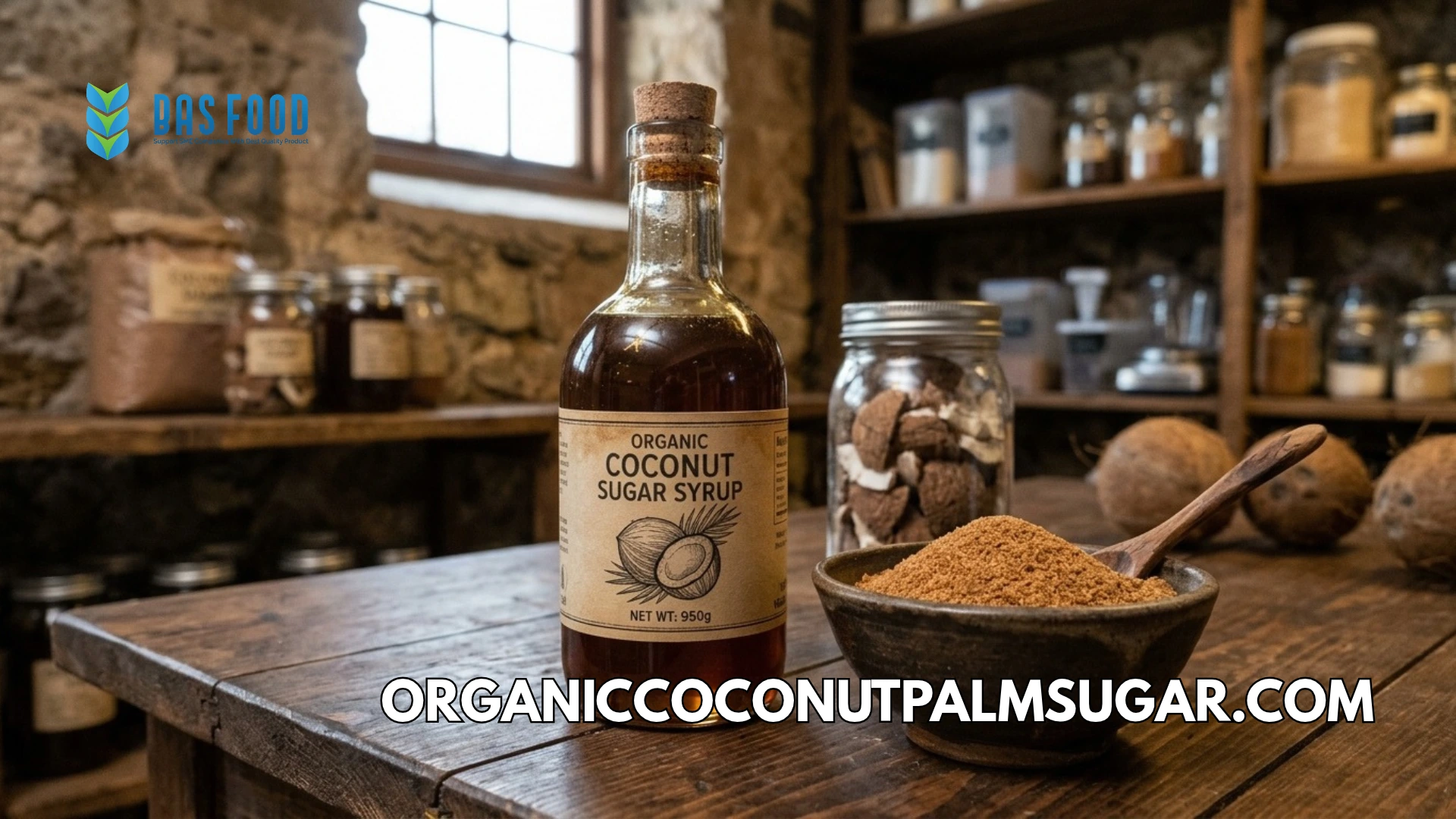
What Is Coconut Sugar Syrup Solids Content?
Coconut sugar syrup is a liquid sweetener produced by concentrating sap collected from coconut palm flower stalks.
Fresh coconut sap contains water, naturally occurring sugars, minerals, and other dissolved substances. During production, heating removes part of the water, increasing the concentration of dissolved components.
The amount of dissolved material remaining in the syrup is commonly described as total soluble solids, or TSS.
These soluble components include sugars and smaller amounts of other dissolved substances naturally present in the sap.
Consequently, solids content provides useful information about the syrup’s concentration.
Why total soluble solids are important
A syrup with a higher concentration of soluble solids generally contains less water relative to its dissolved components.
This can influence sweetness intensity, viscosity, and the amount of syrup required in a recipe.
For example, beverage manufacturers may need to adjust their formulations when switching between syrups with different concentrations.
Similarly, bakery manufacturers may experience changes in moisture balance if the syrup’s concentration varies between batches.
Therefore, monitoring total soluble solids helps manufacturers achieve more predictable results.
However, soluble solids measurements do not reveal the complete composition of the syrup. They should be considered alongside other quality parameters.
Understanding Brix Level in Coconut Sugar Syrup
One of the most common ways to describe syrup concentration is through its Brix level.
Degrees Brix, written as °Bx, represent the mass percentage of sucrose in a pure sucrose-and-water solution.
For example, a pure sucrose solution measuring 70°Bx contains approximately 70 grams of sucrose per 100 grams of solution.
However, coconut sugar syrup is not a pure sucrose solution. It contains a mixture of sugars and other dissolved substances.
Therefore, a refractometer reading of 70°Bx in coconut sugar syrup should be interpreted as an apparent soluble solids measurement expressed on a sucrose scale, rather than proof that the syrup contains exactly 70% sugar.
Why Brix matters for manufacturers
Brix measurements help food businesses compare syrup concentration and monitor production consistency.
For example, if a manufacturer approves a particular syrup concentration, future deliveries can be checked against the agreed specification.
This helps identify unexpected differences between batches.
In addition, Brix measurements can support production adjustments when manufacturers need to achieve consistent sweetness or solids contribution.
Nevertheless, Brix does not independently determine viscosity, microbial safety, sugar composition, or shelf life.
Buyers should avoid treating a single Brix value as a complete quality assessment.
How Producers Control Coconut Sugar Syrup Concentration
The production process plays an important role in determining syrup concentration.
After collecting coconut sap, producers typically filter and heat it to remove water and concentrate the dissolved components.
As evaporation continues, the concentration of soluble solids increases.
The producer must control the process carefully to achieve the intended product characteristics.
Heating and evaporation
Heating is a common method of concentrating coconut sap.
As water evaporates, the syrup gradually becomes more concentrated and may develop a thicker consistency.
However, heating also influences color and flavor.
Excessive exposure to high temperatures can create undesirable darkening, burnt notes, or other quality changes.
Therefore, producers must balance concentration targets with sensory and processing requirements.
Monitoring concentration during production
Manufacturers may use refractometers and other analytical tools to monitor concentration.
These measurements help determine when the syrup has reached its intended specification.
Temperature is also important because refractive index changes with temperature.
Although many refractometers include automatic temperature compensation, users should follow the instrument’s calibration and measurement instructions.
For consistent results, producers should use appropriate sampling procedures and verify that measuring equipment is properly maintained.
How Solids Content Influences Syrup Thickness
One of the most noticeable characteristics of coconut sugar syrup is its viscosity.
Viscosity describes a liquid’s resistance to flow. A syrup with higher viscosity moves more slowly than a thinner liquid under the same conditions.
Solids concentration can influence viscosity because increasing the amount of dissolved material often makes the syrup thicker.
However, the relationship is not determined by Brix alone.
Temperature, sugar composition, and other dissolved components also influence how the syrup flows.
Why viscosity matters in food manufacturing
For beverage manufacturers, viscosity affects pumping, dosing, and mixing.
A thick syrup may require different equipment settings from a thinner syrup.
Meanwhile, manufacturers producing sauces, dessert toppings, or bakery fillings may prefer particular flow characteristics.
For example, a topping should be easy enough to dispense while maintaining the desired appearance on the finished product.
Therefore, buyers should evaluate viscosity under relevant operating temperatures rather than relying only on visual appearance.
Brix and viscosity are not interchangeable
Two syrups with similar Brix measurements can have different viscosities.
This may happen because their sugar compositions, processing histories, or temperatures differ.
Consequently, manufacturers with strict flow requirements should request both concentration and viscosity information when available.
They may also conduct practical trials using their own production equipment.
The Relationship Between Solids Content and Sweetness
Sweetness is one of the main reasons food manufacturers use coconut sugar syrup.
Since the syrup contains naturally occurring sugars, its concentration influences the amount of sweetening material delivered per unit of product.
Generally, a more concentrated syrup can contribute more dissolved solids per gram than a less concentrated version.
However, perceived sweetness depends on the types of sugars present, the overall formulation, temperature, and interactions with other ingredients.
Understanding sugar composition
Coconut sugar syrup may contain sucrose, glucose, fructose, and other naturally occurring components.
These sugars do not have identical sweetness characteristics.
Therefore, two syrups with similar total soluble solids may produce slightly different sensory results.
Processing conditions can also influence the relative composition of sugars.
For this reason, manufacturers should conduct sensory evaluations alongside analytical testing.
Balancing sweetness in food formulations
Beverage manufacturers often need consistent sweetness from one production batch to another.
If syrup concentration changes, the amount needed to reach a target sweetness may also change.
The same principle applies to bakery products, confectionery, and sauces.
However, manufacturers should avoid adjusting recipes solely from Brix readings when flavor and texture are important.
A complete formulation trial provides more reliable information.
Does Higher Solids Content Improve Shelf Life?
Solids concentration can influence the storage stability of coconut sugar syrup.
As dissolved solids increase, the amount of available water may decrease.
This can limit the growth of certain microorganisms.
However, higher solids content does not automatically guarantee a longer shelf life or microbiological safety.
Some yeasts and molds can grow in high-sugar environments, depending on water activity, acidity, temperature, and other conditions.
Understanding water activity
Water activity describes the availability of water for microbial growth and certain chemical reactions.
It differs from total moisture content.
A syrup may contain water while having relatively low water activity because dissolved substances bind or interact with some of that water.
Nevertheless, the relationship between Brix and water activity depends on the product’s composition.
Therefore, manufacturers should measure water activity when it is relevant to their safety and stability assessment.
Shelf-life validation
Food producers should establish shelf life using appropriate testing and documented storage conditions.
Depending on the product, this may include microbiological testing, water activity measurements, pH analysis, and sensory evaluation.
Packaging and processing hygiene also play important roles.
For B2B buyers, the safest approach is to request the supplier’s validated shelf-life information rather than assuming that a particular Brix level guarantees stability.
Coconut Sugar Syrup Solids Content in Beverage Manufacturing
Beverage manufacturers use liquid sweeteners because they can be convenient to measure and blend.
Coconut sugar syrup may be considered for coffee drinks, milk tea, specialty beverages, and other sweetened formulations.
However, consistent concentration is important when producing beverages at commercial scale.
A change in syrup solids can influence sweetness, flavor intensity, and the amount of water introduced into the recipe.
Maintaining consistent beverage quality
Suppose a beverage manufacturer develops a recipe using a particular coconut sugar syrup.
If a later delivery has a different concentration, using the same weight of syrup may produce a different finished beverage.
This can affect consumer experience and product consistency.
Therefore, manufacturers should establish an acceptable Brix range and verify incoming ingredients against the agreed specification.
Improving formulation accuracy
When developing beverages, manufacturers should consider the syrup’s contribution to the final product’s total soluble solids.
They should also evaluate its caramel-like flavor, color, and interaction with other ingredients.
A well-designed formulation accounts for sweetness and sensory characteristics together.
This helps manufacturers create products that remain consistent during repeated production.
Applications in Bakery, Confectionery, and Sauces
Solids content also matters in bakery and confectionery manufacturing.
When coconut sugar syrup is used in cakes, cookies, fillings, or dessert sauces, it contributes both dissolved solids and moisture.
This combination can influence texture, browning, and finished-product characteristics.
For example, replacing dry sugar with syrup changes the water balance of a recipe.
Therefore, manufacturers may need to adjust other liquid ingredients to maintain the intended formulation.
Bakery applications
In bakery products, sugar concentration can influence sweetness, moisture retention, and browning behavior.
However, coconut sugar syrup should not be treated as a direct one-to-one replacement for granulated sugar without testing.
Its water content and flavor profile can produce different results.
Commercial bakeries should evaluate the finished product’s texture, appearance, and stability before approving a new ingredient.
Confectionery and sauce applications
In confectionery fillings and sauces, solids concentration can influence thickness and processing behavior.
Manufacturers may need a syrup that flows easily during filling but provides the desired consistency after cooling.
For these applications, Brix measurements are useful, but viscosity and temperature-dependent behavior may be equally important.
Therefore, ingredient trials should reflect actual manufacturing conditions.
How to Measure Coconut Sugar Syrup Solids Content
A refractometer is commonly used to estimate soluble solids in syrup.
The instrument measures refractive index and converts the result to a Brix reading using a calibration scale.
Handheld digital refractometers can be convenient for routine checks, while laboratory instruments may provide additional measurement capabilities.
However, accurate results depend on proper equipment selection and measurement procedures.
Basic measurement procedure
A typical measurement process includes:
- Confirm that the refractometer is suitable for the expected measurement range.
- Calibrate the instrument according to the manufacturer’s instructions.
- Prepare a representative syrup sample.
- Ensure the sample is suitable for the instrument’s temperature requirements.
- Apply the sample to the measurement surface.
- Record the Brix reading.
- Clean the instrument after testing.
For very thick syrups, manufacturers should follow the equipment manufacturer’s guidance on sample preparation.
Avoiding common measurement errors
Incorrect calibration, unsuitable temperature conditions, and nonrepresentative samples can affect results.
Air bubbles, crystals, or contamination may also interfere with some measurements.
Therefore, operators should use consistent procedures and maintain appropriate testing records.
For important commercial decisions, buyers may request independent laboratory verification.
Important Quality Parameters Beyond Brix
Although Brix is useful, it should not be the only parameter used to evaluate coconut sugar syrup.
International buyers should consider a broader quality specification.
| Quality parameter | Importance |
|---|---|
| Total soluble solids | Helps evaluate concentration |
| Brix level | Provides an apparent soluble solids measurement |
| Water activity | Supports stability and microbial risk assessment |
| pH | Helps describe acidity |
| Viscosity | Supports processing and dispensing requirements |
| Color | Helps assess appearance consistency |
| Flavor and aroma | Supports sensory quality |
| Microbiological results | Supports food safety assessment |
| Packaging integrity | Helps protect product quality during distribution |
The exact requirements depend on the intended application and destination market.
For example, a beverage manufacturer may prioritize sweetness consistency and viscosity, while a bakery ingredient distributor may focus on packaging, concentration, and storage stability.
Therefore, buyers should agree on relevant quality parameters before placing orders.
Choosing a Reliable Coconut Sugar Syrup Supplier
Selecting a dependable supplier is essential for maintaining consistent ingredient quality.
When sourcing coconut sugar syrup, importers should request product specifications and confirm whether the supplier can provide representative samples.
They should also discuss acceptable concentration ranges and any additional technical requirements.
A reliable coconut sugar supplier should communicate clearly about available products, packaging, and quality documentation.
When evaluating a coconut sugar exporter supplier, buyers should also review communication, lead times, traceability, and commercial reliability.
Sourcing Coconut Sugar Products from Indonesia
Indonesia has an established coconut industry that supports the production and trade of coconut-derived ingredients.
Coconut sugar syrup is one product that international food manufacturers may explore when developing sweetened beverages, bakery products, and specialty foods.
For businesses sourcing Indonesian agricultural commodities, CV Bonafide Anugerah Sentosa operates in the commodity supply and export sector, including coconut-derived products.
Importers interested in coconut sugar syrup can contact the company to confirm current product availability, specifications, packaging options, and export arrangements.
Communicating technical requirements
Buyers should explain their intended application and provide their required concentration range.
For example, a beverage manufacturer may need a particular Brix specification, while a sauce producer may prioritize viscosity and flavor.
Importers should also identify their destination country, expected purchasing volume, and documentation requirements.
However, buyers should not assume that a specific Brix level, certification, packaging format, or minimum order quantity is available until the supplier confirms it.
Clear technical communication helps both parties determine whether the product meets the intended requirements.
Conclusion: Better Concentration Control, Better Product Consistency
Understanding coconut sugar syrup solids content helps food manufacturers and international buyers make more informed ingredient decisions.
Total soluble solids and Brix measurements provide useful information about syrup concentration. They can support production monitoring, purchasing specifications, and formulation consistency.
However, Brix alone cannot determine sweetness perception, viscosity, microbial safety, or shelf life.
For reliable quality assessment, businesses should also consider water activity, pH, flavor, packaging, storage conditions, and relevant microbiological testing.
Manufacturers should establish clear technical specifications and evaluate syrup samples under actual production conditions.
For international buyers interested in Indonesian coconut-derived ingredients, CV Bonafide Anugerah Sentosa can be contacted to discuss current product availability and sourcing requirements.
With appropriate quality controls and supplier communication, coconut sugar syrup can be evaluated more effectively for commercial food and beverage applications.