Chocolate has always been about balance. Cocoa brings bitterness and depth, while sugar adds sweetness and helps shape the final taste. For many years, refined white sugar has been the standard choice for chocolate makers. However, as consumers become more interested in recognizable ingredients and alternative sweeteners, chocolate manufacturers are exploring new options.
One ingredient gaining attention is coconut sugar granules for chocolate. Made from coconut blossom sap, coconut sugar offers a different flavor profile from refined sugar. It can bring mild caramel-like notes and a warm brown color, making it interesting for artisan chocolate, specialty confectionery, and selected commercial products.
For B2B buyers, however, using coconut sugar in chocolate involves more than simply replacing one sweetener with another. Particle size, moisture, flavor, color, processing behavior, and formulation all matter. Chocolate manufacturers need a coconut sugar supplier that understands these requirements and can provide consistent material.
This article explores how coconut sugar granules can be used in chocolate production, what makes them different from conventional sugar, and what manufacturers should consider when sourcing them.
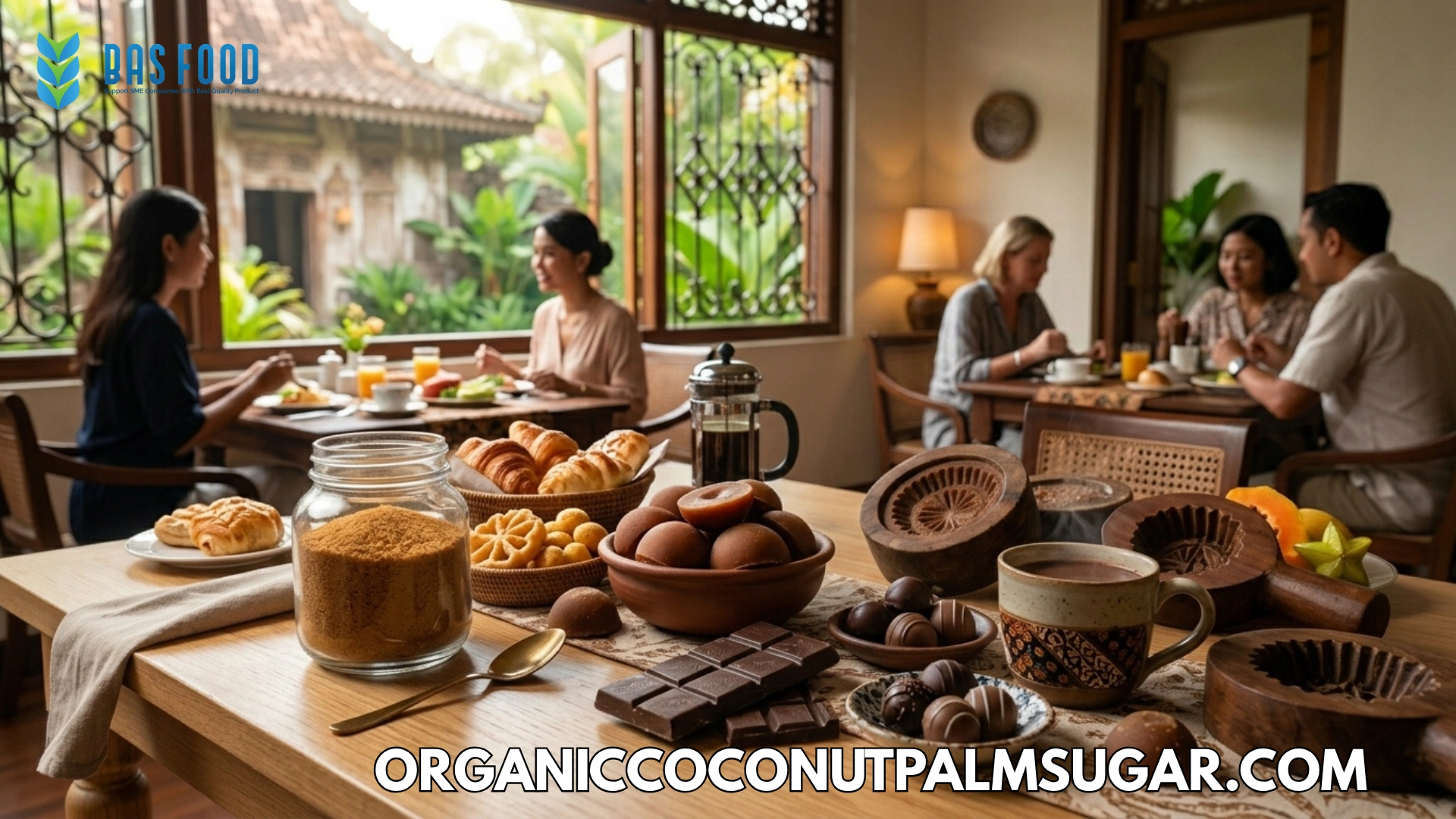
What Are Coconut Sugar Granules for Chocolate?
Coconut sugar granules are small particles of coconut sugar produced from concentrated coconut blossom sap. The sap is collected from coconut flowers and processed to reduce its water content. After concentration, the sugar can be processed into different formats, including granules.
The size of the granules can vary depending on production and processing methods. This matters because chocolate manufacturers need ingredients that work well with their particular formulation and equipment.
When used in chocolate, coconut sugar can contribute sweetness while also adding its own flavor characteristics. Unlike highly refined white sugar, coconut sugar generally has a more noticeable brown color and a distinctive taste.
For manufacturers, this difference can be an advantage when developing chocolate products with a more natural or specialty positioning. However, it also means that coconut sugar should be tested carefully before it becomes part of a standardized production formula.
Why Granule Size Matters
Particle size is one of the first things chocolate manufacturers should consider.
Chocolate has a smooth texture, so coarse sugar particles may create an unpleasant mouthfeel if they do not dissolve or disperse properly during processing. Finer particles may be more suitable for applications where a smooth final texture is important.
Therefore, buyers should discuss the required granulation with their supplier before placing an order.
A reliable coconut sugar supplier should be able to provide clear product specifications so manufacturers can determine whether the granules fit their chocolate-making process.
Why Use Coconut Sugar in Chocolate?
The biggest reason to consider coconut sugar is differentiation. Chocolate brands operate in a competitive market, and consumers increasingly encounter products positioned around unique ingredients, origin, and production methods.
Coconut sugar can provide a different ingredient story from conventional refined sugar. Its connection to coconut-producing regions and traditional sap collection can be relevant to brands that want to communicate a more distinctive product identity.
It also brings a naturally warm color and characteristic flavor. Depending on the formulation, these characteristics can complement cocoa, especially in chocolate products designed around deeper or caramel-like flavor notes.
However, manufacturers should avoid treating coconut sugar as a direct one-to-one substitute without testing. Every chocolate recipe has a specific balance of cocoa solids, cocoa butter, sugar, milk ingredients, emulsifiers, and other components.
A Different Sweetness Experience
Coconut sugar does not taste exactly like refined white sugar. Its flavor can be more pronounced, which means it may influence the overall sensory profile of the chocolate.
This can be useful for brands developing specialty products.
For example, coconut sugar may work particularly well in chocolate formulations where the manufacturer wants a more noticeable caramel or brown-sugar character.
The key is to build the recipe around the ingredient rather than simply replacing white sugar and expecting an identical result.
Coconut Sugar as a Natural Sweetener for Chocolate
Coconut sugar is often described as a natural sweetener because it is produced from coconut blossom sap with processing that concentrates the naturally occurring sugars.
For chocolate manufacturers, the term natural sweetener can be useful when discussing ingredient sourcing and product positioning. However, brands should make sure their marketing claims match the regulations of their target market.
The important point is that coconut sugar can offer a recognizable alternative to highly refined sweetening ingredients.
For specialty chocolate brands, ingredient transparency can also become part of the product story. Consumers may be interested in where an ingredient comes from and how it is produced.
Natural Does Not Mean Simple
Even though coconut sugar comes from a natural agricultural source, manufacturers still need to evaluate it as a technical ingredient.
The sugar’s moisture, particle size, color, flavor, and consistency can influence chocolate processing.
For example, moisture can be particularly important because chocolate manufacturing requires careful control of water. Excess moisture can affect processing and texture.
Therefore, chocolate makers should request technical specifications and conduct trials before moving from sample quantities to commercial production.
How Coconut Sugar Granules Work in Chocolate Production
Chocolate production involves several stages, including ingredient preparation, mixing, refining, conching, tempering, molding, and packaging, depending on the product and manufacturing system.
Sugar particle size becomes especially relevant during refining. Chocolate makers generally want to reduce particle size enough to achieve a smooth sensory experience.
Coconut sugar granules therefore need to be compatible with the manufacturer’s refining process.
Some manufacturers may purchase coconut sugar in a finer format, while others may have equipment capable of processing larger particles.
The appropriate format depends on the factory’s equipment and the final product specification.
Test Before Scaling Up
A small production trial is one of the most practical ways to evaluate coconut sugar.
During testing, manufacturers can examine:
- Flavor
- Sweetness
- Color
- Particle behavior
- Refining performance
- Texture
- Moisture
- Melting behavior
- Final chocolate appearance
- Consumer acceptance
These tests help determine how the coconut sugar behaves in the actual formulation.
A successful laboratory test is a good starting point, but manufacturers should also conduct pilot-scale trials before committing to large commercial volumes.
How Coconut Sugar Changes Chocolate Flavor
One of the most interesting characteristics of coconut sugar is its flavor. It can contribute warm, caramel-like, and slightly toasted notes that differ from refined sugar.
This flavor can complement cocoa, particularly in dark chocolate and specialty chocolate formulations.
However, flavor intensity depends on the coconut sugar itself and the percentage used in the recipe. Cocoa origin, roasting level, milk ingredients, cocoa butter, and other components also influence the final sensory profile.
Therefore, chocolate makers should test different formulations rather than assuming that one percentage will work for every product.
Pairing Coconut Sugar With Cocoa
Chocolate makers can explore coconut sugar with different cocoa profiles.
A strong cocoa flavor may balance the sweetness and caramel-like character of coconut sugar. A milder cocoa may allow the sugar’s flavor to become more noticeable.
This creates opportunities for product development.
For example, brands may experiment with coconut sugar in dark chocolate bars, drinking chocolate, chocolate spreads, filled confectionery, cookies, brownies, and other cocoa-based products.
The goal should be balance. The coconut sugar should support the chocolate rather than overpower it.
Coconut Sugar Granules as Confectionery Ingredients
Chocolate is only one application. Coconut sugar can also be considered among confectionery ingredients for a wider range of sweet products.
Manufacturers may explore it in caramel products, chocolate-coated snacks, fillings, baked confectionery, energy-style snack products, and specialty sweets.
Its brown color and distinctive flavor can contribute to the visual and sensory character of finished products.
However, every application has different technical requirements.
A confectionery manufacturer producing a smooth filling may need a different granule size from a company making a textured chocolate product.
Match the Ingredient to the Product
The right coconut sugar format depends on the finished product.
For smooth chocolate, finer particles may be preferable. For certain baked or textured products, slightly larger granules may be acceptable.
Packaging also matters. B2B manufacturers often need larger quantities packed for warehouse storage and production handling.
Therefore, buyers should discuss both product specifications and packaging requirements with their supplier.
What Chocolate Manufacturers Should Check Before Buying
Buying coconut sugar for chocolate requires more attention than simply checking the price per kilogram.
Manufacturers should request a product specification sheet and confirm the characteristics that matter to their process.
Important points can include:
- Granule size
- Moisture level
- Color
- Flavor
- Aroma
- Product consistency
- Packaging format
- Shelf life
- Storage recommendations
- Available quantities
- Batch consistency
- Quality documentation
These specifications help the buyer determine whether the ingredient can fit the existing production process.
Ask for Samples
Samples are especially valuable for chocolate manufacturers.
A laboratory or pilot test can reveal characteristics that are difficult to judge from a product description alone.
Manufacturers can compare coconut sugar with their current sweetener and evaluate how it performs in the actual recipe.
This also gives the buyer an opportunity to discuss adjustments with the supplier before entering into a larger purchasing agreement.
Choosing the Right Coconut Sugar Supplier
A dependable coconut sugar supplier should provide more than a product catalog. B2B buyers need reliable communication, consistent specifications, and the ability to discuss their particular application.
This becomes even more important when coconut sugar is being used in chocolate production. Chocolate manufacturers may have strict requirements for granule size, moisture, packaging, and consistency.
The supplier should understand that ingredient requirements can differ from one customer to another.
For example, a beverage manufacturer may need a different format from a chocolate producer. A bakery may have different requirements again.
Look Beyond Price
Price is naturally important in B2B purchasing, but the cheapest ingredient is not necessarily the most economical option.
Inconsistent particle size can increase processing problems. Variation between batches can affect finished products. Poor packaging can create storage issues.
Therefore, buyers should consider the total value of the supply relationship.
A supplier that provides consistent product specifications, responsive communication, appropriate packaging, and dependable delivery can help reduce operational problems.
CV Bonafide Anugerah Sentosa as an Indonesian Coconut Sugar Source
Indonesia is an important origin for coconut-based products, supported by extensive coconut-growing areas and long-standing processing traditions.
For international buyers, sourcing from an Indonesian exporter can provide direct access to coconut sugar close to its agricultural origin.
CV Bonafide Anugerah Sentosa is an Indonesian exporter and supplier of coconut sugar and other coconut-derived products. B2B buyers can discuss their requirements based on the intended application, product format, quantity, and packaging.
When sourcing coconut sugar for chocolate, buyers should clearly communicate their technical needs. Granule size, product specifications, packaging, and intended use should be discussed before an order is finalized.
Building a Reliable Ingredient Supply Chain
Chocolate manufacturers often need dependable raw material supplies because production schedules depend on ingredient availability.
For this reason, buyers should evaluate suppliers based on consistency and communication, not only the first shipment.
A good long-term supply relationship can make it easier to maintain the same ingredient specification across multiple production cycles.
For chocolate brands building products for export markets, this consistency can be particularly valuable.
Packaging and Storage of Coconut Sugar Granules
Packaging plays an important role in maintaining coconut sugar quality.
Because coconut sugar can interact with moisture, it should be packed in suitable food-grade packaging that protects the product during storage and transportation.
For B2B buyers, packaging can be selected according to order volume and warehouse requirements. Larger industrial quantities may use bulk bags, sacks, or other suitable formats, while smaller quantities may use smaller inner packaging.
The final packaging should protect the product while also being practical for warehouse handling.
Keep the Product Dry
Storage conditions matter as much as packaging.
Coconut sugar should be stored in a clean, dry area away from direct moisture and water exposure.
Chocolate manufacturers should also consider how the sugar will be transferred from storage into production. Open bags should not remain exposed unnecessarily in humid production environments.
Good storage practices help maintain consistent ingredient quality.
Is Coconut Sugar Suitable for Every Chocolate?
Not necessarily. The suitability of coconut sugar depends on the product concept and production process.
Chocolate manufacturers should consider whether the flavor, color, and processing behavior fit the intended product.
Dark chocolate may provide an interesting base because cocoa’s stronger flavor can work well with the characteristic notes of coconut sugar.
Milk chocolate and white-style chocolate may require additional testing because the color and flavor contribution of coconut sugar can have a more noticeable effect on the final product.
Start With Product Development
Rather than asking whether coconut sugar is universally suitable for chocolate, a better question is: Which chocolate products can benefit from its characteristics?
This approach encourages manufacturers to test different recipes.
A brand may discover that coconut sugar works exceptionally well in one product but not another.
Product development should therefore focus on sensory balance and technical performance.
Benefits and Challenges of Using Coconut Sugar in Chocolate
Coconut sugar can offer several potential benefits for chocolate manufacturers.
First, it provides an alternative sweetener with a distinctive origin and flavor. Second, its brown color can contribute to a different visual profile. Third, it can support specialty product development where brands want to move beyond conventional refined sugar.
It can also create opportunities for storytelling around ingredient origin and sourcing.
However, manufacturers should also recognize the challenges.
Coconut sugar can behave differently from refined white sugar. Its color and flavor are more pronounced, and particle characteristics need to match the chocolate-making process.
A Balanced Decision
The best way to evaluate the ingredient is through testing.
Manufacturers should compare coconut sugar with their existing sweetener and assess the complete production process.
The evaluation should include both technical and commercial factors.
If the product performs well and consumers respond positively, coconut sugar can become a valuable part of the product portfolio.
Final Thoughts: Building Better Chocolate With Coconut Sugar
Coconut sugar granules for chocolate offer an interesting way for chocolate manufacturers to explore new flavors, ingredient stories, and product concepts.
The ingredient can contribute sweetness, warm color, and distinctive caramel-like notes. However, manufacturers need to consider particle size, moisture, texture, processing behavior, and batch consistency before making it part of a commercial recipe.
For businesses sourcing coconut sugar internationally, choosing the right coconut sugar supplier is equally important. A dependable supplier should be able to discuss specifications, samples, packaging, and supply requirements clearly.
For manufacturers developing new confectionery ingredients, coconut sugar can also provide opportunities beyond traditional chocolate bars. Its versatility makes it worth testing across different applications.
Ultimately, successful chocolate development comes down to balance. The cocoa, sweetener, texture, aroma, and other ingredients must work together.
With careful formulation and reliable sourcing, coconut sugar can move from an alternative sweetener to a valuable ingredient in the modern chocolate market.