Baking is no longer only about choosing between white sugar and brown sugar. Today, bakeries, food manufacturers, ingredient distributors, and private-label brands have more options when developing products with a distinctive taste and ingredient story. One option that continues to attract attention is coconut sugar granules for bake.
Coconut sugar comes from the sap of coconut palm flower buds. Producers collect the sap, heat it to reduce its water content, and process the resulting sugar into different forms. Granulated coconut sugar is especially useful for commercial baking because it can be measured, mixed, stored, and handled much like other dry sweeteners.
For professional buyers, however, choosing coconut sugar is not simply about finding a sweet ingredient. The product must also match the needs of the recipe, production process, packaging system, storage environment, and target market. Factors such as sugar particle size, moisture, color, flavor, flowability, and consistency can influence the final product.
This guide explains how coconut sugar granules for baking work in bakery applications, what buyers should consider, and how to evaluate a suitable supplier. It also looks at the role of CV Bonafide Anugerah Sentosa as a potential sourcing partner for businesses looking for coconut-based sweetener products.
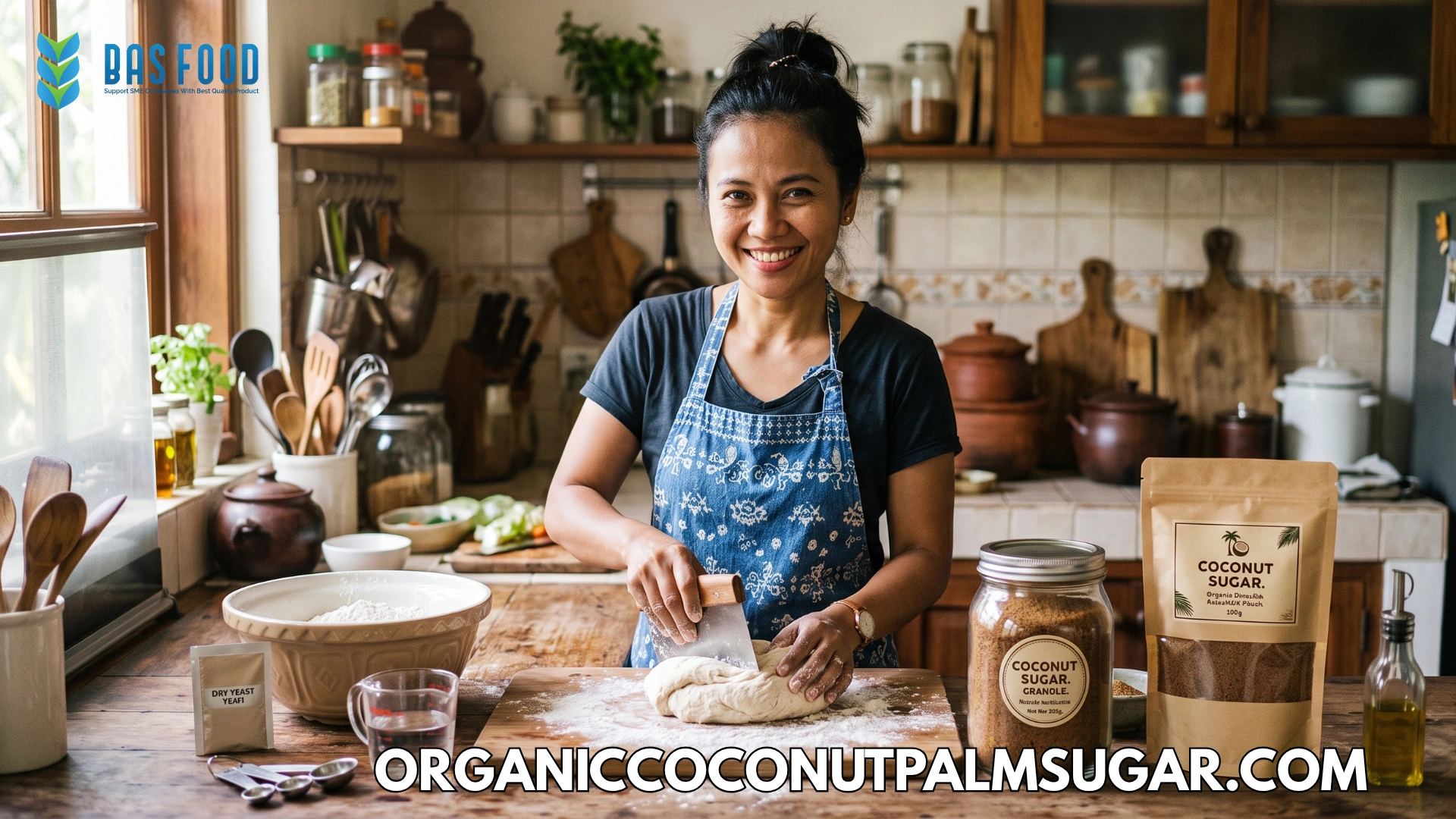
Why Coconut Sugar Granules Are Interesting for Modern Baking
Coconut sugar has a naturally warm flavor that can add more character to baked goods than a highly refined sweetener. Depending on the raw material and processing method, it can offer notes that remind people of caramel, molasses, or toasted sugar. This makes it attractive for recipes where the sweetener contributes not only sweetness but also part of the overall flavor profile.
For bakeries, this can create opportunities to develop products with a more distinctive ingredient identity. Cookies, muffins, cakes, granola bars, brownies, pastries, and other products can use coconut sugar as part of their formulation. However, the result depends heavily on the recipe and the specifications of the coconut sugar being used.
Another advantage is the dry granulated format. Unlike liquid sweeteners, granules are easy to weigh and blend with flour, fat, eggs, cocoa, spices, and other dry ingredients. This can make them practical for bakeries that already use dry sugar in their production lines.
Still, coconut sugar should not automatically be treated as a one-to-one replacement for refined white sugar. It has its own color, flavor, moisture behavior, and particle characteristics. Therefore, commercial bakers should conduct trials before changing a large production formula.
Understanding Coconut Sugar Granules Before You Buy
The first step in purchasing coconut sugar granules for bake is understanding what the product actually contains and how it has been processed. Coconut sugar is made from coconut palm sap, which is collected and heated until it becomes concentrated. The concentrated sugar can then be dried, processed, and screened into granules.
The final appearance can vary. Some coconut sugar has a relatively fine texture, while other products contain larger granules. Color can also range from lighter golden brown to deeper brown. These differences do not automatically mean that one product is better than another. Instead, they show why buyers need clear product specifications.
For industrial baking, consistency matters. A bakery may need the same particle characteristics from one shipment to the next because changes can affect mixing, dissolution, browning, and finished-product appearance. A supplier should therefore be able to explain its specifications and quality control process.
Buyers should also ask about moisture content and packaging. Coconut sugar can interact with moisture from the surrounding environment. If the product absorbs too much moisture during storage or transport, granules can become less free-flowing and may form lumps. Good packaging and proper warehouse conditions are therefore important parts of the purchasing decision.
The Role of Sugar Particle Size in Bakery Applications
One of the most important considerations when purchasing coconut sugar granules for bake is sugar particle size. Particle size describes how large or small the individual sugar particles are. In practical terms, it influences how the sugar behaves during mixing and processing.
Fine granules generally disperse quickly through a mixture. They may be useful when a recipe requires relatively fast integration with other ingredients. Coarser granules, on the other hand, may behave differently during mixing and may take longer to dissolve when moisture is limited.
For example, a cookie manufacturer may evaluate how coconut sugar distributes through flour and fat. A cake manufacturer may focus more on how the sugar interacts with liquid ingredients during mixing. Meanwhile, a granola producer may care about how the granules contribute to surface color, texture, or clustering.
This is why buyers should not select granules based only on the word “fine” or “coarse.” Ask for measurable specifications where possible. A supplier should be able to discuss its available granule grades and explain which options are commonly used for different bakery applications.
Particle size also affects handling. Consistent granules can help automated weighing and dosing systems operate more predictably. When particle size varies widely, however, the product may behave differently during transportation, feeding, and mixing. For large-scale bakeries, this can become an important operational issue.
How Coconut Sugar Performs in Cookies, Cakes, and Bread
Cookies are one of the most natural applications for coconut sugar granules for bake. The sugar’s darker color and characteristic flavor can contribute to the appearance and taste of cookies. Depending on the recipe, it can work particularly well with ingredients such as chocolate, cocoa, cinnamon, nuts, oats, and spices.
However, replacing another sugar with coconut sugar may change the finished cookie. The dough can develop a different color, aroma, and texture. The baker may need to adjust other ingredients to achieve the desired spread, crispness, softness, or chewiness. Commercial bakeries should therefore run controlled trials instead of assuming that a direct substitution will produce identical results.
Cakes provide another interesting application. In cakes, the sweetener interacts with flour, eggs, fat, liquid, and leavening agents. Because coconut sugar has its own color and flavor, it can influence the final appearance and taste of the cake.
Bread and other yeast-based products can also use coconut sugar as part of their formulation. In these applications, the baker needs to consider the overall recipe rather than looking at sweetness alone. The type of flour, hydration, fermentation process, yeast level, fat, and baking conditions all influence the final result.
For manufacturers, the key lesson is simple: coconut sugar granules for baking should be evaluated as a functional ingredient within a complete formulation. A good trial should measure not only sweetness but also dough behavior, mixing performance, color, aroma, texture, and finished-product stability.
Flavor Matters: More Than Just Sweetness
One reason brands explore coconut sugar is its distinctive flavor. Depending on processing and product characteristics, coconut sugar can provide a warm, brown-sugar-like taste with caramel-style notes. This can work well in bakery products that already use rich or toasted flavors.
For example, coconut sugar may complement chocolate cookies, spiced cakes, banana-based baked goods, oatmeal products, nut-based bars, and certain pastry formulations. Its flavor can become part of the product’s identity rather than simply serving as a source of sweetness.
At the same time, flavor consistency matters for commercial production. If one shipment tastes noticeably different from another, customers may notice changes in the finished product. Therefore, bakery manufacturers should discuss flavor expectations with their supplier before entering a long-term supply agreement.
A supplier evaluation should include questions about raw material sourcing, processing, quality checks, storage, and batch consistency. Buyers can also request samples before placing a larger order. Sampling allows the bakery’s technical team to test the ingredient in its own formula.
This approach is especially useful when developing a new product. A laboratory sample may perform differently from another supplier’s material even when both products are labeled coconut sugar. Testing gives the buyer a practical basis for making a sourcing decision.
Moisture and Handling: The Hidden Part of Sugar Quality
Moisture is a major consideration when handling dry sugar products. Coconut sugar can absorb moisture from the environment, especially when exposed to humid conditions or inadequate packaging. This behavior can affect the physical condition of the granules during storage.
When granules absorb moisture, they may become sticky or begin to clump. For a bakery, this can create problems during weighing, conveying, dosing, and mixing. Therefore, coconut sugar granules for baking should be stored in a clean, dry environment with suitable packaging protection.
Bulk buyers should also consider the entire logistics chain. A product may leave the supplier in good condition but encounter humid conditions during transportation, port handling, warehousing, or local distribution. Packaging therefore plays an important role in protecting the product.
Warehouse management matters too. Keep sugar away from water sources, condensation, direct exposure to humid air, and damaged packaging. Once a package is opened, resealing it properly can help reduce unnecessary moisture exposure.
For industrial buyers, these practices can support better product consistency. The goal is not simply to purchase good-quality coconut sugar but also to preserve that quality until the ingredient reaches the production line.
Choosing the Right Specification for Your Bakery
Every bakery has different requirements. A small artisan bakery may prioritize flavor and appearance, while a large food manufacturer may place greater emphasis on particle size, supply consistency, packaging, documentation, and production capacity.
Before purchasing, create a simple specification sheet. It can include product form, color range, granule size, moisture requirement, flavor profile, packaging format, net weight, shelf-life expectations, and required documentation. This gives both the buyer and supplier a clear reference.
The next step is to test the product. Ask for samples and use them in your actual recipe. Compare the results with your current sweetener. Check mixing behavior, dough or batter consistency, baking performance, finished color, aroma, taste, and texture.
It is also useful to test more than one batch when possible. A single sample can show how the product performs at one point in time, but commercial buyers need confidence that future shipments will remain within the agreed specification.
A reliable supplier should be comfortable discussing these details. Clear communication before the first purchase can prevent misunderstandings later.
Why Supplier Experience Matters for International Bakery Buyers
When purchasing coconut sugar granules for baking internationally, buyers should evaluate the supplier as a long-term business partner rather than only as a source of raw materials.
An experienced exporter should understand the practical needs of international shipments. These can include packaging strength, labeling, product documentation, shipment planning, and communication with overseas buyers.
For companies sourcing from Indonesia, CV Bonafide Anugerah Sentosa can be considered as one potential supplier to evaluate. The company works with coconut-derived products, including coconut sugar, and serves B2B sourcing requirements.
Buyers should still perform their own due diligence. Request product information, samples, specifications, packaging details, and relevant documentation before making a purchasing commitment. A professional supplier relationship should be based on clear specifications and realistic expectations on both sides.
For businesses that also purchase other coconut or palm-based sweeteners, working with a supplier that understands multiple product categories can be useful. In addition to coconut sugar, buyers may also encounter related requirements for palm sugar products and other coconut-derived ingredients.
Coconut Sugar Granules and the Future of Bakery Product Development
The bakery industry continues to evolve as brands experiment with new ingredients, flavors, formats, and product stories. This creates opportunities for ingredients such as coconut sugar to move beyond traditional uses.
However, successful product development requires more than following an ingredient trend. Manufacturers need to understand how an ingredient behaves in a real production environment. That means testing its physical properties, flavor, color, particle size, moisture behavior, and interaction with other ingredients.
For this reason, coconut sugar granules for baking are best viewed as a formulation ingredient rather than a simple replacement for conventional sugar. The strongest applications are likely to come from products where the ingredient’s natural color and characteristic flavor fit the product concept.
Food manufacturers can also explore different granule sizes for different applications. A finer product may suit certain doughs or dry mixes, while a larger granule may offer different handling or visual characteristics. The right choice depends on the production process.
As bakery brands continue to develop distinctive products, ingredient sourcing will remain an important part of product strategy. A consistent supplier can support that process by providing clear specifications and dependable communication.
Building a Reliable Coconut Sugar Supply Chain
A successful coconut sugar purchasing strategy combines product quality, supplier reliability, logistics, and communication. Price is important, but it should be considered alongside the total cost and operational risk.
For example, a slightly lower-priced product may not be a good choice if it arrives with inconsistent granules or packaging problems. On the other hand, a supplier that provides clear specifications, stable quality, suitable packaging, and dependable communication may create greater value over the long term.
This is especially important for manufacturers producing products at scale. When a recipe becomes part of a regular production schedule, ingredient consistency becomes closely linked to finished-product consistency.
Therefore, buyers should establish clear specifications before entering a recurring supply arrangement. Discuss acceptable ranges, packaging, shipment quantities, quality documentation, and sample approval procedures.
A long-term relationship also gives both sides a chance to improve. As purchasing volumes grow, buyers and suppliers can discuss packaging changes, product grades, production planning, and other requirements.
Final Thoughts: Turning Coconut Sugar Into a Bakery Advantage
The growing interest in alternative sweeteners gives bakery manufacturers more room to create distinctive products. Coconut sugar granules for bake can provide sweetness while also contributing a naturally warm color and characteristic flavor to cookies, cakes, bread, bars, and other baked products.
However, the best results come from careful selection. Granule size, moisture, color, aroma, packaging, and batch consistency all deserve attention. A buyer should test the ingredient in an actual formulation before moving to large-volume procurement.
For B2B buyers, supplier selection is equally important. Look for a partner that can communicate clearly, provide product information, support sampling, understand export requirements, and maintain consistent specifications.
CV Bonafide Anugerah Sentosa is one Indonesian supplier that businesses can evaluate when looking for coconut-based sweetener products. As with any international sourcing decision, buyers should review samples, specifications, documentation, packaging, and commercial terms before placing an order.
Ultimately, successful coconut sugar sourcing is about matching the right ingredient to the right application. When product specifications, bakery formulation, storage, and supply planning work together, coconut sugar can become more than an alternative sweetener. It can become a useful ingredient for creating bakery products with a distinctive taste and ingredient story.