When buying coconut sugar in bulk, many buyers focus on price, packaging, origin, and certifications. However, one technical detail deserves just as much attention: coconut sugar granule size. Granule size can affect how coconut sugar flows, dissolves, blends, packs, and performs in different food applications. A beverage manufacturer, bakery, confectionery producer, and retail brand may all need coconut sugar, but they may not need the same particle size.
That is why understanding granule size, particle size, and coconut sugar mesh can make the sourcing process much easier. Instead of simply asking for coconut sugar, B2B buyers can define a more precise product specification that matches their production needs.
This guide explains what coconut sugar granule size means, how mesh relates to particle size, why consistency matters, and what buyers should discuss with a coconut sugar supplier before placing a bulk order.
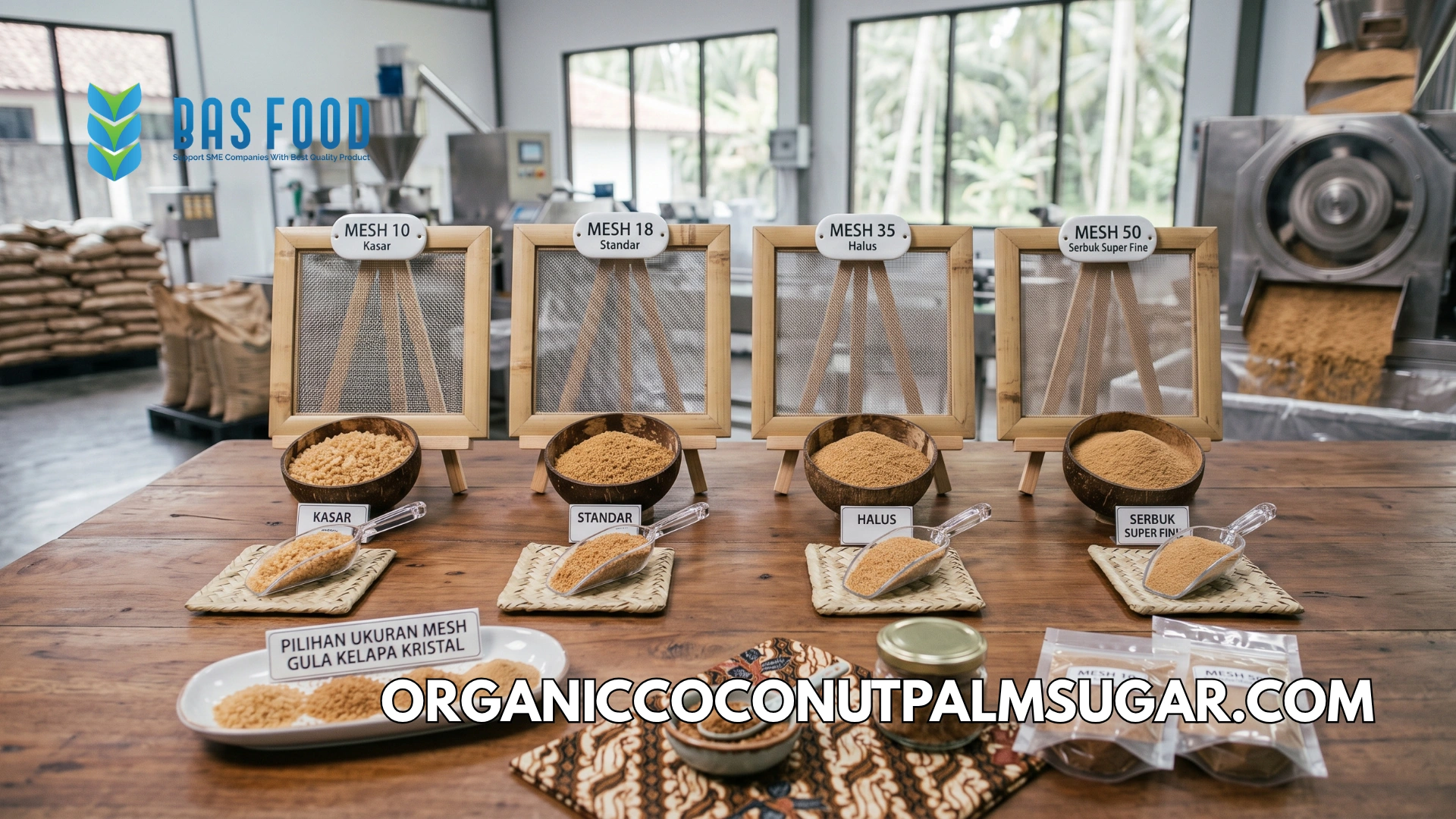
What Is Coconut Sugar Granule Size?
Coconut sugar granule size refers to the size of individual particles found in granulated coconut sugar. Unlike moulded coconut sugar, which comes in blocks or other shapes, granulated coconut sugar consists of many small particles that can flow more freely.
The particles can vary from relatively fine to larger granules. The exact range depends on the production process, grinding or granulation method, screening system, and product specification used by the supplier.
For B2B buyers, granule size is important because it can influence how the sugar behaves during manufacturing. Smaller particles may mix differently from larger particles. They may also behave differently when added to beverages, bakery formulations, dry mixes, or other food products.
Therefore, granule size should not be treated as a simple visual characteristic. It is a technical specification that can influence product performance.
Why Size Matters to Buyers
Imagine a beverage manufacturer using coconut sugar in an instant drink mix. The company may want particles that disperse and dissolve efficiently. Meanwhile, a bakery may need a different particle profile because the sugar must blend with flour, fat, or other ingredients.
Similarly, a food distributor may prefer a standard granule size because its customers already use that specification in their manufacturing processes.
Consequently, the right coconut sugar granule size depends on the end application. There is no universal particle size that is automatically best for every buyer.
Granule Size vs Particle Size: Are They the Same?
The terms granule size and particle size are often used interchangeably when discussing coconut sugar. In practical B2B purchasing, both terms describe the physical dimensions of the individual sugar particles.
However, buyers should understand that a batch does not necessarily contain particles that are all exactly the same size. A commercial product usually has a particle-size distribution, meaning the particles fall within a particular range.
For example, a supplier may describe a product as fine or coarse. These terms provide a general idea, but they may not be precise enough for an industrial buyer with strict processing requirements.
Therefore, professional buyers should ask for a measurable specification when particle size is critical. A supplier may use mesh specifications, screening ranges, or another agreed measurement system.
Why Particle-Size Distribution Matters
Particle-size distribution can influence product consistency. If a batch contains too many very small particles alongside much larger particles, the product may behave differently during mixing, filling, or storage.
For some applications, a relatively narrow particle-size range may be preferred. For others, a broader range may be perfectly acceptable.
The important point is to match the specification with the production process. Buyers should tell the coconut sugar supplier how they plan to use the product rather than choosing a granule size based only on appearance.
Understanding Coconut Sugar Mesh
One of the most common ways buyers discuss particle size is through coconut sugar mesh.
Mesh refers to the screening system used to classify particles according to size. In simple terms, a screen with openings of a particular size allows smaller particles to pass through while retaining larger particles.
This makes mesh useful when discussing the approximate particle-size range of granulated coconut sugar. However, mesh terminology can sometimes create confusion because the relationship between mesh number and actual particle dimensions depends on the screening standard being used.
For that reason, buyers should not rely on the mesh number alone when the specification needs to be precise.
Mesh Number Does Not Tell the Whole Story
A higher mesh number generally indicates a finer screening level because the screen has smaller openings. However, the exact meaning should always be confirmed with the supplier.
For example, two suppliers may use different screening standards or describe their products differently. If an importer simply requests a particular mesh number without confirming the actual particle-size range, misunderstandings can occur.
A better approach is to ask the supplier for both the mesh specification and a clear description of the expected particle-size range where available.
This becomes especially important when coconut sugar is used in automated production. Equipment may be sensitive to particle size, flow behavior, and consistency.
Fine Coconut Sugar Granules: Where Are They Used?
Fine coconut sugar granules contain smaller particles and may be suitable for applications where rapid mixing or a smoother dry ingredient texture is desirable.
For example, fine granules can be considered for beverage mixes, bakery formulations, powdered food products, instant mixes, and some confectionery applications. The exact suitability depends on the formulation and processing equipment.
However, fine does not always mean better. Smaller particles can behave differently during storage and handling. They may also have different flow characteristics compared with larger granules.
Therefore, buyers should evaluate fine coconut sugar based on actual production requirements rather than assuming that a smaller particle automatically delivers better performance.
Fine Granules and Dissolution
When sugar is added to a liquid, particle size can influence how quickly the particles interact with the liquid. Smaller particles have a larger surface area relative to their mass, which can affect the dissolution process.
For beverage manufacturers, this characteristic may be useful. However, dissolution also depends on other factors, including temperature, liquid composition, agitation, and formulation.
As a result, buyers should test the actual coconut sugar in their formulation before committing to a large-volume order.
Coarse Coconut Sugar Granules: When Do They Make Sense?
Coarser coconut sugar particles are larger and can offer different handling and texture characteristics. They may be suitable for products where a more visible sugar structure is acceptable or desirable.
Some food manufacturers may prefer larger granules because they are easier to handle in certain production environments. Others may select them based on the texture they want to achieve in a finished product.
For retail products, granule size can also affect how the sugar looks inside transparent or partially transparent packaging. A brand may intentionally choose a particular appearance to support its product positioning.
Again, the correct coconut sugar granule size depends on the application. Buyers should consider the complete production process rather than choosing fine or coarse granules based on marketing language alone.
How Granule Size Affects Food Manufacturing
Particle size can influence several stages of food manufacturing. During blending, for example, ingredients with significantly different particle sizes may separate more easily under certain conditions.
This can matter when coconut sugar is combined with flour, spices, powdered ingredients, cocoa, or other dry materials. A suitable particle-size profile can help support more consistent blending.
Granule size can also influence feeding and filling equipment. Automated machinery often performs best when the incoming ingredient has predictable physical characteristics.
For that reason, manufacturers should consider particle size when designing their ingredient specifications. The goal is not simply to find coconut sugar that tastes good. The product also needs to work well within the manufacturing process.
Granule Size and Flowability
Flowability refers to how easily a dry material moves under gravity or mechanical handling. Particle size can influence flowability, although it is not the only factor.
Moisture, particle shape, surface characteristics, and the tendency to form lumps can also affect how coconut sugar moves.
Therefore, buyers should evaluate the complete product rather than looking at mesh alone. A consistent granule size combined with suitable moisture and packaging can support better handling.
The Role of Moisture in Coconut Sugar Particle Size
Moisture is closely connected to the handling performance of coconut sugar. Even when the particle size is within specification, excessive moisture can cause particles to stick together.
Once individual particles form lumps, the apparent particle size of the product changes. A fine granule product may no longer behave like a free-flowing powder if moisture causes significant clumping.
This is why B2B buyers should consider both particle size and moisture-related specifications when evaluating coconut sugar.
Proper packaging and storage also matter. Coconut sugar should be protected from excessive humidity and stored according to suitable product-handling guidance.
Why Packaging Matters
Packaging is part of maintaining the product specification. A supplier may produce coconut sugar with a consistent particle size, but poor packaging can allow moisture exposure during storage or transportation.
For international buyers, this issue deserves additional attention because products can spend significant time in warehouses, containers, and distribution facilities.
Consequently, buyers should discuss packaging materials, package size, sealing, storage recommendations, and shipping conditions with their coconut sugar supplier.
How Suppliers Control Coconut Sugar Granule Size
Producing consistent granules requires control at several stages. The producer needs to manage the initial coconut sap processing, drying or concentration, granulation, and screening stages.
Once the sugar reaches the appropriate condition, the producer can process it into particles and separate them according to the required size range.
Screening plays an important role because it helps remove particles that fall outside the desired range. Depending on the production setup, producers may use different equipment and screening methods.
The objective is to create a product that matches the agreed specification as consistently as possible.
Why Consistency Is More Important Than a Perfect Number
A buyer may specify a particular particle size, but commercial production naturally involves some variation. The important question is whether the variation stays within an agreed and practical range.
For repeat B2B orders, consistency between batches is particularly valuable. A manufacturer does not want one shipment to contain fine particles and the next shipment to contain significantly coarser material.
Therefore, buyers should discuss acceptable tolerances with the supplier before ordering.
Coconut Sugar Granule Size and Quality Control
Quality control should cover more than visual inspection. A professional supplier should have a clear way to evaluate whether the finished product meets the agreed specification.
Depending on the buyer’s needs, quality checks may include particle size, moisture, appearance, aroma, taste, cleanliness, packaging condition, and other relevant characteristics.
The exact tests will vary by product and application. Not every buyer needs the same level of testing.
For industrial procurement, however, a documented specification can make quality control much easier. The buyer and supplier can compare the delivered product against the same agreed requirements.
Sampling Before Bulk Orders
A sample is one of the simplest tools available to B2B buyers. It allows the buyer to check whether the product works in the intended application before committing to a larger quantity.
For example, a bakery can test how the granules blend into dough. A beverage manufacturer can test dissolution. A distributor can evaluate packaging and general product appearance.
Once the sample meets expectations, the buyer can use it as a reference for future orders.
Choosing the Right Coconut Sugar Granule Size for Your Product
The best way to select a granule size is to start with the final product.
If the coconut sugar will be used in a beverage, consider dissolution and mixing. it will be used in baking, consider blending and texture. If it will be sold directly to consumers, consider packaging, appearance, and ease of use.
For industrial food production, also consider the machinery involved. Feeding systems, mixers, fillers, and packaging machines can all have different requirements.
By starting with the application, buyers can avoid choosing a specification that looks good on paper but does not work well in production.
A Simple Selection Framework
Before requesting quotations, ask:
- What will the coconut sugar be used for?
- Does the product need fine or larger particles?
- Is fast dissolution important?
- Will the sugar be blended with other dry ingredients?
- Does the manufacturing equipment have particle-size requirements?
- Is consistent flow important?
- What packaging will be used?
- Does the product need a specific coconut sugar mesh?
- What tolerance is acceptable?
These questions can help procurement teams communicate more clearly with suppliers.
Coconut Sugar Supplier: What Should B2B Buyers Check?
A reliable coconut sugar supplier should be able to explain its product specifications clearly. Buyers should not have to guess what “fine,” “medium,” or “coarse” means.
Ask the supplier to provide the relevant technical information and, where appropriate, samples. If mesh is used, clarify the screening standard and expected particle range.
Buyers should also consider production consistency. A supplier may offer an attractive price, but if the particle size varies significantly from batch to batch, the buyer may face problems later.
Communication is therefore an important part of supplier selection. The supplier should understand the buyer’s application and be willing to discuss specifications before production.
Working With CV Bonafide Anugerah Sentosa
For companies exploring Indonesian sourcing options, CV Bonafide Anugerah Sentosa can be considered when evaluating suppliers for coconut sugar products.
As with any B2B sourcing process, buyers should communicate their requirements clearly. Instead of simply requesting a price for coconut sugar, provide information about the desired granule form, particle size, packaging, order volume, application, and destination market.
This approach makes the quotation process more useful because the supplier understands what product is actually required.
For repeat purchases, documenting the agreed specifications can also help maintain consistency. A clear product reference makes future orders easier to manage and reduces the risk of misunderstandings.
Coconut Sugar Granules vs Moulded Coconut Sugar
Coconut sugar is available in different physical forms. Granulated sugar is generally useful for applications where the ingredient needs to be measured, mixed, or incorporated into other products.
Moulded coconut sugar, on the other hand, is formed into blocks, discs, or other shapes. It can be useful for traditional products, retail presentation, foodservice, or applications where the customer prefers a solid form.
This distinction is important because the supplier requirements can be different. A coconut sugar mould supplier needs to manage mould dimensions, block weight, shape, and moulding consistency.
A granule supplier must focus more heavily on particle size, screening, flowability, and related specifications.
Can One Supplier Provide Both?
Some suppliers may offer several product formats. This can be useful for buyers who are developing multiple product lines.
For example, a brand may need granulated coconut sugar for a packaged baking product while also requiring moulded coconut sugar for a traditional retail product.
If multiple formats are required, buyers should ask whether the supplier can maintain consistent quality across each specification.
Conclusion: The Right Granule Size Starts With the Right Specification
Understanding coconut sugar granule size can help B2B buyers make better purchasing decisions. Granule size affects how coconut sugar behaves during handling, blending, dissolution, packaging, and food manufacturing.
The terms particle size and coconut sugar mesh can help buyers communicate their requirements, but they should always be supported by clear specifications and, when necessary, product samples.
Most importantly, buyers should select the granule size based on the final application. Fine granules may work well for some beverage or instant-mix applications, while larger particles may be more suitable for other food products.
A good coconut sugar supplier should be able to discuss these requirements clearly and provide consistent products against an agreed specification. For companies that also need moulded products, working with a supplier or coconut sugar mould supplier that understands different product formats can provide additional flexibility.
For buyers considering CV Bonafide Anugerah Sentosa, the best starting point is a clear sourcing brief covering product form, particle size, packaging, quantity, application, and other commercial requirements.
Ultimately, successful coconut sugar sourcing comes down to one simple principle: choose the specification based on how the product will actually be used. When granule size, quality, packaging, and supplier capability all match the application, buyers can build a more reliable and efficient supply chain.