Coconut sugar granules may look simple, but producing a consistent product requires careful control from the first collection of coconut sap to the final packing stage. For B2B buyers, understanding this process is useful because production methods directly influence color, texture, moisture, solubility, shelf life, and overall product consistency. Unlike refined white sugar, coconut sugar starts with a natural raw material. Producers collect sap from coconut flower stalks and then process it through several stages before turning it into granules. Each stage needs attention because small changes in raw material quality, heating, moisture, or handling can affect the final result.
For importers, food manufacturers, distributors, and private-label brands, learning about coconut sugar granule production can make supplier evaluation much easier. Instead of looking only at price, buyers can understand what happens behind the product and ask better questions about quality, processing, packaging, and supply consistency.
This guide takes a practical look at how coconut sugar granules are produced, what makes the process challenging, and what B2B buyers should consider when choosing a reliable coconut sugar supplier.
What Is Coconut Sugar Granule Production?
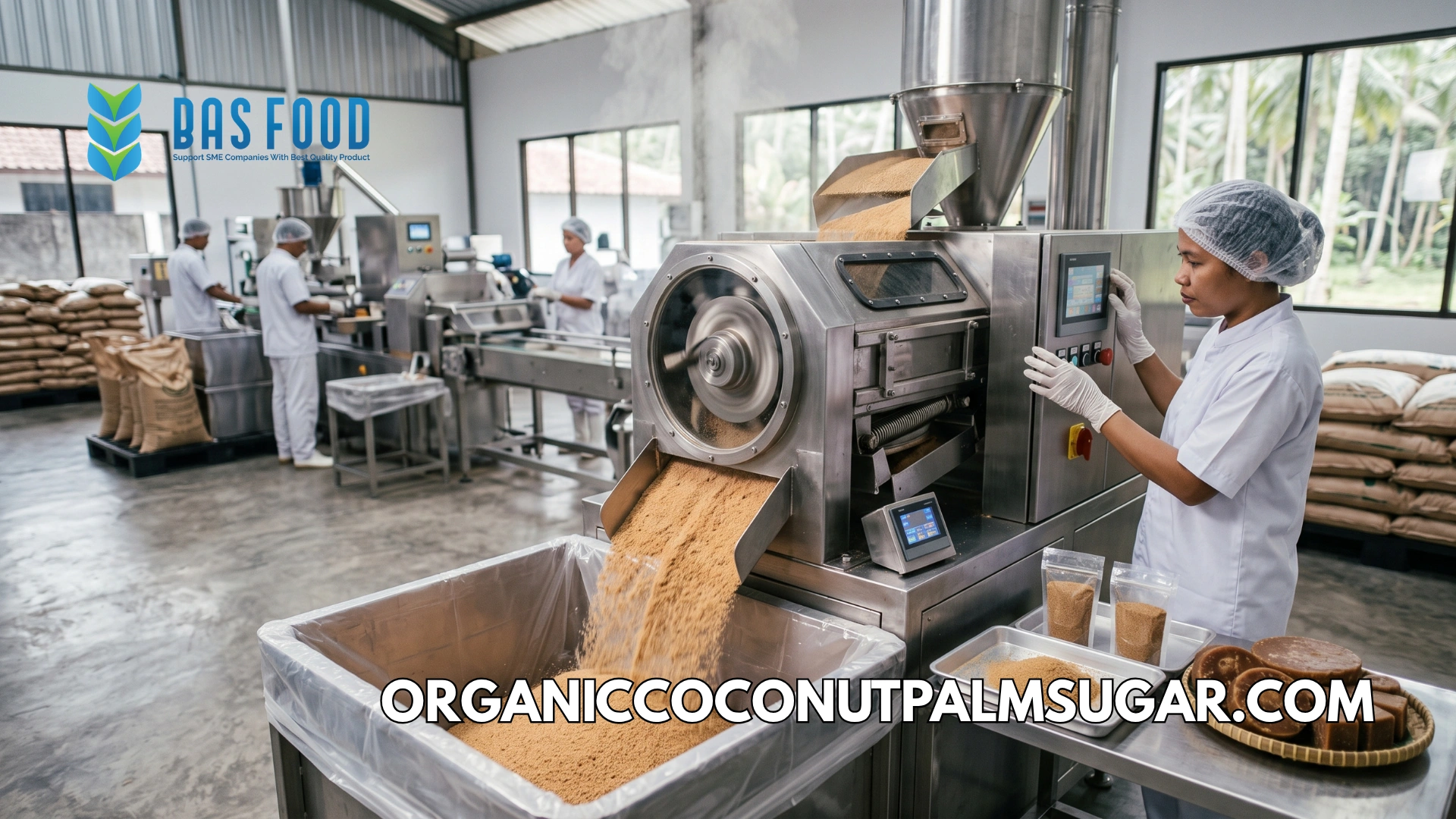
Coconut sugar granule production is the process of converting fresh coconut sap into a dry, free-flowing sugar product with a granular form. The process normally starts with collecting sap from coconut flowers, followed by filtration, heating, concentration, drying or crystallization, granulation, screening, and packaging.
The exact production method can differ between producers. Traditional producers may use simple equipment and hands-on techniques, while larger operations can use more controlled processing systems. However, the basic goal remains the same: reduce the water content of the sap and transform its natural sugars into a stable product that can be handled, packed, stored, and transported.
This process requires more attention than simply heating the sap until it becomes thick. If producers apply too much heat, the sugar can become overly dark or develop an unwanted burnt taste. If the product retains too much moisture, it may become sticky or form lumps during storage.
Therefore, good coconut sugar processing is about balance. Producers need to manage raw material quality, heat, time, moisture, texture, and handling throughout the production chain.
It All Starts With Fresh Coconut Sap
The first major step in coconut sugar production is collecting coconut sap. The sap comes from the flower stalk of the coconut palm rather than directly from the coconut fruit.
Farmers carefully collect the sap using traditional tapping practices. The collection process requires regular attention because fresh sap can naturally change over time. Once collected, it should be handled properly and moved into processing as soon as practical.
The quality of the raw sap matters because it becomes the foundation of the final product. Factors such as freshness, cleanliness, collection practices, and handling conditions can influence subsequent processing.
For this reason, a reliable supply chain starts at the farm level. A producer cannot completely correct poor raw material quality later in the production process. Good sourcing and proper sap handling therefore form an important part of consistent coconut sugar production.
Why Sap Freshness Matters
Fresh coconut sap contains natural sugars and water. After collection, its characteristics can change if it is left for too long under unsuitable conditions. This can affect the way the sap behaves during heating and concentration.
For B2B buyers, this is an important point when evaluating a supplier. A supplier that pays attention to raw material collection and handling is better positioned to maintain consistent production.
Buyers do not necessarily need to understand every farming detail, but they should know where their product comes from and how the supplier manages the raw material before processing.
Filtering and Preparing the Coconut Sap
After collection, the sap is normally filtered to remove visible foreign particles. This step helps prepare the raw material for further processing.
Proper handling at this stage is important because the production process cannot depend entirely on later filtration. Clean collection containers, suitable handling practices, and good production hygiene all contribute to the overall quality system.
Once prepared, the sap moves into the heating and concentration stage. This is where the liquid begins to lose water and become increasingly concentrated.
Although filtering may seem like a basic step, it is an important part of professional coconut sugar processing. B2B buyers should remember that finished product quality depends on many small steps rather than one single processing technique.
Heating: Turning Liquid Sap Into Concentrated Sugar
Heating is one of the most important stages in coconut sugar granule production. The objective is to remove water from the coconut sap while developing the desired texture and flavor.
As the sap heats, water gradually evaporates and the sugar concentration increases. The liquid becomes thicker and eventually reaches a stage where it can be transformed into the desired coconut sugar product.
Temperature and heating time need to be managed carefully. Excessive heating can affect color, flavor, and other characteristics. On the other hand, insufficient concentration can leave too much moisture in the product.
Therefore, experienced producers pay close attention to the condition of the material during processing. The goal is not simply to produce a darker or thicker syrup. The goal is to create a stable intermediate product that can move into the next stage effectively.
Why Heat Control Matters
Heat control is particularly important for buyers who need consistent batches. If the processing conditions change significantly from one production run to another, the final sugar may also show differences in color, texture, or moisture.
This is why quality control should be part of the production process rather than something performed only after manufacturing.
A professional coconut sugar supplier should understand that consistency is essential for commercial buyers. Food manufacturers need ingredients that behave predictably in their own production systems.
From Concentrated Sap to Coconut Sugar
Once the sap reaches the appropriate concentration, the producer continues the process until the material can form the desired sugar structure.
At this stage, traditional and modern production methods may differ. Some producers rely heavily on traditional cooking and manual processing, while others use equipment designed to improve process control and consistency.
The objective is to move from a concentrated sugar mass toward a dry product that can eventually be broken down into granules.
The transformation requires careful handling because the material can become hard or sticky depending on its moisture and temperature. Producers need to control the process so that the resulting sugar can be processed into a suitable granular form.
How Coconut Sugar Becomes Granules
The granulation stage gives coconut sugar its familiar free-flowing appearance. After the concentrated sugar has reached the appropriate condition, producers process it into smaller particles.
The size of the granules can vary according to the intended application. Fine granules may work well for certain beverages, baking products, and instant mixes. Larger granules may be preferred for applications where a more visible sugar texture is useful.
Granule consistency is important for B2B applications. A food manufacturer may need a particular particle size because it affects blending, dissolution, filling, or processing speed.
For this reason, coconut sugar granule production is not simply about making the sugar smaller. It also involves controlling particle size and separating material into a more consistent range.
Screening and Particle Size
Screening can help separate granules according to size. This gives the producer greater control over the final product specification.
For buyers, particle size should be discussed before placing a large order. Terms such as fine, medium, or coarse can have different meanings between suppliers. When accuracy matters, buyers should request measurable specifications or a physical sample.
A clear specification helps both sides avoid misunderstandings. It also makes repeat orders easier because the buyer has an established reference.
Why Moisture Control Is Critical
Moisture is one of the key considerations in coconut sugar processing. Coconut sugar granules need suitable moisture control because excessive moisture can affect flowability, texture, storage stability, and packaging performance.
When granules absorb moisture from their surroundings, they can become sticky. Over time, particles may begin to clump together. This can create problems for manufacturers that use automated filling or blending equipment.
Therefore, moisture control should continue after production. The way sugar is cooled, handled, packed, stored, and transported can all influence its condition.
For international buyers, this becomes even more important because products may travel long distances and pass through different environmental conditions. Suitable packaging and storage practices help protect the product during the supply chain.
Quality Control During Coconut Sugar Production
Quality control should not happen only when the finished product is ready to ship. Instead, producers should monitor important characteristics throughout the production process.
Raw material handling, filtration, heating, concentration, granulation, screening, cooling, and packaging can each affect the final product. Monitoring these stages helps identify potential problems before they become larger production issues.
For B2B buyers, this means supplier evaluation should go beyond asking, “What is your price per kilogram?” A better conversation includes questions about product specifications, batch consistency, packaging, sampling, and quality control.
Buyers can also request product samples before confirming larger orders. A sample allows them to evaluate the product in their own application and compare it with their required specification.
What Buyers Can Check
Depending on the application, buyers may evaluate:
- Granule size and consistency
- Color and appearance
- Aroma
- Taste
- Texture
- Flowability
- Moisture-related behavior
- Packaging condition
- Foreign material control
- Batch-to-batch consistency
The exact specification should depend on the buyer’s application and market requirements. A bakery, beverage manufacturer, retail brand, and ingredient distributor may have different priorities.
Coconut Sugar Granule Production for Food Manufacturers
Coconut sugar granules are used in a wide range of food and beverage applications. Manufacturers may use them in bakery products, beverages, sauces, desserts, snack products, instant mixes, and other formulations.
The granular form can make the ingredient easier to weigh, blend, and distribute through a production process. However, the ideal granule size depends on the product formulation.
For example, a beverage manufacturer may prioritize dissolution and particle consistency. A bakery manufacturer may focus on blending and flavor contribution. A retail brand may care more about appearance and consumer-friendly packaging.
This is why B2B buyers should communicate the intended application to their coconut sugar supplier. When the supplier understands the end use, discussions about granule size, packaging, and product specifications become more practical.
Granule Size and Industrial Applications
Particle size can influence how coconut sugar behaves during manufacturing. Smaller particles generally provide more surface area, which can influence how quickly the sugar interacts with liquids or other ingredients.
However, smaller does not automatically mean better. Some applications may benefit from larger particles because they provide a particular texture or handling characteristic.
For industrial buyers, consistency often matters more than simply choosing the smallest available granule. A stable particle-size range can help manufacturers achieve predictable results during mixing and filling.
Therefore, procurement teams should define their desired granule specification before requesting quotations. If the specification is unclear, the supplier may provide a product that is commercially correct but technically unsuitable for the buyer’s process.
Traditional Production and Modern Processing
Coconut sugar production has strong traditional roots. In many producing regions, farmers and small producers have developed techniques for collecting and cooking coconut sap over generations.
Traditional methods remain important because they preserve established production practices and local knowledge. At the same time, commercial B2B supply often requires additional attention to consistency, hygiene, documentation, packaging, and production planning.
Modern processing equipment can help producers control certain stages more precisely. However, equipment alone does not guarantee a good product. The raw material, process knowledge, quality controls, and people operating the system remain important.
The strongest approach is often to combine practical production experience with suitable process controls. This can help producers maintain the characteristics buyers expect while meeting the consistency required for commercial supply.
Choosing the Right Coconut Sugar Supplier
Selecting a coconut sugar supplier should involve several factors. Price is important, but it should be considered alongside product quality, consistency, communication, packaging, lead time, and supply capability.
Start by reviewing the supplier’s product specification. Does it clearly explain the product form, granule characteristics, packaging, and other important details? If the information is vague, ask for clarification before moving forward.
Next, request samples where appropriate. A sample gives the buyer a chance to compare the actual product against the required specification.
It is also useful to discuss production capacity and repeat-order consistency. B2B buyers often need regular supply rather than a one-time shipment. A supplier should therefore be evaluated for long-term reliability.
Why the Supplier’s Other Product Capabilities Matter
Some buyers need more than one coconut sugar format. For example, a brand may sell granulated coconut sugar while also developing traditional moulded products.
In this situation, it can be useful to work with a supplier that understands different product forms. A coconut sugar mould supplier may focus on blocks and moulded formats, while a granule producer focuses on particle size and free-flowing sugar.
Having a supplier that understands both formats can simplify product development discussions. Buyers can compare moulded and granulated products based on their market requirements.
This is also useful for companies developing multiple product lines. One product may use coconut sugar granules, while another may use a moulded format for traditional retail presentation.
Working With CV Bonafide Anugerah Sentosa
For B2B buyers researching Indonesian suppliers, CV Bonafide Anugerah Sentosa can be part of the supplier evaluation process when sourcing coconut sugar and related products.
When starting a sourcing discussion, buyers can provide practical information about their requirements. This may include the desired product format, granule size, packaging, order volume, target market, and intended application.
Clear information helps create a more productive discussion. Instead of comparing suppliers only by price, buyers can compare them according to how closely their products and services match the actual purchasing requirement.
For repeat business, documented specifications are especially useful. Once the buyer and supplier agree on the product requirements, those details can become a reference for future orders.
Packaging and Storage After Production
The production process does not end when the granules are finished. Packaging plays an important role in protecting the product from moisture, contamination, physical damage, and unsuitable storage conditions.
The appropriate packaging depends on the buyer’s market and distribution model. Bulk industrial buyers may need large bags or other commercial formats, while retail brands may require smaller consumer-ready packaging.
Storage conditions also matter. Coconut sugar should be protected from excessive moisture and stored in suitable conditions according to the supplier’s product guidance.
For international shipments, packaging should also be suitable for transportation and handling. Buyers should discuss packaging specifications before production rather than treating packaging as an afterthought.
Conclusion: Good Granules Begin With Good Production
Coconut sugar granule production is a step-by-step process that starts with coconut sap and ends with a carefully processed granular sweetener. Every stage matters, from raw material collection and filtration to heating, concentration, granulation, screening, packaging, and storage.
For buyers, understanding the process provides a practical advantage. It makes it easier to evaluate suppliers, define product specifications, compare samples, and identify the factors that can affect consistency.
Whether you are a food manufacturer, importer, distributor, retailer, or private-label brand, start with your actual application. Then define the granule size, packaging, quality requirements, order volume, and documentation you need.
Finally, choose a coconut sugar supplier that can communicate clearly and work with your specifications. A reliable supply relationship is built on more than a competitive price. It depends on consistent products, clear expectations, practical communication, and the ability to support future orders.
When these elements come together, coconut sugar granules can become a dependable ingredient for a wide range of food and beverage products.