Coconut sugar may look simple, but its physical specifications can make a big difference in food production. One of the most important specifications for buyers is coconut sugar mesh. Mesh helps buyers understand the approximate particle size of granulated coconut sugar and determine whether the product fits their manufacturing process.
For B2B buyers, choosing the right mesh is not only about appearance. It can affect dissolving speed, blending, filling, packaging, handling, and the final texture of a food product. Therefore, importers, distributors, food manufacturers, and ingredient buyers should understand mesh size, particle distribution, and the difference between fine granules and coarse granules before placing a bulk order.
In this guide, we explain coconut sugar mesh in simple terms. We also discuss how mesh relates to particle size, how suppliers control particle distribution, what buyers should include in a specification sheet, and how to select a reliable coconut sugar supplier for international sourcing.
What Is Coconut Sugar Mesh?
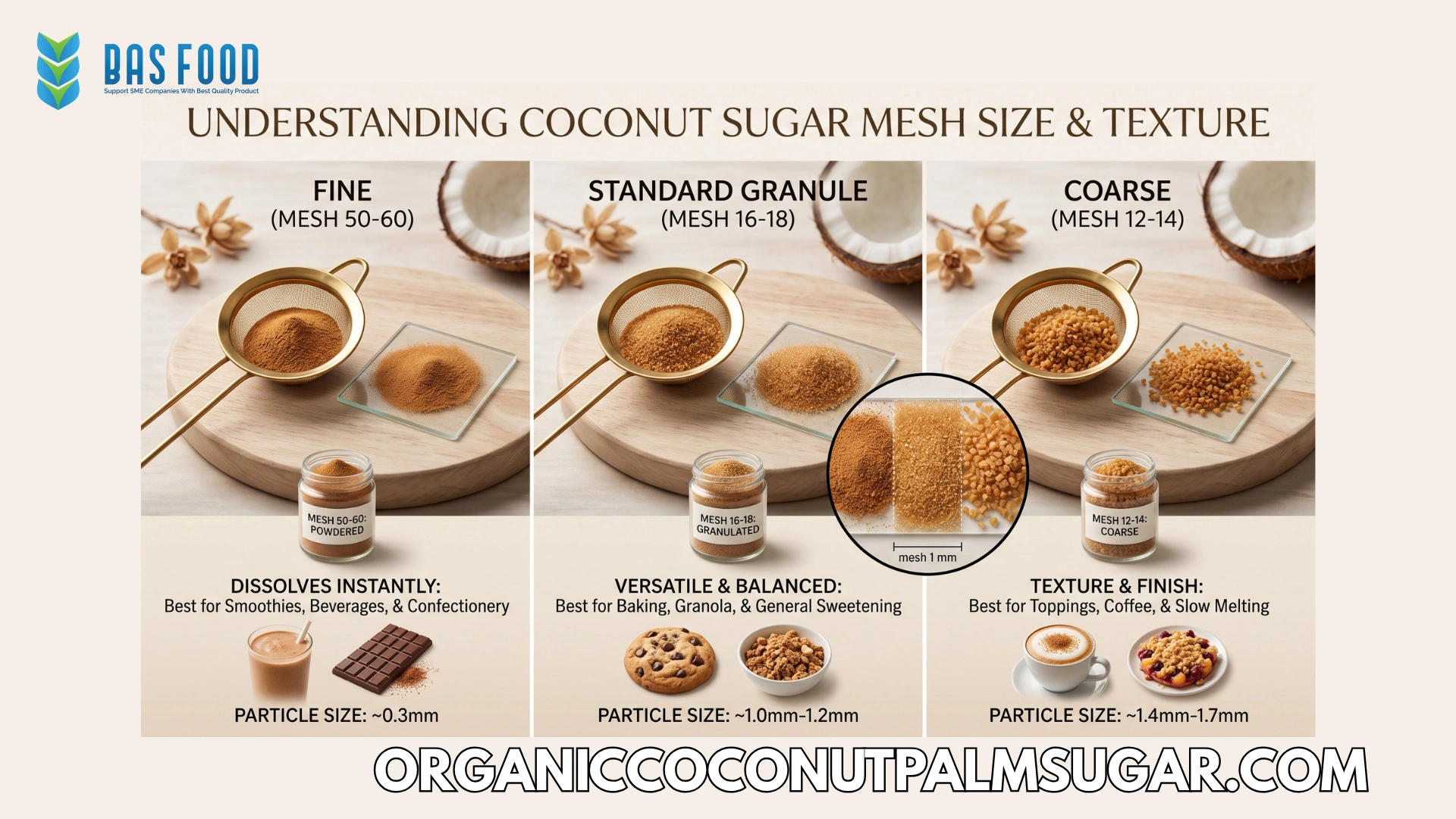
Coconut sugar mesh refers to a grading system used to describe the particle size of granulated coconut sugar. In simple terms, mesh indicates how large or small the particles are after the sugar has been processed and screened.
A mesh screen contains openings through which particles pass. A product described with a certain mesh specification has been screened according to that opening size. However, buyers should remember that mesh numbers are not always a direct measurement of particle diameter in millimeters. The actual specification can vary depending on the screening standard and the supplier’s process.
For this reason, professional buyers should not rely on the mesh number alone. Instead, they should ask for the complete product specification, including particle size range, sieve analysis, moisture, color, packaging, and other relevant quality parameters.
This approach gives buyers a clearer picture of what they will receive. It also helps prevent misunderstandings when comparing coconut sugar from different suppliers.
Why Coconut Sugar Mesh Matters for B2B Buyers
When purchasing coconut sugar for industrial use, consistency is extremely important. A food manufacturer may need a particular particle distribution so the ingredient behaves consistently during mixing, baking, beverage production, or other processes.
For example, fine granules may blend quickly into dry mixes. They can also be useful when a manufacturer wants a relatively smooth distribution of sweetener throughout a formulation. On the other hand, coarse granules can provide a different physical texture and may be preferred for certain applications.
Therefore, the correct coconut sugar mesh depends on the final application. A buyer producing instant beverage mixes may have different requirements from a bakery, chocolate manufacturer, foodservice distributor, or retail brand.
Mesh can also affect packaging and handling. Very fine particles may behave differently from larger particles during filling, transportation, and storage. As a result, particle size should be considered together with moisture control and packaging specifications.
Understanding Mesh Size and Particle Size
One common mistake is assuming that mesh size and particle size are exactly the same thing. They are closely related, but they describe different aspects of screening.
Mesh size generally refers to the number or classification associated with a screen. Particle size refers more directly to the dimensions of the individual particles. A screening specification can therefore provide information about which particles pass through a particular screen.
For B2B procurement, the most useful information is often the expected particle-size distribution rather than one mesh number by itself. A supplier may provide a specification showing the percentage of product retained on or passing through different screens.
This is where particle distribution becomes important. Two coconut sugar products can have similar average particle sizes but behave differently if their particle distributions are not the same.
What Is Particle Distribution?
Particle distribution describes how the particles in a batch are spread across different size ranges. A consistent product usually has a controlled distribution that matches the buyer’s agreed specification.
For example, a buyer may want a product dominated by medium-sized granules with limited amounts of very fine particles. Another buyer may specifically require a finer grade.
In both cases, the supplier should control the screening process and verify the finished product against the agreed specification.
For large-volume purchasing, buyers should ask whether the supplier can maintain consistent particle distribution from one shipment to another. This is particularly important for manufacturers that need predictable processing performance.
Fine Granules vs. Coarse Granules
The difference between fine granules and coarse granules is one of the most practical considerations when buying coconut sugar.
Fine granules have smaller particles and generally offer a more powder-like or fine-grained appearance. Depending on the actual specification, they may disperse and dissolve more easily than larger particles. This can make them suitable for applications where rapid blending or a relatively uniform texture is important.
Coarse granules contain larger particles. They may provide more visible grain and can be useful in applications where the physical structure of the sweetener matters. However, larger particles may require more time to dissolve or blend depending on the formulation and processing conditions.
Neither grade is automatically better. The right option depends on the product being manufactured.
Applications for Fine Granules
Fine coconut sugar can be considered for products where quick mixing and smooth distribution are priorities. Potential applications include bakery mixes, beverage formulations, dry blends, sauces, and other food products.
However, the final suitability should always be tested in the buyer’s own formulation. Processing conditions, liquid temperature, fat content, mixing time, and other ingredients can influence how coconut sugar behaves.
Applications for Coarse Granules
Coarse coconut sugar can be useful when manufacturers want a more noticeable granulated texture. It can also work well in selected bakery, foodservice, and culinary applications.
For example, a food manufacturer may select a larger granule size when the visual or physical character of the sweetener is part of the finished product experience.
Again, the best grade depends on the intended application rather than simply choosing the smallest or largest particle size available.
How Coconut Sugar Is Screened
After coconut sugar is produced and processed, the material can be screened to separate particles according to size. Screening helps the supplier create more consistent grades for different customers.
The exact production process can differ between manufacturers. However, the basic objective remains similar: control the physical size of the granules and remove unwanted oversized or undersized particles according to the agreed specification.
Good process control is important because inconsistent screening can create variation within a shipment. A buyer might receive a product that contains too many fine particles, oversized pieces, or an inconsistent mixture.
For this reason, a professional coconut sugar supplier should have a clear quality-control process for particle size. Buyers should also understand how the supplier checks the finished product before packing.
Coconut Sugar Mesh and Quality Control
Mesh should not be viewed as an isolated quality parameter. It is one part of a broader product specification.
A B2B coconut sugar specification may include particle size, moisture, color, taste, aroma, foreign matter control, microbiological requirements, packaging, and other parameters depending on the buyer’s needs and destination market.
This wider approach is important because a product can meet a particular mesh specification while still requiring attention to other quality characteristics.
For example, moisture can influence the physical behavior of granulated sugar during storage. Packaging can also affect protection against humidity and external contamination. Therefore, buyers should evaluate the complete quality system rather than focusing only on mesh.
Why Consistency Matters
Imagine a manufacturer that receives one shipment with mostly fine granules and another shipment with significantly more coarse particles. Even if both shipments are technically described using a similar product name, the difference could affect production.
Consistent particle distribution helps manufacturers plan their processes with greater confidence. It can also reduce the need for repeated adjustments to production settings.
That is why a buyer should agree on specifications before ordering rather than simply asking for “granulated coconut sugar.”
Choosing the Right Coconut Sugar Mesh for Your Application
The best mesh depends on how the coconut sugar will be used. There is no universal mesh that works perfectly for every food product.
For dry beverage mixes, buyers may prefer a grade that blends efficiently. In bakery products, particle size may depend on the recipe and mixing method. For foodservice applications, handling and appearance may be more important.
Retail brands may also have different requirements. A brand selling coconut sugar directly to consumers may focus on appearance, flowability, packaging, and consumer expectations.
Meanwhile, an industrial food manufacturer may focus more heavily on process performance and consistency.
Therefore, buyers should define the finished-product requirement first and then work backward to determine the appropriate coconut sugar specification.
Coconut Sugar Mesh for Export and International Procurement
International buyers need to think beyond the product itself. Export sourcing also involves packaging, documentation, logistics, storage, and communication between buyer and supplier.
A clear product specification helps reduce the risk of receiving a shipment that does not match production requirements. It also creates a reference point for quality checks before shipment and, where applicable, upon arrival.
For importers, distributors, and food manufacturers, it is useful to establish the specification before discussing large-volume purchasing. Sample approval can also provide a practical way to confirm particle appearance and performance.
This is particularly valuable when buyers are comparing suppliers from different origins. Instead of comparing supplier descriptions alone, buyers can compare documented specifications and samples against their own requirements.
Working With a Reliable Coconut Sugar Supplier
Finding a suitable coconut sugar supplier involves more than comparing prices. A low price does not automatically mean a better sourcing decision.
Buyers should evaluate production consistency, quality control, communication, packaging capability, export experience, and the supplier’s ability to follow agreed specifications.
Ask practical questions before placing a large order.
Clear answers to these questions can help buyers build a more reliable supply chain.
The Role of a Coconut Sugar Mould Supplier
A coconut sugar mould supplier may sound unrelated to granulated coconut sugar, but moulding and granulation are connected to the wider coconut sugar product category.
Coconut sugar can be supplied in different physical forms, including moulded blocks and granulated forms. A mould supplier supports the production of shaped or block-style coconut sugar, while granulated coconut sugar requires a different physical processing and screening approach.
For B2B buyers, understanding these product forms is useful because manufacturers may need different specifications for different markets.
A buyer sourcing both moulded and granulated products should clearly separate the specifications for each product. This prevents confusion during quotation, production, inspection, and shipment.
How CV Bonafide Anugerah Sentosa Can Support B2B Buyers
CV Bonafide Anugerah Sentosa operates in the Indonesian commodity export sector and can be considered by buyers looking for Indonesian coconut sugar sourcing.
For B2B procurement, the key point is to communicate product requirements clearly. Buyers should discuss the required coconut sugar mesh, particle distribution, packaging, volume, and intended application before confirming an order.
A professional sourcing process should also include sample evaluation and specification confirmation. This gives both buyer and supplier a shared reference for the product being discussed.
For importers and distributors, this approach can make purchasing more structured. Instead of treating coconut sugar as a generic commodity, buyers can define the product according to its physical and commercial requirements.
Final Thoughts: Make Mesh Part of Your Buying Specification
Coconut sugar mesh is an important specification for buyers who need consistent granulated coconut sugar. It provides a useful way to discuss particle size, but buyers should look beyond the mesh number and consider the complete particle distribution.
Fine granules and coarse granules can serve different applications. Therefore, the best choice depends on the product being manufactured, the processing method, and the desired result.
For international procurement, the smartest approach is simple: define the application, agree on the particle specification, request a sample, confirm quality requirements, and work with a supplier that can maintain consistency.
Whether you are an importer, distributor, food manufacturer, or private-label brand, a clear specification can make coconut sugar sourcing much easier. By understanding mesh size and particle distribution, you can communicate your requirements more precisely and build a stronger B2B supply chain.