Coconut sugar has become an increasingly popular natural sweetener for food manufacturers, beverage companies, bakeries, retailers, and ingredient distributors. Among the different forms available, coconut sugar granule stands out because it is easy to measure, store, transport, and use in many industrial applications. For international buyers, however, choosing the right coconut sugar is about more than finding a sweetener at a competitive price. Buyers also need to consider particle size, moisture, color, taste, packaging, production consistency, food safety, documentation, and supply reliability.
This guide explains what coconut sugar granule is, how it is produced, what makes good-quality granules, and what B2B buyers should consider before placing an order. It also explains how working with an experienced coconut sugar supplier can make international sourcing easier.
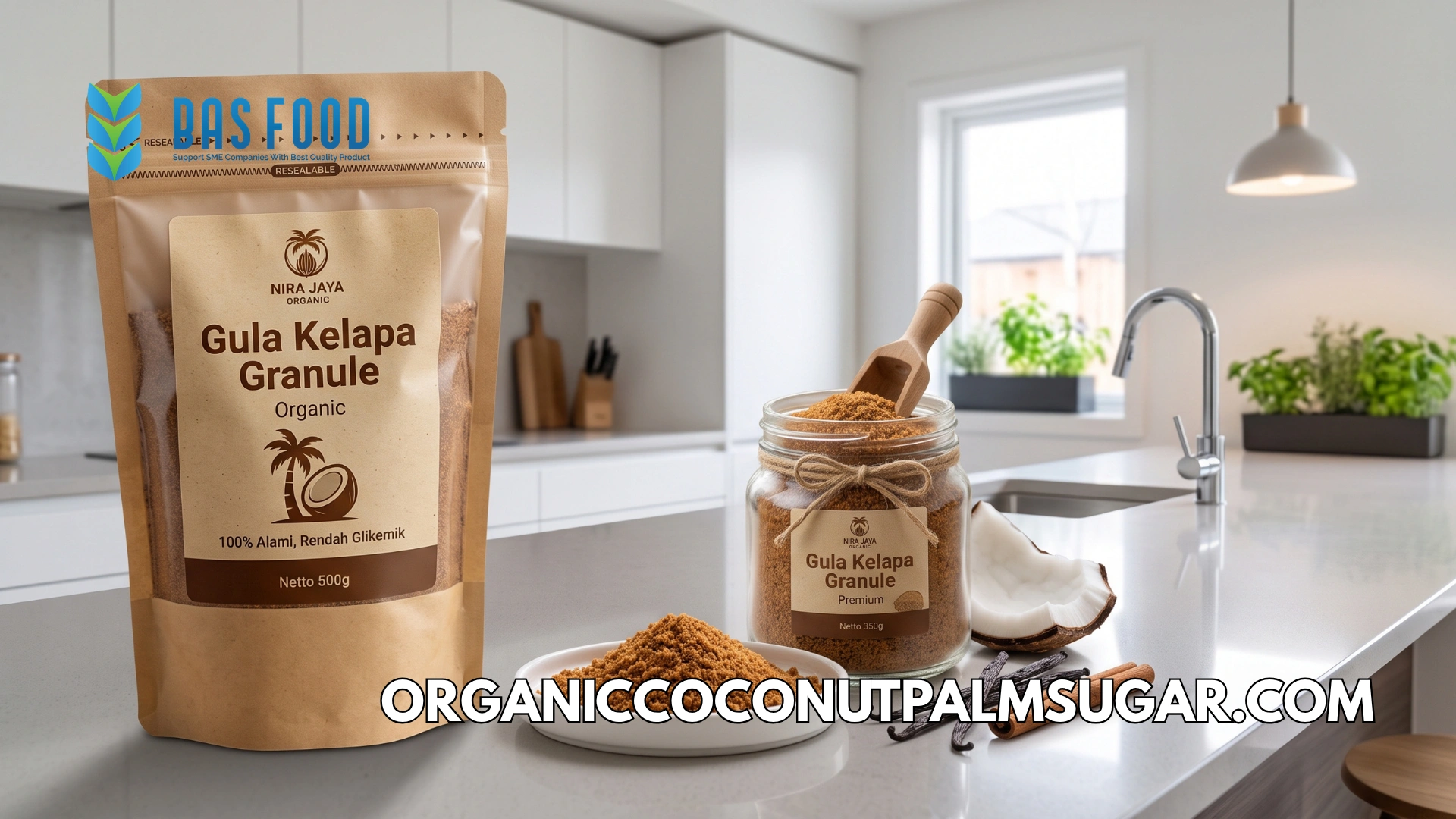
What Is Coconut Sugar Granule?
Coconut sugar granule is coconut palm sugar processed into small, free-flowing particles. It comes from the sap of coconut flower blossoms. Farmers collect the sap, then heat it to reduce its water content and concentrate its natural sugars. After further processing and drying, the sugar can be broken into granules with a relatively uniform size.
Unlike molded coconut sugar, granulated coconut sugar does not keep a solid block shape. This makes it convenient for manufacturers that need to weigh, blend, dissolve, or mix sugar into their formulations. Depending on the production process, the final product can range from relatively fine particles to larger granules.
In international trade, buyers may also see terms such as coconut sugar granules, granulated coconut sugar, or coconut sugar crystals. Although these terms can sometimes describe similar products, buyers should always confirm the supplier’s actual particle size specification rather than relying only on the product name.
For example, a beverage manufacturer may prefer smaller particles because they dissolve more quickly. Meanwhile, a bakery or dry-food manufacturer may choose a different particle size depending on its formulation and mixing process.
How Is Coconut Sugar Granule Made?
The process begins with harvesting coconut blossom sap. Farmers carefully collect the sap from coconut flower stalks and bring it to the cooking stage. Traditional production methods remain important because the quality of the raw sap can influence the taste, aroma, color, and final characteristics of the sugar.
The sap is then heated to evaporate water and concentrate the sugar. Producers must manage temperature and cooking time carefully. If the process is poorly controlled, the sugar may develop undesirable color, flavor, moisture, or texture.
After the concentrated sugar reaches the appropriate stage, producers cool and process it into granules. Depending on the manufacturing method, the sugar can be crushed, screened, dried, and sorted to achieve the required particle size.
For B2B buyers, this processing stage matters because consistent granulation can affect production efficiency. A reliable producer should have a controlled process that helps maintain similar characteristics from one batch to another.
From Coconut Sap to Granules
A simplified production flow looks like this:
- Coconut blossom sap is collected.
- The fresh sap is filtered.
- The sap is heated to reduce water content.
- The concentrated sugar is processed and cooled.
- The sugar is broken into granules.
- Granules are screened according to particle size.
- The finished product is packed for storage or shipment.
Every stage can influence the final product. Therefore, buyers should not evaluate a coconut sugar supplier only by the appearance of the finished sugar. Production practices, raw material sourcing, quality control, and storage conditions are equally important.
Why Choose Granulated Coconut Sugar for B2B Applications?
One of the biggest advantages of granulated coconut sugar is its practicality. Granules are generally easier to portion and measure than molded sugar. This is useful for food manufacturers that need repeatable quantities during production.
Granules can also fit different industrial applications. Food companies may use them in bakery products, beverages, confectionery, sauces, breakfast products, snack foods, and dry mixes. The exact application depends on the buyer’s formulation and technical requirements.
Another advantage is handling. A granulated product can be easier to integrate into automated or semi-automated production systems compared with large molded blocks. Manufacturers can select a particle size that works with their equipment and recipe.
For distributors and importers, granulated coconut sugar can also be practical because bulk packaging allows the product to be transported and stored as an ingredient rather than as individually molded pieces.
However, granules are not automatically better for every application. The right format depends on how the sugar will be used. That is why buyers should communicate their intended application to the supplier before selecting a specification.
Coconut Sugar Granules vs. Coconut Sugar Crystals
The terms coconut sugar granules and coconut sugar crystals are often used in product descriptions. However, terminology can vary between suppliers and markets. A buyer should therefore ask for a technical specification sheet before comparing products from different sources.
Particle size is particularly important. Two products may both be described as coconut sugar crystals while having noticeably different particle distributions. One may be fine and powder-like, while another may contain larger particles.
This difference can affect dissolution, mixing, filling, packaging, and final product texture. For example, a beverage producer may have different requirements from a bakery ingredient manufacturer.
Instead of asking only, “What type of coconut sugar do you supply?” a professional buyer can ask more specific questions:
- What is the particle size?
- Is the particle size controlled by screening?
- What is the typical moisture level?
- What is the color range?
- How consistent is the product between batches?
- What packaging options are available?
- What quality documents can the supplier provide?
These questions help buyers compare products based on measurable specifications rather than marketing terminology.
What Makes a Good Coconut Sugar Granule?
Quality starts with the raw material. Fresh coconut blossom sap and careful handling are important because the condition of the sap can influence the finished sugar. Producers also need to control processing conditions to achieve a stable product.
Appearance is one of the first characteristics buyers notice. Coconut sugar can naturally range from light golden brown to darker brown. Color can vary because of raw material characteristics and processing conditions.
Texture is another important factor. Good granules should have a practical particle structure suitable for the buyer’s intended application. Excessive clumping can create handling problems, especially when the product needs to flow through processing or filling equipment.
Moisture also deserves attention. Too much moisture can contribute to clumping and may affect storage stability. For this reason, buyers should request relevant specifications and, where appropriate, laboratory test results.
A professional coconut sugar supplier should be able to explain its quality parameters clearly. The supplier should also understand that different buyers may require different specifications.
Choosing the Right Particle Size
Particle size is one of the most important considerations when purchasing coconut sugar granule in bulk. There is no single particle size that works perfectly for every application.
For beverage mixes, instant products, and certain food formulations, finer particles may be preferred because they can disperse or dissolve more easily. On the other hand, larger granules may be suitable for applications where a stronger grain structure is desirable.
Industrial buyers should therefore avoid choosing particle size based only on price. A cheaper product may create additional production costs if it does not work well with existing machinery or formulation requirements.
Before ordering a large quantity, it is sensible to request a sample. The buyer can then test the sugar under actual production conditions.
A good sourcing process should compare:
- Particle size
- Moisture
- Color
- Taste and aroma
- Solubility
- Flowability
- Packaging
- Shelf-life requirements
- Documentation
- Batch consistency
This approach gives buyers a much clearer picture of whether the product is suitable.
Coconut Sugar Mould and Granule Production
Not every coconut sugar producer focuses exclusively on granules. Some manufacturers also produce molded coconut sugar. This can be useful for buyers that need several coconut sugar formats from one supply partner.
A coconut sugar mould supplier may work with producers that manufacture molded forms using different shapes and sizes. While molded sugar and granulated sugar serve different applications, both products can originate from coconut blossom sap.
For B2B buyers, having access to multiple formats can simplify sourcing. A food distributor, for example, may need granules for industrial customers while also requiring molded sugar for retail or traditional food applications.
However, buyers should distinguish between a supplier of molds or molding equipment and a supplier of finished coconut sugar. These are different supply categories. Clear communication is important when discussing specifications and purchasing requirements.
If your business needs both molded and granulated products, discuss the complete requirement with the supplier before requesting a quotation. This can help avoid confusion over product format, packaging, and minimum order quantities.
How B2B Buyers Should Evaluate a Coconut Sugar Supplier
Finding a coconut sugar supplier is relatively easy. Finding a supplier that can consistently meet your requirements is more important.
Start by looking at the supplier’s product knowledge. A capable supplier should be able to explain the origin of its coconut sugar, production process, available specifications, packaging options, and export capabilities.
Next, ask about quality control. Buyers should understand how the supplier manages raw materials, production, drying, screening, packing, and storage.
Documentation is also important in international trade. Depending on the destination country and buyer requirements, importers may need documents such as commercial invoices, packing lists, certificates of origin, product specifications, certificates of analysis, and other relevant export or food-safety documents.
Communication should also be considered. A supplier that responds clearly and provides complete technical information can make the procurement process much easier.
Finally, evaluate consistency. A good first sample is useful, but long-term B2B relationships depend on consistent quality across multiple shipments.
Coconut Sugar Granule for Food Manufacturers
Food manufacturers can use coconut sugar granules in a wide range of products. Bakery companies may incorporate them into cookies, cakes, breads, and other baked goods. Beverage companies may use coconut sugar as part of dry drink mixes or sweetener blends.
The sugar can also be used in confectionery, sauces, cereals, snack products, and specialty food formulations. Its characteristic caramel-like flavor can be useful when a product needs a deeper sweet taste.
Nevertheless, formulation testing remains essential. Coconut sugar does not behave exactly like refined white sugar in every recipe. Differences in color, flavor, particle size, and moisture can influence the final product.
Manufacturers should therefore conduct trials before moving into full-scale production. This is especially important when changing suppliers because apparently similar products can perform differently.
A supplier that understands industrial applications can be helpful during this process. The buyer can explain the intended use and ask for a suitable specification or sample.
Packaging and Export Considerations
Packaging plays an important role in protecting coconut sugar during transportation. The correct packaging should help protect the product from moisture, contamination, physical damage, and unsuitable storage conditions.
B2B buyers commonly have different packaging requirements depending on their distribution model. Industrial users may prefer bulk packaging, while distributors may require smaller commercial packs.
Export shipments also require careful preparation. Labels, product information, batch identification, net weight, packaging materials, and shipping documents should match the buyer’s requirements and applicable regulations.
For container shipments, buyers should also consider storage conditions. Coconut sugar should be kept in a clean, dry environment and protected from excessive humidity.
Before confirming an order, discuss packaging specifications with the supplier. This includes bag type, inner liner requirements, carton or sack configuration, palletization, labeling, and container loading where applicable.
Why Work With CV Bonafide Anugerah Sentosa?
For international buyers looking for Indonesian agricultural products, CV Bonafide Anugerah Sentosa can be considered as a sourcing partner for coconut-derived products and other Indonesian commodities.
An experienced exporter can help buyers understand product specifications, sourcing requirements, packaging options, and export processes. This becomes especially valuable when a buyer is importing coconut sugar for the first time.
For long-term B2B purchasing, the relationship should go beyond a single shipment. Buyers need a partner that can communicate clearly, understand specifications, coordinate production, and support repeat orders.
When evaluating CV Bonafide Anugerah Sentosa or another Indonesian supplier, buyers should still conduct their own due diligence. Request product specifications, samples, relevant documentation, packaging details, and commercial terms before placing a large order.
This process helps both sides establish clear expectations from the beginning.
Coconut Sugar Granule for Global Markets
Demand for natural sweeteners continues to create opportunities for coconut sugar exporters. Importers in different markets may use coconut sugar for food manufacturing, retail products, foodservice, or ingredient distribution.
However, international markets can have different technical, labeling, and regulatory requirements. A product specification suitable for one market may require adjustments for another.
That is why export buyers should work with suppliers that understand international procurement. A reliable supplier should be able to discuss product specifications and documentation before shipment rather than treating these requirements as an afterthought.
For importers, the goal is not simply to find the lowest-cost coconut sugar. The better goal is to find the right balance between quality, consistency, price, packaging, documentation, lead time, and service.
Final Checklist Before Buying Coconut Sugar Granule
Before placing a bulk order, buyers can use a simple checklist. First, confirm the product specification. Make sure the supplier understands the required particle size, moisture level, color, packaging, and intended application.
Second, request a sample and test it. If the sugar will be used in industrial production, test it using the actual formulation and equipment whenever possible.
Third, review the supplier’s documentation and export capabilities. Confirm which documents are available and whether they meet your destination market’s requirements.
Finally, discuss commercial terms clearly. Confirm minimum order quantity, lead time, packaging, payment terms, shipping arrangements, and any customized requirements before finalizing the purchase.
A careful procurement process reduces the risk of receiving a product that looks right on paper but does not perform as expected.
Conclusion: Choosing the Right Coconut Sugar Granule Supplier
Coconut sugar granule is a practical ingredient for many food and beverage applications. Its free-flowing format makes it easier to measure, blend, transport, and incorporate into industrial formulations compared with molded sugar.
However, product quality depends on more than appearance. Raw material handling, processing, particle size, moisture, packaging, storage, and batch consistency all influence the value of the finished product.
For B2B buyers, the best approach is to define the required specification first and then select a supplier that can consistently meet it. Ask questions, request samples, review documentation, and test the product before committing to large-volume purchases.
Whether you are an importer, food manufacturer, distributor, bakery ingredient buyer, or private-label business, choosing the right coconut sugar supplier can make a significant difference to your supply chain.
With clear specifications and reliable communication, Indonesian coconut sugar can become a practical ingredient for businesses serving both local and international food markets.