The global food industry continues to look for ingredients that offer more than basic functionality. Food manufacturers want ingredients with a clear origin, distinctive flavor, flexible applications, and reliable supply. At the same time, importers and distributors need suppliers that can deliver consistent quality at commercial volumes. This is where granulated coconut sugar has gained attention. Compared with traditional moulded forms, granules are easier to weigh, blend, process, and use across many food applications. Bakery, beverage, snack, chocolate, and other manufacturers can incorporate granulated coconut sugar into their formulations with relative ease.
However, finding the right coconut sugar granule supplier requires more than searching for the lowest price.
B2B buyers need to consider product specifications, granule size, moisture, consistency, production capacity, packaging, documentation, lead time, and export experience. A supplier may offer an attractive quotation, but that does not always mean the supplier can support long-term commercial requirements.
For companies sourcing from Indonesia, supplier evaluation becomes even more important. The country has a strong coconut production base and established experience in coconut sugar, but suppliers can differ significantly in their production methods and commercial capabilities.
This guide explains what international buyers should look for when selecting a coconut sugar granule supplier, how to compare suppliers, and how to build a reliable sourcing relationship.
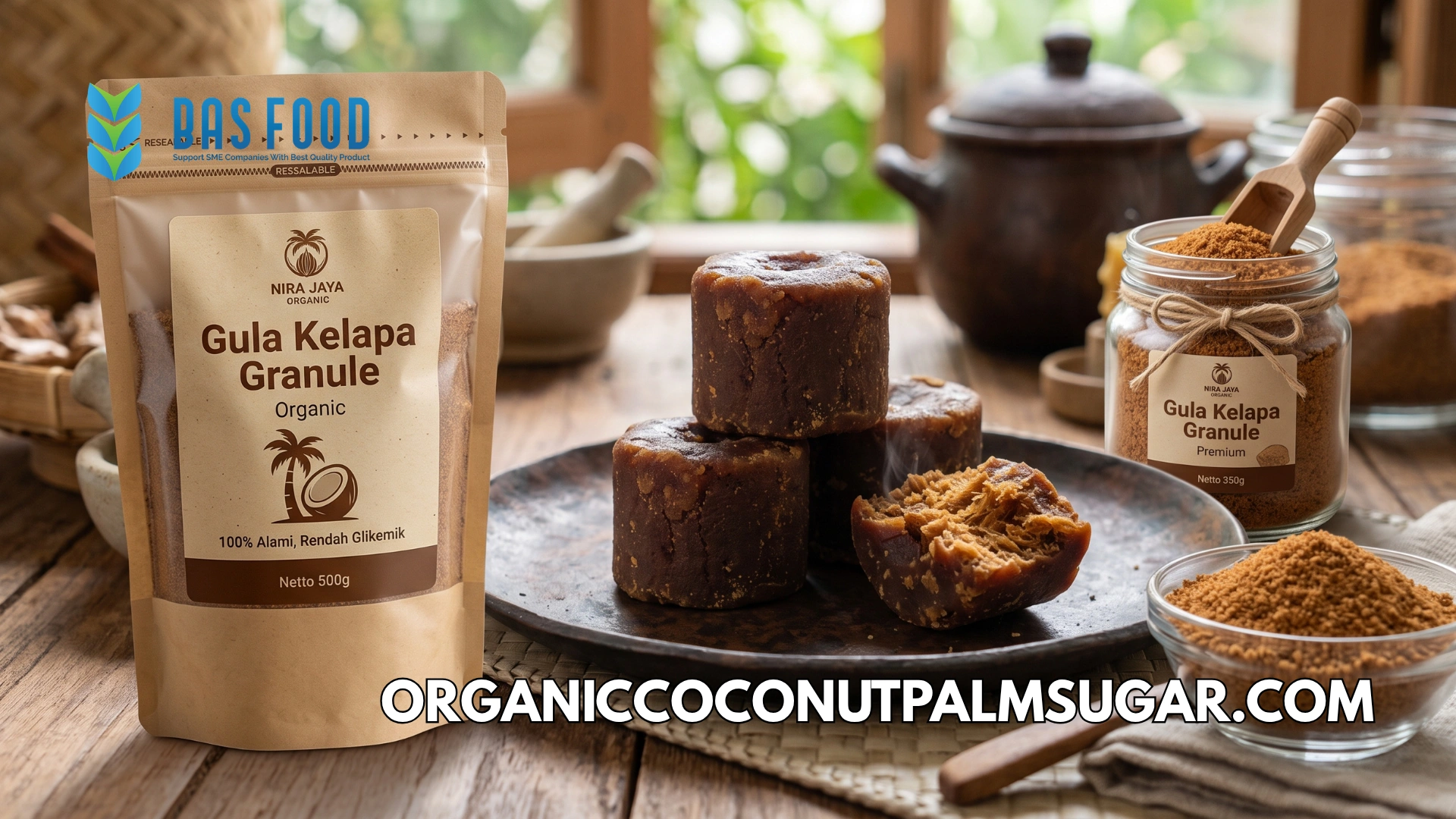
What Is Granulated Coconut Sugar?
Granulated coconut sugar is coconut sugar processed into small particles or granules instead of being sold as a solid block or moulded piece. It originates from coconut sap collected from coconut flower stalks.
After collection, the sap undergoes processing to reduce its water content and concentrate its natural sugars. The resulting sugar mass is then processed into a granular form according to the desired product specification.
The final product can vary in color, texture, moisture, and particle size depending on raw materials and processing methods.
For industrial buyers, these details matter. A food manufacturer usually needs more information than simply the product name. The buyer may require a specific particle-size range, moisture specification, packaging format, and other technical parameters.
Why Buyers Choose Coconut Sugar Granules
Granulated coconut sugar offers practical advantages for many food manufacturers.
The small particle format makes it easier to weigh and incorporate into recipes. Manufacturers can add it to dry mixes, bakery formulations, beverage preparations, snack products, and other applications without first breaking down a large block of sugar.
This can make granulated products more convenient for production environments.
Granulated coconut sugar can also support more consistent dosing when used with appropriate production equipment. For manufacturers producing at scale, this can be an important consideration.
However, the exact performance depends on particle size and product characteristics. Therefore, buyers should always match the granule specification to their intended application.
Why Choosing the Right Supplier Matters
A reliable coconut sugar supplier can have a direct impact on production stability.
Imagine a food manufacturer launches a product using coconut sugar. The first shipment performs well during formulation, but the next shipment has noticeably different particle size or moisture. The production team may need to adjust the recipe or processing conditions.
For large manufacturers, this can create unnecessary work and cost.
That is why supplier selection should focus on consistency over time.
The goal is not simply to find coconut sugar that works today. The goal is to find a supplier capable of delivering the required specification repeatedly.
Start With Your Product Requirements
Before contacting a supplier, buyers should define their own requirements.
Start with the application. Is the coconut sugar intended for bakery products, beverages, snacks, chocolate, sauces, instant mixes, or another food category?
Then determine the physical characteristics needed for the production process.
A buyer may need a specific granule size, moisture level, color range, packaging weight, or shelf-life requirement.
Clear requirements make supplier communication much easier.
Instead of asking, “How much is your coconut sugar?” a professional buyer can ask for a quotation based on a defined product specification.
This produces a more useful comparison between suppliers.
Particle Size Is an Important Specification
Not all coconut sugar granules are identical.
Particle size can influence how the sugar behaves during mixing, blending, dissolving, and processing.
For example, a beverage manufacturer may have different requirements from a bakery producer. A chocolate manufacturer may also need a different particle profile from a company producing granola.
Therefore, buyers should discuss particle size with the supplier.
If the supplier offers several granule options, request the available specifications and samples.
The right specification should be determined by the manufacturing process rather than by the product name alone.
Fine and Coarse Granules Have Different Uses
Fine coconut sugar granules contain smaller particles, while coarse granules contain larger particles.
Fine particles can be useful in applications where faster blending or a smoother distribution within the formulation is important.
Coarser particles may be appropriate for products where particle size is less sensitive or where a particular texture is desired.
There is no universal rule saying that fine granules are always better.
The best choice depends on the finished product, processing equipment, recipe, and desired result.
A good supplier should be willing to discuss these requirements instead of pushing one standard specification to every buyer.
Moisture Can Affect Product Handling
Moisture is another important factor when evaluating a coconut sugar granule supplier.
Dry sugar products can respond to environmental humidity. Excess moisture may affect flowability, texture, clumping, and storage performance.
For industrial buyers, these changes can create problems during handling or processing.
Therefore, buyers should ask about the product’s moisture specification and recommended storage conditions.
Packaging also plays an important role because it helps protect the product from environmental exposure during transportation and storage.
Color and Flavor Should Be Consistent
Coconut sugar is known for its characteristic brown color and distinctive flavor.
However, natural agricultural products can show some variation.
Food manufacturers should establish acceptable ranges for appearance and flavor based on their finished product.
This is especially important for brands where color consistency is part of the consumer experience.
A professional supplier should understand that consistency is important for commercial production and should have quality-control procedures to monitor the finished product.
Production Capacity Matters for B2B Buyers
A supplier may be suitable for a small order but unable to support a larger commercial program.
Therefore, buyers should ask about production capacity before signing a long-term agreement.
The question is not simply, “How much coconut sugar can you produce?”
Buyers should also consider whether the supplier can maintain quality while increasing volume.
A growing food brand may start with a small trial shipment and later require regular container-scale deliveries.
The supplier must be able to grow with the buyer.
Factory Capability Should Be Evaluated Carefully
When assessing a potential coconut sugar granule supplier, buyers should look at the overall production system.
Important areas include raw material sourcing, sap handling, processing, granulation, quality control, packaging, storage, and shipment preparation.
The granulation stage is particularly important because the supplier needs to achieve the agreed particle-size specification.
Good production management helps reduce variation between batches.
For larger buyers, it can also be useful to understand how the supplier handles peak demand and repeat orders.
What Makes an Indonesian Supplier Attractive?
Indonesia is one of the world’s major coconut-producing countries.
The country’s long experience with coconut cultivation and traditional coconut sugar production creates a strong foundation for international sourcing.
For buyers, sourcing from Indonesia can provide access to products close to the agricultural origin.
However, “Made in Indonesia” is not enough to determine supplier quality.
The buyer still needs to evaluate the specific company, production system, product specifications, quality control, capacity, documentation, and export experience.
Supplier evaluation should always come before a major commercial commitment.
Evaluating CV Bonafide Anugerah Sentosa
CV Bonafide Anugerah Sentosa can be considered by international buyers looking for an Indonesian source of coconut sugar products.
For buyers specifically interested in granulated coconut sugar, discussions can focus on product specifications, granule size, moisture, packaging, MOQ, production capacity, lead time, and export documentation.
Buyers should also explain their intended application.
A bakery manufacturer, beverage company, and distributor may have very different requirements. Sharing this information helps the supplier determine whether the available product matches the buyer’s needs.
As always, current specifications, availability, pricing, certifications, capacity, and commercial terms should be confirmed directly with the supplier before placing an order.
Why Samples Should Come Before Bulk Orders
A sample is one of the simplest ways to reduce sourcing risk.
Buyers can inspect the color, aroma, texture, granule size, packaging, and general product quality before committing to larger volumes.
More importantly, food manufacturers can test the coconut sugar in their own formulation.
This can reveal how the ingredient behaves under real production conditions.
For example, a beverage company can test dissolution. A bakery can evaluate the ingredient during mixing and baking. A snack producer can test blending and flavor performance.
These tests provide information that a product specification sheet alone cannot provide.
Packaging Matters for International Shipments
Good coconut sugar can still face problems if the packaging is not suitable for export.
International shipments can involve long transportation times and changes in temperature and humidity.
Packaging should therefore help protect the product during storage and transportation.
B2B buyers should discuss packaging options with the supplier before ordering.
Bulk buyers may need larger industrial packaging, while distributors or private-label brands may require smaller consumer-ready formats.
The right packaging depends on the distribution model.
Bulk Coconut Sugar Requires Good Storage
After delivery, the buyer becomes responsible for storage.
Coconut sugar should be stored under appropriate conditions to help maintain its physical quality.
A dry, clean environment is generally important for dry sugar products.
Buyers should also avoid unnecessary exposure to humidity and ensure that packaging remains properly sealed.
Good warehouse management can help preserve product quality throughout the supply chain.
Export Documentation Should Be Discussed Early
International food shipments require proper documentation.
The exact documents depend on the destination country, product, importer, and regulatory requirements.
Depending on the transaction, buyers may need commercial invoices, packing lists, certificates of origin, product specifications, certificates or test reports, and other documents.
The buyer should communicate documentation requirements before production or shipment.
This gives the supplier time to prepare the necessary paperwork.
Don’t Ignore Lead Time
Lead time can become a major issue for food manufacturers.
A delayed ingredient shipment can affect production schedules, inventory planning, and customer deliveries.
Therefore, buyers should ask about typical production lead times and shipping schedules.
It is also useful to understand what happens during high-demand periods.
A supplier that communicates clearly about lead times can help buyers plan their inventory more effectively.
MOQ Should Match Your Business
Minimum order quantity, or MOQ, is another important factor.
A large manufacturer may have no problem ordering in bulk.
However, a smaller food brand may need a lower initial volume for product testing.
Buyers should discuss MOQ before requesting a final quotation.
A supplier that understands different stages of product development may be able to provide options for samples, trial orders, and regular commercial shipments.
Price Is Important, but It Is Not Everything
Price will always matter in procurement.
However, focusing exclusively on price can create problems.
A supplier offering the lowest price may not necessarily offer the best consistency, packaging, documentation, or delivery performance.
A better approach is to compare total value.
Consider product quality, rejection risk, logistics, lead time, communication, and supply reliability.
A slightly higher unit price can sometimes be more economical if it reduces operational problems.
What a Good Supplier Relationship Looks Like
A strong supplier relationship should be based on clear communication.
Both sides should understand product specifications, order quantities, timelines, packaging, payment terms, and documentation.
If a supplier expects a change in raw material availability or production schedule, early communication gives the buyer time to respond.
Likewise, buyers should provide realistic forecasts when possible.
This can help suppliers prepare production and raw material requirements.
Coconut Sugar Granule Supplier vs Coconut Sugar Mould Supplier
Some buyers need granulated coconut sugar, while others prefer traditional moulded products.
A coconut sugar mould supplier focuses on moulded formats such as discs, blocks, or other defined shapes.
A granule supplier, on the other hand, provides sugar in particle form suitable for applications where the ingredient needs to be weighed, mixed, or processed.
The two formats serve different purposes.
Before contacting a supplier, buyers should understand which format matches their manufacturing process.
When Should You Choose Moulded Coconut Sugar?
Moulded coconut sugar can be a good choice for traditional culinary applications, foodservice, retail products, and markets where shape is part of the product identity.
Blocks and discs can also provide a distinctive visual appearance.
However, they may require additional processing before being incorporated into industrial formulations.
For this reason, manufacturers that need direct blending may prefer granules.
The application should determine the format.
Why Consistency Is the Real Competitive Advantage
Many suppliers can offer coconut sugar.
Fewer can provide the same specification consistently over time.
For food manufacturers, consistency is often the real value.
When the ingredient behaves predictably, production teams can maintain recipes and processes with fewer adjustments.
That can improve operational efficiency and reduce unexpected problems.
Therefore, buyers should evaluate suppliers based on repeatability, not only on the first shipment.
The Future of Coconut Sugar Granules
The demand for differentiated food ingredients continues to create opportunities for coconut sugar.
Granules are particularly well positioned for manufacturers because they can be incorporated into many formulations.
However, future growth will depend on professional supply chains.
Suppliers will need to provide consistent quality, clear specifications, appropriate packaging, reliable capacity, and strong communication.
At the same time, buyers will need to become more precise about their requirements.
This combination can create stronger relationships between Indonesian producers and international food companies.
Conclusion: Choose a Supplier That Can Grow With Your Business
Finding the right coconut sugar granule supplier is not simply about finding a company that sells coconut sugar.
For B2B buyers, the right supplier should be able to provide a product that matches the required specification and maintain that quality across repeat shipments.
Particle size, moisture, color, flavor, packaging, capacity, documentation, lead time, and logistics all deserve attention.
Indonesia offers strong potential for coconut sugar sourcing because of its established coconut sector and traditional production experience. However, individual supplier evaluation remains essential.
For buyers considering CV Bonafide Anugerah Sentosa, a direct discussion can help clarify available coconut sugar granule specifications, packaging, MOQ, production capacity, documentation, lead times, and export requirements.
Buyers should also compare whether granulated coconut sugar or moulded products better fit their application. A coconut sugar mould supplier may be more suitable for traditional blocks and discs, while a granulated product may offer greater convenience for food manufacturing.
The best sourcing decision is ultimately the one that balances quality, consistency, price, capacity, and reliability.
When those elements come together, coconut sugar becomes more than a raw ingredient. It becomes a dependable part of a long-term food supply chain.