When sourcing coconut sugar for international markets, buyers often focus on sweetness, color, moisture, packaging, and price. However, one practical detail can have a surprisingly large impact on the final product: moulded coconut sugar size. The size and shape of moulded coconut sugar affect how the product is packed, stored, transported, handled, displayed, and used. For a food manufacturer, the right size can make processing easier. A retail brand, it can improve consumer convenience. For an importer, consistent dimensions can simplify packaging and inventory planning.
That is why moulded coconut sugar should not be treated as a one-size-fits-all product. Different buyers may require different block formats depending on their market and application.
For B2B buyers working with an Indonesian coconut sugar supplier, discussing the mould format before production can help prevent misunderstandings. It also allows the supplier to prepare the right mould design, packaging configuration, and product specification.
In this guide, we will look at what buyers should know about moulded coconut sugar size, how sugar mould dimensions affect commercial products, and how to choose a practical format for export.
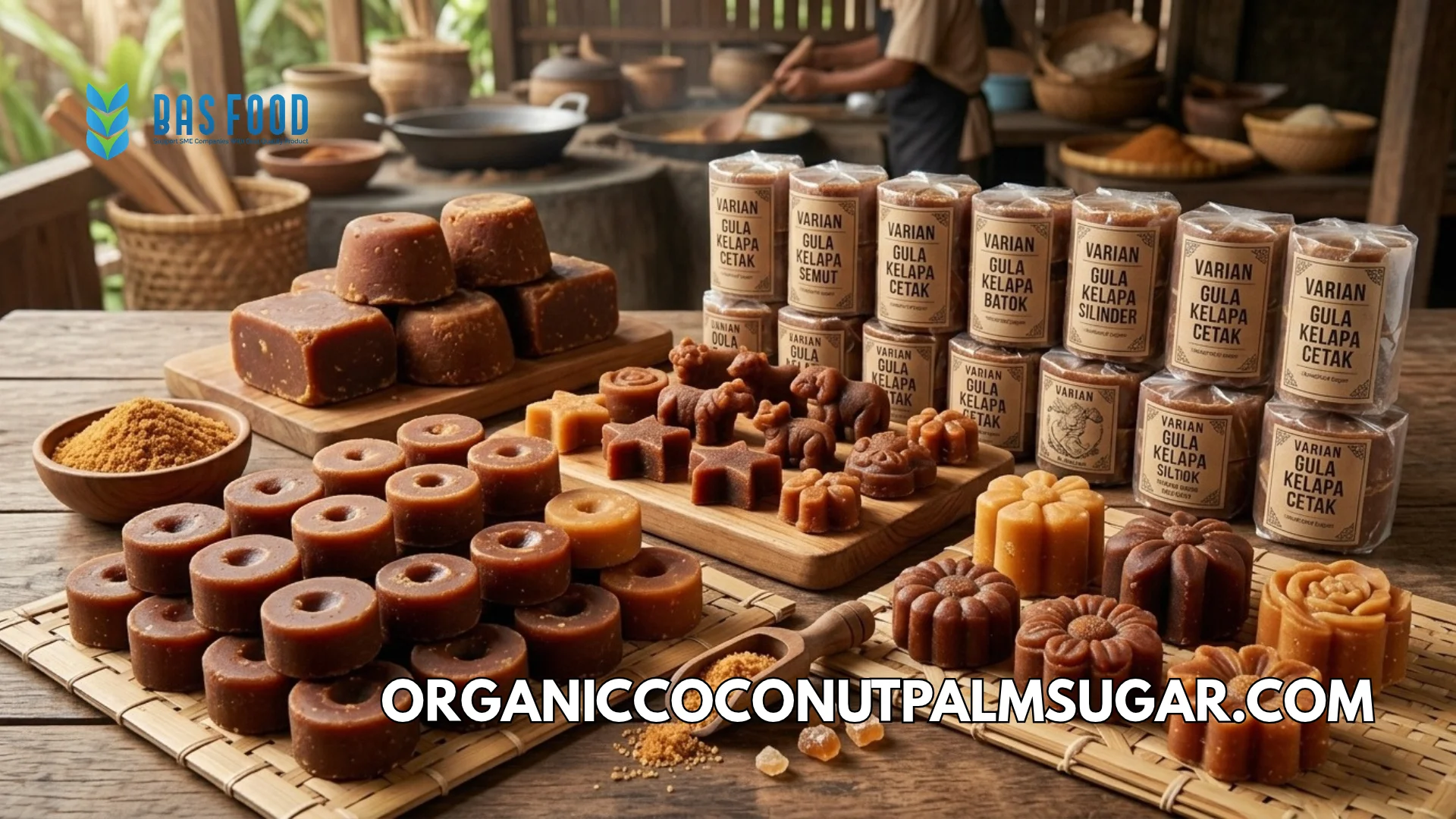
What Is Moulded Coconut Sugar?
Moulded coconut sugar is coconut sugar formed into a specific shape using a mould. Instead of being sold as granules or powder, the sugar is shaped into blocks, cakes, discs, or other formats.
This form has a long history in traditional coconut sugar production. Today, moulded coconut sugar is also used for commercial food applications and international markets.
The main advantage is simple: the sugar becomes easier to portion, handle, pack, and identify as a physical product.
For some buyers, blocks are useful because they can be stored and transported in a relatively straightforward way. For others, moulded sugar offers a convenient format for retail or foodservice use.
However, the ideal moulded coconut sugar size depends on the intended application.
A restaurant may prefer a practical block that can be broken into smaller pieces. A retail brand may want a smaller format that fits neatly inside consumer packaging. Meanwhile, an industrial food manufacturer may prefer a larger block because the product will be processed before use.
Therefore, buyers should start by defining the purpose of the product rather than selecting a size simply because it looks attractive.
Why Moulded Coconut Sugar Size Matters
The physical size of coconut sugar can influence many parts of the supply chain.
First, it affects packaging. A larger block requires more internal space, while smaller pieces may allow a package to hold multiple units.
Second, size can affect handling. Workers can generally move smaller pieces more easily, while larger blocks may be more efficient when selling the product in bulk.
Third, the size can influence portion control.
For retail products, portion size can be important because consumers may want to use a predictable amount of sugar. A consistent block format can make the product easier to understand and use.
In foodservice businesses, the preferred size may depend on recipes and daily production volumes.
For example, a café or restaurant may prefer a format that can be quickly measured and added to beverages or recipes.
On food manufacturers, the situation is different. They may purchase coconut sugar in bulk and process it further, so the physical appearance may be less important than the efficiency of breaking, grinding, dissolving, or processing the blocks.
This is why moulded coconut sugar size should always be considered together with the product’s intended use.
Understanding Sugar Mould Dimensions
Sugar mould dimensions normally describe the physical measurements of each moulded piece.
Depending on the shape, these measurements may include:
- Length
- Width
- Height
- Diameter
- Weight per piece
For a rectangular block, a specification could describe the length, width, and height.
For a round mould, the specification may use diameter and height.
However, dimensions alone do not determine the exact weight.
The density of the sugar, moisture content, production process, and mould structure can all affect the final weight.
Therefore, buyers should avoid assuming that two blocks with identical external dimensions will always have exactly the same weight.
Instead, a professional specification should include both the desired dimensions and target weight when weight consistency is important.
This is particularly useful for export buyers who need to plan packaging.
If each piece has a predictable size and approximate weight, it becomes easier to estimate the number of units per carton and total shipment weight.
Choosing the Right Mould Design
The mould design is closely connected to the intended use of the product.
A simple rectangular mould can be practical for bulk and foodservice applications. It is easy to stack and can make efficient use of packaging space.
Round or disc-shaped moulds may provide a different consumer experience. They can look attractive in retail packaging and may be convenient for portioning.
Custom moulds are another possibility.
A buyer may want a specific shape because of branding, packaging requirements, or a particular market.
For example, a private-label brand may want its coconut sugar to have a distinctive shape that matches its product identity.
However, custom moulds require more planning.
The buyer should first confirm the required dimensions, weight, packaging, and production quantity before finalizing the design.
The shape should also be practical for handling and transportation.
A beautiful mould design is not necessarily a good commercial design if it creates excessive empty space in packaging or makes stacking difficult.
Therefore, the best mould is usually one that balances appearance, functionality, production efficiency, and logistics.
Common Factors That Determine Moulded Coconut Sugar Size
Several factors should be considered when deciding the size of a moulded product.
Intended Application
The first question is how the sugar will be used.
Retail, foodservice, bakery, beverages, and industrial food manufacturing can all require different formats.
Packaging
The mould must fit comfortably inside the selected packaging.
If the package is already designed, the buyer should provide its internal dimensions to the supplier.
This allows the supplier to consider whether the proposed moulded sugar size is practical.
Target Weight
The buyer should determine whether the product is sold by piece, package, or total weight.
If the product is sold by piece, consistent weight becomes particularly important.
Handling
The size should be practical for workers and consumers.
Very large pieces may be difficult to handle, while very small pieces may require more packaging and labor.
Shipping
Export buyers should consider carton dimensions and container utilization.
A mould size that works well for the product itself may not necessarily provide the best shipping efficiency.
These factors should be evaluated together rather than separately.
Moulded Coconut Sugar Size and Product Consistency
Product consistency is one of the most important concerns for B2B buyers.
When customers purchase moulded coconut sugar repeatedly, they generally expect the product to look and behave similarly from one shipment to the next.
Consistent dimensions make this easier.
For example, if a buyer orders a rectangular block, significant changes in length, width, or thickness can affect packaging and handling.
In retail, inconsistent sizes can also affect the visual appearance of the product.
In manufacturing, size variations may affect processing efficiency.
Therefore, buyers should discuss acceptable production tolerances with their supplier.
Natural products can have minor variations, particularly when traditional production methods are involved. A realistic tolerance helps both buyer and supplier understand what level of variation is acceptable.
The goal is not necessarily to make every piece perfectly identical to a machine-made object.
Instead, the goal is to establish a commercially acceptable range that supports consistent quality.
How Size Affects Packaging
Packaging is one of the biggest reasons to carefully select mould dimensions.
A product should fit securely inside its packaging without excessive empty space.
Too much empty space can allow the pieces to move during transportation. This may increase the chance of breakage or surface damage.
On the other hand, packaging that is too tight can make filling difficult and may place unnecessary pressure on the product.
For retail products, packaging may also need to look attractive on a shelf.
A consistent block size makes it easier for packaging designers to create a neat presentation.
For wholesale products, carton efficiency may be more important.
Buyers may want to maximize the number of units per carton while keeping the product adequately protected.
Therefore, the relationship between mould size and packaging should be tested before mass production.
A sample package can help the buyer confirm whether the selected mould works well in practice.
Moulded Coconut Sugar for Different B2B Applications
Retail
Retail brands often prefer convenient shapes and sizes.
The product should be easy for consumers to store, handle, and use.
Packaging also plays a major role because the moulded sugar must fit the selected retail container or pouch.
Foodservice
Restaurants, cafés, caterers, and hotels may prioritize practical handling.
The preferred size may depend on how the sugar is used in daily recipes or beverages.
Bakery
Bakeries may use moulded coconut sugar as a raw ingredient.
In this case, the block needs to be practical to break, crush, dissolve, or process.
Beverage Production
Beverage companies may process the sugar before adding it to their final formulation.
Therefore, they may prioritize a size that is easy to process rather than a particular retail appearance.
Food Manufacturing
Large manufacturers may buy in bulk and use their own processing equipment.
For these buyers, the physical size may be less important than consistency, weight, packaging, and production efficiency.
This demonstrates why there is no single “best” moulded coconut sugar size.
The right format depends on the commercial application.
Why Buyers Should Request Samples
A sample is one of the easiest ways to evaluate moulded coconut sugar.
Technical descriptions are useful, but buyers can learn much more by handling the actual product.
A sample allows the buyer to measure the dimensions and weight.
They can also test whether the sugar fits the intended packaging.
If the product will be processed, the buyer can check how easily the block breaks, cuts, dissolves, or grinds.
This practical testing is particularly useful for international buyers who may not have worked with the supplier before.
It reduces the risk of approving a specification that looks suitable on paper but creates problems during actual production.
For private-label projects, sample approval should ideally happen before the final packaging design is locked.
That way, the buyer can confirm the product and packaging work together.
Mould Dimensions and Export Logistics
Export logistics are another reason to pay attention to product size.
The dimensions of individual pieces affect how many units can fit inside a carton.
Carton dimensions then influence pallet arrangement and container loading.
Even a small change in block size can sometimes alter the packing configuration.
For large-volume shipments, these differences can become commercially important.
A supplier and buyer should therefore consider the complete packaging chain.
This includes the individual piece, inner packaging, carton, pallet, and shipping container.
The goal is to protect the product while making efficient use of available space.
For exporters, this can also help create more accurate shipment calculations.
Buyers can then plan warehouse capacity and landed costs more effectively.
Custom Moulded Coconut Sugar for Private Labels
Private-label buyers may want more control over the appearance of their coconut sugar.
Custom moulds can support a unique product shape, size, or weight.
However, customization should start with a clear technical brief.
The buyer should provide the preferred shape, dimensions, target weight, packaging, and estimated order volume.
If the product needs a particular logo or design, the buyer should also discuss whether the proposed details can be reproduced clearly on the sugar.
The design should remain practical for production.
Very complicated shapes may be harder to manufacture consistently.
Therefore, the best custom mould often combines a distinctive appearance with a simple and repeatable production structure.
This approach can help maintain product consistency while giving the brand a recognizable format.
Working With an Indonesian Coconut Sugar Supplier
Choosing a reliable coconut sugar supplier is just as important as choosing the right mould size.
International buyers need a supplier that understands the relationship between product specifications, packaging, production, and export logistics.
For moulded coconut sugar, communication is especially important because buyers may have specific requirements for shape, dimensions, weight, and packaging.
An experienced supplier should be able to discuss whether the requested format is practical.
They should also be able to explain the available options and help buyers understand potential production considerations.
For buyers comparing a coconut sugar exporter supplier, it is useful to evaluate more than price.
Product consistency, communication, sampling, packaging capability, production capacity, and export experience can all influence the success of the sourcing relationship.
Sourcing Moulded Coconut Sugar From CV Bonafide Anugerah Sentosa
CV Bonafide Anugerah Sentosa is an Indonesian supplier and exporter of coconut sugar and other coconut-derived products.
For buyers interested in moulded coconut sugar, the sourcing process can begin with a simple product brief.
The buyer can provide the preferred mould shape, approximate size, target weight, intended application, packaging requirements, and estimated order quantity.
From there, the supplier and buyer can discuss the most practical production format.
This is particularly useful when the buyer needs a custom specification.
For example, a private-label customer may already have a retail package and need the moulded sugar to fit a specific internal space.
In that case, the packaging measurements can become an important part of the product development discussion.
For bulk buyers, the conversation may instead focus on carton efficiency, product consistency, and export packaging.
Either way, defining the requirements before production helps both parties work toward the same result.
Final Thoughts: Finding the Right Moulded Coconut Sugar Size
Choosing the right moulded coconut sugar size is an important part of successful B2B sourcing.
The ideal format depends on the intended application, packaging, target weight, handling requirements, product consistency, and logistics.
There is no universal size that works for every importer or food manufacturer.
Instead, buyers should define what they need and communicate those requirements clearly to their supplier.
Important considerations include mould design, sugar mould dimensions, target weight, acceptable tolerances, packaging, and intended use.
Samples can then help confirm whether the selected format works in practice.
For international buyers, working with a dependable coconut sugar supplier or coconut sugar exporter supplier can make the sourcing process much easier.
For buyers sourcing from Indonesia, CV Bonafide Anugerah Sentosa can be part of that discussion by helping businesses define practical requirements for moulded coconut sugar and other coconut-derived products.
Ultimately, the best moulded coconut sugar is not simply the one with the most attractive shape. It is the one that fits the buyer’s product, packaging, production process, market, and logistics requirements.
By treating mould size as an important part of the overall product specification, buyers can make better purchasing decisions and build a more reliable coconut sugar supply chain.