When buyers evaluate moulded coconut sugar, size and weight are often the first things they check. However, there is another detail that deserves just as much attention: coconut sugar mould texture.
Texture affects more than how a coconut sugar block feels in the hand. It can influence the product’s appearance, handling, packaging performance, cutting, breaking, storage, and even how easily the sugar works in different food applications. For importers and food manufacturers, understanding texture can therefore make product sourcing much easier.
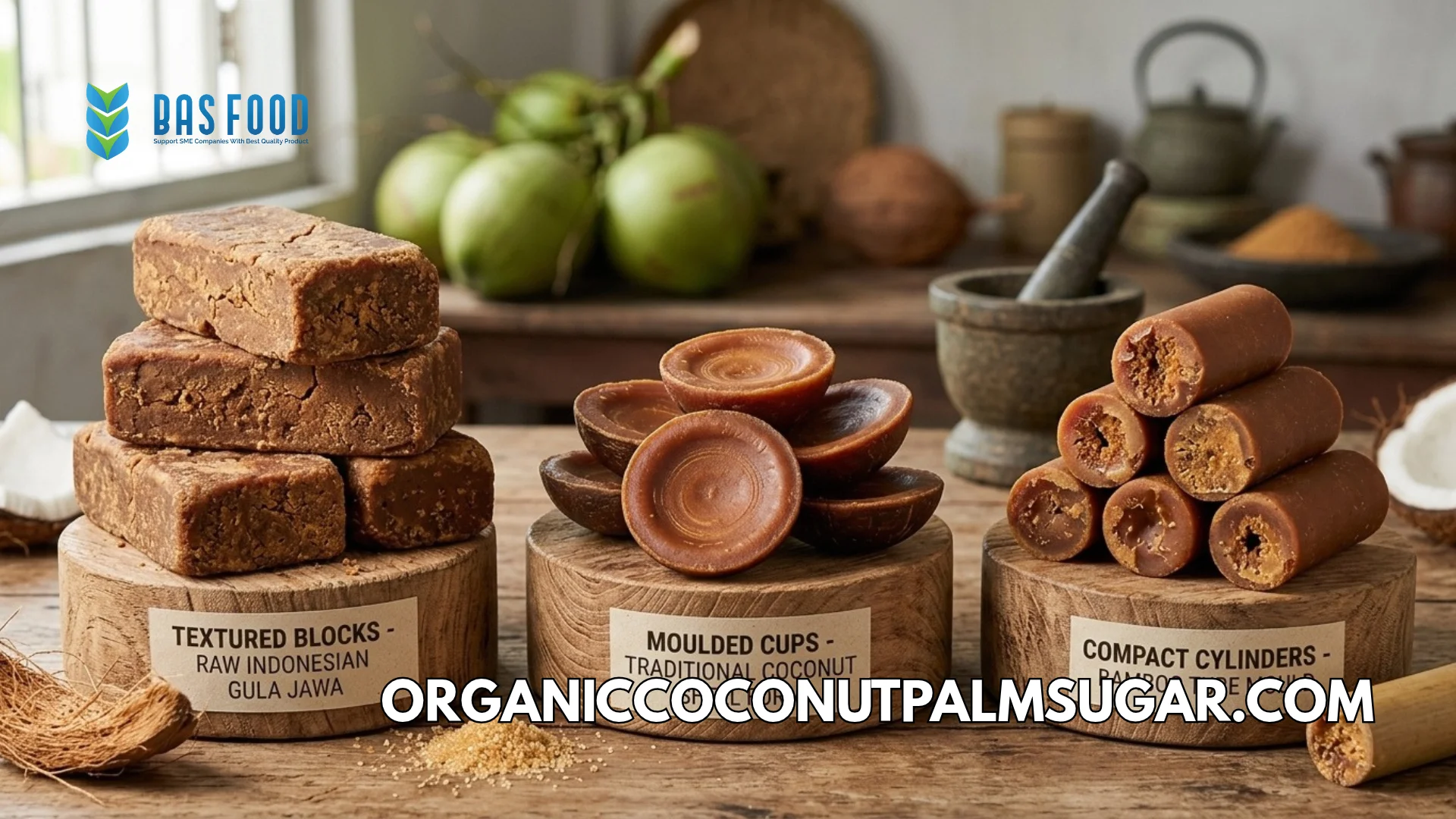
Moulded coconut sugar is made by shaping coconut sugar into a specific form after processing. Depending on the production method, moisture level, cooling process, mould design, and handling conditions, the finished product may have a smooth, slightly grainy, firm, compact, or naturally rustic texture.
For B2B buyers, the important point is not simply finding the smoothest product. Instead, the goal is to find a texture that matches the intended application, packaging format, market expectations, and product specifications.
What Does Coconut Sugar Mould Texture Mean?
Coconut sugar mould texture refers to the physical feel and structure of moulded coconut sugar. It describes characteristics such as firmness, compactness, smoothness, graininess, density, and the way the surface feels when touched or handled.
The texture develops from several production factors. These include the characteristics of the coconut sugar itself, moisture content, heating and concentration, moulding pressure or method, cooling conditions, and storage. Therefore, two products made from coconut sugar can look similar while having slightly different textures.
For buyers, texture should be viewed as part of the overall product specification. A block intended for retail display may require a neat and consistent surface. Meanwhile, a block designed for food manufacturing may place greater emphasis on firmness, breakability, solubility, and consistency between batches.
It is also useful to distinguish texture from appearance. Product appearance describes what buyers see, while texture describes what they feel and how the product behaves physically. Nevertheless, the two characteristics are closely connected.
A well-controlled moulding process can create products with consistent dimensions and a relatively uniform surface. On the other hand, natural variations in coconut sugar processing can create subtle differences in texture. These differences are not automatically a quality problem, but they should be understood and controlled according to the buyer’s requirements.
Why Moulded Sugar Texture Matters for B2B Buyers
For a consumer buying one small package, texture might seem like a minor detail. For an importer ordering hundreds of kilograms or several tonnes, however, texture can become an important commercial consideration.
First, texture affects how the product is handled. A block that is too soft may deform during packing, stacking, or transportation. Conversely, a block that is excessively hard may be difficult to break or process when it reaches a food manufacturing facility.
Furthermore, texture can influence packaging performance. A firm and stable block can maintain its shape more effectively inside individual packaging. If the product surface is uneven or the block easily crumbles, however, the packaging may require additional protection.
This is particularly important for export shipments. Products can experience vibration, stacking pressure, temperature changes, and varying humidity during transportation. Therefore, buyers should evaluate not only the initial texture but also how the texture performs under normal storage and shipping conditions.
Moulded sugar texture also contributes to the customer’s perception of quality. A consistent surface, clean edges, and stable shape can create a more professional appearance on retail shelves. For private-label products, this becomes even more important because the finished product represents the buyer’s brand.
As a result, B2B buyers should not treat texture as an isolated characteristic. Instead, they should consider it together with moisture, dimensions, weight, packaging, storage stability, and intended application.
What Creates the Texture of Moulded Coconut Sugar?
Several factors determine the final texture of moulded coconut sugar. One of the most important is the condition of the sugar before moulding.
If the sugar has a different moisture level or particle structure, the finished mould may behave differently during production. Moisture can affect firmness, cohesion, and the way the product responds to cooling and storage.
The heating and concentration process also matters. Coconut sugar is produced by processing coconut sap until it reaches the desired concentration and consistency. When the material reaches the appropriate stage for moulding, it can be shaped into blocks or other forms.
After moulding, cooling plays another important role. As the product cools, its structure becomes more stable. The cooling environment and handling process can therefore influence the final surface and internal texture.
Mould design is another important factor. The shape and depth of a mould affect how the sugar fills the mould and how the finished product releases from it. A well-designed mould can support consistent dimensions and a clean product surface.
However, mould design alone does not determine quality. The production process must also remain consistent. Even a high-quality mould cannot compensate for major variations in raw material condition or processing.
For this reason, experienced suppliers normally consider the entire production chain rather than focusing on one production step.
Smooth, Grainy, Firm, or Rustic: Understanding Different Textures
Not every moulded coconut sugar product needs to have exactly the same texture. Different applications can require different characteristics.
A relatively smooth texture can be attractive for retail products because it creates a clean visual impression. Consumers can easily recognize the shape of the block, and the surface may work well with individual wrapping or branded packaging.
A slightly grainy texture can also occur naturally. This may be related to the sugar structure, processing conditions, cooling, or the characteristics of the raw material. A grainy surface does not automatically mean that the product is unsuitable.
Firmness is another important characteristic. A firm block generally maintains its shape during handling. This can be useful for export packaging, foodservice applications, and retail products that need to remain intact throughout distribution.
On the other hand, excessive hardness may create difficulties for users who need to break the sugar into smaller pieces. Therefore, the ideal texture depends on how the customer intends to use the product.
For example, a bakery ingredient may eventually be dissolved, melted, or mixed into another formulation. In this case, physical appearance may be less important than consistent composition and practical handling.
A retail product, however, may need both functional performance and attractive appearance. This is why buyers should communicate the intended application before finalizing product specifications.
How the Sugar Surface Affects Product Appearance
The sugar surface is one of the easiest texture characteristics to observe. Buyers can usually evaluate it visually before touching the product.
A good surface should match the agreed product specification. Depending on the product design, buyers may look for clean mould impressions, stable edges, minimal unwanted cracks, and a consistent overall appearance.
However, natural coconut sugar should not always be expected to look identical to highly refined confectionery products. Coconut sugar retains characteristics associated with its raw material and processing method. Therefore, buyers should define acceptable variations instead of simply requesting a “perfect” surface.
For export products, consistency is usually more important than absolute uniformity. If every batch follows the same agreed specification, buyers can plan packaging, marketing, and production more effectively.
Surface texture can also influence how the product photographs and displays in retail packaging. This matters for brands that sell coconut sugar as a natural or traditional sweetener.
Consequently, the surface should be discussed during sample approval. Buyers can compare physical samples, photographs, dimensions, weight, and packaging before placing a larger order.
Texture Consistency Between Production Batches
One of the most important concerns for B2B buyers is consistency. A supplier may provide an attractive sample, but the real test is whether future production maintains the agreed characteristics.
Texture consistency means that products from different production batches remain reasonably similar in firmness, surface structure, shape, and handling characteristics.
Of course, natural agricultural products can have some variation. Coconut sap comes from a biological source, so raw material characteristics can change. The goal is therefore not necessarily to eliminate every natural variation.
Instead, a professional supplier should work toward controlled and repeatable production. Clear specifications make this process easier because both buyer and supplier understand what characteristics are expected.
For example, a specification can describe the mould shape, target weight, dimensions, surface expectations, packaging format, and acceptable variation. Additional parameters may be included depending on the application.
This approach is much more useful than simply saying that the product should have a “good texture.” The word “good” can mean different things to different buyers.
A clear specification turns a subjective expectation into a practical purchasing requirement.
How Mould Design Influences Texture
Mould design directly affects the shape and surface of moulded coconut sugar. The internal dimensions of the mould determine the final dimensions of the block, while the mould surface can influence the appearance of the finished product.
A mould with clean and consistent cavities can help produce blocks with more uniform shapes. In contrast, damaged or inconsistent moulds can make it harder to maintain the same appearance across production batches.
Mould depth can also affect how the sugar is formed and handled. Deeper moulds may produce thicker blocks, while shallow moulds may create thinner pieces. The best design depends on the target weight, packaging, and intended application.
For custom products, mould design becomes even more important. A private-label customer may request a particular shape that fits a retail box or creates a distinctive brand presentation.
Before approving a custom mould, buyers should review drawings or samples where possible. The dimensions should be checked against the proposed packaging.
It is also helpful to consider how easily the finished product can be removed from the mould. A technically attractive shape is not useful if it creates production or handling problems.
Therefore, mould design should balance appearance, manufacturability, consistency, packaging, and logistics.
Evaluating Texture During Sample Approval
Samples provide one of the best opportunities to evaluate coconut sugar texture before committing to a larger purchase.
A buyer should inspect the sample visually and physically. Look at the surface, edges, shape, cracks, density, and overall appearance. Then check how easily the block can be handled and broken if the intended application requires it.
It is also useful to compare several pieces rather than inspecting only one block. A single piece may not represent the entire production batch.
If possible, buyers should document their expectations. Photos can help explain surface preferences, while written specifications can define dimensions, weight, packaging, and acceptable variation.
For international B2B transactions, this process reduces misunderstandings. Buyers and suppliers may use different descriptions for texture, so visual references and measurable specifications can make communication clearer.
A sample approval process can also support private-label development. Once the buyer approves the physical sample, the supplier has a clearer reference for future production.
In this way, sampling becomes more than a product check. It becomes part of quality control and purchasing management.
Texture, Packaging, and Export Logistics
Packaging plays an important role in protecting moulded coconut sugar. The packaging should match the physical characteristics of the product and the requirements of the destination market.
A block with a stable texture is generally easier to pack and stack. However, the supplier and buyer should still consider moisture protection, internal movement, carton strength, and handling during transportation.
Individual wrapping can provide additional protection for retail products. Bulk packaging may be more appropriate for industrial customers. The choice depends on the buyer’s business model and downstream application.
Texture should also be considered alongside shipping conditions. Export cargo may spend significant time in warehouses, ports, containers, and distribution centers. Temperature and humidity can influence food products during this journey.
Therefore, packaging decisions should not be based solely on appearance. Buyers should consider the full supply chain from factory to final destination.
A reliable supplier can help buyers discuss packaging options based on product format and intended market. However, final packaging specifications should always be agreed between buyer and supplier before production.
Choosing the Right Texture for Different Applications
The ideal texture depends heavily on the final use of the coconut sugar.
For retail products, appearance and handling may receive greater attention. Consumers generally expect the block to maintain its intended shape and look clean inside the package.
For foodservice customers, practical handling may become more important. The product should be easy to store, portion, and use in kitchens or beverage preparation.
Food manufacturers may prioritize functional properties over visual appearance. They may need a product that can be broken, dissolved, melted, or processed efficiently.
Meanwhile, private-label brands often require a balance between appearance and function. The product needs to look attractive while also meeting the technical requirements of the buyer’s packaging and distribution system.
Therefore, there is no single “best” coconut sugar mould texture for every customer.
The best texture is the one that fits the application and remains consistent with the agreed specifications.
Working With a Reliable Coconut Sugar Supplier
Choosing the right supplier is essential when texture consistency matters. Buyers should look beyond product photos and ask detailed questions about specifications, samples, packaging, and production consistency.
A professional coconut sugar supplier should be able to discuss the product in practical terms. Instead of relying only on descriptions such as “smooth” or “high quality,” buyers should ask about dimensions, weight, packaging, production specifications, and acceptable variation.
Sample approval is particularly useful. It allows both sides to establish a physical reference before moving to larger orders.
Buyers should also explain their target market and final application. A supplier may recommend a different mould format or packaging approach depending on whether the product is intended for retail, foodservice, or industrial processing.
For international buyers, communication is equally important. Clear specifications can reduce confusion and make repeat orders easier.
A long-term supplier relationship works best when both sides understand that consistency is a shared responsibility. The buyer provides clear requirements, while the supplier works to maintain the agreed production standard.
Why Indonesian Coconut Sugar Is Interesting for Global Buyers
Indonesia has a strong connection with coconut-based agricultural products, including coconut sugar. The product is closely associated with traditional production in many coconut-growing regions.
For international buyers, Indonesian coconut sugar can be an interesting sourcing option because suppliers can offer different forms, including granules, powder, syrup, and moulded formats.
Moulded coconut sugar is particularly useful when buyers need a traditional block format or a specific shape for their market. However, buyers should still evaluate every supplier based on product specifications, consistency, communication, packaging, and export readiness.
This is where a company such as CV Bonafide Anugerah Sentosa can become relevant to B2B buyers looking for Indonesian coconut sugar products.
When comparing a coconut sugar exporter supplier, buyers should focus on the complete supply process rather than one product characteristic. Texture is important, but it should be considered together with specifications, packaging, quality control, and order requirements.
Ultimately, the right sourcing decision comes from matching the supplier’s capabilities with the buyer’s actual needs.
Final Thoughts: Texture Is Part of the Product Experience
Coconut sugar mould texture may seem like a small technical detail, but it can influence many parts of the B2B buying process. From surface appearance and handling to packaging, logistics, and customer perception, texture contributes to the overall product experience.
The ideal texture depends on the intended application. Retail products may require a neat and attractive surface, while industrial users may prioritize functional handling and processing characteristics.
Therefore, buyers should not search for one universal texture. Instead, they should define what works for their market and application.
A good sourcing process combines clear specifications, physical samples, consistent production, suitable packaging, and reliable communication. By taking these factors into account, importers can make better decisions and build stronger long-term supply relationships.
For buyers looking for an Indonesian coconut sugar supplier, working with an experienced exporter such as CV Bonafide Anugerah Sentosa can be part of a broader sourcing strategy. The key is to communicate the desired product characteristics clearly and evaluate the product against agreed specifications.
In the end, good moulded coconut sugar is not simply about how the block looks. It is about how consistently the product meets the buyer’s expectations from production to final use.