As consumers continue to choose foods made with natural ingredients, manufacturers are expanding their sweetener options beyond traditional refined sugar. Today, coconut sugar and various liquid sweeteners have become popular choices for bakery products, beverages, sauces, confectionery, dairy alternatives, and healthy snacks. However, many buyers still ask an important question: Which one is better for commercial food production? When comparing coconut sugar vs liquid sweetener, there is no universal answer. Each sweetener offers unique advantages depending on the product, manufacturing process, storage requirements, and target market. While liquid sweeteners provide convenience for some applications, coconut sugar offers versatility, easier handling, and longer storage stability in many dry food products.
For importers, wholesalers, distributors, and food manufacturers, understanding these differences is essential before selecting the right ingredient. Choosing the proper sweetener can improve production efficiency, simplify logistics, and create better finished products that meet consumer expectations.
This guide explores coconut sugar vs liquid sweetener, explains the differences between syrup vs sugar, discusses the benefits of using a dry sweetener, and highlights why working with a trusted coconut sugar supplier Indonesia can support long-term sourcing success.
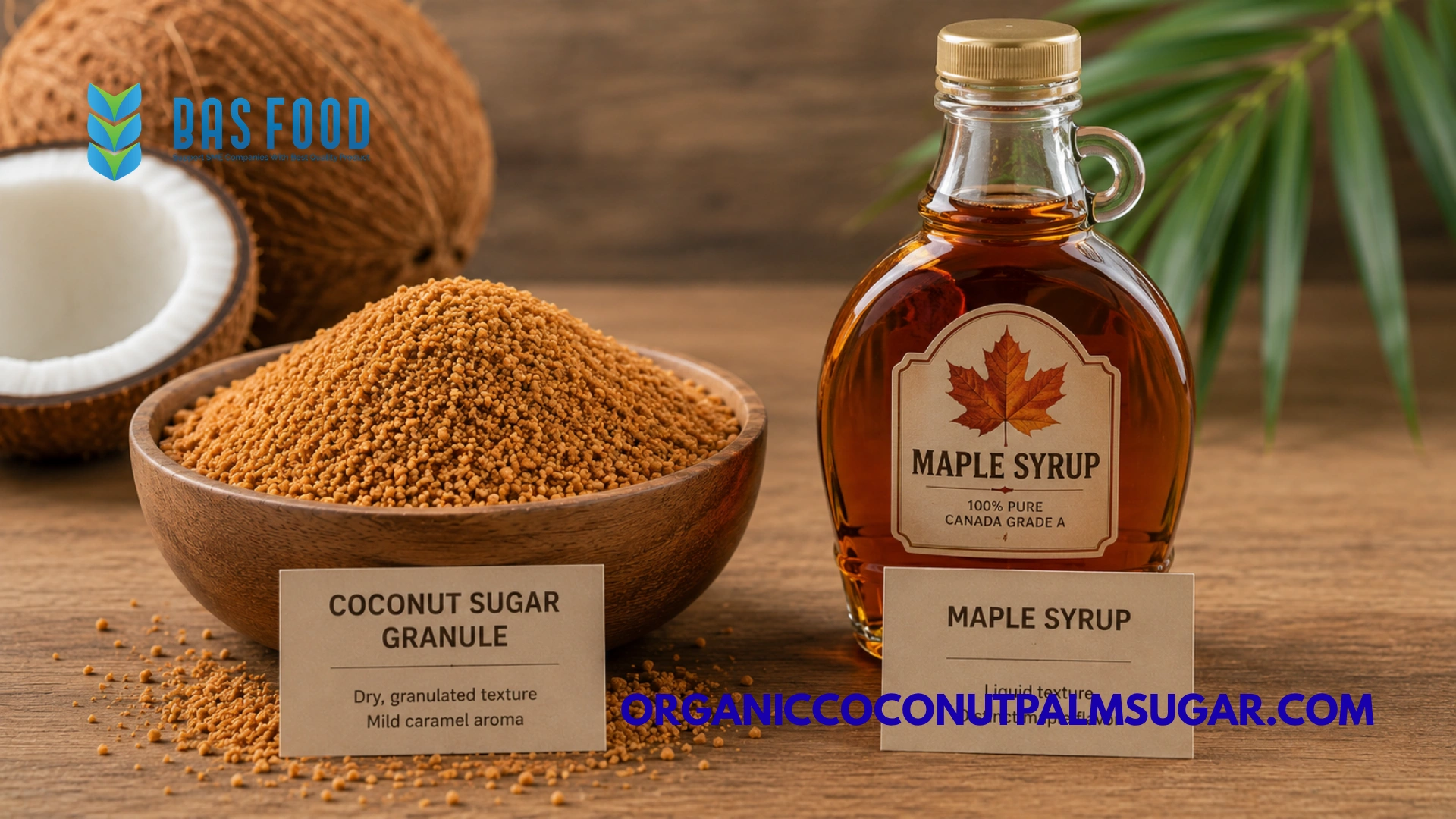
Understanding Coconut Sugar and Liquid Sweeteners
Before comparing these sweeteners, it is important to understand how they differ.
Coconut sugar is produced by collecting fresh sap from coconut blossom flowers. The sap is filtered and slowly heated until the water evaporates, leaving natural sugar crystals that can be processed into granules or powder.
Liquid sweeteners, on the other hand, remain in syrup form. Examples include maple syrup, agave syrup, rice syrup, glucose syrup, date syrup, and coconut syrup. These products retain much of their liquid consistency and are commonly used where immediate blending with liquids is required.
Although both products provide sweetness, they differ significantly in texture, storage, transportation, and manufacturing performance.
Understanding these basic differences helps buyers choose the most appropriate ingredient for their production needs.
Coconut Sugar vs Liquid Sweetener: What Is the Main Difference?
The biggest difference in coconut sugar vs liquid sweetener is physical form.
Coconut sugar is a dry crystalline product that is easy to measure, package, transport, and store. Depending on customer requirements, it is available as granules, powder, or blocks.
Liquid sweeteners contain a higher moisture content and remain pourable throughout storage. Because of their consistency, they are especially useful in products that already contain significant amounts of liquid.
Another important distinction is processing flexibility.
A dry ingredient like coconut sugar works well in both dry and liquid formulations, while liquid sweeteners are generally limited to applications where additional moisture is acceptable.
This flexibility gives coconut sugar an advantage across a broader range of food manufacturing industries.
Syrup vs Sugar: Which Works Better in Manufacturing?
When comparing syrup vs sugar, manufacturers should focus on production efficiency rather than sweetness alone.
Liquid syrups blend quickly into beverages, sauces, and liquid foods because they are already dissolved. This can reduce mixing time in certain production environments.
However, syrups also introduce additional water into recipes.
Extra moisture may require longer cooking times, additional processing, or recipe adjustments to maintain the desired consistency.
Coconut sugar avoids this issue because it is a dry ingredient.
Manufacturers can add sweetness without significantly changing moisture levels, making formulation easier for many bakery products, snack foods, powdered beverages, cereals, and confectionery.
As a result, dry sugar often provides greater flexibility during product development.
Why Dry Sweeteners Offer Greater Production Flexibility
One of the biggest advantages of coconut sugar is that it functions as a reliable dry sweetener.
Dry sweeteners simplify ingredient handling because they are easy to weigh, measure, blend, and package.
Manufacturers producing powdered drink mixes, baking ingredients, instant foods, or nutritional supplements often prefer dry ingredients because they integrate naturally into automated production systems.
Dry ingredients also reduce the risk of unwanted moisture affecting product texture.
For products that require crispness, long shelf life, or controlled moisture content, coconut sugar frequently becomes the preferred sweetening solution.
This versatility explains why coconut sugar is widely used across many different food categories.
Comparing Storage and Shelf Stability
Storage conditions are another important consideration when evaluating sweeteners.
Coconut sugar is relatively easy to store when protected from excessive humidity. Proper packaging helps preserve its quality throughout transportation and warehouse storage.
Liquid sweeteners often require additional attention because containers must prevent leakage while maintaining product quality.
Depending on the product, viscosity may also change under different storage temperatures.
For international shipping, dry products generally offer simpler handling and lower transportation risks.
Because coconut sugar contains less moisture than liquid sweeteners, it is often easier to manage during long-distance export logistics.
Reliable packaging remains important for both products, but dry sugar typically provides greater convenience.
Flavor Differences Between Coconut Sugar and Liquid Sweeteners
Flavor plays an important role in ingredient selection.
Coconut sugar offers a naturally rich sweetness with gentle caramel notes that complement a wide variety of foods.
Its balanced flavor works especially well in bakery products, cereals, coffee, chocolate, desserts, and snack foods.
Liquid sweeteners vary considerably depending on their source.
Some syrups deliver mild sweetness, while others contribute stronger flavors that may influence the final product.
Manufacturers should consider whether they want the sweetener to remain neutral or become part of the overall flavor profile.
For many premium food products, coconut sugar provides a balanced sweetness without overwhelming other ingredients.
Best Applications for Coconut Sugar
Coconut sugar performs exceptionally well across many food categories.
Popular applications include:
- Cookies
- Cakes
- Muffins
- Bread
- Breakfast cereals
- Granola
- Chocolate
- Coffee blends
- Tea products
- Protein powders
- Nutrition bars
- Seasoning mixes
- Dry beverage mixes
- Baking ingredients
Its dry form allows manufacturers to maintain precise ingredient ratios while supporting efficient large-scale production.
Many companies also appreciate the flexibility of using coconut sugar in both retail and industrial products.
When Liquid Sweeteners May Be the Better Choice
Although coconut sugar offers many advantages, liquid sweeteners also have important applications.
Products that naturally contain high moisture often benefit from syrup-based ingredients.
Examples include:
- Beverage concentrates
- Dessert sauces
- Ice cream toppings
- Liquid nutritional supplements
- Syrup-based confectionery
- Ready-to-use sauces
In these applications, liquid sweeteners blend smoothly and help maintain consistent product texture.
Manufacturers should always evaluate how the sweetener interacts with the complete recipe rather than selecting ingredients based solely on sweetness.
Logistics and Transportation Considerations
Logistics can significantly influence ingredient selection for international buyers.
Dry coconut sugar generally requires less specialized handling than liquid products.
Because it is lightweight relative to its sweetness contribution and easier to package in moisture-resistant bags, transportation is often more efficient.
Liquid sweeteners require sealed containers that prevent leaks and may occupy more shipping volume because of their water content.
For exporters shipping internationally, dry products often simplify warehousing, palletizing, and container loading.
These practical advantages make coconut sugar particularly attractive for businesses importing large quantities.
Choosing a Reliable Coconut Sugar Supplier Indonesia
Finding the right supplier is just as important as selecting the right sweetener.
An experienced coconut sugar supplier Indonesia understands international quality standards and offers customized solutions for global food manufacturers.
Reliable suppliers typically provide:
- Various particle sizes
- Powder and granule options
- OEM manufacturing
- Private label services
- Flexible packaging
- Export documentation
- Consistent production quality
- Technical product support
Working with an experienced supplier allows buyers to receive products tailored to their manufacturing processes while ensuring dependable international supply.
Long-term partnerships also improve communication, production planning, and product consistency.
Why Indonesia Leads the Global Coconut Sugar Market
Indonesia is widely recognized as one of the world’s leading producers of coconut sugar.
The country benefits from abundant coconut plantations, experienced farmers, and generations of traditional knowledge in coconut sap harvesting.
Modern export-oriented manufacturers combine these natural advantages with standardized production systems and strict quality control.
As a result, Indonesian exporters can consistently supply high-quality coconut sugar to customers across Europe, North America, Asia, the Middle East, and Africa.
Their ability to provide customized specifications, flexible packaging, OEM production, and reliable export services has made Indonesia a preferred sourcing destination for businesses around the world.
Building a Long-Term Sweetener Sourcing Strategy
Successful ingredient sourcing requires more than choosing the right product.
Importers should evaluate supplier reliability, production capacity, product consistency, packaging quality, and export experience before placing commercial orders.
Requesting product samples and technical specifications helps manufacturers confirm that coconut sugar meets their production requirements.
Regular communication with suppliers also supports continuous improvement as product portfolios expand.
Strong supplier relationships create a stable supply chain, reduce sourcing risks, and improve long-term business performance.
Conclusion
The comparison between coconut sugar vs liquid sweetener ultimately depends on your production goals, product formulation, and target market. While liquid sweeteners are ideal for moisture-rich applications, coconut sugar offers exceptional flexibility as a dry sweetener, making it suitable for a broad range of bakery products, beverages, nutritional foods, confectionery, cereals, and dry ingredient blends.
When evaluating syrup vs sugar, manufacturers should consider not only sweetness but also processing efficiency, storage, transportation, shelf stability, and production consistency. For many commercial food applications, coconut sugar provides a practical and versatile solution that simplifies manufacturing while delivering a rich, naturally caramel-like flavor.
By partnering with a trusted coconut sugar supplier Indonesia, importers and food manufacturers gain access to reliable product quality, customized specifications, professional export support, and long-term supply stability. Choosing the right sweetener today helps create better products and stronger business success tomorrow.