The global demand for coconut sugar continues to grow as food manufacturers and consumers seek natural sweeteners that offer excellent taste, versatility, and minimal processing. While many buyers focus on flavor, color, moisture content, or certifications, one technical specification is often overlooked: coconut sugar particle size.
Particle size may seem like a small detail, but it has a significant impact on food manufacturing. It influences how quickly coconut sugar dissolves, how evenly it blends with other ingredients, how products look, and even how efficiently production equipment operates. For importers, distributors, and food manufacturers, selecting the right particle size is just as important as choosing the right supplier.
Whether you produce instant beverages, bakery products, confectionery, sauces, or nutritional supplements, understanding coconut sugar particle size helps you improve product consistency and manufacturing performance. Choosing the wrong specification can result in uneven mixing, inconsistent sweetness, longer production times, or higher manufacturing costs.
This guide explains everything buyers need to know about coconut sugar particle size, including the differences between fine and coarse granules, how particle size affects food applications, why it matters during international sourcing, and how working with a reliable fine coconut sugar supplier, experienced producer of coarse coconut sugar, and trusted coconut sugar supplier Indonesia supports long-term business success.
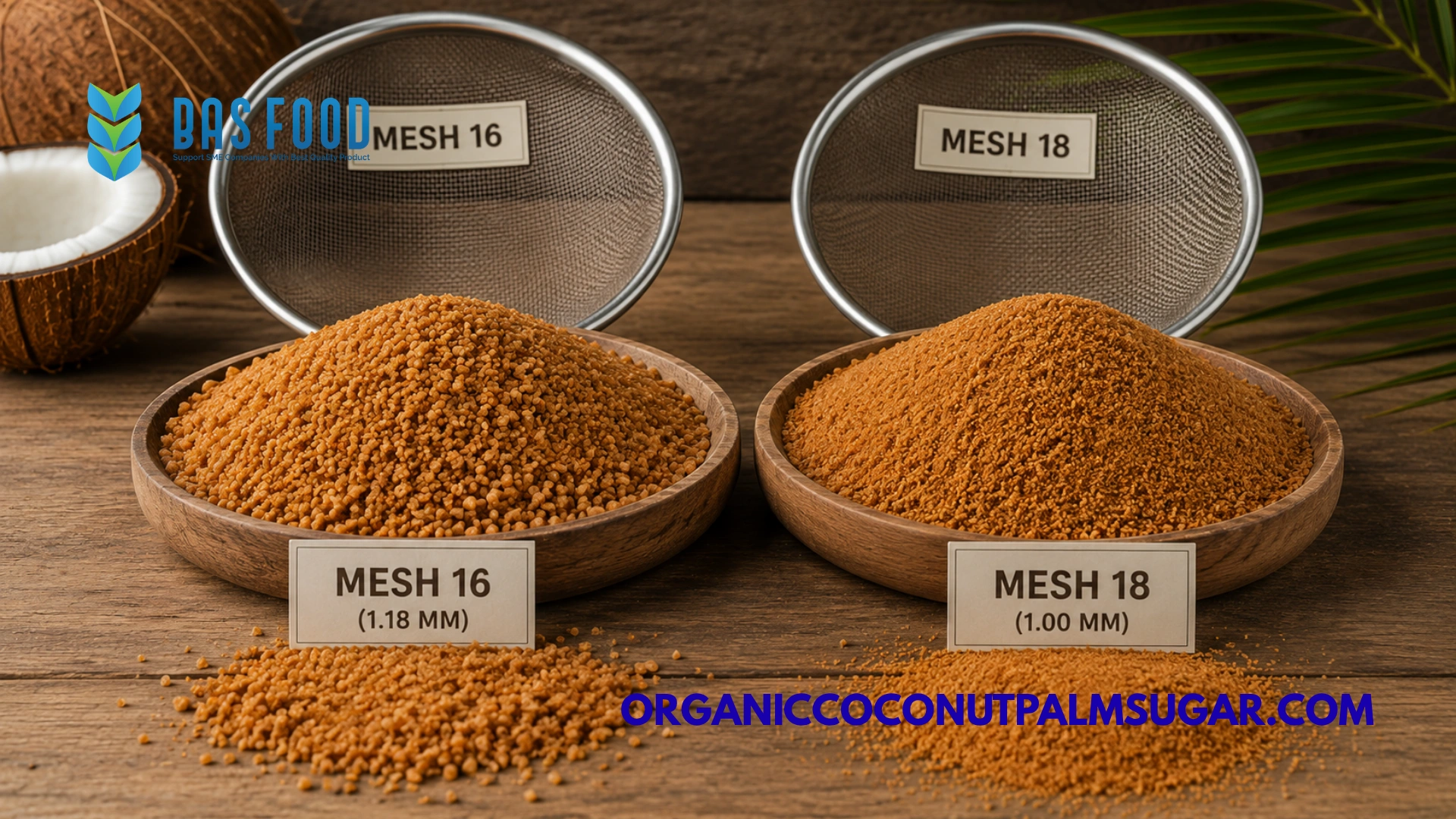
Why Coconut Sugar Particle Size Is More Important Than You Think
Many buyers assume all coconut sugar performs the same because it comes from the same raw material. In reality, particle size changes how the product behaves during processing.
Particle size determines the physical dimensions of each sugar crystal. Smaller particles provide more surface area, allowing them to dissolve faster. Larger granules dissolve more gradually and often contribute additional texture to finished products.
For manufacturers, this difference affects production efficiency, product appearance, sweetness distribution, and processing time.
Selecting the correct particle size ensures coconut sugar performs consistently throughout manufacturing. It also reduces production adjustments and helps companies maintain stable product quality from one batch to another.
How Coconut Sugar Is Produced Before Particle Size Is Adjusted
Coconut sugar begins as fresh sap collected from coconut blossom flowers. Skilled farmers harvest the sap daily before it is filtered and heated slowly to remove water.
As moisture evaporates, natural sugar crystals develop. After drying, the crystals become stable enough for further processing.
At this stage, manufacturers can classify the sugar into different particle sizes using screening and milling equipment.
Some products remain as larger granules, while others are ground into finer particles depending on customer requirements.
Although every specification comes from the same coconut blossom sap, processing allows exporters to provide customized products for different food industries.
Understanding Different Coconut Sugar Particle Sizes
There is no universal particle size that works for every application.
Manufacturers generally classify coconut sugar into several categories, including:
- Fine granules
- Medium granules
- Coarse granules
- Powder
Each specification provides different handling characteristics.
Fine coconut sugar contains smaller crystals that dissolve quickly and distribute evenly during mixing.
Medium granules offer balanced performance across many food applications.
Coarse coconut sugar contains larger crystals that remain visible longer and contribute additional texture.
Powdered coconut sugar provides the fastest dissolution and is commonly used in instant beverage formulations.
Professional exporters often customize particle size according to customer specifications.
Fine Coconut Sugar: Ideal for Fast Mixing and Smooth Products
Many beverage manufacturers and nutritional product companies prefer working with a fine coconut sugar supplier because smaller particles dissolve rapidly.
Fast dissolution improves production efficiency while reducing mixing time.
Fine coconut sugar is commonly used in:
- Instant coffee
- Tea blends
- Chocolate drinks
- Protein powders
- Nutrition supplements
- Dry beverage mixes
- Seasoning blends
Smaller particles also create smoother finished products because they distribute evenly throughout the formulation.
This consistency supports higher product quality while simplifying large-scale manufacturing.
For businesses producing powdered products, fine coconut sugar often delivers the best overall performance.
Coarse Coconut Sugar Offers Excellent Texture
While fine particles dissolve quickly, coarse coconut sugar provides unique advantages in many food applications.
Larger granules help create visual appeal and texture in finished products.
Common applications include:
- Cookies
- Muffins
- Cakes
- Artisan bread
- Breakfast cereals
- Granola
- Dessert toppings
Because coarse particles dissolve more gradually, they contribute to the eating experience while maintaining a natural appearance.
Many premium food brands intentionally choose coarse coconut sugar to create products that look handcrafted and authentic.
The best choice always depends on the intended product application.
How Particle Size Affects Food Manufacturing
Particle size influences almost every stage of food production.
Smaller particles improve ingredient distribution because they blend more easily with dry mixes.
They also dissolve faster during liquid processing, reducing mixing time and improving production efficiency.
Larger particles may require additional mixing, but they often provide better texture and appearance in baked goods.
Particle size also affects equipment performance.
Uniform granules flow more consistently through automated filling systems, reducing production interruptions and supporting accurate packaging.
These factors demonstrate why selecting the correct particle size contributes directly to manufacturing success.
Choosing the Right Particle Size for Different Products
Different food categories require different coconut sugar specifications.
For beverages and powdered formulations, fine particle sizes are usually preferred because they dissolve quickly.
For bakery products, medium and coarse granules often create better texture and appearance.
Confectionery manufacturers may select customized particle sizes depending on product design.
Sauce producers often prefer fine granules that blend smoothly without extended mixing.
There is no single specification suitable for every industry.
Experienced suppliers help customers select particle sizes based on production methods and finished product requirements.
Quality Control for Consistent Particle Size
Maintaining consistent particle size requires careful production control.
Professional manufacturers use screening equipment to separate granules according to customer specifications.
Quality control teams regularly inspect:
- Particle size distribution
- Moisture content
- Color consistency
- Product cleanliness
- Flavor
- Aroma
- Packaging quality
Uniform particle size improves production consistency while reducing manufacturing variability.
Reliable exporters perform routine inspections throughout production to ensure every shipment matches customer requirements.
Consistency builds confidence and supports long-term supplier relationships.
Why Buyers Should Request Particle Size Specifications
Many importers request information about moisture content or packaging but forget to discuss particle size.
This oversight may lead to production challenges after the shipment arrives.
Before placing commercial orders, buyers should request detailed technical specifications describing the desired particle size.
It is also helpful to receive product samples representing the requested granule size.
Testing these samples in actual production conditions allows manufacturers to confirm performance before approving larger purchases.
Clear communication reduces misunderstandings while improving production efficiency.
Choosing a Reliable Coconut Sugar Supplier Indonesia
Finding the right supplier is just as important as selecting the right product specification.
A professional coconut sugar supplier Indonesia understands international quality expectations and offers flexible manufacturing capabilities.
Experienced exporters can provide:
- Customized particle sizes
- Product samples
- Technical specifications
- Flexible packaging
- OEM manufacturing
- Private label services
- Export documentation
- Reliable production schedules
Strong communication also allows suppliers to recommend the most suitable particle size for specific food applications.
Working with an experienced Indonesian exporter helps businesses reduce sourcing risks while maintaining consistent product quality.
Why Indonesia Leads the Global Coconut Sugar Industry
Indonesia has become one of the world’s largest producers and exporters of coconut sugar thanks to its abundant coconut plantations and experienced farming communities.
Traditional harvesting techniques, combined with modern processing technology, allow Indonesian manufacturers to produce coconut sugar in a wide range of specifications.
Many export-oriented facilities operate standardized quality management systems that ensure consistency in flavor, color, moisture content, and particle size.
International buyers also benefit from Indonesia’s strong export infrastructure, competitive production capacity, and flexible packaging options, making the country a preferred sourcing destination for businesses around the world.
Building a Long-Term Supply Partnership
Long-term sourcing success depends on more than competitive pricing.
Businesses should work with suppliers that understand technical requirements, communicate clearly, and maintain consistent production quality.
Regular discussions about particle size, packaging, production schedules, and future demand help strengthen supplier relationships.
As trust develops, suppliers can often recommend process improvements and customized specifications that improve manufacturing efficiency.
Strong partnerships create greater stability throughout the supply chain while supporting sustainable business growth.
Conclusion
Understanding coconut sugar particle size helps importers, food manufacturers, and distributors choose the right product for their specific applications. Fine particles improve dissolution, mixing, and production efficiency, while coarse coconut sugar provides enhanced texture and visual appeal for bakery and specialty food products.
Working with an experienced fine coconut sugar supplier ensures access to customized specifications that match production requirements. Likewise, partnering with a trusted coconut sugar supplier Indonesia offers dependable quality, flexible packaging, consistent manufacturing, and professional export support.
By carefully selecting the appropriate particle size and building long-term relationships with reliable suppliers, businesses can improve product quality, streamline manufacturing processes, and strengthen their position in the growing global market for natural sweeteners.