The snack industry keeps changing. Consumers want convenient foods, interesting flavors, and ingredient lists that are easy to understand. At the same time, manufacturers need ingredients that work reliably at scale. This combination has created more interest in alternative sweeteners, including coconut sugar granules. For manufacturers developing granola bars, energy bites, roasted nuts, snack clusters, cookies, crackers, and other products, coconut sugar granules for snacks can provide sweetness along with a characteristic caramel-like flavor and warm color. Unlike liquid sweeteners, granules are easy to weigh, blend, transport, and store.
However, selecting a sweetener for commercial snack production involves more than choosing a product based on its name. Particle size, moisture, color, flavor, solubility, packaging, and batch consistency can all affect the manufacturing process.
This guide explains how coconut sugar granules can fit into snack production and what international buyers should consider when working with a coconut sugar exporter supplier.
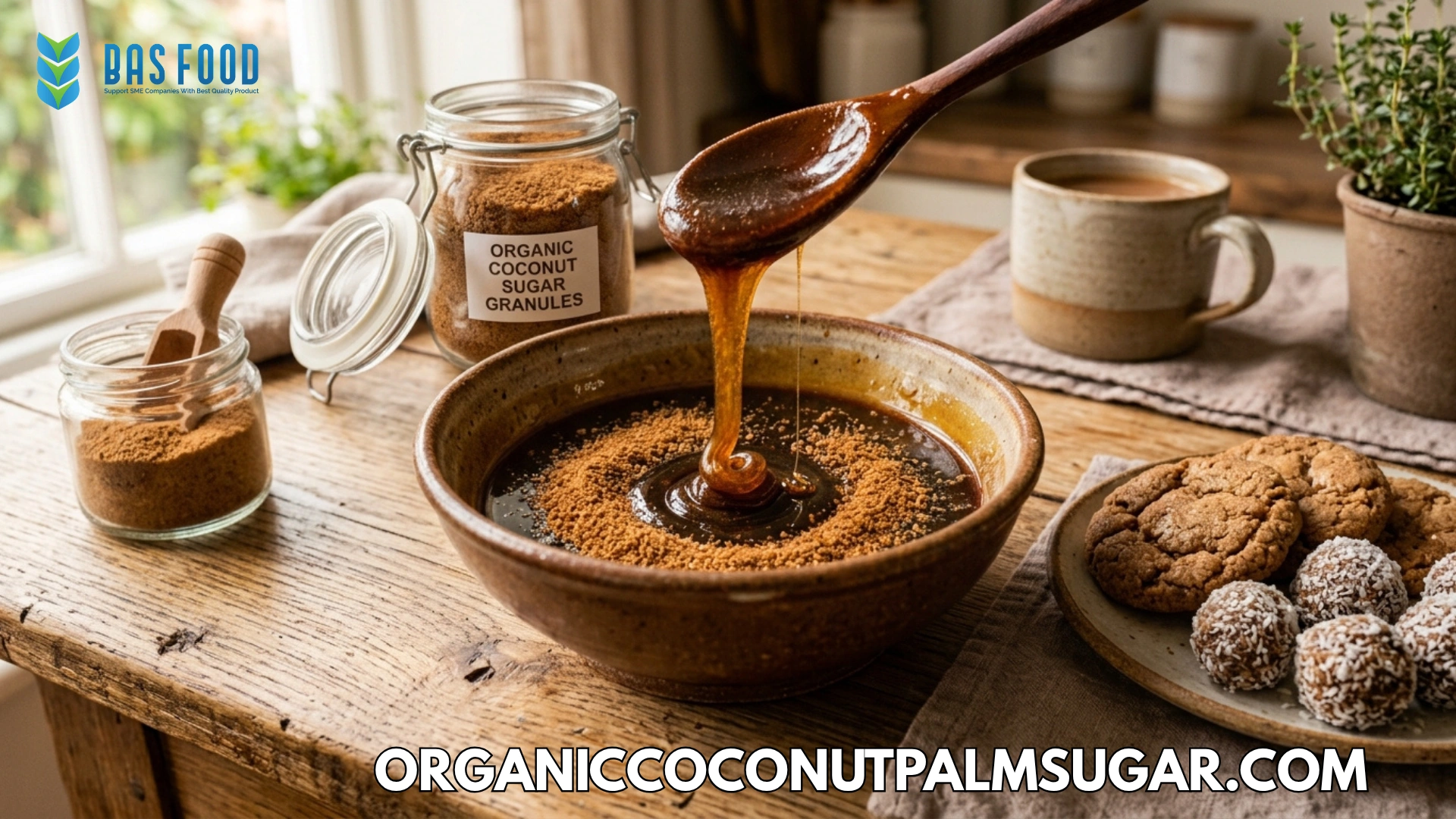
Why Coconut Sugar Granules Are Interesting for Snack Production
Snacks come in many forms, so manufacturers need ingredients that can work across different production methods. Granules can be blended with dry ingredients, incorporated into doughs, used in coatings, or dissolved as part of a larger formulation.
This versatility makes coconut sugar granules an interesting option for different types of snacks. They can complement ingredients such as oats, nuts, seeds, coconut, chocolate, dried fruit, spices, and grains.
The granules also provide a distinct flavor compared with ordinary white sugar. Depending on the product and processing, coconut sugar can contribute caramel-like and mildly earthy notes that may support the overall flavor profile of a snack.
For food manufacturers, this can create opportunities to develop products with a different sensory character while maintaining a familiar sweet taste.
What Are Coconut Sugar Granules?
Coconut sugar granules are a dry form of coconut sugar processed into small particles. They are produced from coconut sap through controlled processing and concentration before being formed into a granular product.
The finished granules can vary in particle size, color, moisture, and texture. These differences matter because not every granule size performs in exactly the same way.
For example, fine granules can disperse more easily in some formulations, while larger granules may provide different handling characteristics. Therefore, manufacturers should select the format based on the intended application.
When sourcing commercially, buyers should ask their coconut sugar supplier about particle size and product specifications rather than assuming all coconut sugar granules have identical properties.
Coconut Sugar Granules for Snacks: Where Can They Be Used?
The phrase coconut sugar granules for snacks covers a wide range of potential applications. Dry granules can be incorporated into recipes where manufacturers need a granular sweetening ingredient.
Potential applications include:
- Granola
- Granola bars
- Snack bars
- Energy bites
- Roasted nuts
- Seed clusters
- Trail mixes
- Cookies
- Biscuits
- Baked snacks
- Cereal-based snacks
- Coconut snacks
- Chocolate snacks
- Oat-based products
- Snack coatings
Each application has different processing requirements. Therefore, the same coconut sugar granules may perform differently depending on the recipe and manufacturing method.
The best approach is to test the ingredient in the actual formulation. This helps manufacturers understand how the granules interact with other ingredients during mixing, baking, roasting, binding, or coating.
Granola and Snack Clusters
Granola is one of the most natural applications for coconut sugar granules. Granola often combines oats, nuts, seeds, dried fruit, and a sweetening or binding component.
Coconut sugar can contribute sweetness and a warm flavor that pairs well with toasted oats and nuts. It can also complement ingredients such as cinnamon, cocoa, coconut, almonds, cashews, and dried berries.
In dry granola formulations, particle size matters. The granules need to distribute reasonably evenly throughout the mixture so that sweetness does not become concentrated in particular areas.
For manufacturers, consistent mixing is therefore an important part of production. A well-controlled ingredient specification can make formulation trials and repeat production easier.
Snack Bars and Energy Bites
Snack bars and energy bites often contain combinations of oats, nuts, seeds, dried fruit, protein ingredients, and sweeteners. Depending on the formulation, coconut sugar granules can be used as part of the sweetening system.
The flavor of coconut sugar can work particularly well with nuts, cocoa, peanut, coconut, cinnamon, and vanilla. These combinations can create a more rounded flavor profile than sweetness alone.
However, manufacturers should consider how the dry granules interact with the other ingredients. In some formulations, the sugar may need to dissolve or partially melt during processing to help create the desired texture.
Therefore, product testing is important. The ideal ingredient specification depends on whether the manufacturer wants a soft bar, crunchy bar, chewy bite, or another texture.
Roasted Nuts and Seed Snacks
Roasted nuts and seeds are another potential application. Snack producers may use sweeteners as part of a coating or flavor system for almonds, peanuts, cashews, sunflower seeds, pumpkin seeds, and mixed nut products.
Coconut sugar’s characteristic color and flavor can complement roasted ingredients. The combination can create a sweet and toasted sensory profile.
However, coating performance depends on the complete recipe and processing conditions. Sugar behavior during heating should be evaluated carefully during product development.
For commercial production, manufacturers should run controlled trials before moving from laboratory batches to full-scale production.
Cookies, Biscuits, and Baked Snacks
Coconut sugar granules can also be incorporated into cookies and biscuits. In these products, the sugar contributes sweetness while also influencing color and texture.
The choice of granule size can affect how quickly the sugar dissolves or disperses during mixing and baking. Fine granules may behave differently from larger particles.
The other ingredients also matter. Flour, fats, eggs, water, leavening agents, chocolate, nuts, and other components can all affect the final product.
Therefore, manufacturers should evaluate coconut sugar as part of the complete formulation rather than considering it as an isolated ingredient.
The Importance of Particle Size
Particle size is one of the most useful specifications to discuss when purchasing coconut sugar granules. The term “granules” can cover different particle ranges.
For snack manufacturers, particle size can influence mixing, dissolution, distribution, texture, and processing behavior.
A manufacturer producing a dry snack blend may prefer a particular particle size to achieve uniform distribution. Meanwhile, a bakery producer may have different requirements based on the mixing and baking process.
Consequently, buyers should ask their coconut sugar exporter supplier for clear information about available particle sizes and whether a particular specification can be maintained consistently.
Moisture and Storage
Moisture is another important consideration for dry snack ingredients. Coconut sugar granules should be stored appropriately to help maintain their physical condition.
Exposure to moisture can affect granule flow and may cause particles to become sticky or form lumps. This can make handling and automated dosing more difficult.
For this reason, packaging plays an important role. Manufacturers and distributors should keep the product protected from excessive humidity and follow the supplier’s recommended storage conditions.
During international transportation, packaging should also be suitable for the destination and expected handling environment.
Flavor Profile and Snack Development
One of the main reasons manufacturers may explore coconut sugar as a natural sweetener is its distinctive flavor. The taste can add another sensory layer to a snack instead of providing sweetness alone.
Coconut sugar can work well with familiar snack flavors such as chocolate, coffee, coconut, cinnamon, nuts, caramel-style flavors, and dried fruit.
However, the flavor should match the product concept. A subtle sweetener profile may be more suitable for one snack, while another product may be designed around a richer caramel-like taste.
This makes sensory testing an important part of product development. Manufacturers can compare different dosage levels and determine how coconut sugar affects the final product.
Color and Appearance in Snack Products
Coconut sugar typically has a brown to golden-brown appearance. When used in snack production, this color can influence the finished product.
In cookies and baked snacks, for example, the sugar can contribute to a darker appearance. In granola, the color may support the toasted visual character of oats and nuts.
However, color requirements vary by product. A manufacturer developing a very light-colored snack may prefer a different sweetening approach.
Therefore, buyers should consider both flavor and visual appearance when testing coconut sugar granules for snacks.
Coconut Sugar as a Natural Sweetener
The term natural sweetener is commonly used when discussing coconut sugar. From a sourcing perspective, manufacturers should still focus on the actual product specification and intended use rather than relying on marketing language alone.
Coconut sugar comes from coconut sap, which is processed into a dry sweetener. Its characteristic flavor, color, and granular form make it different from highly refined white sugar.
For snack brands, this can provide an alternative ingredient story when appropriate for their product positioning.
However, food manufacturers should always ensure that their product labeling and claims meet the requirements of the market where the finished snack will be sold.
Mixing Coconut Sugar With Other Snack Ingredients
Snack formulations often contain several ingredients that need to be evenly distributed. Coconut sugar granules therefore need to mix properly with the rest of the recipe.
Dry mixing can involve oats, flour, nuts, seeds, cocoa, spices, milk powders, or other powdered ingredients. The particle size of each ingredient can influence the final distribution.
If coconut sugar particles are significantly different in size or density from the other ingredients, the manufacturer may need to adjust the mixing process.
A practical production trial can help determine the correct mixing time and sequence. This is particularly important for large-scale production where small differences can become more noticeable.
Coconut Sugar Granules in Clean-Label Snack Development
Many snack brands pay close attention to ingredient lists. As a result, manufacturers continue to evaluate recognizable ingredients that fit their product concept.
Coconut sugar can be considered as one option within this broader ingredient strategy. Its simple identity as a sugar derived from coconut sap can make it relevant to certain product formulations.
However, “clean label” does not mean the same thing in every market. Regulatory expectations, labeling rules, and consumer preferences can differ between countries.
Therefore, manufacturers should work with their regulatory and product development teams when determining how an ingredient should be presented on packaging.
Why Samples Matter for Food Manufacturers
A sample can provide much more useful information than a product description alone. Manufacturers can use the sample in their own formulation and evaluate actual production behavior.
For example, a product development team can test how coconut sugar distributes through a granola mixture, how it behaves during baking, or how it contributes to the flavor and color of a snack bar.
The team can also compare different particle sizes if the supplier offers multiple options.
This process reduces the risk of selecting a product that looks suitable on paper but does not perform as expected in production.
Choosing a Coconut Sugar Exporter Supplier
For international buyers, supplier selection involves both product quality and supply capability. A suitable coconut sugar exporter supplier should be able to communicate product specifications clearly and support the requirements of international customers.
Buyers should consider the supplier’s ability to provide consistent products, appropriate packaging, export documentation, samples, and clear communication.
Price is naturally an important factor, but it should be evaluated alongside product performance and supply reliability.
A slightly different product specification can sometimes create additional costs during manufacturing. Therefore, the most useful comparison is the overall fit between the ingredient and the production process.
CV Bonafide Anugerah Sentosa for Coconut Sugar Sourcing
CV Bonafide Anugerah Sentosa is an Indonesian exporter of coconut sugar and other coconut-derived products. International buyers looking for coconut sugar products can include the company in their supplier evaluation process.
For snack manufacturers, product discussions can focus on the intended application, particle size, packaging, volume requirements, and other relevant specifications.
This application-based approach helps both buyer and supplier understand what type of coconut sugar product is needed.
It can also make the sample evaluation process more useful because the supplier knows how the buyer intends to use the ingredient.
Building a Long-Term Supply Strategy
Buying coconut sugar once is different from developing a long-term ingredient supply. Snack manufacturers need to consider future production volumes and whether the supplier can support repeat orders.
Consistency becomes particularly important as production grows. A recipe developed using a specific ingredient should continue to perform as expected when new batches arrive.
Therefore, manufacturers should establish clear specifications and quality expectations from the beginning.
Regular communication with the coconut sugar supplier can also help both sides manage changes in demand, packaging, production schedules, and shipment requirements.
Common Mistakes When Buying Coconut Sugar Granules
One common mistake is focusing only on price. A low-cost ingredient may not provide the required particle size, moisture level, flavor, or consistency for a specific snack application.
Another mistake is ordering a large volume without first testing a sample. This can create unnecessary risk, especially when introducing a new ingredient into an established production process.
Some buyers also fail to specify storage and packaging requirements. Since coconut sugar is a dry ingredient that can respond to moisture, proper handling matters.
Finally, buyers sometimes use the word “granules” without defining the desired particle range. Clear specifications can prevent misunderstandings between buyer and supplier.
The Future of Coconut Sugar in Snack Manufacturing
Snack manufacturers continue to explore ingredients that offer useful functionality and distinctive sensory properties. Coconut sugar is one ingredient that can fit certain product concepts because it provides sweetness in a dry, granular format.
Its flavor and color can complement many familiar snack ingredients, particularly nuts, oats, coconut, chocolate, spices, and dried fruits.
At the same time, manufacturers will continue to prioritize consistency, efficient processing, reliable supply, and clear product specifications.
Therefore, future demand for coconut sugar in snacks will depend not only on consumer interest but also on suppliers’ ability to provide consistent ingredients that meet commercial manufacturing requirements.
Final Thoughts
Coconut sugar granules for snacks can be a versatile ingredient for manufacturers developing granola, snack bars, roasted nuts, cookies, energy bites, and other food products.
The main advantage is not simply sweetness. Coconut sugar granules can contribute a characteristic flavor and warm color while offering the practical handling benefits of a dry ingredient.
However, successful commercial use requires careful evaluation. Particle size, moisture, flavor, color, storage, packaging, and batch consistency should all be considered before placing a large order.
For international buyers, working with a capable coconut sugar supplier can make the sourcing process more straightforward. Clear specifications and product samples allow manufacturers to evaluate the ingredient before moving into regular production.
For businesses searching for an Indonesian coconut sugar exporter supplier, CV Bonafide Anugerah Sentosa can be included in the supplier evaluation process. By matching the right coconut sugar specification with the intended snack application, manufacturers can create a more predictable and efficient ingredient sourcing strategy.