Walk through any supermarket today and you will find cereal in many forms. There are crunchy breakfast cereals, granola clusters, oat mixes, cereal bars, muesli, and specialty grain products. Although these products can look very different, they often share one important ingredient challenge: finding the right sweetener. For manufacturers, sweetness is only part of the equation. The sweetener also needs to work well with grains, nuts, seeds, dried fruit, oils, flavors, and other ingredients. It should be easy to handle during production and provide consistent results from batch to batch. This is where coconut sugar granules for cereal can become an interesting ingredient option.
Coconut sugar granules are made from coconut blossom sap that is collected, heated, concentrated, and processed into a dry granular form. Their natural brown color and mild caramel-like flavor can complement many cereal products.
For B2B buyers, however, choosing coconut sugar involves more than simply replacing conventional sugar. Granule size, moisture, flavor, color, packaging, quality specifications, and supply capacity all deserve attention. Therefore, manufacturers should understand both the ingredient and the production requirements before making a purchasing decision.
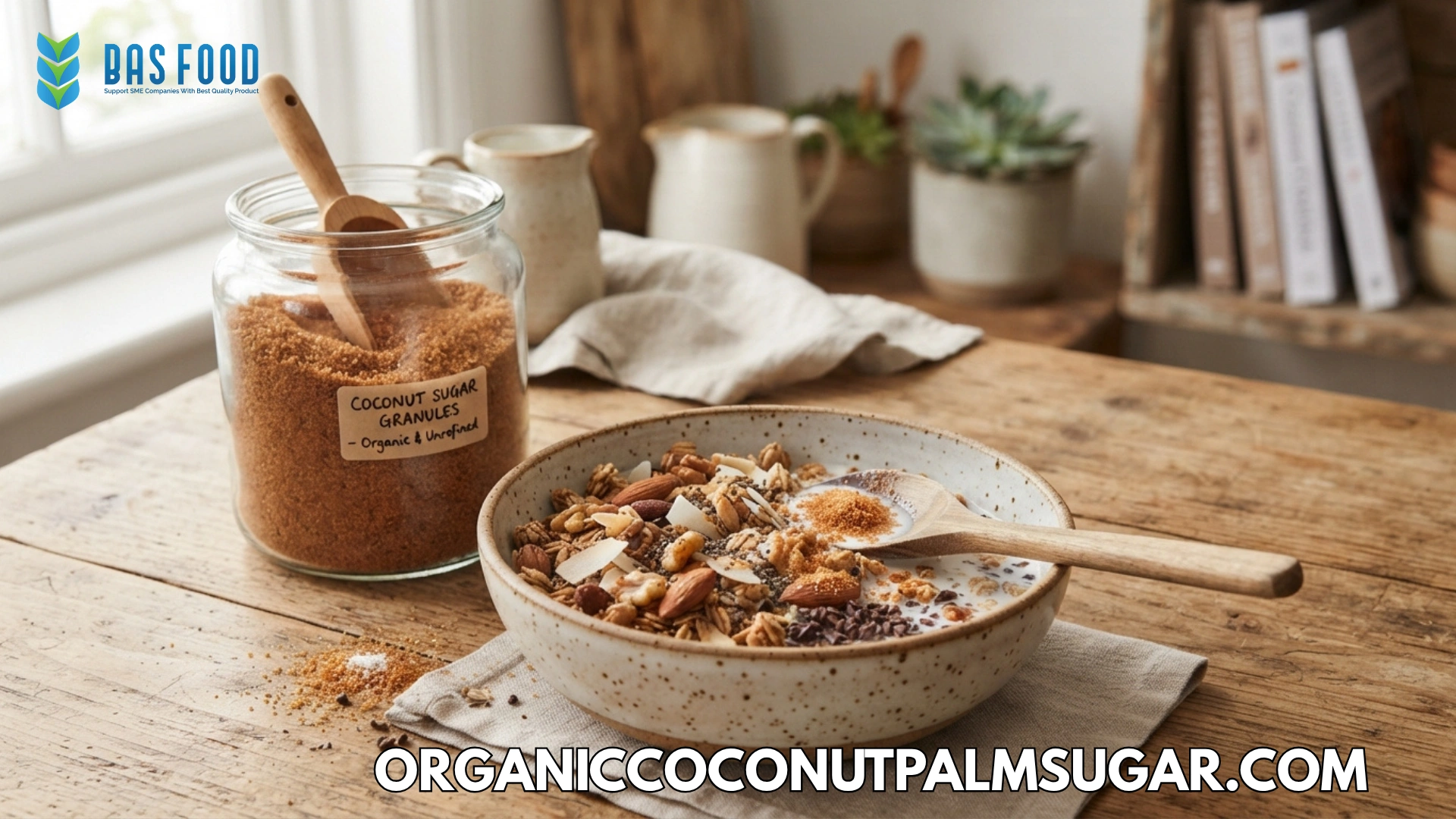
What Are Coconut Sugar Granules?
Coconut sugar granules are a dry sweetener produced from the sap of coconut flower blossoms. The sap is collected and concentrated through controlled heating until it develops the characteristics associated with coconut sugar. Producers can then process the sugar into different physical formats, including granules.
The granular form is particularly practical for food manufacturing because it can be weighed, mixed, stored, and transported as a dry ingredient. Manufacturers can incorporate it into dry blends or use it in processes where the sugar later dissolves or melts.
Coconut sugar generally has a brown or golden-brown appearance. It also has a characteristic sweet flavor that can include mild caramel or toffee notes. These qualities may work well with cereal products that already contain oats, nuts, seeds, cocoa, cinnamon, or dried fruit.
However, not every cereal formulation requires the same sugar specification. Manufacturers should select a product based on the needs of the final application rather than simply choosing a standard coconut sugar product.
Why Coconut Sugar Granules Work Well in Cereal Products
Cereal products often combine several ingredients with different textures and flavors. Grains may provide a neutral base, while nuts, seeds, fruit, cocoa, spices, and sweeteners create the final sensory profile.
Because of its granular format, coconut sugar can be incorporated into certain dry cereal blends relatively easily. Its brown color can also complement whole-grain products and granola, where a darker appearance is often consistent with the overall product style.
The flavor is another consideration. Coconut sugar can provide a deeper sweetness than a very neutral refined sugar. Its caramel-like notes may complement toasted oats, almonds, peanuts, cashews, cinnamon, cocoa, and other common cereal ingredients.
Nevertheless, manufacturers should conduct formulation trials. The effect of coconut sugar depends on the amount used and the other ingredients in the recipe.
For example, a lightly sweetened oat cereal may need a different amount of coconut sugar from a heavily flavored granola cluster. Product developers should therefore determine the appropriate dosage through testing.
Coconut Sugar as a Granola Ingredient
Granola is one of the most natural applications to explore for coconut sugar. Typical granola formulations include oats, nuts, seeds, dried fruit, oils, spices, and a sweetening component.
In this setting, granola ingredients need to work together during mixing and baking. Coconut sugar can contribute sweetness and a brown color while complementing the toasted flavors that develop during processing.
Manufacturers can use coconut sugar in granola recipes where its flavor profile fits the desired product. It may work especially well with ingredients such as cinnamon, cocoa, coconut flakes, almonds, walnuts, pumpkin seeds, or dried berries.
However, granola production requires attention to formulation balance. Sugar does not simply add sweetness. It can also influence browning, texture, cluster formation, and the overall eating experience.
Therefore, food technologists should test coconut sugar at different inclusion levels. This helps determine how it affects the finished product without relying on assumptions based solely on its ingredient name.
The Role of Granule Size in Cereal Manufacturing
Particle size is an important specification when sourcing coconut sugar granules for cereal. Different cereal products can require different granule characteristics depending on the production method.
Smaller granules may distribute more evenly throughout a dry mix. Larger particles, meanwhile, may behave differently during mixing and baking.
For cereal manufacturers, uniform distribution is important. If the sweetener does not distribute evenly, some portions of the product may taste sweeter than others.
Particle size can also influence how quickly the sugar dissolves or melts during processing. This becomes particularly relevant when manufacturers use heat to create clusters or other cereal textures.
As a result, buyers should discuss particle-size options with their coconut sugar supplier. A supplier that understands the intended application can provide more useful guidance than one that simply offers a generic product.
How Coconut Sugar Fits Cereal Manufacturing
Cereal manufacturing can involve several production methods. Some products are mixed and baked, while others are extruded, toasted, coated, dried, or combined with additional ingredients after processing.
The suitability of coconut sugar depends on the specific production method. In baked granola, for example, sugar can contribute to browning and cluster formation. In a dry cereal mix, the focus may be more on sweetness distribution and ingredient handling.
Manufacturers should therefore assess coconut sugar at the process level. The question is not simply whether coconut sugar tastes good. Instead, the important question is whether it performs consistently under the manufacturer’s actual processing conditions.
This is where pilot production becomes valuable. A small-scale test can reveal how the ingredient behaves before the manufacturer commits to a large commercial order.
Testing can include mixing performance, processing behavior, finished-product appearance, flavor, texture, and shelf-life considerations.
Coconut Sugar for Granola Clusters
Granola clusters have become a popular cereal format because consumers often enjoy a combination of crunch, grains, nuts, and sweetness. Creating consistent clusters, however, requires careful formulation.
Sweeteners can play a role in binding ingredients together during baking or heating. Coconut sugar may be useful in selected recipes, particularly when manufacturers want its characteristic color and flavor.
The exact effect depends on the formulation. Oils, syrups, grains, nuts, seeds, and other ingredients can all influence cluster formation.
Therefore, manufacturers should test the ingredient together with the complete recipe rather than evaluating coconut sugar separately.
A well-designed trial can help determine whether the granules provide the desired level of sweetness and contribute to the desired cluster structure.
Coconut Sugar for Different Breakfast Foods
The market for breakfast foods extends well beyond traditional cereal. It includes granola, muesli, oat mixes, cereal bars, breakfast bites, and other grain-based products.
This creates several potential applications for coconut sugar granules. Manufacturers can evaluate the ingredient wherever a dry sweetener with a distinctive brown color and flavor fits the formulation.
For cereal bars, for example, coconut sugar can be considered alongside other sweetening and binding ingredients. For muesli, the main consideration may be distribution throughout the dry mixture.
Meanwhile, granola manufacturers may focus more on caramelization, browning, and cluster formation during baking.
The important point is that each application needs its own formulation approach. There is no single recipe that works for every breakfast product.
Flavor Pairings That Work With Coconut Sugar
One advantage of coconut sugar is its ability to pair with many familiar cereal flavors. Its mild caramel-like profile can complement ingredients that already appear in breakfast products.
Some potential combinations include:
- Oats and whole grains
- Almonds and other nuts
- Pumpkin and sunflower seeds
- Cinnamon and warming spices
- Cocoa and chocolate
- Coconut flakes
- Dried berries
- Raisins and dates
- Vanilla
- Coffee flavors
These combinations can help manufacturers develop products with a more layered flavor profile.
However, the amount of coconut sugar matters. Too much sweetener can overpower delicate ingredients, while too little may not deliver the intended flavor contribution.
Product development teams should therefore conduct controlled trials and evaluate both sweetness and overall flavor balance.
Color and Appearance in Cereal Products
Visual appearance has an important role in food products. Cereal buyers may expect a certain color based on the type of product they purchase.
Coconut sugar naturally has a brown color, which can work well with whole-grain cereal, granola, and toasted products.
For some manufacturers, this color can contribute to the visual identity of the product. It may create an appearance that fits naturally positioned or minimally styled cereal products.
However, it may not be suitable for every formulation. Manufacturers producing very light-colored cereals should consider whether the color contribution fits their product concept.
This is another reason to request samples before purchasing in bulk. A simple visual test can quickly show how the ingredient affects the final cereal.
Moisture and Storage Considerations
Moisture is an important consideration when handling granular sweeteners. Excessive moisture can affect the physical condition of dry ingredients during storage.
Cereal manufacturers typically need ingredients that remain manageable during transportation, storage, weighing, and production.
Therefore, buyers should review the supplier’s moisture specification and recommended storage conditions.
The storage environment also matters. Coconut sugar granules should generally be protected from excessive humidity and stored in suitable food-grade conditions according to the supplier’s recommendations.
Proper packaging can help maintain the ingredient’s condition during transportation and storage. This becomes especially important for international shipments, where the product may travel for extended periods.
Quality Control for Coconut Sugar Granules
Quality control is essential when sourcing any ingredient for commercial food production. For coconut sugar granules for cereal, buyers should consider both physical and food-safety characteristics.
Depending on the buyer’s requirements, specifications may cover:
- Appearance
- Color
- Granule size
- Moisture
- Flavor and aroma
- Foreign matter
- Microbiological parameters
- Packaging condition
- Shelf life
- Storage requirements
The exact specification should be agreed between the buyer and supplier.
For larger cereal manufacturers, batch consistency is particularly important. A major change in color or particle size can affect the finished product and may require production adjustments.
Therefore, buyers should work with suppliers that maintain clear product specifications and quality-control procedures.
Why Sampling Matters Before Bulk Purchasing
A product specification can tell buyers a lot, but a physical sample provides another level of information.
Manufacturers can test the coconut sugar in their actual cereal or granola formulation. This allows the R&D team to evaluate flavor, color, mixing, baking performance, and final texture.
Sampling also gives purchasing teams an opportunity to compare potential suppliers using the same application test.
Rather than asking which supplier has the lowest price, manufacturers can evaluate which product meets their technical requirements at the desired commercial cost.
For B2B sourcing, this approach creates a more useful basis for purchasing decisions.
Packaging Options for Cereal Manufacturers
Cereal manufacturers purchase ingredients at different scales. A small specialty producer may require smaller bags, while a large industrial facility may need bulk packaging.
Therefore, packaging flexibility can be an important supplier consideration.
The packaging should protect the coconut sugar from moisture, contamination, and physical damage. It should also be practical for the buyer’s warehouse and production system.
International buyers should discuss packaging requirements before confirming an order. This includes the size of each package, number of units, pallet configuration where applicable, and other shipping considerations.
An experienced supplier can help buyers determine a practical packaging solution based on order volume and logistics requirements.
Choosing the Right Coconut Sugar Supplier
Selecting a coconut sugar supplier requires a broader evaluation than comparing product prices.
Food manufacturers should consider:
- Product consistency
- Technical specifications
- Production capacity
- Quality-control procedures
- Packaging options
- Documentation
- Minimum order quantities
- Lead times
- Export experience
- Communication
A supplier that meets the technical requirements but cannot provide sufficient volume may not be suitable for a large cereal manufacturer.
Similarly, a supplier with adequate capacity but inconsistent product specifications may create formulation challenges.
Therefore, buyers should evaluate the complete supply relationship.
Why an Experienced Coconut Sugar Exporter Supplier Matters
For international cereal manufacturers, the supply chain does not end at the factory gate. The ingredient must also be packaged, documented, shipped, and delivered to the destination market.
An experienced coconut sugar exporter supplier can help overseas buyers navigate these practical requirements.
Export experience can be especially useful when buyers require specific packaging, commercial documentation, shipment planning, or regular supply.
It can also make communication easier. International ingredient sourcing often involves technical discussions between purchasing, quality, production, and supplier teams.
A supplier that understands these needs can make the process more predictable.
Sourcing Coconut Sugar From Indonesia
Indonesia is an established origin for coconut-based agricultural products. Its large coconut-growing areas provide access to raw materials used in various coconut-derived ingredients.
For international cereal manufacturers, sourcing from an Indonesian coconut sugar supplier can provide access to coconut sugar produced close to its agricultural source.
Nevertheless, buyers should evaluate individual suppliers carefully. Production systems, product specifications, capacity, and export capabilities can differ.
Sample evaluation and technical discussions remain important regardless of the origin.
CV Bonafide Anugerah Sentosa as a Potential Supply Partner
For companies exploring Indonesian coconut sugar, CV Bonafide Anugerah Sentosa is an exporter that can be considered when evaluating potential supply partners.
The company supplies coconut sugar and other coconut-derived products for international buyers. Manufacturers interested in using coconut sugar for cereal or granola can discuss their specific requirements directly with the supplier.
When approaching a supplier, buyers should provide useful information about their application. This may include the intended product, required granule size, packaging preference, expected order volume, and destination market.
Clear information allows the supplier to respond with a more relevant product proposal.
Building a Reliable Cereal Ingredient Supply Chain
A successful ingredient relationship should work beyond the first purchase order. Manufacturers that use coconut sugar regularly need predictable quality and supply.
One way to support this is to establish an agreed product specification before starting regular purchases. Both parties can then use the specification as a reference for future batches.
Forecasting can also help. If a manufacturer expects its cereal production to increase, sharing demand information with the supplier can support better production planning.
Regular communication becomes even more valuable for export orders because production and shipping require coordination.
A long-term supply relationship can therefore benefit both the manufacturer and supplier when expectations are clear from the beginning.
Final Thoughts: Is Coconut Sugar Right for Your Cereal?
Coconut sugar granules for cereal offer food manufacturers a versatile ingredient option for granola, muesli, cereal bars, whole-grain products, and other breakfast foods.
Its granular format makes it practical to handle, while its brown color and caramel-like flavor can complement oats, nuts, seeds, cocoa, spices, and dried fruit.
However, successful commercial use depends on selecting the right specification. Granule size, moisture, color, flavor, packaging, and consistency all need consideration.
For this reason, manufacturers should begin with samples and application trials. Once the product performs well, buyers can establish clear specifications and discuss commercial supply requirements.
For international manufacturers looking for Indonesian coconut sugar, CV Bonafide Anugerah Sentosa can be evaluated as a potential coconut sugar supplier and coconut sugar exporter supplier.
The right sourcing process starts with a simple question: what does your cereal production line actually need? Once that requirement is clear, finding the appropriate coconut sugar specification becomes much easier.