The global food industry is paying closer attention to where ingredients come from. Buyers are no longer looking only at price, taste, and availability. They also want to understand how agricultural products are sourced, how farmers are treated, and how production affects the environment. That is where sustainable coconut sugar becomes increasingly relevant. Coconut sugar is made from the sap of coconut palm trees, giving food manufacturers an alternative ingredient with a strong agricultural story. However, calling a product “sustainable” involves more than simply using a natural raw material.
For B2B buyers, sustainability needs to be considered across the supply chain. Farmers, sap collection, processing, packaging, transportation, and supplier management all play a role.
This article explores what sustainable coconut sugar really means, how ethical sourcing and sustainable agriculture can support the supply chain, and what international buyers should look for when choosing a coconut sugar supplier.
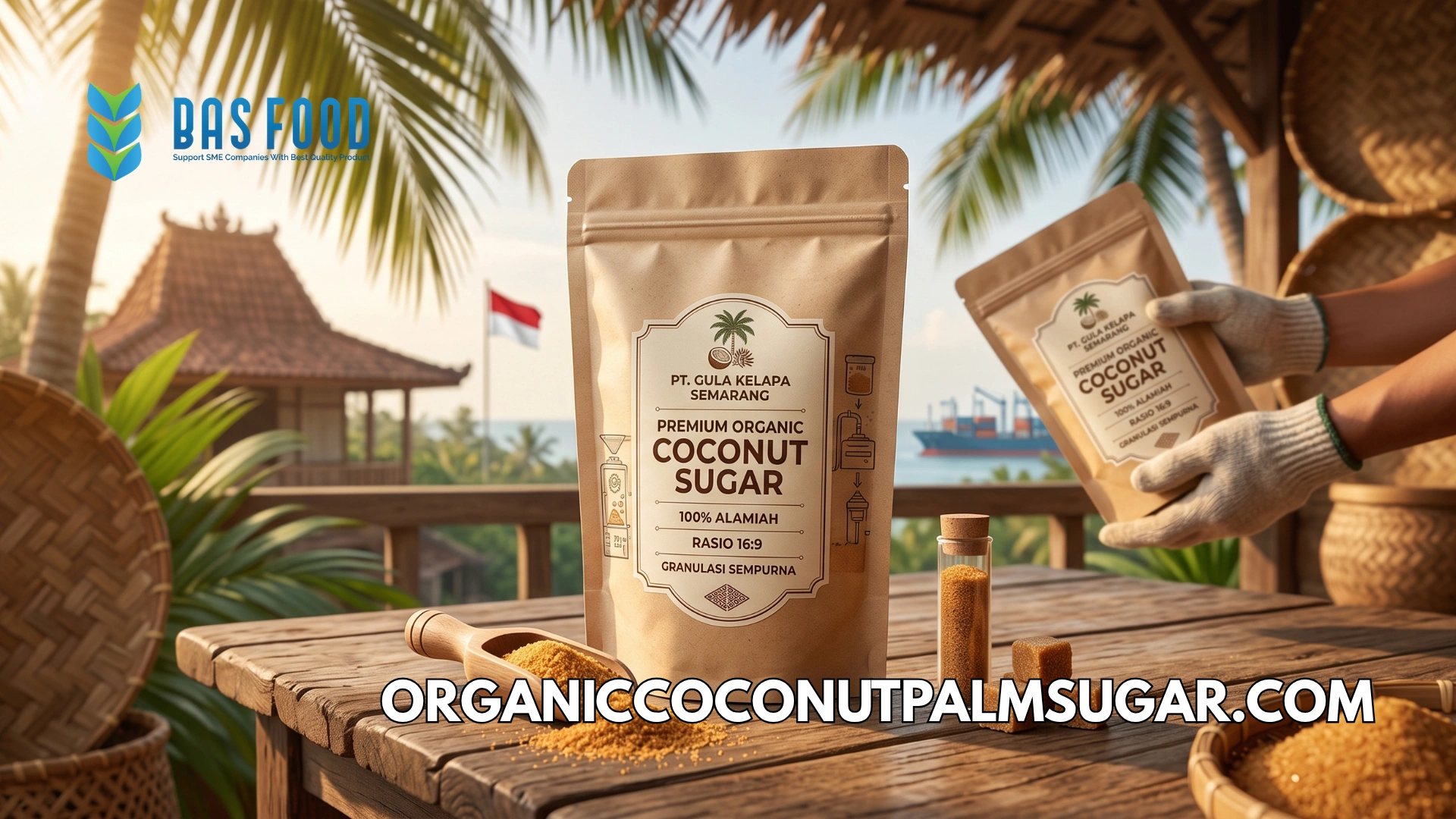
What Is Sustainable Coconut Sugar?
Sustainable coconut sugar refers to coconut sugar produced and sourced with attention to environmental, social, and economic factors throughout the supply chain.
The basic production process starts with coconut palms. Farmers collect sap from the flower stalks of mature coconut trees. Producers then process the sap to reduce its water content and turn it into coconut sugar. Depending on the product specification, the sugar may be processed into blocks, syrup, powder, or granules.
However, the word “sustainable” goes beyond the production process itself.
A responsible supply chain considers how coconut trees are managed, how farmers participate in the supply chain, how raw materials are handled, how resources are used during processing, and how workers are treated. It also considers whether farmers and producers can maintain the business over the long term.
Therefore, sustainability should be viewed as a supply-chain approach rather than a marketing label alone.
Why Coconut Sugar Is Connected to Sustainable Agriculture
Coconut palms are perennial crops. Unlike annual crops that need to be replanted every season, coconut trees can continue producing over many years when properly managed.
This characteristic makes coconut farming an interesting part of discussions about sustainable agriculture.
Coconut farms can also provide farmers with products beyond coconut sugar. Depending on the farming system, coconuts may support food, oil, fiber, water, and other agricultural products.
For farmers, having multiple potential income streams can make agricultural production more resilient.
However, buyers should avoid assuming that every coconut farm automatically follows sustainable practices. Farming methods vary considerably between locations and producers.
That is why sourcing practices need to be evaluated rather than assumed.
The Role of Farmers in Sustainable Coconut Sugar
Farmers are at the beginning of the coconut sugar supply chain.
They maintain coconut trees, collect sap, and provide the raw material used by processors.
Because of this, sustainability cannot be separated from farmer relationships.
A supply chain that focuses only on the finished product may overlook the people responsible for producing the raw material.
Responsible sourcing should consider whether farmers have a stable relationship with buyers, understand quality requirements, and receive commercially reasonable terms.
Long-term cooperation can also make it easier for suppliers to communicate better harvesting and handling practices.
When farmers, collectors, processors, and exporters work together, the supply chain can become more consistent.
Ethical Sourcing Starts at the Source
Ethical sourcing means paying attention to how products and raw materials are obtained.
For coconut sugar buyers, this means looking beyond the factory.
A buyer can ask where the coconut sap comes from, how farmers participate in the supply chain, and how the supplier manages relationships with its sourcing network.
These questions are especially important for companies that want to communicate a responsible sourcing story to customers.
However, ethical sourcing should be based on evidence rather than assumptions.
A supplier should be able to explain its sourcing structure clearly and provide relevant information about its supply chain.
Farm-to-Factory Traceability Matters
Traceability is an important part of responsible sourcing.
A buyer should ideally be able to understand the path from coconut farms to the processing facility and eventually to the finished product.
This is often described as a farm-to-factory supply chain.
The exact traceability system can vary between suppliers. Some may use farmer-group records, collection records, batch numbers, production records, or other identification systems.
For B2B buyers, the important question is whether the supplier can identify where its raw material comes from and connect it to the finished product.
Good traceability can also help suppliers investigate quality issues more efficiently.
How Coconut Sap Becomes Coconut Sugar
Understanding production helps buyers understand sustainability.
The process starts when farmers collect coconut sap from suitable coconut palm flower stalks. The sap is then transported for processing.
At the processing stage, producers reduce the liquid’s water content through controlled heating and other processing steps.
The concentrated material is then prepared into the desired product form.
For granulated products, additional processing can be used to produce the required particle characteristics.
Every production stage uses resources.
Therefore, a sustainable production strategy should consider energy use, water management, equipment efficiency, waste handling, and worker safety.
Energy Efficiency in Coconut Sugar Processing
Heating is an important part of coconut sugar production.
Traditional processing often uses heat to reduce water content in coconut sap.
Energy sources and equipment can vary between producers.
From a sustainability perspective, improving energy efficiency can be valuable because processing requires thermal energy.
Producers may consider more efficient equipment, better heat management, improved production scheduling, or suitable renewable-energy solutions where practical.
However, buyers should be careful about making environmental claims without supporting information.
A supplier that says it uses “sustainable energy” should be able to explain what that means.
Clear communication is more valuable than vague environmental language.
Sustainable Water Management
Water plays an important role in agricultural and food-processing systems.
While coconut sugar production primarily focuses on coconut sap, processing facilities still need to manage water used for cleaning, sanitation, and other operational activities.
Good water management helps reduce unnecessary waste.
Factories can review where water enters the production process, where it is used, and how wastewater is handled.
For international buyers, these practices can form part of a broader supplier sustainability assessment.
The exact requirements will depend on the factory, local regulations, certification systems, and customer standards.
Reducing Waste During Production
Food production naturally creates waste streams.
The goal of responsible production is not necessarily to claim that there is zero waste. Instead, producers can identify waste and look for practical ways to reduce it.
For coconut sugar processing, this can include improving raw-material handling, minimizing product losses, optimizing packaging materials, and managing organic residues appropriately.
Waste reduction can also make commercial sense.
When a factory uses raw materials and energy more efficiently, it can potentially reduce production losses.
Therefore, sustainability and operational efficiency can sometimes support each other.
Sustainable Coconut Sugar Granules for Food Manufacturers
Many B2B buyers purchase coconut sugar in granular form because it is convenient for food manufacturing.
A coconut sugar granules supplier needs to provide consistent particle characteristics while maintaining suitable production and packaging controls.
For manufacturers, granule size can affect how the ingredient behaves during mixing and processing.
That makes quality consistency an important part of sustainable sourcing.
If a manufacturer receives inconsistent material, it may need to adjust formulations or reject product.
A consistent supplier can help reduce unnecessary waste and production problems.
Packaging Is Part of Sustainability
Sustainability does not end when the coconut sugar leaves the factory.
Packaging also matters.
B2B coconut sugar may be packed in different formats depending on the buyer’s needs. Bulk industrial packaging can reduce the amount of packaging required per kilogram compared with some smaller retail formats, although the best option depends on the application and supply chain.
Buyers should consider packaging durability as well.
Packaging needs to protect the product during storage and international transportation.
If packaging fails and product is damaged, the environmental and financial costs increase.
Therefore, sustainable packaging should balance material efficiency with adequate product protection.
Certification and Sustainability Claims
Certification can provide useful evidence, but buyers need to understand what each certification actually covers.
For example, organic certification and sustainability certification are not automatically the same thing.
An organic certification generally relates to compliance with a defined organic standard.
A sustainability program may address other areas, depending on its specific criteria.
Therefore, buyers should ask for the relevant certificate and review its scope, validity, product coverage, and certification body.
Avoid treating a single certificate as proof of every possible sustainability claim.
Responsible sourcing requires a broader view.
Organic Does Not Automatically Mean Sustainable
This is an important distinction.
An organic product follows the requirements of a particular organic standard.
Sustainability is broader.
It can involve environmental management, farmer livelihoods, labor practices, resource efficiency, waste management, traceability, and long-term economic viability.
Therefore, organic coconut sugar can be part of a sustainable sourcing strategy, but buyers should not automatically use “organic” and “sustainable” as interchangeable terms.
For B2B communication, precise wording is important.
Accurate claims help protect both the supplier and the buyer.
How Sustainable Coconut Sugar Supports Food Brands
Food companies are under increasing pressure to understand their ingredient supply chains.
A brand may want to explain the origin of its sweetener to customers.
It may also need information for internal procurement teams, sustainability reports, customer questionnaires, or retailer requirements.
A well-managed coconut sugar supply chain can make these conversations easier.
The supplier can provide information about sourcing, processing, product specifications, and documentation.
However, brands should only communicate claims that they can support with reliable evidence.
Transparency is more valuable than exaggerated promises.
Sustainable Agriculture and Farmer Resilience
A sustainable agricultural system needs to remain viable for farmers.
If farmers cannot earn a reasonable income, maintaining agricultural production becomes difficult.
That is why sustainable sourcing should consider economic factors as well as environmental factors.
Long-term purchasing relationships can help create more predictable demand.
At the same time, buyers need to understand that agricultural supply is affected by weather, seasonal patterns, crop conditions, and other factors.
A realistic purchasing plan should therefore account for agricultural variability.
Good communication between buyer and supplier becomes particularly important here.
Supporting Long-Term Supplier Relationships
Sustainable sourcing is easier when buyers and suppliers think beyond a single transaction.
Instead of treating each purchase as a separate event, companies can develop long-term supply relationships.
This can involve agreed specifications, regular quality reviews, demand forecasts, packaging standards, and clear communication.
Long-term relationships can also help suppliers plan production more effectively.
For buyers, the benefit is greater visibility.
For suppliers, predictable demand can make planning easier.
Both sides can therefore work toward more stable supply-chain performance.
The Role of CV Bonafide Anugerah Sentosa
Businesses looking for Indonesian agricultural ingredients can consider CV Bonafide Anugerah Sentosa as a potential coconut sugar sourcing partner.
For companies interested specifically in sustainable or responsible sourcing, however, buyers should evaluate the current product and supply-chain information directly with the company.
Ask about raw material sourcing, farmer relationships, processing practices, traceability, product specifications, packaging, production capacity, and relevant certifications.
This is especially important because sustainability requirements differ between buyers and markets.
A European food manufacturer, a US importer, or an Asian food producer may have different internal sourcing standards.
Therefore, the most useful approach is to define your requirements first and then discuss them with the supplier.
Conclusion: Sustainable Coconut Sugar Starts With the Supply Chain
Sustainable coconut sugar is about more than a coconut palm or a finished bag of sugar.
It represents a supply chain that connects farmers, raw material collection, processing, quality control, packaging, logistics, exporters, importers, and food manufacturers.
For B2B buyers, the most important step is to look beyond marketing claims.
Ask questions.
Understand the sourcing structure.
Review traceability.
Evaluate ethical sourcing practices.
Understand how the supplier approaches sustainable agriculture.
Check relevant certifications and documentation.
And most importantly, make sure the information matches the requirements of your target market.
For businesses sourcing from Indonesia, CV Bonafide Anugerah Sentosa can be considered as a potential supplier of coconut sugar and other agricultural commodities. Buyers should confirm current product specifications, sourcing practices, traceability, certifications, production capacity, packaging, MOQ, lead time, and export documentation directly with the company.
A responsible coconut sugar supplier should be more than a seller. The supplier should be able to provide clear information about the product and its supply chain.
Ultimately, sustainable sourcing is built through transparency, responsible relationships, and continuous improvement.
When buyers and suppliers work together with those principles in mind, coconut sugar can become not only an ingredient, but also part of a more responsible and resilient food supply chain.