Coconut sugar syrup is becoming an interesting ingredient for food and beverage manufacturers looking for a sweetener with a distinctive caramel-like flavor. From coffee drinks and sauces to bakery products and dessert toppings, this liquid sweetener can serve many purposes. However, sweetness and flavor are only part of the story. Coconut sugar syrup viscosity also plays an important role in how the product flows, mixes, pours, and performs during commercial production.
Imagine two bottles of coconut sugar syrup with a similar color and sweetness. One pours smoothly from the bottle, while the other moves slowly and sticks to the sides. These differences can affect filling speed, ingredient mixing, product consistency, and the customer experience. For manufacturers, understanding viscosity helps them select the right syrup for their production needs.
In this guide, we will explain what viscosity means, which factors influence it, how manufacturers measure it, and why it matters when choosing a coconut sugar supplier. We will also explore practical ways to evaluate syrup performance and maintain consistency between batches.
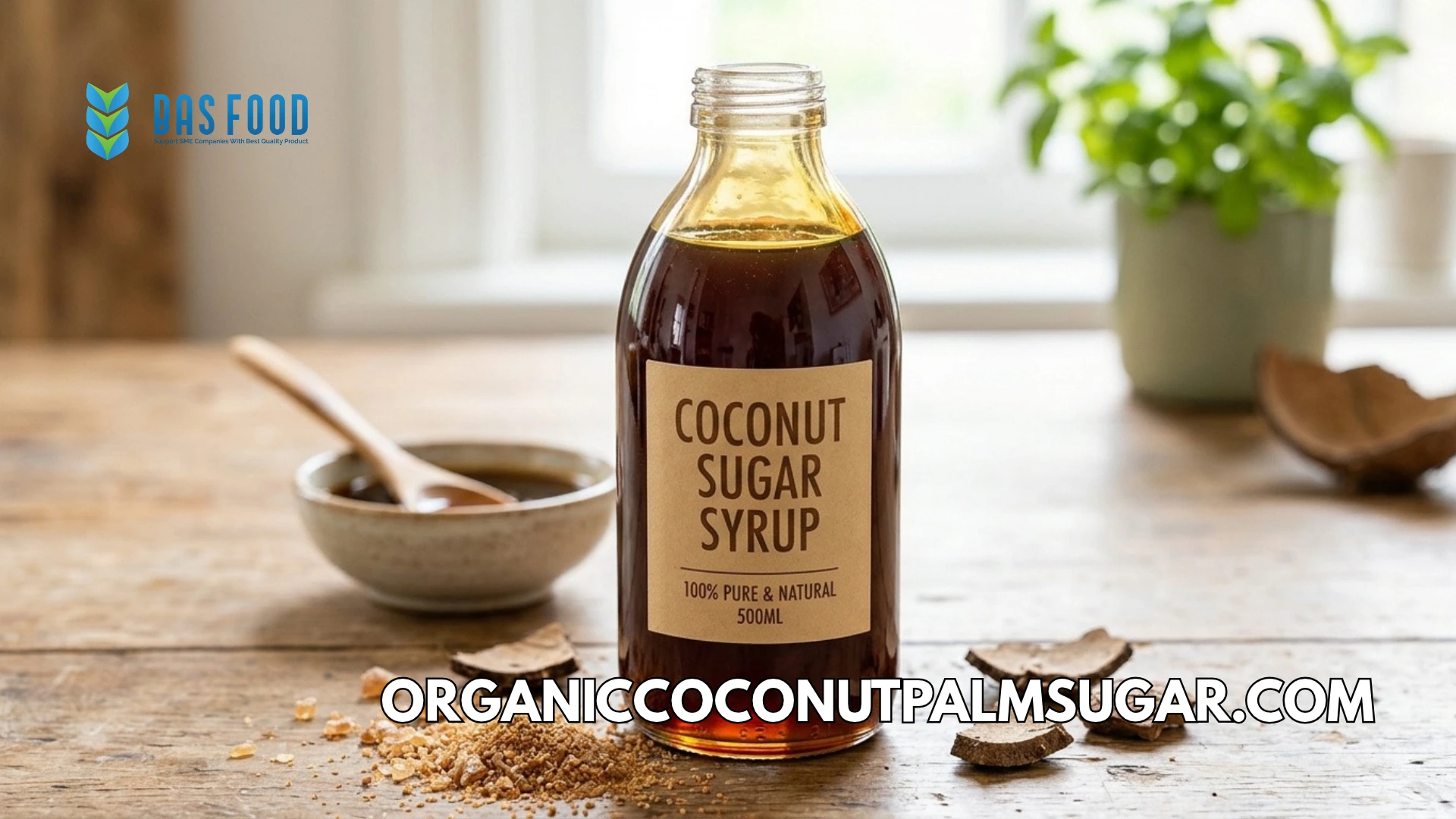
What Is Coconut Sugar Syrup Viscosity?
Viscosity describes a liquid’s resistance to flow. In simple terms, it tells us whether a liquid moves easily or slowly. Water has relatively low viscosity, so it pours quickly, while many concentrated syrups have higher viscosity and flow more slowly.
Coconut sugar syrup viscosity refers to the resistance to flow of syrup made by concentrating coconut sap or a suitable coconut sugar-based liquid formulation. Its viscosity can influence how easily workers pour the syrup, how efficiently pumps transfer it, and how evenly it mixes with other ingredients.
However, viscosity is not the same as sweetness or concentration. A syrup with a higher dissolved-solids concentration often has a higher viscosity, but this relationship also depends on its composition and temperature. Two coconut sugar syrups with similar Brix readings may still flow differently.
Viscosity also differs from density. Density measures mass per unit of volume, while viscosity describes resistance to flow. Although both properties can matter during food processing, manufacturers should measure the property that matches their actual production requirement.
For B2B buyers, this distinction is important. A syrup may meet a supplier’s concentration specification but still be unsuitable for a filling line, dosing system, or recipe if its flow behavior does not match the equipment and formulation.
Why Viscosity Matters in Food and Beverage Manufacturing
Better control during ingredient mixing
Food manufacturers often combine liquid sweeteners with water, milk, plant-based drinks, flavorings, oils, or other ingredients. If the syrup is too thick for the mixing system, it may take longer to disperse or require additional processing adjustments.
For example, a beverage producer may need coconut sugar syrup to blend evenly into a coffee concentrate. A syrup that flows smoothly under the intended processing conditions can make dosing and mixing easier. Nevertheless, the final result also depends on the recipe, temperature, mixing equipment, and other ingredients.
Consistent filling and packaging
Viscosity can affect the speed and accuracy of filling operations. A high-viscosity syrup may move slowly through pipes or nozzles, while a lower-viscosity syrup may flow more quickly under the same conditions.
This difference matters when manufacturers fill bottles, jars, pouches, or bulk containers. If viscosity changes between batches, the production team may need to adjust pump settings, filling time, or other process parameters. These adjustments can affect production efficiency.
Reliable product texture
Viscosity also influences how a finished product feels and behaves. In sauces, toppings, and dessert applications, syrup thickness may affect coating, spreading, and pouring. In beverages, it can influence how the sweetener moves through the production system and interacts with the formulation.
Still, a thicker syrup is not automatically better. A beverage manufacturer may prefer easy-flowing syrup, while a dessert producer may need a thicker product. The ideal viscosity depends on the intended application and the buyer’s product specification.
What Factors Affect Coconut Sugar Syrup Viscosity?
Several factors influence syrup flow behavior. Understanding them helps manufacturers investigate differences between batches and select the right processing conditions.
Temperature
Temperature is one of the most important factors affecting viscosity. For many sugar syrups, viscosity decreases as temperature rises, allowing the liquid to flow more easily. As the syrup cools, it may become thicker and move more slowly.
This effect can create practical challenges during storage and transport. A syrup that pours easily in a warm production area may flow differently in a cooler warehouse. Therefore, manufacturers should evaluate viscosity at a defined temperature and consider the expected conditions during shipping, storage, and use.
When warming syrup, operators should follow appropriate product and equipment instructions. Excessive or uncontrolled heating can affect flavor, color, product quality, and packaging safety.
Sugar concentration and soluble solids
The concentration of dissolved solids is another major factor. As water evaporates during syrup production, the remaining liquid generally becomes more concentrated. This often increases viscosity because more dissolved material is present in a given amount of syrup.
Manufacturers may use Brix measurements to monitor soluble-solids concentration. However, Brix does not directly measure viscosity. It provides useful information about concentration, while a viscosity test measures resistance to flow.
For this reason, buyers who need a specific flow behavior should not rely on Brix alone. They should ask for viscosity data measured under agreed conditions and confirm that the syrup performs as expected in the intended application.
Composition of the syrup
Coconut sugar syrup may contain different proportions of sugars and other dissolved compounds, depending on the raw material and processing method. These compositional differences can influence viscosity, flavor, color, and other physical properties.
Even when two syrups have similar concentrations, their compositions may not be identical. As a result, they may show different flow behavior. This is one reason why manufacturers should establish product specifications using actual measurements rather than general assumptions.
Processing and storage conditions
Heating time, evaporation, mixing, and cooling can all influence the final properties of syrup. The precise effect depends on the formulation and production process. Consistent procedures help manufacturers reduce unwanted variation.
Storage conditions can also matter. If a syrup is stored at changing temperatures, its viscosity may change during handling. Manufacturers should therefore define suitable storage conditions and evaluate the product at temperatures relevant to the customer’s operations.
Understanding Liquid Sugar Viscosity and Syrup Flow Rate
Liquid sugar viscosity is particularly important when sweeteners move through production equipment. A liquid’s viscosity affects how much resistance it encounters as it flows through a pipe, hose, valve, or pump. However, the actual flow rate also depends on equipment design, pressure, pipe dimensions, and other operating conditions.
The syrup flow rate describes how much syrup passes through a system over a given period. It may be expressed as a volume per unit of time or a mass per unit of time. Manufacturers monitor flow rate when transferring syrup between tanks, dosing ingredients, or filling containers.
A more viscous syrup may require greater pumping effort or more time to pass through the same equipment under otherwise comparable conditions. However, the relationship is not always simple. The syrup’s temperature, flow behavior, pump type, and system pressure can all change the result.
Some liquids also behave differently depending on how quickly they are stirred or moved. If a syrup shows non-Newtonian behavior, its apparent viscosity may change with the applied shear rate. In such cases, the test method must reflect how the product will be handled during actual production.
For manufacturers, the practical lesson is clear: viscosity and flow rate are related but not interchangeable. Measuring viscosity helps describe the syrup’s physical behavior, while testing flow rate helps determine how it performs in a specific production system.
How to Measure Coconut Sugar Syrup Viscosity
Accurate viscosity measurement helps suppliers and buyers establish consistent specifications. The appropriate method depends on the syrup’s concentration, expected viscosity range, required accuracy, and intended application.
One common instrument is a rotational viscometer. It measures the resistance experienced by a rotating spindle or measuring element as it moves through the sample. Depending on the instrument and method, the result may be reported in millipascal-seconds (mPa·s) or centipoise (cP). These units are numerically equivalent: 1 mPa·s equals 1 cP.
A rotational viscometer can be useful for comparing batches when operators use the same instrument setup, spindle, speed, temperature, and sampling procedure. For syrups that may show shear-dependent behavior, recording the test conditions is especially important.
A practical viscosity testing procedure
A consistent testing procedure generally includes the following steps:
- Prepare the sample. Collect a representative sample from the batch using a clean container.
- Control the temperature. Bring the sample to the agreed test temperature and allow it to stabilize.
- Check the instrument. Follow the manufacturer’s calibration and verification instructions.
- Select the test settings. Choose the appropriate spindle, speed, or other settings for the expected viscosity range.
- Measure the sample. Follow the instrument’s procedure and allow the reading to stabilize when required.
- Record the result. Document the viscosity value, temperature, instrument settings, batch number, and test date.
- Clean the equipment. Remove all syrup residue according to the instrument’s cleaning instructions.
These steps help make measurements more repeatable. Nevertheless, the exact procedure should follow the instrument manufacturer’s guidance and the agreed testing method.
Why test conditions matter
A viscosity number without test conditions may be difficult to interpret. For example, two suppliers could report different results because they tested the syrup at different temperatures or used different instruments and settings.
For reliable comparisons, buyers should agree on the measurement method before comparing samples or approving a supplier. If the syrup is intended for automated filling, additional testing under relevant operating conditions may help confirm that the product is suitable for the equipment.
What Is the Ideal Viscosity for Coconut Sugar Syrup?
There is no single viscosity value that works for every coconut sugar syrup. The ideal range depends on the intended use, formulation, production equipment, packaging, and storage conditions.
A syrup used in beverages may need to pour and blend easily. A syrup intended for toppings or sauces may require a thicker texture that coats food effectively. Meanwhile, a manufacturer using automated dosing equipment may need a narrower viscosity range to support repeatable measurements and consistent filling.
For this reason, buyers should define the target viscosity based on application trials. A specification should identify the acceptable range and the method used to measure it. It should also state the test temperature and any other conditions needed to interpret the result.
If a supplier offers several syrup grades, ask for the available specifications rather than assuming that a particular grade will meet your needs. Product names such as “thick,” “premium,” or “concentrated” do not replace measurable technical requirements.
A practical evaluation should consider viscosity alongside Brix, flavor, color, appearance, and other relevant quality characteristics. This approach helps manufacturers choose a syrup that performs well rather than selecting it based on thickness alone.
How Manufacturers Can Maintain Consistent Viscosity
Consistency begins with a controlled production process. Manufacturers should monitor important factors such as incoming raw material quality, heating conditions, concentration, and cooling. Clear procedures help operators understand which variables may cause viscosity to change.
Regular testing also helps identify variation early. If one batch is much thicker than expected, the production team can investigate the concentration, temperature, sample condition, and process records. Repeating the measurement can help rule out testing errors before the team makes adjustments.
Manufacturers should also maintain reliable measurement equipment. Instruments require appropriate care, verification, and calibration according to their specifications. Operators need training so they can collect representative samples and apply the same test method consistently.
Storage and packaging procedures are equally important. The syrup should be stored under suitable conditions, and the packaging should protect it from contamination and damage. Because temperature affects flow behavior, suppliers and buyers should agree on how to evaluate viscosity when the product is received.
A documented quality process can include target viscosity, acceptable variation, test method, test temperature, sampling frequency, and procedures for handling results outside the specification. For B2B transactions, these details make product acceptance clearer and reduce disagreements between suppliers and buyers.
Common Viscosity Problems and How to Solve Them
One common problem is syrup that becomes too thick during storage or transport. Temperature changes may explain the difference, although concentration and composition should also be checked. Before changing the formulation, repeat the measurement at the agreed temperature and compare the result with the original specification.
Another issue is inconsistent flow during pumping or filling. In this case, the manufacturer should review viscosity data alongside equipment settings, temperature, pipe dimensions, and transfer conditions. The problem may come from the syrup, the equipment, or a combination of factors.
A third problem occurs when two batches have similar Brix values but different viscosity. This can happen because Brix estimates soluble-solids concentration rather than directly measuring resistance to flow. Composition, temperature, and other physical properties may also influence the result.
Finally, buyers sometimes assume that a higher viscosity indicates better quality. However, quality depends on the agreed specification and intended use. A thick syrup may be suitable for a topping but inconvenient for a high-speed beverage filling line.
The best solution is to define requirements before production and use consistent test methods. When a deviation occurs, review the available data and investigate the cause instead of relying on appearance alone.
Choosing a Reliable Coconut Sugar Supplier
Selecting a reliable coconut sugar supplier requires more than reviewing price and product appearance. Buyers should assess whether the supplier understands their application, provides clear specifications, and can explain how it monitors product consistency.
Ask for relevant technical information, including the product’s Brix range where applicable, viscosity specification if available, recommended storage conditions, packaging options, and batch documentation. If viscosity is important to your production line, confirm the measurement method and test temperature before comparing suppliers.
For international buyers, communication and export readiness also matter. Confirm the available shipment formats, order quantities, lead times, and documentation before placing an order. If the syrup will be used in a specific formulation, request a sample when practical and test it under realistic processing conditions.
CV Bonafide Anugerah Sentosa can be considered as part of a sourcing evaluation for Indonesian coconut-based ingredients. Buyers should contact the company directly to confirm current coconut sugar syrup availability, product specifications, packaging formats, minimum order quantities, and export terms. Do not assume that a particular viscosity grade or technical specification is available without confirmation.
Businesses researching a coconut sugar exporter supplier should also distinguish between product categories. Coconut sugar syrup, granulated coconut sugar, and other coconut-derived ingredients have different physical properties and may require different specifications. Confirm each product separately so that the selected ingredient meets the actual production requirement.
A reliable supplier relationship is built on transparent information, clear specifications, and consistent communication. These factors help buyers make better purchasing decisions and manage ingredient quality over time.
Conclusion: Get the Right Flow for Better Production
Coconut sugar syrup viscosity is an important factor in ingredient selection, product formulation, and manufacturing efficiency. It affects how the syrup pours, mixes, moves through equipment, and performs during filling and dispensing. However, viscosity alone does not define the syrup’s overall quality.
For the best results, manufacturers should measure viscosity under controlled conditions and evaluate it alongside Brix, temperature, composition, and application performance. Buyers should also establish clear specifications, request relevant technical documentation, and test samples when practical.
Whether you produce beverages, bakery products, sauces, or dessert toppings, the right syrup is the one that meets your technical requirements and performs consistently in your process. By understanding liquid sugar viscosity, monitoring syrup flow rate, and applying reliable viscosity measurement methods, your business can make more informed sourcing decisions and maintain better production control.