Coconut sugar is widely known in granule and block forms, but there is another product that deserves attention in the food industry: coconut sugar syrup. With its smooth texture, sweet taste, and easy-to-pour form, this ingredient can be useful for beverage makers, bakeries, sauce producers, dessert manufacturers, and other food businesses.
Behind every bottle of coconut sugar syrup is a process that starts with fresh coconut palm sap. Producers must handle the sap carefully, control the heating process, and monitor the final concentration to create a consistent product. These steps are important because raw sap can change quickly, while differences in processing can affect the syrup’s color, flavor, thickness, and shelf life.
For importers and food manufacturers, understanding coconut sugar syrup production helps when selecting suppliers, comparing product specifications, and planning commercial applications. This guide explains how producers turn coconut sap into syrup, which quality factors matter most, and what B2B buyers should consider when sourcing coconut sugar syrup from Indonesia.
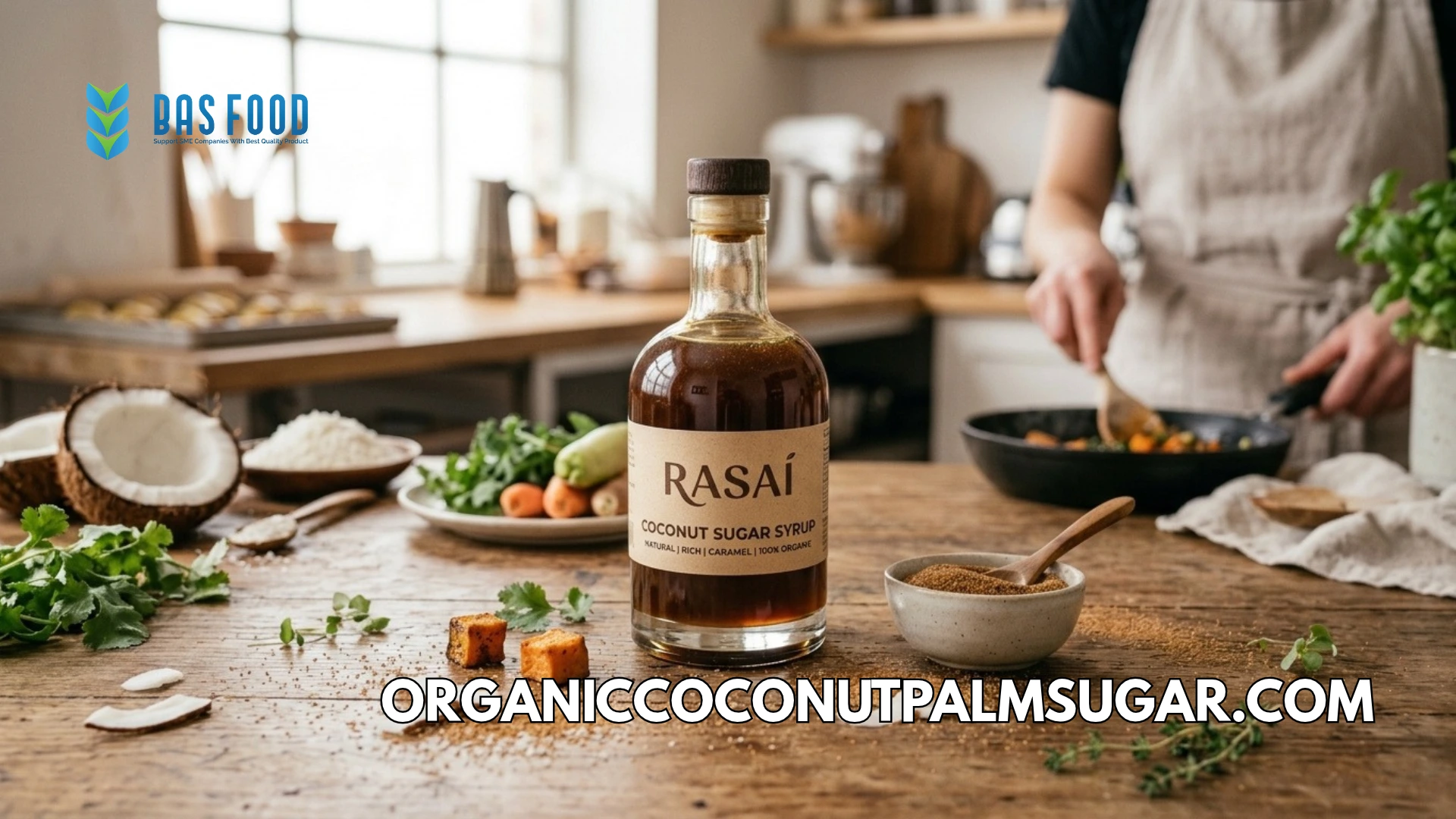
What Is Coconut Sugar Syrup?
Coconut sugar syrup is a liquid sweetener made by concentrating the sap collected from coconut palm flower stalks. The sap naturally contains sugars, water, and small amounts of other compounds. When producers heat the sap and remove some of its water, the liquid becomes more concentrated and develops the color, aroma, and sweetness associated with coconut palm sugar products.
Unlike granulated coconut sugar, which producers concentrate further and process into crystals or granules, coconut sugar syrup remains in liquid form. Its thickness depends on the production method, concentration level, and product specifications. Some syrups flow easily, while others have a thicker consistency suitable for toppings, sauces, and specialty food products.
Coconut sugar syrup is different from coconut nectar products that may use different processing methods or naming conventions. Buyers should therefore confirm the raw material, production process, ingredient list, and specifications rather than relying on the product name alone.
For commercial users, the main appeal is convenience. A liquid sweetener can be easier to measure, pump, blend, or incorporate into selected recipes than a solid sweetener. However, manufacturers still need to assess its sweetness, color, viscosity, and compatibility with their production equipment before using it at scale.
The First Step: Coconut Sap Processing
Successful coconut sugar syrup production begins with good-quality raw material. Producers collect sap from the flower stalks of coconut palms, a process that requires experience and regular attention. Skilled tappers prepare the flower stalk and collect the sap in suitable containers while taking steps to protect it from dirt and other contaminants.
Fresh sap contains a high proportion of water, along with natural sugars and other dissolved substances. Its composition can vary with palm condition, collection practices, weather, and other factors. These natural differences can influence the final syrup’s sweetness, flavor, color, and processing time.
Why fresh sap needs careful handling
Fresh coconut sap can ferment because naturally occurring microorganisms begin changing its sugars. Fermentation may produce acidity, gas, and noticeable changes in aroma and flavor. If the producer does not manage the sap properly, the resulting syrup may not meet the desired taste or quality requirements.
To reduce these risks, producers should use clean collection containers, maintain hygienic handling practices, and minimize unnecessary delays between collection and processing. Depending on the production setup, they may also use suitable preservation or temperature-control methods. The exact approach should follow the producer’s food-safety procedures and product requirements.
Sorting and checking the raw material
Before heating, producers should inspect the collected sap and check whether it meets their quality criteria. They may assess its appearance, smell, cleanliness, and other relevant parameters. Sap that shows signs of unwanted fermentation or contamination should not automatically enter the production process.
This early quality control is important because heating cannot correct every problem that occurs during collection. A consistent final product starts with suitable raw material, supported by trained workers, clean equipment, and a controlled collection system.
How Coconut Sugar Syrup Production Works
Although production methods vary by manufacturer, the basic principle is straightforward: producers concentrate coconut sap by removing water while controlling heat and maintaining hygiene. Each stage contributes to the finished syrup’s characteristics.
Step 1: Filtration
After collection, producers may filter the sap to remove visible particles and other unwanted material. The filtration method depends on the raw material and the facility’s equipment. Proper filtration supports cleanliness, but it does not replace good collection practices or later food-safety controls.
Step 2: Heating and concentration
The filtered sap is transferred to a suitable heating vessel. Producers apply heat to evaporate water and increase the concentration of dissolved solids. During this stage, the liquid gradually becomes more concentrated and may develop a deeper color and richer cooked-sugar aroma.
Temperature, heating time, vessel design, batch size, and evaporation rate all affect the process. Excessive heating can create unwanted darkening, burnt flavors, or changes in the syrup’s sensory profile. Insufficient concentration, on the other hand, may result in a product that is too thin or does not meet its target specification.
For this reason, producers need a controlled heating process instead of relying only on visual appearance. A consistent method helps them achieve a more predictable result across production batches.
Step 3: Monitoring concentration
As water evaporates, the dissolved solids become more concentrated. Producers can monitor concentration using suitable measurements, such as soluble solids expressed in degrees Brix, where appropriate for the product and process.
Brix is a useful indicator, but it should not be treated as a complete measure of quality or shelf stability. A target value must be established according to the product specification, and the manufacturer should also consider factors such as acidity, water activity, packaging, and storage conditions.
Step 4: Reaching the target consistency
The producer continues heating until the syrup reaches the required concentration and flow characteristics. This point depends on the intended use. A syrup for beverages may need to pour easily, while a thicker product may suit toppings or certain food preparations.
Consistency should be checked under defined conditions because temperature affects how easily a syrup flows. Comparing samples at different temperatures can lead to misleading conclusions about viscosity.
Step 5: Filling and packaging
Once the syrup meets its production requirements, the manufacturer prepares it for filling and packaging. Depending on the process, the syrup may need controlled cooling or filling at a specified temperature. The equipment, containers, closures, and filling environment should all support the required hygiene and product quality.
The manufacturer should validate its filling and preservation process rather than assume that hot filling alone guarantees safety. Suitable packaging and handling help protect the syrup during storage and distribution.
Key Factors That Affect Syrup Quality
Consistent quality is essential when coconut sugar syrup is sold to food manufacturers and international buyers. A product may look attractive but still fail to meet the buyer’s requirements if its flavor, thickness, or storage performance changes between batches.
Color and flavor
Coconut sugar syrup often has shades of golden brown to darker brown, depending on the raw material and production process. Heating can develop characteristic cooked-sugar notes, while prolonged or excessive heating may create a darker appearance and stronger flavors.
Neither a darker nor a lighter syrup is automatically better. The right color depends on the intended application and buyer specification. Beverage producers, for example, may prefer a particular shade to maintain the appearance of their finished drinks.
Viscosity and flow
Viscosity describes a liquid’s resistance to flow. In practical terms, it helps explain why one syrup pours easily while another moves slowly. Soluble solids, temperature, composition, and processing conditions can all affect viscosity.
For B2B applications, viscosity matters because it influences dosing, pumping, mixing, and packaging. A syrup that works well in a small kitchen may behave differently in an automated production line. Buyers should request relevant specifications and test the syrup using their actual equipment.
Sweetness and soluble solids
The sweetness of coconut sugar syrup depends on its composition and concentration. Brix can help producers monitor soluble solids, but it does not directly measure every aspect of perceived sweetness. Different batches may still show sensory differences even when their Brix readings are similar.
Manufacturers should establish clear acceptance limits for the characteristics that matter to their products. Where necessary, they can evaluate sweetness and flavor through controlled sensory testing.
Hygiene and food safety
Clean equipment, suitable water, hygienic handling, and appropriate process controls are essential throughout production. Contamination can occur during sap collection, processing, filling, or storage, so quality management should cover the entire operation.
Commercial buyers should ask how the supplier manages hygiene, batch traceability, and product release. Relevant documentation may include product specifications, a certificate of analysis, and food-safety records or declarations appropriate to the product and destination market.
Coconut Sugar Manufacturing: Syrup Compared With Granules and Blocks
Coconut sugar manufacturing can produce different forms of sweetener, including liquid syrup, granules, and moulded blocks. Although these products may share a raw material, their processing targets and final properties differ.
For syrup, producers stop the concentration process when the liquid reaches the desired specifications. The product retains enough moisture to remain pourable, subject to its formulation and storage conditions. This makes it convenient for applications that require a liquid sweetener.
Granulated coconut sugar requires further concentration and processing to create a dry, free-flowing product. Producers must manage the final moisture level, texture, and particle characteristics. Moulded coconut sugar, meanwhile, is processed to achieve a shape and firmness that suit the intended format.
These differences affect packaging, handling, and storage. Syrup may require leak-resistant containers and careful control of product stability. Granules may need protection from moisture absorption and caking, while blocks need packaging that protects their physical integrity.
For importers, it is important to specify the required form at the start of the purchasing process. A quotation for coconut sugar granules should not be assumed to cover syrup, and specifications for one form should not be applied automatically to another.
Liquid Sugar Production: Managing Concentration and Shelf Life
Liquid sugar production requires a careful balance between concentration, processing conditions, and storage stability. Concentrating a liquid sweetener reduces its water content, but the final product’s shelf life depends on more than how thick it looks.
Factors such as soluble solids, acidity, water activity, microbial quality, packaging integrity, and storage temperature may influence stability. The relative importance of each factor depends on the specific syrup and its manufacturing process.
For this reason, producers should establish product-specific shelf-life data through suitable validation or testing. They should not assign a shelf life based only on color, thickness, or a general assumption about sugar content.
Why packaging matters
Packaging protects the syrup from contamination and helps maintain product quality during storage and transport. The right container depends on viscosity, filling conditions, intended portion size, distribution requirements, and the buyer’s equipment.
Commercial buyers should confirm that the packaging is suitable for food contact and compatible with the product. They should also check the closure, seal integrity, labeling, batch coding, and protection against leakage during shipping.
Storage and transport
Coconut sugar syrup should be stored according to the supplier’s documented instructions. Buyers should clarify the recommended temperature range, protection from direct sunlight, handling procedures after opening, and any specific requirements for refrigerated storage.
International shipments may experience changes in temperature during loading, transit, and warehousing. Before placing a large order, importers should discuss expected shipping conditions with the supplier and confirm that the packaging and validated shelf life suit the planned distribution route.
Applications of Coconut Sugar Syrup in the Food Industry
Coconut sugar syrup can be useful across several food categories because it is a liquid sweetener that can be measured and incorporated into recipes. Its natural brown color and characteristic flavor may also contribute to the sensory profile of selected products.
Beverages and drink concentrates
Beverage manufacturers may use coconut sugar syrup in coffee drinks, tea beverages, smoothies, specialty drinks, and liquid concentrates. Because the sweetener is already in liquid form, it can simplify dosing and mixing in suitable production systems.
However, the syrup may affect the beverage’s color and flavor. Product developers should check solubility, sweetness, stability, and the finished drink’s appearance before approving a formulation.
Bakery and desserts
Bakeries and dessert producers may explore coconut sugar syrup in sauces, toppings, fillings, and selected baked goods. It can contribute sweetness and a brown-sugar-like flavor profile, depending on the product.
Replacing granulated sugar with syrup can also introduce additional water into a recipe. Therefore, manufacturers may need to adjust the liquid content, baking conditions, or other ingredients. A direct weight-for-weight substitution does not always produce the same texture or result.
Sauces, dressings, and marinades
Some sauce and marinade formulations use liquid sweeteners to balance acidity, saltiness, spice, and other flavors. Coconut sugar syrup may suit products where its flavor and color complement the overall recipe.
Manufacturers should assess the syrup’s viscosity, mixing behavior, and stability in the complete formulation. If the product contains acidic ingredients, oils, or suspended particles, the final mixture may require additional formulation and shelf-life testing.
How B2B Buyers Should Evaluate a Coconut Sugar Syrup Supplier
Finding a suitable supplier involves more than comparing the price per kilogram. Buyers should evaluate the product specification, quality controls, packaging, documentation, communication, and ability to meet their commercial requirements.
Start by defining the intended application and the characteristics the syrup must meet. These may include soluble solids, viscosity, color, flavor, ingredient declaration, packaging format, and shelf-life requirements. If the syrup will be used in a regulated food category, confirm the relevant requirements in the destination market.
Next, request current documentation. A product specification sheet describes the intended product characteristics, while a certificate of analysis reports selected results for a particular batch or lot. Buyers should understand which values are guaranteed, which are typical, and which tests apply to the supplied product.
It is also helpful to ask about batch traceability, production controls, packaging options, minimum order quantities, lead times, and export documentation. Suppliers may offer different arrangements, so confirm the details directly instead of relying on assumptions.
Sourcing Coconut Sugar Syrup From Indonesia
Indonesia has a long history of producing coconut-based ingredients, and its agricultural supply chains offer opportunities for businesses seeking coconut sugar products. However, buyers should evaluate each supplier individually because production methods, specifications, capacity, and commercial terms can vary.
When contacting a supplier, explain the intended use of the syrup, the target market, the required quality parameters, packaging preferences, and expected order volume. This information helps the supplier assess whether its current offering can meet the buyer’s needs.
CV Bonafide Anugerah Sentosa operates in the Indonesian commodity export sector and supplies coconut-related products. Businesses interested in coconut sugar syrup should contact the company directly to confirm current product availability, specifications, packaging formats, minimum order quantities, and export terms. These details should be verified before a purchase order is issued.
For buyers entering a new supply relationship, a sample or production trial can be useful if available. Evaluate the syrup in the intended recipe, measure the relevant technical parameters, and confirm that the product meets the business’s quality and regulatory requirements.
A clear agreement on specifications, packaging, documentation, delivery expectations, and acceptance criteria can help establish a more dependable commercial relationship. This is especially important for food manufacturers that need consistency across repeated production runs.
Coconut Sugar Exporter Supplier: Finding the Right Product for Your Market
The term coconut sugar exporter supplier can refer to businesses offering different coconut sugar formats, including granules, blocks, and syrup. Buyers should therefore state the exact product they need when requesting a quotation.
For example, a beverage company may need a pourable syrup with a defined Brix range and viscosity, while a bakery may focus on flavor, color, and recipe performance. These requirements can lead to different product specifications, even when the products originate from coconut palm sap.
International buyers may also use the Spanish search term exportador de azúcar de coco, which means coconut sugar exporter. When sourcing across languages, it is useful to confirm the exact form of the product, its intended application, and the required documentation to avoid misunderstandings.
A reliable coconut sugar supplier should be able to explain its product specifications and clarify which requirements it can meet. Buyers should confirm current availability and avoid assuming that a supplier offering one coconut sugar format can automatically provide every other form.
CV Bonafide Anugerah Sentosa can be contacted to discuss its current product range and export capabilities. The buyer should confirm whether coconut sugar syrup is available and request the relevant product information before proceeding.
Conclusion: Turning Coconut Sap Into a Consistent Commercial Sweetener
Coconut sugar syrup production combines traditional raw-material collection with careful processing and quality control. From fresh coconut sap to the final packaged syrup, every stage can influence the product’s color, flavor, concentration, viscosity, and storage performance.
For producers, the key is to control raw-material quality, heating, concentration, hygiene, and packaging. For B2B buyers, the priority is to define the required specifications, review documentation, test the syrup in its intended application, and verify shelf-life and storage information.
Whether you manufacture beverages, bakery products, sauces, or desserts, understanding the production process helps you make better purchasing decisions. If you are sourcing coconut sugar syrup from Indonesia, contact CV Bonafide Anugerah Sentosa to discuss current product availability and confirm the specifications and export arrangements that fit your business.