Launching a sweetener brand does not always mean building your own factory. For many food companies, distributors, retailers, and importers, coconut sugar granule private label offers a more practical way to develop a branded product while working with an experienced manufacturer or exporter. Private labeling allows a business to sell coconut sugar granules under its own brand name. The supplier handles the agreed product production and packing requirements, while the buyer develops the brand identity, packaging concept, market strategy, and sales channels. As a result, companies can enter the coconut sugar market without managing every stage of manufacturing themselves.
However, successful private labeling requires more than putting a logo on a package. Buyers need to define product specifications, packaging requirements, quality expectations, labeling information, order quantities, and shipping arrangements before production begins.
This guide explains how coconut sugar granule private label works, what buyers should prepare, and how to evaluate an Indonesian coconut sugar supplier for a long-term private-label project.
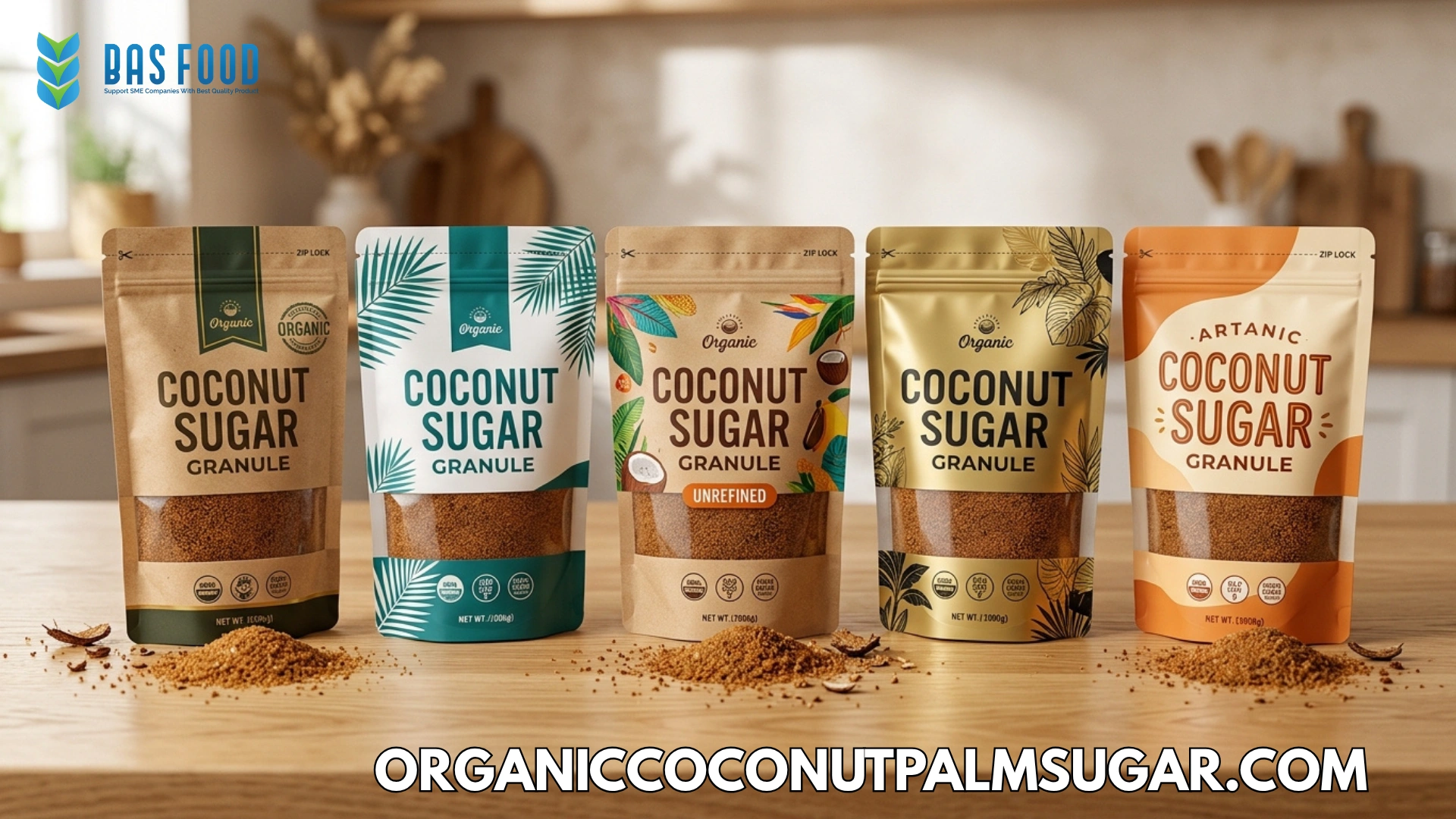
What Is Coconut Sugar Granule Private Label?
Coconut sugar granule private label refers to a business arrangement where coconut sugar granules are produced or packed for sale under the buyer’s own brand. The finished product can carry the buyer’s brand name, packaging design, and other agreed product information.
This model can suit food distributors, natural ingredient brands, specialty food companies, retailers, wholesalers, and importers that want to develop their own coconut sugar product.
Instead of building a production facility, the brand owner works with a supplier that has the necessary production and packing capabilities. The exact responsibilities depend on the commercial agreement between both parties.
For example, the buyer may provide the brand artwork and packaging specifications, while the supplier manages production and filling. In another arrangement, the buyer may select from existing product specifications and use a standard packaging format with customized labels.
Therefore, private labeling can be flexible. The most important point is to define exactly what the supplier will provide before production starts.
Why Businesses Choose Private-Label Coconut Sugar
Private labeling can give businesses greater control over how a product appears in the market. Rather than selling a generic ingredient, the company can build a recognizable product identity.
For distributors and importers, this can create an opportunity to develop a dedicated coconut sugar line for their own customers. The product can be positioned for retail, foodservice, specialty stores, online sales, or other channels depending on the business model.
Another advantage is operational simplicity. A company does not necessarily need to manage the entire manufacturing process itself. Instead, it can focus more of its resources on branding, distribution, customer relationships, and market development.
However, private labeling still requires active involvement from the buyer. A successful project depends on clear specifications and communication between the brand owner and supplier.
Building a Distinctive Product
A private-label product can be designed around a specific market. For example, a buyer may want a small retail pack for household consumers or a larger pack for foodservice customers.
The product format can also be connected to the brand’s overall positioning. Packaging, product description, granule characteristics, and application information should work together.
Consequently, private label is not simply a packaging exercise. It is a product development and sourcing project.
OEM Coconut Sugar vs Private Label
The terms OEM coconut sugar and private label are sometimes used interchangeably, although they can describe slightly different arrangements.
OEM, or original equipment manufacturing, generally refers to a supplier producing a product according to specifications established by another company. Private labeling focuses more specifically on selling a product under the buyer’s brand.
In practice, a coconut sugar project can involve elements of both models. A buyer may request specific granule characteristics, packaging, and labeling while selling the finished product under its own brand.
The exact arrangement should therefore be discussed with the supplier. Buyers should ask what can be customized and which product characteristics come from the supplier’s existing production capabilities.
When OEM May Be Useful
OEM arrangements can be useful when a brand requires a specific product specification or packaging setup.
For instance, a buyer may need a particular granule size, pack format, label design, or other agreed characteristics. The supplier can then determine whether these requirements fit its production process.
The important point is to distinguish between standard options and genuine customization. Not every supplier can make every specification economically or operationally.
Defining Your Coconut Sugar Granule Specification
Before requesting a private-label quotation, buyers should prepare a product specification. This document gives both sides a clear understanding of what needs to be produced.
Start with the product format. Specify that the product is coconut sugar granules and identify the desired characteristics.
Particle size can be particularly important. Different applications may require different granule characteristics. A retail consumer product may have different expectations from an ingredient intended for industrial food production.
Buyers should also discuss other relevant specifications, such as appearance, color, flavor profile, moisture-related requirements, packaging, and storage conditions.
Why Specifications Matter
A clear specification helps reduce misunderstandings. If the buyer simply asks for “good coconut sugar,” the supplier may interpret the request differently from the buyer.
Instead, define measurable or clearly described requirements wherever possible.
The specification can then become a reference during sample approval, production, and future repeat orders. This is especially valuable for brands that want the same product quality across multiple shipments.
Custom Packaging for Private-Label Coconut Sugar
Custom packaging is one of the most visible parts of a private-label project. The package is often the first thing a customer sees, so it needs to represent the brand clearly.
Depending on the market and sales channel, a buyer may consider different pack sizes and packaging formats. Retail products may require smaller consumer-friendly packs, while foodservice or wholesale products may use larger formats.
The packaging also needs to protect the coconut sugar during storage and transportation. Coconut sugar can be affected by moisture exposure, so suitable packaging and sealing are important considerations.
For export shipments, buyers should also think about the complete logistics chain. Products may move through factory storage, trucking, port handling, ocean freight, customs clearance, and destination warehousing.
Designing the Package
A buyer normally provides brand artwork or works with a packaging designer. The artwork should include the information required for the intended market.
Depending on the destination, labeling requirements can vary. Buyers should therefore confirm applicable requirements with their regulatory or compliance team before final artwork approval.
The supplier can then review the packaging specification to determine whether the requested format is compatible with its production and packing process.
From Brand Idea to Finished Product
A private-label project usually works best when divided into clear stages. Starting production before the details are approved can create unnecessary delays.
The first stage is product planning. The buyer defines the target market, product format, granule specification, pack size, brand positioning, and expected order volume.
Next comes supplier discussion. The buyer shares the requirements and asks the supplier what options are available.
After that, the buyer can request a sample. The sample allows the product team to evaluate the coconut sugar before approving the final specification.
Sample Approval
Sample approval is an important stage because the buyer can compare the actual product with the intended specification.
The buyer can evaluate appearance, granule characteristics, aroma, flavor, packaging concept, and suitability for the intended market.
If changes are needed, they should be documented clearly before production.
Once the product and packaging are approved, the buyer and supplier can finalize the commercial details and production schedule.
Private Label Packaging and Minimum Order Quantity
Minimum order quantity, or MOQ, is an important consideration in private-label sourcing. Customized packaging often requires additional preparation, materials, printing, or production planning.
As a result, private-label MOQ can differ from the MOQ for a standard product.
The actual quantity depends on the supplier, packaging format, customization level, production schedule, and other commercial factors.
Buyers should therefore ask for a specific quotation rather than assuming that a standard coconut sugar MOQ will apply to a private-label order.
Planning the Right Quantity
Ordering too much product can tie up working capital and create storage challenges. On the other hand, ordering too little may make customized packaging less economical.
A useful starting point is to estimate expected sales over a defined period. Then consider lead time, shipping time, safety stock, and the expected frequency of future orders.
This approach can help buyers choose a more practical order quantity.
Quality Control for Private-Label Coconut Sugar
Quality control becomes especially important when the product carries your brand name. Customers will associate the finished product with your company, even though another business may manufacture or pack it.
For this reason, buyers should establish quality expectations before production. These may cover product appearance, granule characteristics, flavor, packaging integrity, labeling, and other relevant specifications.
The supplier should understand which requirements are critical and which characteristics have acceptable variation.
Keep a Reference Specification
A documented specification can serve as a reference for future orders. It helps the buyer and supplier compare production batches against an agreed standard.
For repeat purchasing, this can make communication much easier. Instead of describing the product again for every order, both parties can refer to the approved specification.
Buyers can also establish a process for handling any quality concerns that arise during inspection.
Choosing a Coconut Sugar Supplier for Private Label
Choosing the right coconut sugar supplier is one of the most important decisions in a private-label project.
The supplier should be evaluated not only for product quality but also for communication, production capability, packaging options, export experience, documentation, and ability to support repeat orders.
A supplier that understands private-label projects should be willing to discuss the buyer’s requirements in detail.
Working With a Coconut Sugar Exporter Supplier in Indonesia
Indonesia is an important sourcing location for coconut-based products, making Indonesian suppliers relevant to international buyers looking for coconut sugar.
For importers, working directly with a coconut sugar exporter supplier can provide a more direct connection to the production and packing process.
However, buyers should still conduct appropriate supplier due diligence. Export capability alone does not guarantee that a supplier’s product or packaging setup will match a specific private-label requirement.
Communication is particularly important when working across countries. Product specifications, packaging artwork, order quantities, documentation, production schedules, and shipping details should all be confirmed in writing.
For buyers considering Indonesia as a sourcing market, CV Bonafide Anugerah Sentosa can be evaluated as a potential partner for coconut sugar and other coconut-derived products.
How to Build a Strong Private-Label Product Brief
A clear product brief can make the sourcing process much faster. Instead of sending scattered requests through multiple emails, buyers can organize the main requirements in one document.
The brief can include the product name, target market, desired granule specification, packaging size, packaging material, branding requirements, label information, expected order quantity, destination country, and intended application.
It can also include quality expectations and any special requirements that need supplier confirmation.
Keep Requirements Practical
Not every customization is necessary. Buyers should distinguish between requirements that are essential for the market and features that are simply preferences.
For example, a specific package size may be necessary because of the retailer’s shelf requirements. In contrast, a highly complex packaging design may add cost without creating meaningful value.
A practical product brief helps both sides identify priorities early.
Common Mistakes in Coconut Sugar Private Label Projects
One common mistake is starting with packaging before defining the product. A beautiful package cannot compensate for an unclear product specification.
Another mistake is changing the specification repeatedly after production planning has started. Frequent changes can create additional cost or delay, particularly when customized packaging materials have already been prepared.
Buyers should also avoid assuming that all suppliers offer the same private-label services. Some suppliers may focus on standard bulk products, while others may support more customized arrangements.
Finally, do not overlook future orders. A private-label brand should ideally have a repeat purchasing plan so that the approved product specification can remain consistent over time.
How Private Label Can Support Brand Growth
A private-label coconut sugar product can give a company more control over its market identity. Instead of competing only as a distributor of generic ingredients, the business can build recognition around its own brand.
This can be useful for retailers, specialty food companies, wholesalers, and importers that already have established customer relationships.
A private-label strategy can also allow businesses to develop different product sizes for different sales channels.
For example, a brand might offer a smaller pack for retail customers and a larger format for foodservice or wholesale buyers.
The key is to keep the product strategy aligned with actual customer demand.
Building a Long-Term Supplier Relationship
Private-label sourcing works best when the relationship continues beyond the first shipment. Once a product has been approved, both buyer and supplier can use the experience from the first order to improve future procurement.
The buyer can provide feedback on packaging, product performance, customer response, and order planning. The supplier can use this information to prepare future production more efficiently.
Over time, clear communication can reduce misunderstandings and make repeat orders easier to manage.
For this reason, buyers should think about supplier selection as a long-term sourcing decision rather than simply a one-time price comparison.
Turn Coconut Sugar Into Your Own Brand
Coconut sugar granule private label gives businesses an opportunity to create a branded sweetener product without having to manage every part of manufacturing themselves. With the right supplier relationship, buyers can focus on branding, distribution, and market development while the supplier handles the agreed production and packing activities.
However, private label works best when both sides have clear expectations. Product specifications, granule characteristics, packaging, labeling, MOQ, quality control, and export requirements should be discussed before production begins.
For international buyers, an experienced Indonesian coconut sugar exporter supplier can also provide a practical sourcing route. CV Bonafide Anugerah Sentosa can be evaluated by businesses looking for a potential Indonesian partner for coconut sugar and related products.
The strongest private-label projects start with a simple principle: define the product clearly before designing the package. Once the product, specifications, packaging, and commercial requirements are aligned, the brand has a much stronger foundation for launching and growing its own coconut sugar product.