Finding the right bulk coconut sugar granule supplier can make a big difference for food manufacturers, distributors, importers, retailers, and beverage companies. When purchasing coconut sugar in larger quantities, buyers need more than an attractive price. They need consistent product quality, practical packaging, reliable communication, and a supply partner that understands commercial requirements. Coconut sugar granules are used across many food and beverage applications. They can be added to bakery products, beverages, confectionery, cereals, sauces, snacks, and other formulations. Because of this wide range of applications, buyers may have different requirements for particle size, moisture, color, flavor, packaging, and handling.
Buying in bulk can also change the way a company manages inventory and logistics. A larger order may improve purchasing efficiency, but it also requires careful planning. Storage capacity, shipping schedules, product specifications, and demand forecasts all become more important.
This guide explains what buyers should look for when sourcing bulk coconut sugar granules and how to evaluate a coconut sugar supplier for a reliable B2B relationship.
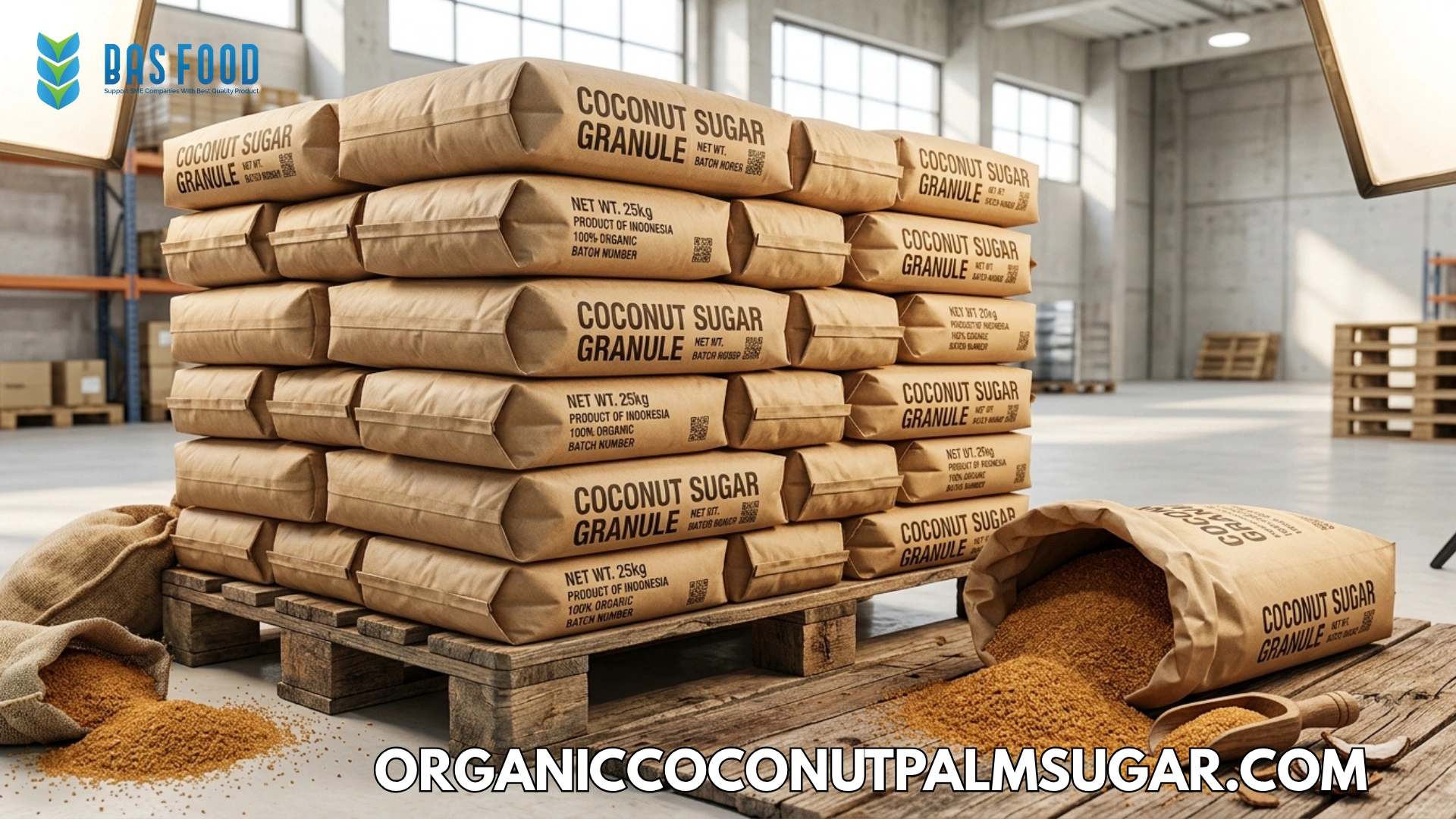
What Does a Bulk Coconut Sugar Granule Supplier Do?
A bulk coconut sugar granule supplier provides coconut sugar granules in quantities designed for commercial buyers rather than only household consumption. These buyers can include food manufacturers, wholesalers, importers, distributors, foodservice companies, and private-label brands.
The supplier’s role can involve several stages of the purchasing process. Depending on the business arrangement, this may include product preparation, quality control, bulk packing, labeling, documentation, storage, and export coordination.
For buyers, this means supplier selection should cover the complete purchasing process. A supplier may offer a suitable product but still not meet the buyer’s packaging, documentation, or shipping requirements.
Therefore, the first step is to define exactly what you need before comparing suppliers.
Bulk Does Not Mean One Standard Product
The word “bulk” describes purchasing volume, but it does not automatically define product quality or specifications.
Two suppliers may both sell bulk coconut sugar granules while offering different particle sizes, colors, packaging formats, moisture specifications, or production processes.
As a result, buyers should always request detailed product information instead of comparing suppliers based only on the word “bulk.”
Why Businesses Buy Wholesale Coconut Sugar Granules
Wholesale coconut sugar granules can be useful for businesses that need a steady supply of sweetener for manufacturing or distribution.
Food manufacturers may purchase larger quantities because coconut sugar becomes part of their regular production process. Similarly, distributors may buy in bulk before supplying smaller quantities to restaurants, retailers, or food manufacturers.
Buying larger quantities can also help simplify procurement. Instead of placing many small orders, a company can plan its purchases around production schedules and expected demand.
However, bulk purchasing requires good inventory management. A buyer needs to understand how much product can be stored safely and how quickly the stock will be used.
Bulk Buying and Cost Planning
Price is naturally an important factor in wholesale purchasing. However, the lowest quoted price is not always the most useful measure of total purchasing cost.
Buyers should also consider packaging, transportation, import costs, storage, handling, and potential losses caused by unsuitable product or packaging.
For example, a slightly lower product price may not provide an advantage if the packaging is unsuitable for the buyer’s warehouse conditions.
Therefore, compare the complete landed purchasing cost whenever possible.
How to Define Your Coconut Sugar Granule Requirements
Before contacting a supplier, create a basic purchasing specification. This makes the quotation process easier and helps suppliers understand exactly what you need.
Start with the product type. Confirm that you are looking for coconut sugar granules and identify the intended application.
Next, consider particle size. Granule size can influence handling, mixing, dissolution, appearance, and application performance. A beverage manufacturer may have different needs from a bakery or confectionery producer.
You should also consider color, flavor profile, moisture-related requirements, packaging, storage conditions, and any other product parameters relevant to your production process.
Why Particle Size Matters
Particle size is particularly important when purchasing granules for industrial use.
Fine and coarse granules can behave differently during mixing and processing. Therefore, the buyer should communicate the preferred granule characteristics clearly.
If the supplier offers different particle sizes, ask for samples and test them in the intended application.
This approach is much more reliable than choosing a specification based only on a product name.
What Makes a Good Bulk Coconut Sugar Supplier?
A strong supplier should provide more than a product catalogue. B2B buyers need clear information and consistent communication throughout the purchasing process.
Start by evaluating product consistency. Ask how the supplier defines its product specifications and how quality is monitored during production.
Next, evaluate communication. Does the supplier answer technical questions clearly? Can it explain packaging options? Can it provide samples? Can it discuss export requirements?
These factors matter because bulk purchasing usually involves a longer planning cycle than buying a small quantity.
Production Capability
Production capability is another important consideration. A supplier needs to understand the buyer’s expected purchasing pattern.
If the buyer needs regular shipments, the supplier should be able to discuss production planning and order scheduling.
However, buyers should not assume that every supplier can guarantee the same volume at all times. Production capacity, raw material availability, seasonal factors, and order schedules can affect supply.
Therefore, discuss realistic requirements with the supplier before making long-term commitments.
Evaluating Coconut Sugar Quality
Quality should be defined using clear specifications rather than general descriptions such as “premium” or “high quality.”
Depending on the application, buyers may evaluate appearance, color, aroma, taste, particle size, moisture-related characteristics, and packaging condition.
For industrial buyers, consistency between shipments can be especially important. A formulation developed using one batch should perform similarly when another batch arrives.
That is why a documented product specification can become an important part of the supplier relationship.
Sample Testing Before Bulk Orders
Before placing a large order, request a sample whenever possible.
Use the sample in the actual application. A food manufacturer can test it in its production recipe, while a beverage company can evaluate mixing and flavor performance.
Sample testing can reveal issues that are difficult to identify from a specification sheet alone.
After testing, document the approved product characteristics. This gives both the buyer and supplier a reference for future orders.
Bulk Packaging: Protecting Product Quality
Packaging plays a major role in bulk coconut sugar purchasing. Coconut sugar can interact with moisture from the surrounding environment, which can affect its handling characteristics.
Therefore, buyers should discuss packaging carefully with the supplier. The package should be appropriate for the product, intended storage conditions, handling process, and transportation route.
For export shipments, packaging may need to withstand several stages of handling. Products can move from the production facility to a warehouse, then to inland transportation, port handling, ocean freight, customs, and the destination warehouse.
Choosing the Right Pack Size
Pack size depends on how the buyer plans to use and distribute the product.
A food manufacturer may prefer larger bulk packs because the ingredient goes directly into production. A distributor may prefer a different format depending on its repacking or sales process.
The buyer should therefore select packaging based on actual operational needs rather than choosing a format simply because it is commonly used.
Protecting Bulk Product During Storage
Once the shipment arrives, storage becomes the buyer’s responsibility.
Warehouse conditions should follow the supplier’s recommended storage instructions. Buyers should also consider humidity, temperature, cleanliness, pallet placement, and protection from direct environmental exposure.
Good storage practices help maintain the product’s intended condition until it enters production or distribution.
Coconut Sugar Exporter vs Local Supplier
International buyers often need to decide whether to purchase directly from a producer or work with an export-oriented supplier.
A coconut sugar exporter can be useful when the buyer is importing from another country and needs experience with international shipment procedures.
An export supplier may understand common requirements related to documentation, packaging, shipping coordination, and overseas delivery.
However, export experience should be evaluated alongside product quality and commercial capability.
Why Direct Sourcing Can Be Useful
Direct sourcing can give buyers a clearer connection with the supplier handling the product.
It can also make communication about product specifications and packaging more direct.
However, direct sourcing does not eliminate the need for due diligence. Buyers should still confirm the supplier’s product quality, production capability, documentation, and commercial terms.
Working With CV Bonafide Anugerah Sentosa
For buyers sourcing coconut sugar from Indonesia, CV Bonafide Anugerah Sentosa can be evaluated as a potential B2B sourcing partner.
The company supplies coconut sugar and other coconut-derived products for commercial markets. International buyers can discuss product specifications, packaging requirements, order quantities, and export arrangements according to their specific needs.
As with any supplier evaluation, buyers should review samples, specifications, commercial terms, packaging, and documentation before approving a product for regular purchasing.
This is particularly important for businesses that intend to build a long-term supply relationship.
Planning Your Bulk Coconut Sugar Order
A successful bulk purchase starts with demand planning. Estimate how much coconut sugar your business will consume during the expected purchasing period.
Consider current production volume, projected sales, seasonal demand, lead times, shipping schedules, and warehouse capacity.
Then determine how frequently you want to reorder. A larger order may reduce the number of purchasing cycles, while smaller but more frequent orders may require more procurement work.
There is no universal order size that works for every business. The right quantity depends on actual demand and operational capacity.
Avoid Overstocking
Buying too much can create unnecessary inventory pressure.
Excess inventory uses warehouse space and working capital. It can also make stock management more difficult.
Therefore, buyers should balance purchasing efficiency with realistic consumption.
Avoid Underestimating Lead Time
The opposite problem can occur when buyers order too late.
International procurement can involve production, packing, inland transportation, port handling, ocean freight, customs clearance, and destination delivery.
Consequently, purchasing plans should include enough time for the complete supply chain.
Bulk Coconut Sugar for Different Industries
One advantage of coconut sugar granules is their broad application potential.
Food Manufacturing
Food manufacturers can use coconut sugar granules in bakery products, sauces, snacks, cereals, confectionery, and other formulations.
The exact product specification should match the production process.
Beverage Manufacturing
Beverage companies can use coconut sugar granules in powdered drink mixes, coffee products, tea products, and other beverage applications where the ingredient’s format is suitable.
Particle size and dissolution behavior may be particularly important for these applications.
Foodservice
Restaurants, cafés, bakeries, and catering businesses may also purchase coconut sugar in larger quantities.
Their needs can differ from industrial manufacturers, especially regarding packaging and ease of handling.
Distribution and Wholesale
Distributors may purchase wholesale coconut sugar granules and supply them to multiple downstream customers.
In this case, packaging, labeling, inventory planning, and shipment consistency can become especially important.
Common Mistakes When Choosing a Bulk Supplier
One common mistake is choosing a supplier based only on price. Price matters, but it should be considered alongside product quality, packaging, logistics, and communication.
Another mistake is failing to specify the required granule characteristics. If the buyer does not explain the intended application, the supplier may provide a standard specification that does not match the production process.
Skipping sample testing is another avoidable problem. A sample provides an opportunity to test the actual ingredient before making a larger commitment.
Finally, buyers sometimes overlook future orders. A supplier relationship should be evaluated based on both the first shipment and the possibility of repeat purchasing.
Building a Long-Term Coconut Sugar Supply Strategy
A long-term sourcing strategy should begin with a stable product specification. Once the buyer approves a particular coconut sugar granule specification, that reference can be used for future purchasing.
The buyer and supplier can then discuss expected order frequency, packaging requirements, production planning, and shipment schedules.
Regular communication can also help both sides prepare for changes in demand.
For example, if a buyer expects a significant increase in production, discussing it with the supplier early can make planning easier.
Keep Procurement and Product Teams Connected
The procurement team should not work separately from the product development or production team.
Technical requirements need to reach the supplier clearly. Likewise, commercial decisions should consider how the product actually performs in production.
This connection can reduce the risk of purchasing a product that looks attractive commercially but does not perform as expected in the factory.
Making Bulk Coconut Sugar Purchasing More Efficient
Bulk purchasing becomes easier when buyers treat the supplier relationship as an ongoing process rather than a series of individual transactions.
Start with a clear specification and approved sample. Then document the packaging and commercial requirements.
For repeat orders, use the same reference specification whenever possible. If changes are required, communicate them before production begins.
Also, keep demand forecasts updated. Suppliers can plan more effectively when they understand expected purchasing volumes and timing.
Over time, these practices can create a smoother procurement process and reduce unnecessary communication gaps.
Final Thoughts: Finding the Right Bulk Coconut Sugar Partner
Finding the right bulk coconut sugar granule supplier requires a balanced approach. Product quality matters, but so do specifications, packaging, communication, logistics, and long-term supply planning.
For businesses purchasing wholesale coconut sugar granules, the first step is to understand the exact product requirement. Define the intended application, granule characteristics, packaging, expected quantity, and destination market.
Next, evaluate suppliers based on actual evidence. Request samples, review specifications, discuss packaging, ask about export processes, and clarify commercial terms before placing a large order.
For international buyers, an experienced coconut sugar exporter supplier from Indonesia can provide a direct sourcing option. CV Bonafide Anugerah Sentosa can be considered by businesses looking for an Indonesian coconut sugar supplier for commercial purchasing.
Ultimately, the strongest supplier relationship is built on clear expectations. When buyers and suppliers communicate openly about product specifications, quality, packaging, and purchasing plans, bulk coconut sugar sourcing becomes much easier to manage.