Good packaging does more than hold a product. For food ingredients moving from a production facility to an international buyer, packaging protects quality, supports efficient handling, and helps the product arrive in good condition. This is especially important for coconut sugar granules. As a dry food ingredient, coconut sugar can be affected by moisture, heat, handling, and storage conditions. Therefore, choosing the right coconut sugar granule packaging is an important part of B2B sourcing.
For importers, distributors, food manufacturers, and private-label brands, packaging requirements can vary significantly. A manufacturer buying several hundred kilograms may have different needs from a retailer preparing small consumer packs.
The right packaging solution should therefore consider product volume, destination, transportation method, warehouse conditions, handling equipment, and the final use of the coconut sugar.
In this guide, we will explore the key factors behind effective coconut sugar granule packaging, from bulk packaging and export packaging to food grade bags, labeling, storage, and supplier communication.
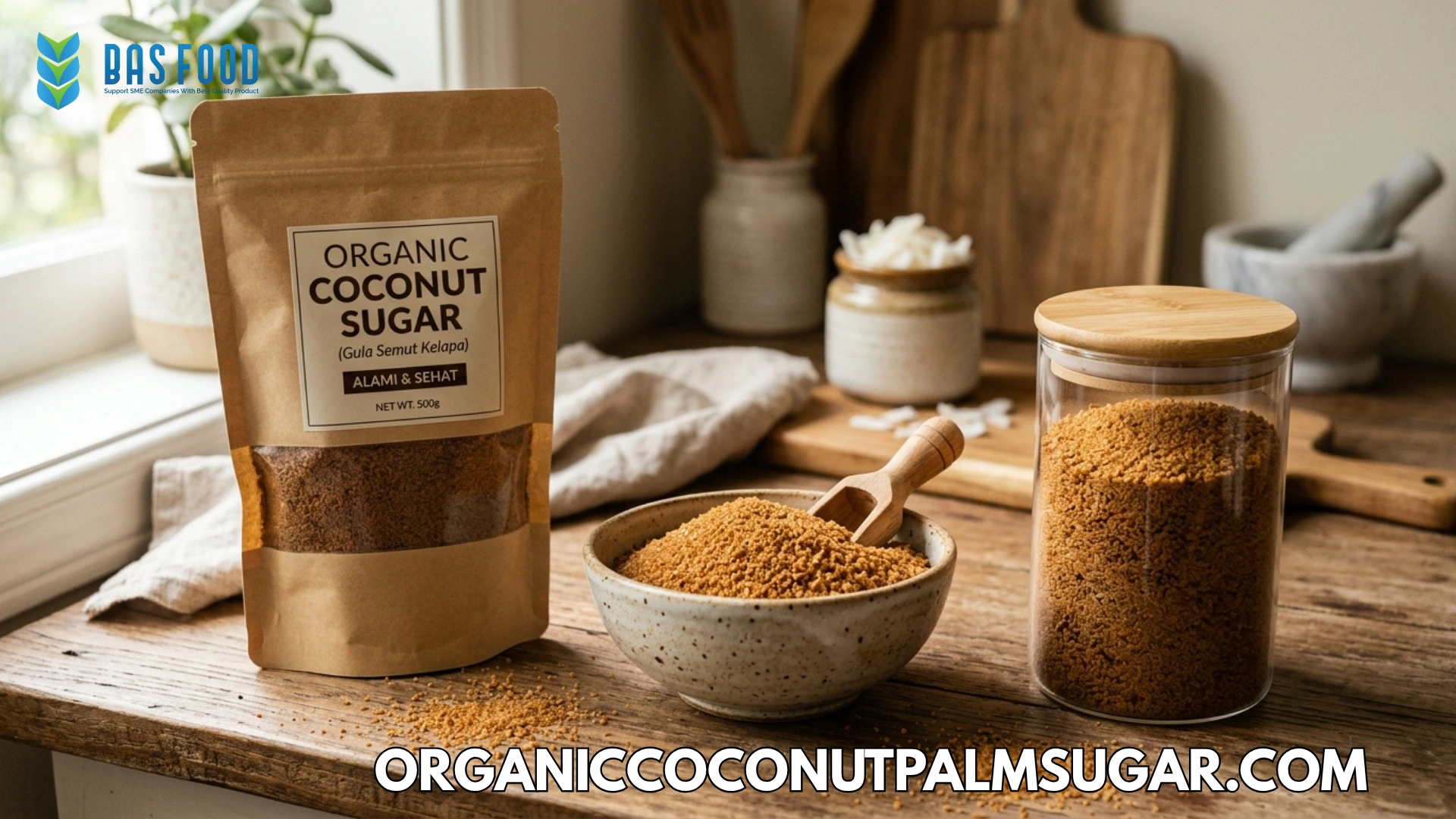
Why Coconut Sugar Granule Packaging Matters
Coconut sugar granules need protection from external conditions during transportation and storage. Although the product is dry, exposure to moisture can affect its physical condition and make the granules less free-flowing.
Good packaging creates a barrier between the product and its surrounding environment. It can help reduce exposure to humidity, dirt, and other sources of contamination while also making the product easier to handle.
For B2B buyers, this matters because packaging problems can create costs after the shipment arrives. Damaged bags, moisture exposure, or poor sealing may affect warehouse handling and product usability.
Therefore, packaging should be treated as part of the overall product specification rather than as an afterthought.
What Makes Good Coconut Sugar Granule Packaging?
A suitable packaging system should protect the product while remaining practical for transportation and handling.
For commercial coconut sugar, buyers generally look for packaging that provides:
- Adequate moisture protection
- Secure sealing
- Food-contact suitability
- Strong construction
- Easy handling
- Clear product identification
- Suitable weight capacity
- Protection during transportation
- Compatibility with warehouse storage
The exact packaging structure can vary depending on the customer’s requirements. For example, a distributor receiving a full container may choose a different format from a food manufacturer purchasing smaller quantities for production.
Consequently, packaging decisions should start with the supply chain rather than the bag itself.
Bulk Packaging for B2B Coconut Sugar
Bulk packaging is commonly used when coconut sugar granules are purchased for industrial production, foodservice distribution, or further repacking.
The main advantage is efficiency. Larger units can reduce the amount of individual packaging required and simplify warehouse operations.
However, bulk packaging also needs to be strong enough to withstand lifting, stacking, loading, unloading, and transportation. A package that works well in a warehouse may not perform equally well during a long international shipment if it is not designed for the journey.
Therefore, B2B buyers should discuss bulk packaging requirements with their supplier before finalizing an order.
Choosing the Right Bag Size
There is no single bag size that works for every buyer. Packaging can be selected according to production volume, warehouse capacity, handling systems, and distribution requirements.
A food manufacturer may prefer larger bags because the product will go directly into production. A distributor may need a format that can be easily divided or repacked for smaller customers.
Bag weight also affects manual handling. Larger bags can improve packing efficiency but may require appropriate lifting equipment.
Therefore, buyers should balance packaging efficiency with safe and practical handling.
Food Grade Bags for Coconut Sugar
Food grade bags are an important consideration when packaging coconut sugar intended for food production. The packaging material needs to be suitable for its intended food-contact application.
The purpose of food-grade packaging is not simply to make the product look professional. It also helps establish an appropriate barrier between the ingredient and the outside environment.
For B2B buyers, packaging specifications should be discussed alongside the product specification. The buyer and supplier should agree on the packaging material, bag size, sealing method, and any additional inner or outer protection that may be required.
Where specific market regulations apply, buyers should also confirm that the packaging meets the requirements of the destination market.
Inner and Outer Packaging
Some commercial coconut sugar products may use more than one packaging layer. An inner layer can provide direct product protection, while an outer layer can add strength for handling and transportation.
This approach can be useful when the product needs additional protection during long-distance shipping.
The exact structure depends on the product, bag material, shipment conditions, and buyer requirements.
For this reason, importers should discuss the complete packaging system with their coconut sugar supplier rather than focusing only on the outer bag.
Moisture Protection Is a Key Priority
Moisture is one of the biggest packaging considerations for dry sugar products. Coconut sugar granules can interact with moisture from the surrounding environment.
When exposed to high humidity, granules may become less free-flowing or begin to form lumps. This can make the product harder to handle and dose.
Packaging should therefore provide suitable protection against environmental moisture. However, packaging alone is not enough. Proper warehouse storage also plays an important role.
Buyers should keep the product in a dry environment and follow the supplier’s recommended storage practices.
Sealing and Packaging Integrity
A good bag is only effective if it remains properly sealed. During transportation, packages can experience vibration, pressure, stacking, and repeated handling.
Weak seals or damaged packaging can allow moisture and contaminants to enter. Therefore, sealing quality is an important part of packaging control.
Suppliers should inspect packages before shipment and ensure that bags are securely closed.
Buyers should also inspect incoming shipments. If damaged packaging is found, documenting the condition can help both parties investigate the issue.
Export Packaging for International Shipments
Export packaging needs to account for a longer and more complex supply chain than domestic packaging.
A coconut sugar shipment may move through a factory, warehouse, truck, port, container, destination port, warehouse, and finally the buyer’s production facility.
During this journey, the product may experience different temperatures, humidity levels, vibration, stacking pressure, and handling conditions.
Therefore, export packaging needs to be designed around the full transportation journey.
The supplier and buyer should discuss the expected shipping method and destination so that packaging can be selected accordingly.
Packaging and Container Loading
Packaging also affects how efficiently a shipment can be loaded. Bag dimensions, weight, stacking ability, and pallet configuration can influence the use of container space.
Efficient loading can help reduce wasted space and make cargo handling easier.
However, maximizing container utilization should not come at the expense of product protection. Excessive stacking or poor cargo arrangement can put unnecessary pressure on packages.
Therefore, exporters should balance space efficiency with safe cargo handling.
Palletizing Coconut Sugar Granules
Pallets can make bulk shipments easier to move using forklifts or pallet jacks. They can also help organize cargo inside warehouses and shipping containers.
However, pallet use depends on the buyer’s warehouse system and shipping requirements. Some customers may prefer palletized cargo, while others may have their own handling systems.
The pallet configuration should therefore be agreed before production and shipment.
Buyers should communicate their preferred pallet dimensions, maximum load, wrapping requirements, and handling process when applicable.
Labeling Requirements
Clear labeling helps everyone identify the product throughout the supply chain. A commercial coconut sugar package may include information such as product name, net weight, batch or lot number, production information, and storage instructions.
Exact labeling requirements depend on the destination country and the intended use of the product.
For export shipments, buyers should communicate any specific label requirements before production begins. Last-minute labeling changes can create unnecessary delays.
A clear packaging specification can help both the supplier and buyer avoid misunderstandings.
Batch and Lot Identification
Batch identification is especially useful for B2B food ingredients. It allows manufacturers and suppliers to connect a shipment with a particular production batch.
If a quality question arises, batch information can help identify the relevant product and production records.
For manufacturers operating formal quality systems, traceability can also be an important part of ingredient management.
Therefore, buyers should ask how batch identification is applied to the packaging and shipping documents.
Packaging and Product Traceability
Traceability is closely connected to labeling and batch identification. A well-organized packaging system helps buyers track the product from receipt through warehouse storage and production.
This can be particularly useful for companies managing multiple suppliers or multiple ingredient batches.
The supplier should provide consistent product identification so that the buyer’s warehouse and quality teams can easily record incoming materials.
As a result, packaging contributes not only to physical protection but also to supply chain organization.
Packaging for Different Buyer Types
Different customers can require different packaging solutions. Industrial food manufacturers often purchase coconut sugar in bulk, while distributors may need formats suitable for repacking.
Retail brands can have another requirement because they may need smaller consumer-ready packages with custom labeling.
Foodservice companies may prefer medium-sized bags that are convenient for commercial kitchens.
Therefore, the best coconut sugar granule packaging depends on the buyer’s business model.
A good supplier should be able to discuss these different requirements and identify a practical format.
Private Label and Custom Packaging
Some buyers purchase coconut sugar under their own brand. In this case, packaging becomes part of the brand experience.
Private-label customers may require custom labels, specific bag sizes, printed packaging, or other branding elements.
However, custom packaging requires additional planning. Artwork, packaging materials, printing schedules, minimum quantities, and approval processes may all need to be considered.
Buyers should therefore communicate private-label requirements early in the sourcing process.
Packaging and Warehouse Storage
Once the shipment reaches the buyer, packaging still has an important role. Even strong packaging cannot completely replace proper storage practices.
Coconut sugar should generally be kept in a clean, dry storage area away from excessive moisture and unsuitable environmental conditions.
Packages should also be protected from physical damage. Poor stacking can crush bags or make them difficult to handle.
Warehouse teams should follow appropriate stock rotation practices and inspect packages regularly.
How Packaging Can Affect Product Handling
Packaging influences how easily workers can move and open the product. A heavy bulk bag may require mechanical handling, while smaller bags may be manageable manually.
Opening design can also matter. Food manufacturers often need to transfer ingredients from the packaging into production equipment efficiently.
Therefore, buyers should think about what happens after the shipment arrives.
The ideal package is not necessarily the cheapest or largest. It is the one that protects the product while fitting the buyer’s actual workflow.
Common Packaging Mistakes B2B Buyers Should Avoid
One common mistake is choosing packaging based only on price. A cheaper bag may provide less protection or may not be suitable for a long international journey.
Another mistake is failing to communicate the destination and transportation conditions. Packaging requirements can change depending on the shipping route and storage environment.
Some buyers also focus heavily on product specifications while leaving packaging decisions until the last stage. This can create delays when custom materials or printing are required.
Finally, buyers may overlook storage conditions after delivery. Good packaging and poor storage can still result in product problems.
What to Ask Your Coconut Sugar Supplier
Before confirming an order, buyers should ask practical packaging questions.
Consider discussing:
- What packaging materials are available?
- Are food grade bags used?
- What bag sizes are available?
- Is inner packaging available?
- What sealing method is used?
- Can packaging be customized?
- Is private-label packaging possible?
- How are bags palletized?
- How is cargo protected during export?
- What information appears on the package?
- How is batch identification handled?
- What storage conditions are recommended?
These questions help buyers establish clear expectations before production begins.
They also help suppliers understand the buyer’s actual logistics requirements.
Working With a Coconut Sugar Exporter Supplier
For international buyers, choosing an experienced coconut sugar exporter supplier can simplify packaging discussions.
Export suppliers understand that the product must move through several stages before reaching the buyer. Therefore, packaging needs to support transportation, handling, storage, and final production.
However, buyers should still provide clear requirements. The supplier cannot know the buyer’s warehouse system, destination conditions, or repacking process without proper communication.
A detailed packaging specification can therefore become an important part of the purchase agreement.
CV Bonafide Anugerah Sentosa and Coconut Sugar Packaging
CV Bonafide Anugerah Sentosa is an Indonesian exporter of coconut sugar and other coconut-derived products. International buyers evaluating coconut sugar sourcing can discuss product and packaging requirements with the company based on their intended application and supply needs.
For B2B customers, packaging discussions can include bulk quantities, bag formats, export requirements, labeling, and shipment handling.
This application-based approach helps connect the packaging format with the buyer’s actual supply chain.
Whether the customer needs bulk packaging for food production or packaging designed for further distribution, clear communication remains important from the beginning.
Why Packaging Should Be Included in Supplier Evaluation
When comparing coconut sugar suppliers, buyers often focus on price, product quality, and production capacity. Packaging deserves similar attention.
A supplier may offer an attractive product specification, but the packaging may not match the buyer’s transportation or warehouse requirements.
Therefore, packaging should be included in the supplier evaluation checklist.
Buyers can compare packaging materials, bag sizes, sealing methods, customization options, palletization, and export handling alongside product specifications.
This creates a more complete picture of the supplier’s ability to meet commercial requirements.
Final Thoughts on Coconut Sugar Granule Packaging
Coconut sugar granule packaging plays an important role in protecting product quality and supporting efficient B2B supply. From the factory to the final warehouse, the packaging must withstand handling while helping protect the granules from moisture and physical damage.
For international shipments, export packaging requires additional consideration because the product may travel through several stages of transportation and storage.
At the same time, bulk packaging and food grade bags can be selected according to the buyer’s production volume, handling system, destination, and final application.
The most effective approach is to discuss packaging early with the coconut sugar supplier. Buyers should clearly communicate bag size, material, labeling, palletization, storage, and transportation requirements before production begins.
For businesses sourcing from Indonesia, CV Bonafide Anugerah Sentosa can be considered as a potential coconut sugar exporter supplier. By treating packaging as part of the overall product specification, buyers and suppliers can create a smoother and more predictable supply process.
Ultimately, good packaging is not simply about putting coconut sugar into a bag. It is about protecting the ingredient, supporting logistics, simplifying handling, and helping the product reach its destination in suitable condition.