Coconut sugar comes in more than one texture. While the ingredient may look similar at first glance, the size of its granules can make a real difference in food production, beverage preparation, packaging, and customer use. For B2B buyers, understanding fine vs coarse coconut sugar granules is especially important. A food manufacturer may need a sugar that blends quickly, while a bakery could prefer a slightly larger particle for a particular recipe. Meanwhile, a retailer may focus more on appearance and consumer convenience.
The difference mainly comes down to particle size. Fine coconut sugar has smaller particles, while coarse coconut sugar has larger granules. This simple difference can influence how quickly the sugar dissolves, how it mixes with other ingredients, how it feels in the mouth, and how it performs during production.
Choosing the right format can therefore help businesses avoid unnecessary processing adjustments and product development problems. Instead of selecting coconut sugar based only on price or appearance, buyers should consider the intended application first.
In this guide, we will compare fine and coarse coconut sugar granules, explain where each format works best, discuss important quality factors, and provide practical tips for B2B buyers looking for a reliable coconut sugar supplier.
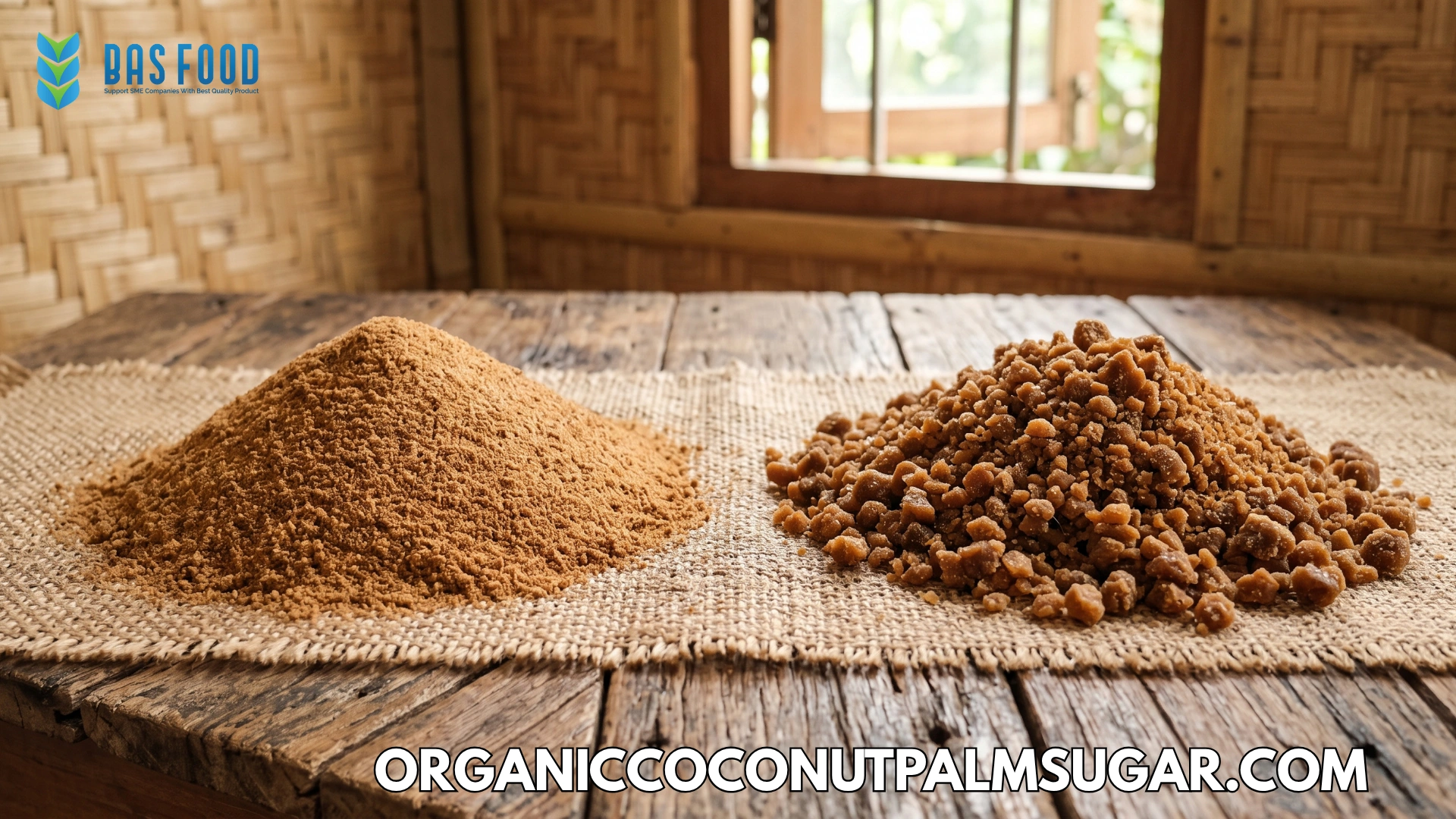
What Does Fine vs Coarse Coconut Sugar Granules Mean?
The phrase fine vs coarse coconut sugar granules refers mainly to the physical size of the sugar particles.
Fine coconut sugar consists of smaller particles that generally have a smoother, more powder-like appearance. Coarse coconut sugar contains larger particles that are easier to distinguish individually.
The exact particle range can vary between suppliers and production specifications. Therefore, terms such as “fine” and “coarse” should not be treated as universal measurements.
For B2B purchasing, it is better to ask for the actual particle size specification rather than relying only on the product name.
Why Particle Size Matters
Particle size affects how coconut sugar behaves during use.
Smaller particles generally provide more surface area, which can help them mix or dissolve more easily in certain applications. Larger particles may take longer to dissolve but can provide a different texture and handling experience.
For this reason, a buyer should not simply ask, “Do you sell fine coconut sugar?”
A more useful question is:
“What is the particle size range of your fine coconut sugar, and can you provide a sample?”
This creates a clearer basis for product comparison.
Understanding Fine Coconut Sugar
Fine coconut sugar is made by processing coconut sugar into smaller granules.
Its loose texture makes it practical for applications where the ingredient needs to mix easily with other components.
For example, food manufacturers may use fine granules in powdered beverage mixes, bakery formulations, dessert products, or other dry ingredient systems.
Fine coconut sugar can also be useful for consumers who want a sugar that is relatively easy to scoop and measure.
Where Fine Coconut Sugar Works Best
Fine coconut sugar can be considered for:
- Coffee and tea
- Powdered beverages
- Bakery products
- Cake mixes
- Chocolate products
- Desserts
- Dry food blends
- Sauces and formulations
- Instant drink mixes
- Retail cooking products
The main advantage is flexibility.
Because the particles are relatively small, they can often be incorporated into recipes without requiring the buyer to break down larger pieces.
However, actual performance depends on the specific particle size, moisture level, recipe, and production process.
Understanding Coarse Coconut Sugar
Coarse coconut sugar contains larger granules.
This format can be useful when the application does not require rapid dissolution or when a more noticeable sugar texture is acceptable.
Coarse granules can also be easier to identify visually, which may be useful for certain specialty food products.
For example, a manufacturer producing a textured baked product may find coarse coconut sugar suitable for its formulation.
Where Coarse Coconut Sugar Can Be Used
Potential applications include:
- Baking
- Cookies
- Granola
- Specialty desserts
- Food toppings
- Traditional recipes
- Certain beverage applications
- Specialty retail products
Coarse coconut sugar can also be useful for businesses that want a less powder-like ingredient.
However, manufacturers should always test the ingredient in the actual recipe.
A granule that works well in one product may not work equally well in another.
Fine vs Coarse Coconut Sugar Granules for Beverages
Beverage applications are one of the clearest areas where particle size can matter.
Fine granules may be more convenient when the sugar needs to dissolve or disperse quickly.
This can be useful for coffee, tea, powdered beverages, and other applications where the sweetener needs to become part of the drink rather than remain as visible particles.
Coarse granules may take longer to dissolve, particularly in cooler beverages.
Hot and Cold Drinks
Temperature can influence sugar dissolution.
In hot beverages, both fine and coarse coconut sugar may dissolve more easily because the higher temperature can support faster dissolution.
Cold beverages can be more challenging.
For iced coffee, cold tea, and other chilled drinks, finer particles may be more practical depending on the formulation.
For beverage manufacturers, the best approach is to test the coconut sugar under actual production conditions.
Fine vs Coarse Coconut Sugar for Coffee
Coffee is another important application.
Fine coconut sugar can be useful for cafés, coffee manufacturers, and beverage brands that want an easy-to-measure sweetener.
The smaller particles can mix efficiently with hot coffee, depending on the formulation and particle characteristics.
Coarse coconut sugar can still be used in coffee, particularly when the customer adds the sweetener manually.
However, larger particles may require more stirring or time to dissolve.
Coffee Flavor and Particle Size
Particle size does not only influence physical behavior. It can also influence the customer’s perception of the beverage.
A sugar that dissolves quickly can create a more consistent sweetness throughout the cup.
A slower-dissolving product may create a different experience, especially if the customer drinks the coffee before all the sugar has dissolved.
Therefore, coffee businesses should consider both technical performance and customer experience.
Fine vs Coarse Coconut Sugar for Baking
Baking provides opportunities for both formats.
Fine coconut sugar can blend easily with flour and other dry ingredients, making it practical for cake, muffin, cookie, and baking mix applications.
Coarse coconut sugar can be useful when the recipe benefits from more noticeable sugar particles.
For example, a product developer may intentionally use a larger particle to create a particular texture.
Match Particle Size With the Recipe
A bakery should consider the mixing method, baking temperature, recipe structure, and desired texture.
If the sugar needs to blend evenly throughout a cake batter, a finer format may be easier to work with.
If the product is designed to have a textured surface or visible sugar particles, coarse coconut sugar may be more suitable.
The best choice depends on the finished product rather than a general assumption about quality.
Why Particle Size Is Important for Food Manufacturers
For industrial food production, particle size can affect more than taste.
It can influence ingredient flow, mixing time, blending consistency, and dosing.
If a production line is designed for a particular ingredient format, switching to a substantially different particle size may require adjustments.
This is why B2B manufacturers should include particle size in their purchasing specifications.
Establish a Clear Specification
Instead of ordering “coconut sugar granules,” manufacturers can define requirements such as:
- Preferred particle size
- Acceptable particle size range
- Moisture requirement
- Color
- Flavor profile
- Packaging
- Net weight
- Storage conditions
This makes the purchasing process more precise.
It also helps the supplier understand what the buyer actually needs.
Moisture and Its Relationship With Granule Size
Moisture is another important quality consideration when comparing fine and coarse coconut sugar.
Coconut sugar can be affected by humidity, so proper processing, packaging, and storage are important.
Fine particles can have a larger total surface area relative to their volume, which may make moisture management particularly important during handling.
Coarse granules may behave differently during storage, but they still require appropriate protection from humidity.
Packaging Matters
Regardless of particle size, the product should be packed in suitable food-grade packaging.
International shipments may experience changes in temperature and humidity.
Therefore, B2B buyers should discuss packaging requirements with their supplier before ordering.
Good packaging can help protect the product during transportation, storage, and handling.
Fine vs Coarse Coconut Sugar for Retail
Retail businesses need to consider consumer convenience as well as product performance.
Fine coconut sugar can be easy for consumers to scoop and use in everyday cooking, baking, coffee, and tea.
Coarse coconut sugar may appeal to customers looking for a more traditional or visibly granulated product.
Packaging design can also influence the way customers perceive the product.
Choosing Based on Target Customers
A modern baking brand may prefer fine granules.
A traditional food brand may prefer coarse granules or even moulded coconut sugar.
Neither option is automatically more premium.
The product should match the expectations of the target customer.
Retailers should also consider package size, resealability, moisture protection, labeling, and shelf presentation.
Fine vs Coarse Coconut Sugar for Industrial Production
Large food manufacturers often use automated equipment.
In these environments, ingredient consistency becomes extremely important.
Particle size can affect how the ingredient moves through hoppers, mixers, feeders, and other equipment.
Fine coconut sugar may work well for some automated systems, while coarse coconut sugar may be more suitable for others.
Test With Your Production Line
Before committing to a large order, manufacturers should test samples using their actual equipment.
A laboratory test can provide useful information, but a production-line trial gives a more realistic picture.
During the trial, manufacturers can monitor:
- Feeding
- Mixing
- Dosing
- Dissolution
- Product texture
- Processing time
- Waste
- Finished-product quality
This information can help determine the most suitable granule specification.
How to Compare Fine and Coarse Samples
When comparing fine vs coarse coconut sugar granules, buyers should avoid judging the products based only on visual appearance.
Instead, evaluate both samples under the same conditions.
Use the same recipe, production process, temperature, mixing time, and storage conditions whenever possible.
This makes the comparison more meaningful.
A Simple Evaluation Method
For each sample, record:
| Evaluation Area | Fine Coconut Sugar | Coarse Coconut Sugar |
|---|---|---|
| Particle size | Smaller | Larger |
| Dissolution | Often faster | Often slower |
| Dry mixing | Generally easy | May require more mixing |
| Beverage use | Very practical | Application dependent |
| Baking | Highly versatile | Useful for selected recipes |
| Texture | Smoother | More noticeable |
| Retail use | Convenient | Distinctive |
| Industrial use | Process dependent | Process dependent |
This table is a starting point rather than a universal technical specification.
Actual performance should always be confirmed through testing.
Fine vs Coarse: Which One Is Better?
There is no single answer.
Fine coconut sugar may be better when the priority is easy blending, quick dissolution, and flexible food or beverage applications.
Coarse coconut sugar may be better when the product requires more visible granules, specific texture, or a traditional ingredient format.
The right decision depends on the buyer’s application.
Fine vs Coarse Coconut Sugar and Moulded Formats
Granules are not the only coconut sugar format available.
Some businesses prefer moulded products because they offer solid pieces that can be broken or portioned before use.
This is where a coconut sugar mould supplier can be relevant.
Moulded coconut sugar may be appropriate for traditional food products, specialty retail, foodservice, or applications where solid blocks are preferred.
Choosing Between Three Formats
B2B buyers can think of the options this way:
Fine: best suited to applications that require easy mixing and smaller particles.
Coarse: useful for applications where larger particles and texture are acceptable.
Moulded: suitable when solid pieces, traditional formats, or custom shapes are required.
The choice depends on the product concept and production process.
How to Choose a Coconut Sugar Supplier
Finding the right coconut sugar supplier is just as important as selecting the right particle size.
A supplier should be able to explain its available product formats and provide clear specifications.
For international B2B buyers, the supplier should also understand export packaging, documentation, order quantities, and delivery requirements.
Questions Worth Asking
Before ordering, ask:
- What particle sizes are available?
- Can you provide samples?
- What are the coconut sugar specifications?
- What moisture level is specified?
- What packaging formats are available?
- What is the minimum order quantity?
- Can you support regular bulk orders?
- What is the production lead time?
- Can you supply moulded formats?
- What export documentation is available?
These questions help buyers compare suppliers more effectively.
Why Supplier Consistency Matters
A sample may perform perfectly in product development, but long-term supply requires consistent quality.
If the particle size changes significantly between shipments, the manufacturer’s process may also change.
This can affect mixing, dosing, texture, and final product quality.
Therefore, buyers should discuss quality consistency before placing recurring orders.
From Sample to Long-Term Supply
Once a buyer approves a sample, the agreed specifications should be documented.
The buyer and supplier can use the approved specifications as a reference for future orders.
This is particularly important for manufacturers producing large quantities.
Consistency helps reduce unnecessary recipe adjustments and supports a more predictable production process.
CV Bonafide Anugerah Sentosa as an Indonesian Supplier
Indonesia is an important source of coconut-based products, and international buyers can source coconut sugar from Indonesian suppliers for a range of food and beverage applications.
When selecting an Indonesian supplier, buyers should consider product specifications, supply capacity, packaging, communication, and export readiness.
CV Bonafide Anugerah Sentosa is an Indonesian exporter and supplier of coconut sugar and other coconut-derived products.
For B2B buyers, discussing the intended application can help clarify whether fine, coarse, moulded, or another coconut sugar format is appropriate.
Final Thoughts: The Right Granule Size Starts With the Right Application
Understanding fine vs coarse coconut sugar granules can help B2B buyers make better sourcing decisions.
Fine coconut sugar is often a practical choice for applications that require smaller particles, easy mixing, and convenient use in beverages and food formulations. Coarse coconut sugar can be useful when texture, visible granules, or a more traditional format is preferred.
However, particle size is only one part of the quality equation.
Buyers should also evaluate moisture, color, flavor, packaging, storage, consistency, and supplier reliability.
For international businesses, selecting the right coconut sugar supplier can make the entire purchasing process easier.
Start with a clear product requirement, request samples, review the specifications, and test the ingredient in the actual application.
For buyers sourcing from Indonesia, CV Bonafide Anugerah Sentosa can be considered as a potential supplier for coconut sugar and related formats.
Ultimately, there is no universal winner in the fine versus coarse debate. The best coconut sugar is the one that performs well in your product, fits your production process, meets your quality requirements, and can be supplied consistently.