When buying coconut sugar in bulk, price is important, but coconut sugar granule quality matters just as much. For food manufacturers, importers, distributors, and private-label brands, consistent granules can make production easier and help maintain a stable finished product.
However, quality is not simply about whether coconut sugar looks good. Buyers should evaluate several factors, including color, moisture, aroma, purity, particle consistency, taste, packaging, and handling. Each factor can influence how the sugar performs during storage, processing, and final use.
This guide explains how to evaluate coconut sugar granule quality from a practical B2B perspective. We will look at the main quality indicators, common problems, supplier questions, quality-control practices, and what buyers should consider before purchasing bulk coconut sugar.
What Is Coconut Sugar Granule Quality?
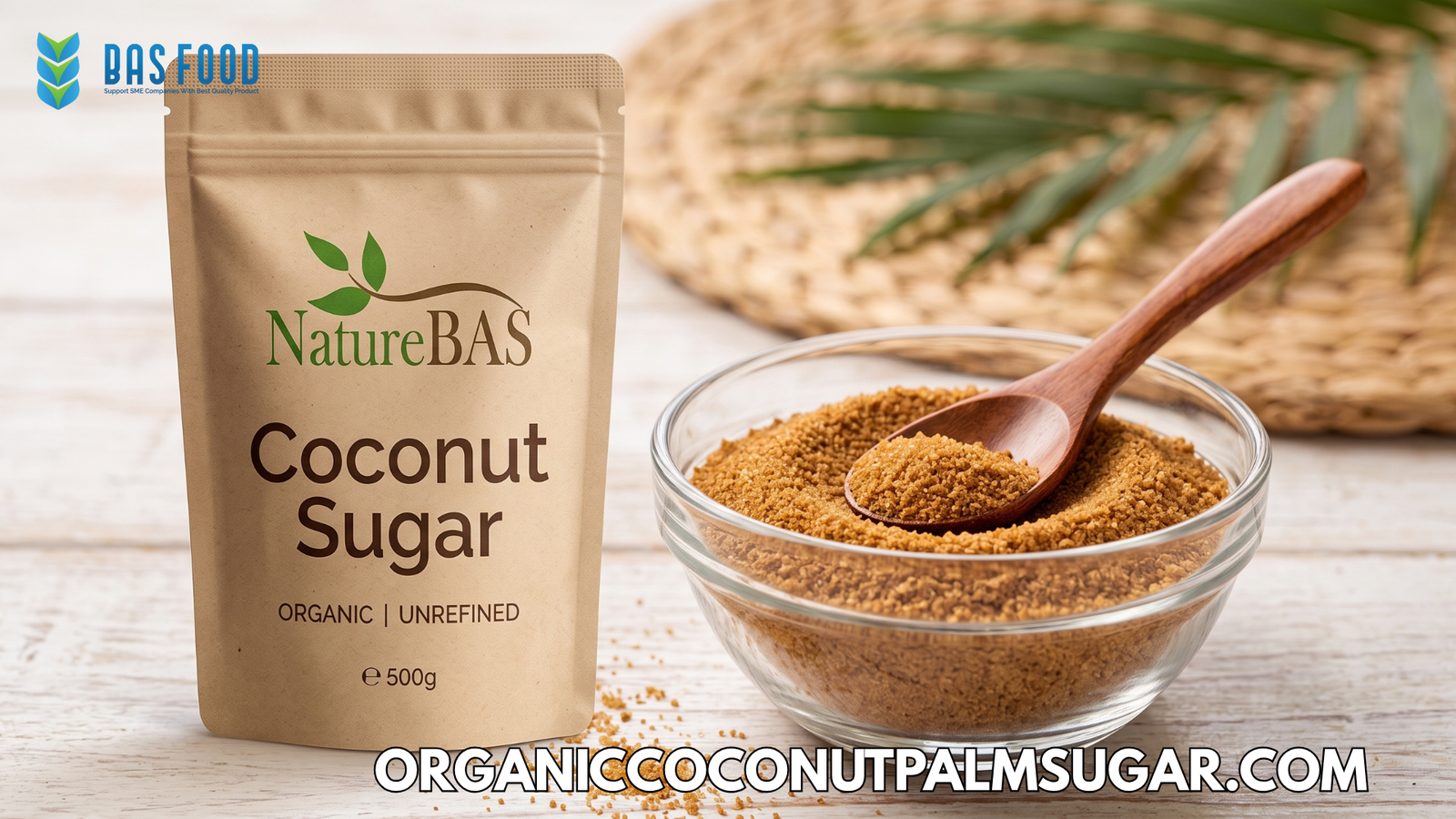
Coconut sugar granule quality describes the overall physical and sensory condition of granulated coconut sugar and how consistently it meets an agreed product specification. It covers more than particle size. A quality assessment should consider the appearance, color, moisture, aroma, purity, texture, and consistency of the product.
For B2B buyers, this broader definition is important. A shipment may have an attractive appearance but still fail to meet the buyer’s requirements for moisture or particle distribution. Similarly, a product may have an acceptable color but contain unwanted foreign material. Therefore, professional procurement should always evaluate several quality parameters together.
Good granule quality should also remain reasonably consistent between production batches. This consistency becomes especially important when coconut sugar is used as an ingredient in commercial food production.
If a manufacturer receives noticeably different sugar from one shipment to another, the difference may affect the appearance, taste, processing, or formulation of the finished product. That is why buyers should establish specifications before ordering large quantities.
Why Granule Quality Matters in B2B Sourcing
For consumers, coconut sugar may simply be a sweetener. For a food manufacturer, however, it is a production ingredient. The ingredient needs to perform predictably inside a specific recipe or manufacturing process.
For example, a bakery may need consistent granules for mixing into dough or dry ingredients. A beverage producer may need a particle size that disperses efficiently. Meanwhile, a food distributor may focus more on appearance, packaging, shelf stability, and consistency across multiple shipments.
As a result, there is no single definition of “best” coconut sugar for every buyer. The right product is the one that matches the application and the buyer’s specification.
This is also why buyers should avoid choosing a supplier based only on price. A cheaper product may create additional costs if it has inconsistent moisture, poor packaging, excessive fines, or variable color. In B2B procurement, reliable quality can be more valuable than a small difference in purchase price.
Color: The First Quality Indicator Buyers Notice
Color is one of the easiest characteristics to observe when evaluating coconut sugar granules. Depending on the product and processing method, coconut sugar can show natural variations in brown tones.
Buyers often look for a color that matches the agreed specification and remains reasonably consistent between batches. A significant change in color can indicate differences in raw material, processing conditions, concentration, or other production factors.
However, color should not be judged in isolation. Natural agricultural products can show some variation, and visual appearance alone cannot confirm overall quality.
For B2B purchasing, it is better to define an acceptable color range or provide an approved sample as a reference. This gives the buyer and supplier a common standard.
Why Color Consistency Matters
Imagine a food brand that uses coconut sugar in a light-colored bakery product. If one shipment is significantly darker than the previous shipment, the finished product may look different.
Similarly, manufacturers selling packaged coconut sugar may want a consistent appearance because consumers expect the product to look similar each time they purchase it.
Therefore, buyers should discuss color requirements before production. A supplier should understand whether the buyer needs a specific shade, a natural range, or simply a consistent appearance within an agreed tolerance.
Moisture: A Critical Factor in Granule Quality
Moisture is another important part of coconut sugar granule quality. Coconut sugar is hygroscopic, meaning it can absorb moisture from its surrounding environment. This characteristic makes moisture control particularly relevant during processing, packaging, transportation, and storage.
Excess moisture can affect the physical behavior of granulated sugar. Depending on conditions, particles may become less free-flowing and may begin to clump. This can create problems during filling, handling, and industrial processing.
For this reason, B2B buyers should always ask for the moisture specification before placing a bulk order. The supplier should also explain how moisture is controlled during production and packaging.
Moisture During Storage and Shipping
Even when a product leaves the production facility in good condition, storage and transportation can affect it. Humid environments, unsuitable packaging, damaged bags, or poor warehouse conditions can introduce additional moisture.
This means packaging plays an important role in protecting granule quality. Export buyers should discuss packaging materials, inner liners, sealing methods, palletization, and storage recommendations with their supplier.
For long-distance shipments, the buyer should also consider the destination climate. A product shipped to a humid environment may require different handling precautions from one stored in a dry warehouse.
Aroma: A Simple but Useful Sensory Check
Natural coconut sugar has its own characteristic aroma. A normal sensory profile can be useful when evaluating a sample because it gives buyers another way to compare products.
A strong or unusual smell may require further investigation. For example, the buyer may want to check whether the product has been exposed to another material, unsuitable storage conditions, or packaging issues.
However, aroma should always be assessed as part of a broader quality check. Sensory evaluation alone cannot replace laboratory testing or documented quality specifications where those are required.
For B2B buyers, the best approach is to approve a representative sample before purchasing at scale. The approved sample can serve as a practical reference for future discussions about color, aroma, texture, and overall appearance.
Purity and Foreign Material Control
Purity is a fundamental consideration when sourcing coconut sugar for commercial use. Buyers expect the product to be suitable for food applications and free from unwanted foreign materials according to the agreed specification.
Foreign material can enter a food ingredient at different stages if handling and process controls are not adequate. Therefore, suppliers should have procedures for raw material handling, processing, screening, packing, and finished-product inspection.
For importers, purity should be addressed clearly in the product specification and quality documentation. The buyer should understand the supplier’s quality-control process rather than relying on a general statement that the product is “high quality.”
Why Purity Matters for Manufacturers
Food manufacturers need reliable ingredients because contamination or foreign material can create serious production and commercial problems.
A supplier with clear process controls can help reduce these risks. Buyers should therefore ask about inspection procedures, cleaning, screening, storage, and finished-product checks before committing to regular supply.
The exact testing and documentation requirements can vary according to the buyer, application, and destination market. Therefore, buyers should communicate their requirements clearly from the beginning.
Granule Size and Particle Consistency
Granule size is another major part of coconut sugar granule quality. The particles should match the buyer’s agreed specification and application.
Some buyers need relatively fine granules, while others prefer larger particles. The right choice depends on how the coconut sugar will be used.
A food manufacturer may need a particular particle distribution to achieve consistent mixing. A retail brand may have different requirements based on consumer expectations and packaging performance.
Why Particle Distribution Matters
Particle distribution refers to the range of particle sizes found within a batch. A product can contain mostly fine particles but still have some larger particles. Likewise, a product classified as a larger granule may contain a certain percentage of smaller particles.
For professional procurement, buyers should ask for a particle-size specification or sieve analysis when appropriate.
This information can provide a clearer understanding of the product than simply using terms such as “fine” or “coarse.” Clear specifications also make it easier to compare samples from different suppliers.
Texture and Flowability
The physical texture of coconut sugar granules can tell buyers a great deal about the product. Granules should generally match the agreed physical specification and should be suitable for the intended handling process.
Flowability is particularly important for industrial users. If granules become heavily compacted or clumped, automated filling and mixing can become more difficult.
Moisture is one factor that can influence this behavior, but packaging, storage conditions, particle size, and handling can also contribute.
Therefore, buyers should evaluate the product not only by looking at a sample but also by considering how it behaves during their own production process.
How Coconut Sugar Is Processed Into Granules
Understanding the production process helps buyers understand why quality can vary. Coconut sugar begins with sap collected from coconut flower blossoms. The sap is handled and processed before being concentrated into coconut sugar.
The concentrated material is then processed into the desired physical form. For granulated coconut sugar, further processing and screening help achieve the required particle size.
The exact methods can differ between producers. Processing conditions, equipment, raw material handling, and quality-control systems can all influence the finished product.
This is why buyers should evaluate the supplier’s process as well as the final sample. A good sample is useful, but consistent production capability is what matters for long-term B2B supply.
How Suppliers Control Coconut Sugar Granule Quality
Quality control should begin with raw material handling and continue through the entire production process. Suppliers need to monitor relevant production conditions and maintain clean handling practices.
After processing, the product can undergo screening and inspection to help achieve the agreed granule specification. Packaging then protects the finished product during storage and transportation.
For B2B buyers, the key question is not simply whether a supplier has quality control. The buyer should understand what parameters the supplier checks and how the finished product is released.
A clear specification sheet is a useful starting point. Depending on the buyer’s requirements, additional documents or testing may also be needed.
The Difference Between Coconut Sugar Granules and Moulded Sugar
Coconut sugar is available in different physical forms. Granulated coconut sugar is processed into smaller particles, while moulded coconut sugar is formed into blocks, discs, or other shapes.
This distinction matters because different forms require different production and packaging considerations.
A coconut sugar mould supplier is therefore relevant when buyers need moulded coconut sugar rather than granulated material. Buyers should clearly communicate which form they need because the production process and specifications are different.
For companies selling multiple coconut sugar formats, it can make sense to source both granulated and moulded products from suppliers with experience in different product specifications.
CV Bonafide Anugerah Sentosa and B2B Coconut Sugar Sourcing
CV Bonafide Anugerah Sentosa is an Indonesian exporter that can serve as a sourcing partner for buyers interested in Indonesian coconut sugar and related products.
For B2B buyers, the most important step is to communicate the required product specification clearly. Instead of asking only for “coconut sugar,” buyers can provide details about granule size, color, moisture, aroma, purity, packaging, order volume, and intended application.
This makes the quotation and sampling process more efficient. It also gives both parties a clear reference for the product being discussed.
When building a long-term sourcing relationship, buyers should evaluate consistency across samples and shipments. A supplier’s ability to maintain agreed specifications is often more important than simply providing one attractive sample.
Packaging and Storage Can Protect Granule Quality
Even excellent coconut sugar can experience quality problems if it is packaged or stored incorrectly. Because coconut sugar can absorb moisture, packaging needs to provide appropriate protection for the intended storage and shipping conditions.
For bulk export, buyers should discuss bag materials, inner liners, sealing, palletization, container loading, and warehouse conditions.
Storage conditions also matter after the product arrives. Buyers should keep the product in a clean, dry environment and protect packaging from damage.
Good storage practices help preserve the original granule quality and reduce the risk of moisture-related clumping or other physical changes.
Final Thoughts on Coconut Sugar Granule Quality
Coconut sugar granule quality involves much more than particle size. A professional evaluation should consider color, moisture, aroma, purity, texture, granule size, particle distribution, packaging, and consistency.
For B2B buyers, the goal is not simply to find coconut sugar that looks good. The goal is to find a product that consistently fits the manufacturing process, quality requirements, packaging needs, and target market.
Therefore, always define your specification before ordering. Request samples, compare the product against clear criteria, and discuss quality control with the supplier.
Whether you are an importer, distributor, food manufacturer, restaurant supplier, or private-label brand, a clear sourcing process can reduce quality problems and create a more dependable supply chain.
By working with a reliable coconut sugar supplier and clearly defining your requirements, you can make purchasing decisions with greater confidence. And when granule quality stays consistent from shipment to shipment, your own production and customer experience become easier to manage.