The baking industry has changed significantly in recent years. Consumers are paying more attention to ingredient labels and looking for baked goods made with natural, recognizable ingredients. As a result, bakeries, food manufacturers, and private label brands are exploring alternative sweeteners that deliver both great flavor and excellent baking performance. One ingredient that continues to gain popularity is coconut sugar for baking. Made from the sap of coconut blossom flowers, coconut sugar offers a pleasant caramel-like sweetness that complements a wide variety of baked products. Unlike highly refined sugars, coconut sugar undergoes a relatively simple production process, making it an attractive ingredient for brands that want to create premium bakery products with a natural image.
For commercial bakeries, importers, distributors, and food manufacturers, choosing the right sweetener affects much more than taste. It influences texture, color, consistency, processing efficiency, shelf stability, and consumer perception. Understanding how coconut sugar performs during baking helps businesses develop products that meet both manufacturing requirements and market expectations.
In this comprehensive guide, we will explore why coconut sugar for baking has become a preferred choice among professional bakers, how it works as a reliable baking sweetener, its role in modern bakery ingredients, and why partnering with a trusted palm sugar supplier or experienced coconut sugar supplier Indonesia supports long-term sourcing success.
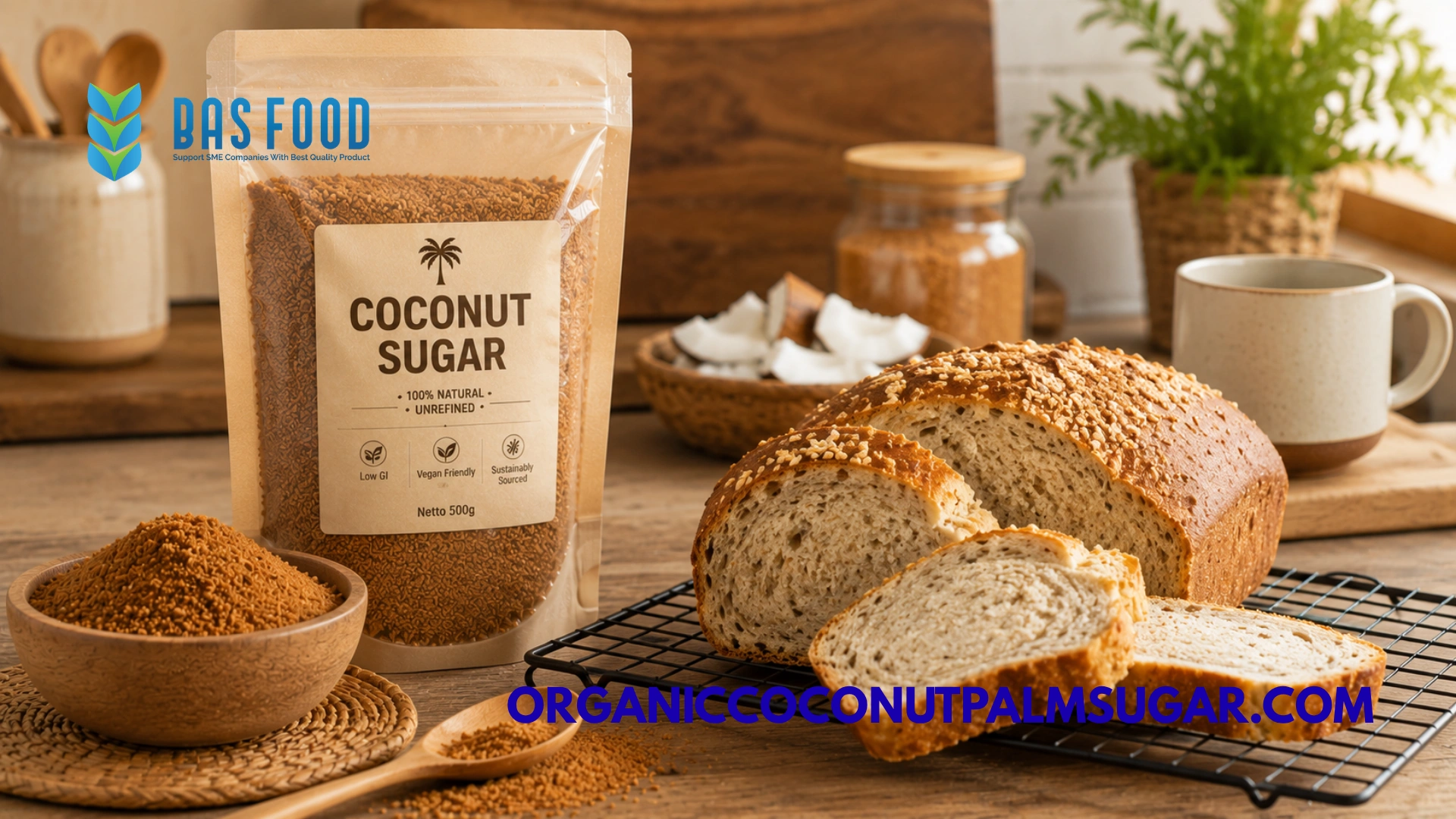
Why Coconut Sugar Is Becoming Popular in Modern Baking
Consumer preferences continue to shape the bakery industry. Today, many shoppers look for products that contain simple ingredients and authentic flavors.
This trend has encouraged manufacturers to replace highly refined ingredients with alternatives that better align with clean-label product development. Coconut sugar fits this demand because it is produced from coconut blossom sap through a relatively straightforward process.
Beyond consumer interest, coconut sugar also provides functional advantages for commercial baking. It contributes sweetness while adding a rich caramel flavor that enhances the taste of many baked goods.
Because of these qualities, coconut sugar is now widely used by artisan bakeries, industrial manufacturers, cafés, food service companies, and premium bakery brands around the world.
What Makes Coconut Sugar a Great Baking Sweetener?
Every sweetener behaves differently when exposed to baking temperatures.
As a natural baking sweetener, coconut sugar offers balanced sweetness that blends well with flour, butter, oils, fruits, chocolate, spices, nuts, and dairy or plant-based ingredients.
Unlike some sweeteners that provide only sweetness, coconut sugar also contributes subtle caramel notes that add complexity to finished products.
Its dry form makes measuring and mixing simple during commercial production.
Manufacturers can also choose different particle sizes, including fine granules, coarse granules, and powder, depending on the recipe and production equipment.
These characteristics make coconut sugar suitable for both small-batch artisan baking and large-scale industrial production.
Coconut Sugar Performs Well in Many Bakery Ingredients
Professional bakers carefully select every ingredient because each one influences the final product.
Coconut sugar has become one of the most versatile bakery ingredients because it works well across numerous product categories.
Common applications include:
- Cookies
- Cakes
- Muffins
- Brownies
- Bread
- Croissants
- Donuts
- Cinnamon rolls
- Biscuits
- Crackers
- Granola
- Energy bars
- Breakfast pastries
Its versatility allows manufacturers to standardize ingredient sourcing while creating a broad range of bakery products.
Many companies appreciate using one sweetener across multiple product lines because it simplifies purchasing and inventory management.
Flavor Benefits That Consumers Love
Flavor remains one of the biggest reasons manufacturers choose coconut sugar.
Instead of producing an overly sweet taste, coconut sugar delivers balanced sweetness with gentle caramel notes.
This richer flavor profile complements ingredients such as vanilla, cocoa, cinnamon, coffee, coconut, banana, apple, pumpkin, nuts, and dried fruits.
As a result, recipes often develop a more complex and satisfying taste without relying on artificial flavor enhancers.
Many premium bakery brands intentionally use coconut sugar because consumers associate its flavor with handcrafted, authentic baked goods.
This perception supports product differentiation in competitive retail markets.
How Coconut Sugar Affects Texture in Baked Products
Texture is another important consideration when selecting sweeteners.
Coconut sugar helps create baked goods with appealing structure while supporting even ingredient distribution.
Fine coconut sugar dissolves more quickly during mixing and works well in cakes, muffins, and soft cookies.
Coarser granules may contribute subtle texture in specialty baked products.
Particle size selection should always match the desired product characteristics and manufacturing process.
Commercial bakeries often work closely with suppliers to identify the most suitable specification for each recipe.
Consistent particle size also supports automated production systems by improving ingredient flow and reducing mixing variability.
Color Development During Baking
One noticeable characteristic of coconut sugar is the attractive color it contributes to baked goods.
Its natural golden-to-brown appearance can enhance the visual appeal of cookies, cakes, breads, and pastries.
During baking, coconut sugar helps create appealing surface browning that many consumers associate with freshly baked products.
This natural color development often reduces the need for additional coloring ingredients.
For premium bakery products, appearance is nearly as important as taste.
Beautifully baked products create stronger first impressions and improve consumer satisfaction.
Coconut Sugar Works in Both Traditional and Plant-Based Recipes
Modern bakeries increasingly develop products for different dietary preferences.
Coconut sugar performs well in traditional recipes as well as many plant-based formulations.
It pairs naturally with:
- Oat flour
- Almond flour
- Coconut flour
- Soy ingredients
- Oat milk
- Almond milk
- Coconut milk
- Plant-based butter
- Fruits
- Nuts
- Seeds
This versatility allows manufacturers to develop diverse bakery products without changing their primary sweetener.
As plant-based baking continues to expand globally, coconut sugar remains a valuable ingredient for product innovation.
Choosing the Right Coconut Sugar Specification
Not every baking application requires the same coconut sugar specification.
Manufacturers should consider:
- Particle size
- Moisture content
- Color
- Flavor consistency
- Solubility
- Packaging
- Production method
Fine granules generally perform well in cakes and soft baked goods.
Medium granules offer balanced performance across many applications.
Powdered coconut sugar dissolves quickly in dry mixes and instant formulations.
Working with experienced suppliers helps manufacturers choose specifications that support efficient production and consistent product quality.
Quality Standards Matter for Commercial Bakeries
Reliable ingredient quality is essential for consistent baking results.
Professional suppliers implement quality control throughout the production process.
Important quality factors include:
- Moisture content
- Particle size
- Product cleanliness
- Flavor consistency
- Aroma
- Color uniformity
- Packaging quality
- Food safety procedures
Manufacturers should also request technical specifications and product samples before placing commercial orders.
Testing coconut sugar under actual production conditions allows bakeries to verify performance before full-scale manufacturing begins.
Consistent ingredients lead to consistent finished products.
Packaging Solutions for the Baking Industry
Packaging protects coconut sugar throughout storage and transportation.
Professional exporters offer multiple packaging options suitable for industrial and retail customers.
Common packaging choices include:
- Kraft paper bags
- Food-grade inner liners
- Bulk sacks
- Retail pouches
- Industrial packaging
- OEM packaging
- Private label packaging
Proper packaging helps protect coconut sugar from moisture while maintaining product quality during international shipping.
Customized packaging also allows brands to meet different market requirements while improving warehouse efficiency.
Reliable packaging is an important part of successful ingredient sourcing.
Choosing a Reliable Palm Sugar Supplier
Selecting the right palm sugar supplier benefits companies that source multiple natural sweeteners for their product portfolios.
Many experienced exporters offer both palm sugar and coconut sugar, allowing buyers to simplify procurement through a single trusted supplier.
When evaluating suppliers, buyers should consider:
- Manufacturing experience
- Production capacity
- Export history
- Product consistency
- Packaging capabilities
- Technical documentation
- OEM manufacturing
- Customer support
Long-term supplier relationships improve communication, production planning, and overall supply chain reliability.
Why Global Buyers Choose a Coconut Sugar Supplier Indonesia
Indonesia has become one of the world’s leading producers of coconut sugar because of its abundant coconut plantations and long tradition of coconut sap harvesting.
Today, many export-oriented manufacturers combine traditional expertise with modern food processing technology to produce high-quality coconut sugar for international markets.
An experienced coconut sugar supplier Indonesia can provide customized particle sizes, flexible packaging, OEM manufacturing, private label services, and complete export documentation.
These capabilities help importers, distributors, and bakery manufacturers source ingredients efficiently while maintaining consistent quality.
Indonesia’s strong export infrastructure and skilled workforce continue to make it a preferred sourcing destination for natural sweeteners worldwide.
Building Long-Term Success in Bakery Ingredient Sourcing
Successful bakery production depends on reliable ingredient partnerships.
Rather than selecting suppliers based only on price, manufacturers should evaluate quality consistency, communication, production flexibility, and export experience.
Requesting samples, reviewing technical specifications, and conducting production trials before placing large orders can reduce sourcing risks.
Regular communication also helps suppliers recommend product improvements as recipes evolve.
Strong partnerships create more stable supply chains while supporting continuous product innovation.
Conclusion
The growing popularity of coconut sugar for baking reflects the bakery industry’s increasing focus on natural ingredients, authentic flavor, and premium product quality. As a dependable baking sweetener, coconut sugar enhances cookies, cakes, breads, pastries, muffins, and many other baked goods while delivering balanced sweetness and pleasant caramel notes.
Its versatility as one of today’s most valuable bakery ingredients allows manufacturers to develop traditional, premium, and plant-based products that meet changing consumer expectations.
By partnering with a trusted palm sugar supplier or experienced coconut sugar supplier Indonesia, importers and bakery manufacturers gain access to consistent product quality, customized specifications, professional export support, and dependable long-term supply. Choosing the right ingredient partner today helps build stronger bakery brands for tomorrow’s global market.