In today’s competitive food market, offering a good product is only part of building a successful brand. Businesses also need consistent quality, suitable packaging, and products that match their customers’ preferences. For brands looking to enter the natural sweetener market, moulded coconut sugar OEM offers an opportunity to develop a distinctive product without managing every stage of manufacturing themselves. OEM stands for Original Equipment Manufacturer. In the food industry, an OEM arrangement generally means that a manufacturer produces a product according to a buyer’s agreed requirements. Depending on the supplier’s capabilities, these requirements may cover product shape, size, weight, packaging, labelling, and other specifications. The finished product can then be marketed under the buyer’s own brand.
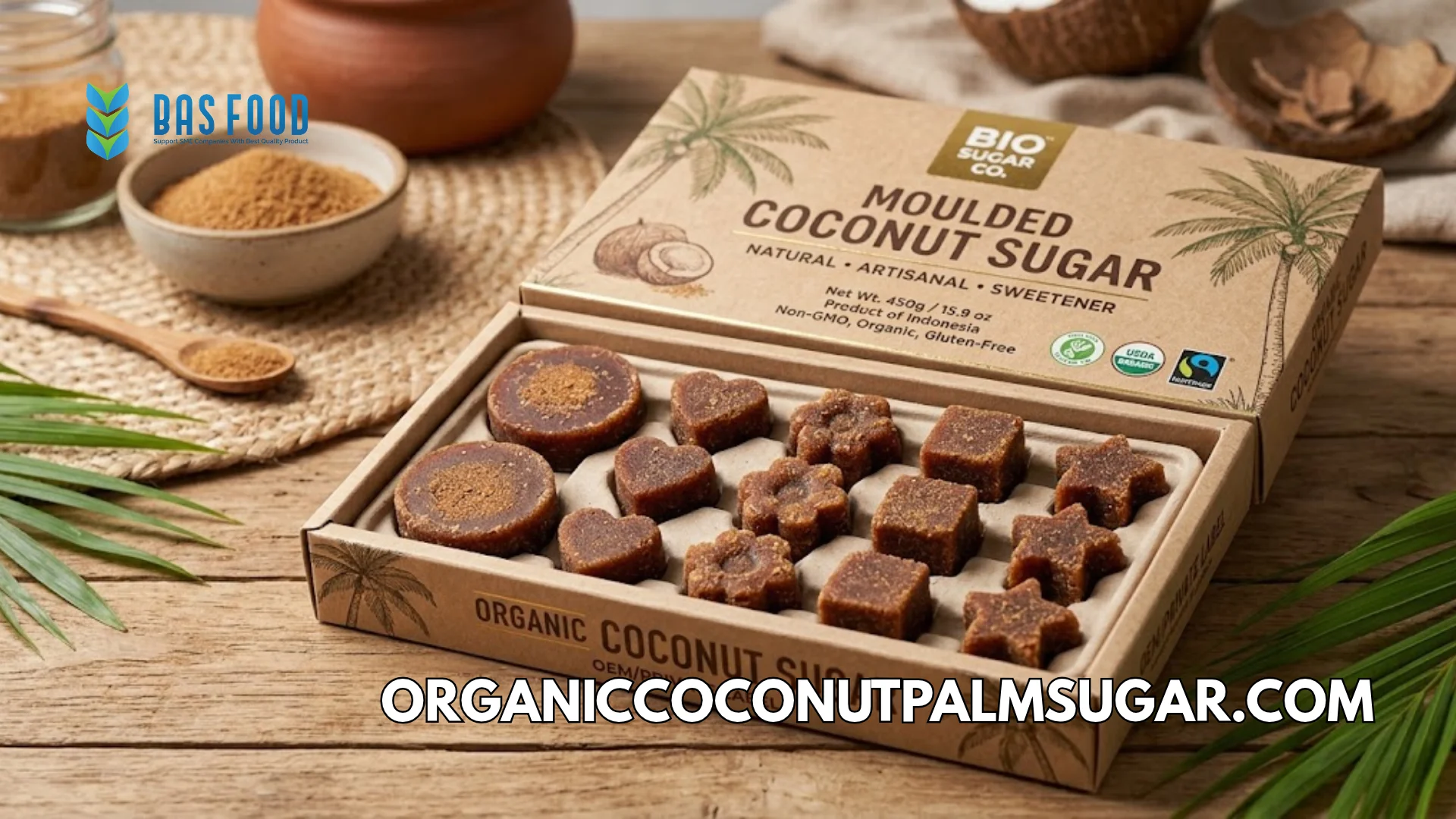
Moulded coconut sugar is made by heating coconut sap until it reaches a concentrated consistency and then pouring it into moulds. After cooling and setting, the sugar forms solid blocks or other shapes. Unlike granulated coconut sugar, which consists of small particles, moulded coconut sugar is supplied in a solid form that customers can grate, cut, crush, or dissolve according to their needs.
For importers, wholesalers, food distributors, and private-label brands, this product format creates several commercial opportunities. Businesses can offer traditional sweeteners in a convenient form while building a brand identity around Indonesian ingredients and established food traditions.
Why Choose Moulded Coconut Sugar for Your Private Label Brand?
A product with a distinctive identity
Coconut sugar has a natural caramel-like flavour that can complement a wide range of foods and beverages. Its flavour profile, colour, and solid format make it an interesting option for brands seeking alternatives to conventional sweeteners. Moulded coconut sugar can appeal to consumers who enjoy traditional cooking ingredients, particularly in markets where coconut-based products already have cultural or culinary relevance.
For a private-label business, the product format also provides opportunities to create a recognisable retail offering. A brand might choose compact blocks for household use, larger blocks for traditional food preparation, or specific shapes that suit its intended market. However, the available shapes and dimensions depend on the manufacturer’s production capabilities and should be confirmed before an order is placed.
More control over brand positioning
Working with an OEM manufacturer allows a business to focus on branding, marketing, distribution, and customer relationships while the manufacturing partner handles the agreed production activities. This arrangement can be useful for companies that want to expand their product range without investing immediately in their own processing facilities.
For example, a distributor could introduce a private-label coconut sugar range for ethnic grocery stores, specialty food shops, or online retailers. A food brand could also develop a product line for baking, cooking, and traditional beverages. With the right market research, packaging, and product specifications, moulded coconut sugar can become part of a broader natural sweetener portfolio.
Nevertheless, private labelling does not automatically guarantee market success. Businesses still need to evaluate consumer demand, retail pricing, product quality, labelling requirements, and distribution costs before launching a new product.
How the Moulded Coconut Sugar OEM Process Works
A successful OEM project starts with clear communication. Buyers and manufacturers need to agree on the product requirements before production begins. Although each supplier may follow a different workflow, the process generally includes several important stages.
Step 1: Define your product requirements
First, decide what type of moulded coconut sugar you want to sell. Consider the target market, intended application, preferred block size, unit weight, packaging format, and expected order volume. You should also identify any requirements for colour, flavour, moisture content, product consistency, or other quality parameters.
These details help the manufacturer assess whether the requested product is feasible. They also reduce the risk of misunderstandings later in the project. If you are still developing your product concept, start with a practical specification sheet and mark which requirements are essential and which are open to discussion.
Step 2: Discuss manufacturing capabilities
Next, contact potential suppliers and ask about their OEM services. A suitable manufacturing partner should be able to explain its available product formats, production process, quality controls, packaging capabilities, and documentation options.
Not every manufacturer offers every service. Some may produce standard moulded coconut sugar but have limited options for custom shapes or printed packaging. Others may be able to coordinate several stages of private-label production. Therefore, confirm the scope of service instead of assuming that every OEM request is available.
Step 3: Evaluate samples and specifications
Before committing to a large order, request product samples when available. Samples allow your team to assess the product’s appearance, aroma, flavour, texture, and suitability for the intended application.
You should also review the product specification sheet. Depending on the supplier and destination market, relevant parameters may include moisture content, physical appearance, foreign matter controls, microbiological criteria, and other agreed quality indicators. Confirm how each parameter is measured and what acceptance limits apply to the commercial order.
Step 4: Approve the product and packaging
Once the product meets your expectations, finalise the packaging design, label information, order quantity, pricing, lead time, and shipping arrangements. Ask for written confirmation of the approved specifications so both parties have a clear reference during production.
Step 5: Production, inspection, and shipment
After approval, the supplier proceeds according to the agreed production schedule. The buyer should clarify which inspections take place, what records are available, and how the finished goods will be packed for transport.
Before shipment, check that the product, packaging, labels, carton markings, and export documents match the agreed requirements. This final review helps reduce avoidable delays and makes receiving the goods easier for your warehouse or distribution team.
Private Label Sugar: Packaging That Supports Your Brand
Packaging is a key part of a private-label coconut sugar project. It protects the product during handling and transport, communicates important information, and influences how customers perceive the brand. For moulded coconut sugar, packaging should also account for the product’s solid form, weight, fragility, and sensitivity to moisture.
Choose packaging for your sales channel
The best packaging format depends on where and how you plan to sell the product. Retail brands may prefer individual units or smaller packs that are easy to display on shelves. Wholesale buyers may prioritise larger packs that simplify storage and distribution. Food-service customers may require packaging that supports frequent use in commercial kitchens.
When evaluating options, consider product protection, storage conditions, shipping distance, pack size, ease of opening, and the amount of information customers need. Packaging materials should be suitable for food contact and appropriate for the intended product and market.
Custom packaging may be available through some OEM arrangements, but printing, material selection, minimum order quantities, and setup costs vary by supplier. Ask for a breakdown of these requirements before approving the final design.
Build a clear and compliant label
A strong label does more than display a logo. It helps customers understand what the product is, how to use it, and how to store it. Depending on the destination market, labels may need to include the product name, ingredient declaration, net weight, country of origin, lot identification, responsible business details, date marking, storage instructions, and nutritional information.
Importers should verify the applicable rules before printing packaging. Requirements can differ between countries, and some markets have specific language, formatting, allergen, or traceability requirements. A supplier may be able to provide product information, but the brand owner or importer should confirm that the final label meets local regulations.
For example, a brand selling moulded coconut sugar in European markets may need to consider relevant EU food-information rules. A brand selling in the United States should check applicable Food and Drug Administration labelling requirements. Always confirm the current rules for the actual destination and product category.
How to Choose the Right OEM Manufacturer
Choosing an OEM manufacturer is one of the most important decisions in a private-label project. A low quotation may look attractive, but the total value of a supplier also depends on quality consistency, communication, documentation, production capability, and delivery reliability.
Evaluate product quality and consistency
Ask how the manufacturer controls raw materials and finished-product quality. Coconut sap is a natural agricultural material, so characteristics may vary with sourcing and processing conditions. A professional supplier should be willing to discuss the quality parameters it can monitor and the specifications it can commit to.
Where relevant, ask for a product specification sheet, sample evaluation process, batch identification details, and available test reports. If your market requires particular certifications or independent testing, confirm whether the supplier can provide valid supporting documentation. Never assume that a certification is available simply because a product is described as natural or export-ready.
Confirm production and packaging capabilities
Your manufacturer should understand the product format and packaging requirements you need. Ask whether the supplier can produce the requested block dimensions, unit weights, or shapes. If you require printed retail packaging, find out whether the supplier handles printing directly or works with a separate packaging provider.
It is also important to clarify minimum order quantities, production lead times, payment terms, sample costs, and the process for approving changes. These commercial details affect your launch budget and your ability to respond to market demand.
Assess communication and documentation
Reliable communication can make the difference between a smooth OEM project and a costly misunderstanding. Look for a supplier that answers questions clearly, documents specifications, and explains limitations before an order is confirmed.
For international trade, discuss the documents needed for customs clearance and destination-market compliance. Depending on the transaction, these may include a commercial invoice, packing list, transport document, certificate of origin, or product-related documents requested by the importer. The exact requirements depend on the product, destination, and shipping arrangement.
Understanding Costs, Minimum Orders, and Lead Times
The cost of a moulded coconut sugar OEM project depends on more than the price of the sugar itself. Buyers should consider product specifications, packaging materials, custom mould requirements, label design, testing, order volume, handling, and international freight.
Customisation can affect the total project cost. For example, a standard block packed in an existing food-grade package may require a different investment from a product that uses a new shape, custom-printed packaging, and additional testing. Packaging artwork, printing setup, and sourcing special materials can also add time and expense.
For this reason, ask the supplier to separate the quotation into clear components wherever possible. Understand what is included in the unit price and what may be charged separately. This approach makes it easier to compare quotations from different manufacturers on a like-for-like basis.
Minimum order quantities (MOQs) vary according to the supplier, product format, packaging method, and level of customisation. Printed packaging, for instance, may require a larger order than standard packaging because of printing and material procurement constraints. Do not assume that one MOQ applies to every product option.
Lead times also vary. Sampling, artwork approval, packaging procurement, production scheduling, quality checks, and shipping preparation can all affect the delivery date. Ask the supplier to provide an estimated schedule and identify which activities must be completed before production can begin.
For a first order, consider balancing customisation with manageable inventory risk. Starting with an achievable product specification can help you test customer demand before committing to more complex packaging or a wider product range.
Quality Control and Product Specifications for Export Markets
International buyers should define quality expectations before placing an order. A clear specification helps the manufacturer understand what the buyer requires and gives both parties a consistent basis for evaluating the finished product.
For moulded coconut sugar, the specification may cover appearance, colour range, aroma, flavour, block dimensions, unit weight, moisture content, foreign matter, packaging integrity, and other parameters relevant to the buyer’s market. Not every characteristic requires the same acceptance criteria, so agree on measurable limits where possible.
Moisture management deserves particular attention. Sugar products can be affected by humid storage conditions, which may influence texture, stickiness, clumping, or product stability. Appropriate packaging, storage, and transport conditions can help protect product quality. Ask the supplier about its recommended handling conditions and confirm whether the packaging is suitable for your distribution environment.
Traceability is another important consideration. Batch or lot identification helps businesses connect products with production records and supports investigations if a quality concern arises. Importers should clarify how lot codes are assigned and what information can be provided if an issue occurs after delivery.
Quality control should not stop when the goods leave the factory. Buyers should also plan for receiving inspections, warehouse storage, stock rotation, and procedures for handling damaged packaging or nonconforming goods. Agreeing on these processes in advance can reduce disputes and protect customer confidence.
Finally, confirm the food safety and import requirements of the destination country. Ask for relevant documentation, but verify its suitability and validity rather than relying on general assurances. The required tests, declarations, and certificates may differ between markets.
How CV Bonafide Anugerah Sentosa Fits into Your Sourcing Plan
For businesses exploring Indonesian coconut-derived ingredients, CV Bonafide Anugerah Sentosa can be a point of contact for discussing sourcing needs and export opportunities. As with any supplier relationship, buyers should begin by explaining the product they need, the destination market, the intended sales channel, and the expected order volume.
If you are looking for moulded coconut sugar OEM, provide a brief that includes your preferred block dimensions, unit weight, packaging style, branding requirements, and quality specifications. Also explain whether you need a standard product with your own label or a more customised solution. This information makes it easier to determine whether the requested arrangement is feasible.
A business searching for a coconut sugar exporter supplier should also evaluate the supplier’s ability to support export documentation, product specifications, communication, and shipping coordination. These factors are particularly important when the buyer and manufacturer operate in different countries and time zones.
The phrase coconut sugar supplier can refer to businesses that source or supply different forms of coconut sugar, including granulated, powdered, or moulded products. However, buyers should confirm the exact product format offered rather than assuming that every supplier carries every type.
Similarly, the Spanish search term exportador de azúcar de coco means coconut sugar exporter. It may be useful for buyers researching suppliers in Spanish-language markets, but the same sourcing checks still apply: confirm the product, specifications, packaging, documentation, and commercial terms directly.
Contact CV Bonafide Anugerah Sentosa to discuss current product availability and determine whether your moulded coconut sugar requirements can be supported. Confirm all product options, OEM services, custom packaging capabilities, order quantities, and delivery terms before making purchasing decisions.
Conclusion: Turn a Traditional Sweetener into a Market-Ready Brand
Moulded coconut sugar OEM can help importers, distributors, and food brands develop a distinctive product without building their own manufacturing operation. By combining a suitable product format with clear specifications, appropriate packaging, and a reliable supplier relationship, businesses can create a private-label offer that fits their target market.
The key is to plan each stage carefully. Define your product requirements, evaluate samples, confirm quality standards, review packaging and labelling, and understand the full cost of the project. Just as importantly, verify production capabilities and export requirements before committing to an order.
If you are exploring Indonesian coconut sugar for your product portfolio, contact CV Bonafide Anugerah Sentosa to discuss your sourcing requirements and confirm current options. A clear initial brief is the best starting point for determining whether the proposed product, packaging, and commercial arrangement match your business goals.