Coconut sugar syrup is becoming an interesting ingredient for food manufacturers, beverage companies, distributors, and specialty food businesses. Its sweet taste, caramel-like notes, and liquid form make it suitable for a range of applications, including sauces, bakery products, beverages, desserts, and confectionery. As international buyers explore new ingredient sources, Indonesia is one of the countries they may consider.
However, importing coconut sugar syrup involves more than finding a supplier and arranging international shipping. Buyers must understand the food import rules in their destination country, prepare the correct documents, check product specifications, and make sure the shipment meets applicable safety and labeling requirements.
The coconut sugar syrup import requirements can differ significantly between markets. The European Union and the United States, for example, have their own food safety systems, importer responsibilities, and customs procedures. Other countries may apply different rules based on product classification, ingredients, packaging, and intended use.
This guide explains the main steps importers should consider when sourcing coconut sugar syrup from Indonesia. It focuses on practical preparation, including product information, documentation, food safety, EU food imports, US food imports, and importer compliance.
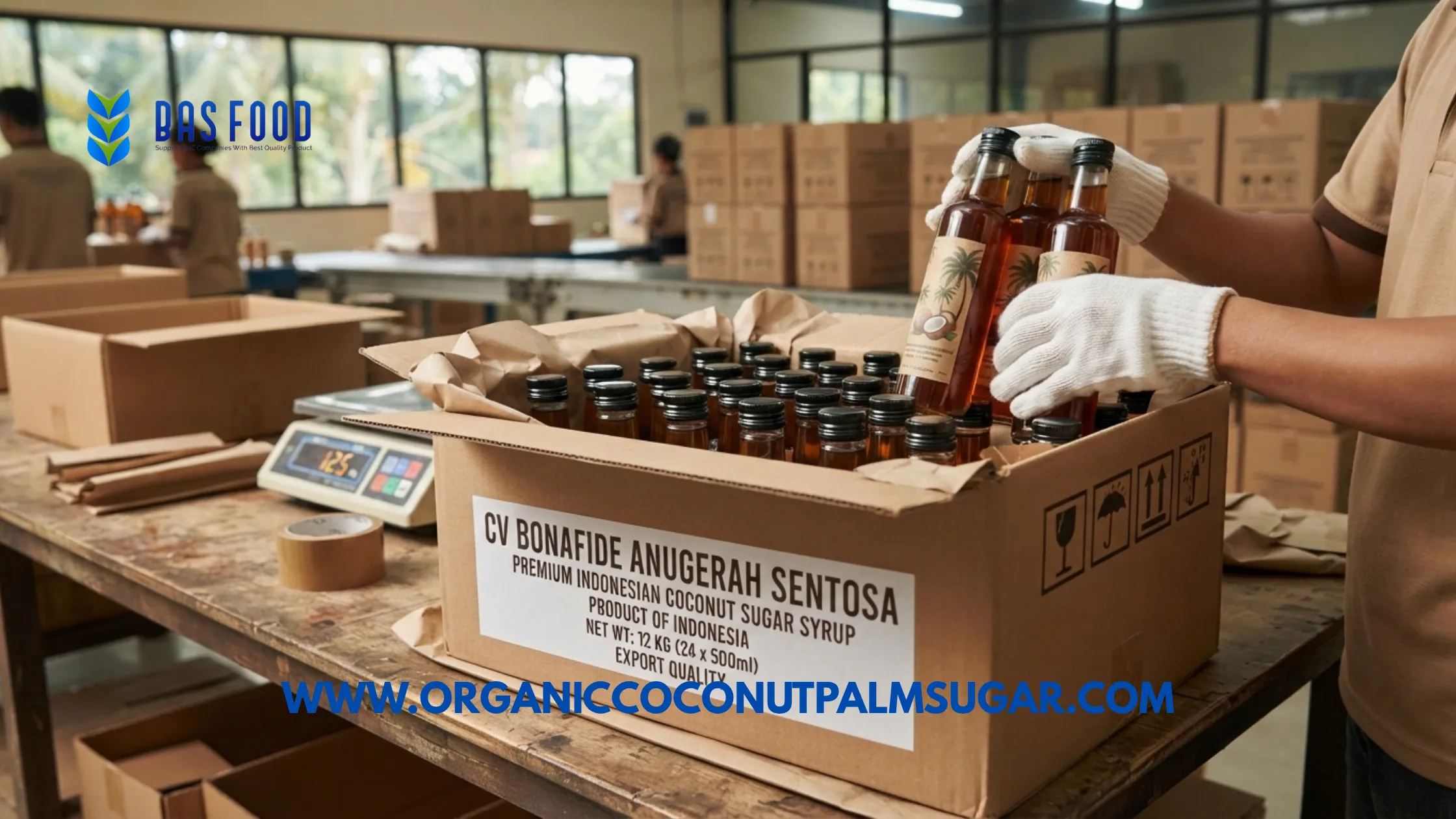
Understand the Product Before Starting the Import Process
Before checking import regulations, buyers should establish exactly what product they intend to import. Coconut sugar syrup is generally made by concentrating sap collected from coconut palm flowers. Producers heat the sap to reduce its water content and create a sweet liquid with a thicker consistency.
However, product characteristics can vary between producers. The color, flavor, aroma, viscosity, soluble solids, and moisture content may depend on the raw material and processing method. Therefore, importers should not assume that every product sold as coconut sugar syrup has identical specifications.
Start by requesting a product specification sheet. It should identify the product name, ingredients, botanical source, physical characteristics, and relevant quality parameters. If the supplier has laboratory test results, review them to understand which parameters have been tested and the methods used.
It is also important to distinguish between Brix, moisture content, and water activity. Brix is commonly used to estimate soluble solids in a liquid, while moisture content measures the amount of water present. Water activity describes how available that water is for microbial growth and other reactions. These measurements are related to product stability, but they are not interchangeable.
Finally, explain how you intend to use the syrup. A beverage manufacturer may focus on flavor, solubility, and consistency, while a sauce producer may have different viscosity and formulation requirements. The intended use can influence product specifications, labeling, and regulatory considerations.
Why Import Requirements Matter for International Buyers
Food import regulations protect consumers and help ensure that products entering a market meet its legal standards. For importers, understanding these rules before ordering can prevent delays, additional costs, rejected shipments, or the need to correct non-compliant labels.
The requirements may cover several areas. These include food safety, permitted ingredients, contaminants, pesticide residues where relevant, packaging materials, traceability, labeling, and customs classification. The exact rules depend on the destination country and the product’s characteristics.
For example, a product that is acceptable in one market may need additional documentation or label changes before it can enter another. A buyer importing coconut sugar syrup for further food manufacturing may also have different documentation needs from a distributor selling the product directly to consumers.
This is why importer compliance should begin during the supplier evaluation stage, not after the cargo has left Indonesia. Importers should identify the applicable rules, share them with the exporter, and agree on the documents and product information required before confirming the order.
A practical approach is to prepare a compliance checklist for each destination market. This checklist should cover product classification, food authority requirements, customs documents, labeling, packaging, and any required notifications or approvals.
Coconut Sugar Syrup Import Requirements for the European Union
Businesses planning EU food imports must consider the European Union’s food safety and food information rules. The EU applies a framework designed to protect consumers and ensure that food placed on the market meets applicable requirements.
One important principle is that food business operators are responsible for ensuring that food under their control complies with relevant food law. For imported products, the EU-based importer should understand the obligations that apply to the product and the supply chain.
Depending on the product and its ingredients, importers may need to review requirements covering food hygiene, contaminants, pesticide residues, food additives, and food-contact materials. They should also check whether any specific import controls apply to the product’s country of origin or category.
Food safety and traceability
EU food businesses need systems that support traceability through the supply chain. Importers should maintain records that help identify the supplier and the businesses to which products are supplied. Product and shipment records should be consistent and accessible when needed.
Importers should also assess the supplier’s food safety information. Relevant materials may include product specifications, ingredient declarations, production information, and available laboratory results. The documents should reflect the actual product being shipped.
Labeling requirements
Prepacked foods sold to EU consumers generally need to comply with the EU food information framework. Depending on the product and how it is marketed, labels may need to include the food name, ingredients, allergen information where applicable, net quantity, date marking, storage conditions, responsible food business operator details, and nutrition information.
Language requirements also matter. Mandatory food information must appear in a language easily understood by consumers in the country where the product is marketed, subject to applicable national rules.
For bulk ingredients supplied to food manufacturers, the applicable information and delivery format may differ from retail packaging. Importers should confirm the correct labeling and accompanying-document requirements for their specific supply chain.
Check whether additional border controls apply
Not every food product is subject to the same border inspection process. Importers should check the current EU rules for the specific product and country of origin. If additional official controls apply, the shipment may need specific certificates, notifications, or entry procedures.
Do not assume that coconut sugar syrup automatically requires a particular health certificate or inspection route. Confirm the current position with the relevant EU authority or an experienced customs and food compliance professional before shipping.
Coconut Sugar Syrup Import Requirements for the United States
Businesses planning US food imports must understand the requirements administered by the US Food and Drug Administration (FDA), as well as customs procedures handled by US Customs and Border Protection (CBP).
The FDA regulates most foods imported into the United States. Importers should determine which requirements apply to the specific product, facility, and transaction. Compliance may involve food facility registration, prior notice, food safety controls, labeling, and other applicable rules.
Food facility registration
Foreign facilities that manufacture, process, pack, or hold food for consumption in the United States may need to register with the FDA unless an exemption applies. The registration requirement should be checked against the actual activities performed by the facility.
Importers should not assume that a supplier’s general export experience automatically confirms FDA compliance. Ask for relevant facility information and verify that the registration obligations have been addressed where required.
Prior Notice of imported food
The FDA generally requires prior notice before food shipments arrive in the United States, subject to applicable exemptions. The notice provides information about the food, manufacturer, shipper, country of origin, and expected arrival.
The importer, customs broker, or another authorized party may submit the notice. However, the parties should agree in advance who will handle this task and make sure the information matches the shipment documents.
Foreign Supplier Verification Programs
The US Foreign Supplier Verification Programs (FSVP) rule places responsibility on certain US importers to verify that imported food meets applicable US food safety requirements. The importer generally needs to establish and follow a risk-based supplier verification program, unless an exemption or modified requirement applies.
For coconut sugar syrup, the importer should assess relevant food safety hazards and determine appropriate verification activities. These may include reviewing supplier records, evaluating food safety practices, checking product test results, or conducting other suitable verification steps.
Labeling and customs
Retail-ready products must meet applicable FDA food labeling rules. These may include requirements for the statement of identity, ingredient list, net quantity, manufacturer or distributor information, and Nutrition Facts, depending on the product and any applicable exemptions.
Customs entry requirements should also be checked with CBP or a qualified customs broker. The correct tariff classification, customs value, country of origin, and shipment information must be established. Importers should not guess the HS classification based only on the phrase coconut sugar syrup.
Essential Documents for Importing Coconut Sugar Syrup
Import documentation helps authorities and logistics providers identify the goods, review the transaction, and process the shipment. The exact document list depends on the destination market, shipping method, product classification, and regulatory requirements.
The commercial invoice is one of the main trade documents. It records the seller, buyer, product description, quantity, unit price, total value, and agreed trade terms. Make sure the description accurately identifies the product as coconut sugar syrup and does not create confusion with other sweeteners.
The packing list explains how the goods are packed. It commonly includes the number of packages, package type, net weight, gross weight, and other cargo details. The information should match the actual shipment and the transport documents.
A Bill of Lading is commonly used for sea freight. It records shipment and transportation details and serves functions that depend on the type of document issued. For air freight, an Air Waybill is generally used instead.
Other documents may include:
- Certificate of Origin: Confirms the origin of the goods under applicable rules. It may support preferential tariff claims when the shipment qualifies under a relevant trade agreement.
- Product specification sheet: Describes ingredients, product characteristics, and agreed quality parameters.
- Certificate of Analysis (COA): Presents laboratory results for specified parameters, where available or required.
- Ingredient declaration: Identifies the ingredients used in the product.
- Food safety or health certificates: Official documents that may be required for particular products or destinations.
- Customs declarations: Information submitted to the relevant customs authority for export or import clearance.
A COA does not replace an official health certificate when a destination authority requires one. Likewise, a Certificate of Origin does not prove that a product is organic or meets every food safety requirement.
Importers should confirm the required documents with their customs broker and relevant food authority before the goods leave Indonesia.
Product Specifications and Food Safety Checks
Import compliance is not only about paperwork. Buyers must also make sure that the product itself meets the agreed specifications and applicable food safety rules.
Start with the ingredient declaration. Confirm that the syrup is made from coconut palm sap and identify whether any other ingredients have been added. This information supports accurate product classification, labeling, and formulation decisions.
Next, review the quality parameters relevant to the product. These may include Brix, moisture content, water activity, pH, viscosity, color, aroma, and microbiological criteria. Not every parameter is necessary for every buyer, so select tests based on the product’s intended use and regulatory needs.
Laboratory testing can help verify specific characteristics, but buyers should check the test method, sampling process, laboratory competence, and date of analysis. A test report only supports the parameters actually tested. It should not be treated as proof of overall compliance.
Food safety assessments should consider hazards relevant to the product and its production process. Depending on the process and destination requirements, buyers may need information about microbiological hazards, chemical contaminants, and foreign material controls.
Also, do not assume that a high Brix value alone guarantees microbiological safety or a particular shelf life. Product stability depends on several factors, including water activity, processing, packaging, storage, and possible contamination after production. Shelf-life claims should be supported by appropriate validation.
Packaging, Storage, and Labeling Considerations
Coconut sugar syrup needs packaging that protects the product during storage and transportation. Since it is a liquid ingredient, packaging must prevent leakage and be compatible with the syrup’s characteristics.
Depending on the supplier’s available options and the buyer’s needs, liquid food ingredients may be packed in suitable bottles, jerry cans, drums, or larger industrial containers. The right choice depends on order size, handling facilities, shipping conditions, and the buyer’s production system.
Importers should confirm that the packaging material is suitable for food contact and compatible with the product. They should also review the container’s closure system, tamper protection where relevant, and resistance to the expected handling conditions.
Storage instructions should be based on product-specific information. Ask the supplier for recommended storage conditions and evidence supporting the stated shelf life. Avoid assuming that all coconut sugar syrups have the same storage requirements.
Labeling should also be reviewed before production or shipment. Depending on the market and packaging format, the label or accompanying product information may need the product name, ingredients, net quantity, lot identification, date marking, storage instructions, and responsible business details.
For bulk industrial shipments, some information may be provided through accompanying documents rather than a consumer-style retail label. However, the buyer should confirm what the destination market requires for that specific product and transaction.
Working with an Indonesian Coconut Sugar Exporter
Choosing an exporter that understands international trade can make sourcing easier. A supplier should be able to discuss product details, commercial terms, packaging, and the export documents relevant to the shipment. However, importers remain responsible for confirming the requirements that apply in their own market.
CV Bonafide Anugerah Sentosa is an Indonesian exporter of coconut sugar and other coconut derivative products, as well as spices, fishery products, and coffee. The company provides a point of contact for businesses interested in sourcing Indonesian agricultural commodities.
As a coconut sugar exporter and coconut sugar supplier, CV Bonafide Anugerah Sentosa can be approached by buyers exploring coconut-based sweeteners and related products. Importers interested in coconut sugar syrup should confirm the product’s availability, ingredients, specifications, packaging options, and supporting documents directly with the company.
Before requesting a quotation, prepare a clear product inquiry. Include your destination country, intended application, preferred packaging, estimated order quantity, and any specific technical or regulatory requirements. This information helps the supplier understand the request and discuss the relevant product details.
It is also useful to share your destination market’s documentation checklist early. For example, a US importer may need to coordinate FSVP responsibilities, while an EU importer may need to review labeling and traceability requirements. Early communication gives both parties time to identify what information is needed before shipment.
Conclusion: Prepare Before You Import
Importing coconut sugar syrup from Indonesia can offer opportunities for food manufacturers, distributors, and ingredient buyers. However, a successful shipment depends on more than product availability and competitive pricing. Importers must understand the product, check destination-market regulations, prepare accurate documents, and confirm that packaging and labeling meet the applicable rules.
The most important point is to identify the requirements before placing the order. EU food imports and US food imports follow different regulatory frameworks, so buyers should not use a single checklist for every destination. Instead, confirm the rules with the relevant authorities and qualified compliance professionals.
A reliable supplier can support the process by providing accurate product information and discussing export documentation. At the same time, importers should take responsibility for their own regulatory obligations and verify that the shipment meets the rules of the destination market.
CV Bonafide Anugerah Sentosa welcomes inquiries from businesses exploring Indonesian coconut sugar and related products. Contact the company to discuss your sourcing needs and confirm the product information relevant to your import market.