For food manufacturers, distributors, wholesalers, retailers, and ingredient buyers, choosing the right sweetener supplier is an important part of the sourcing process. When production volumes increase, buying small packs is no longer practical. Buyers need reliable supply, suitable specifications, consistent quality, proper packaging, and smooth international logistics. That is why many businesses search for ways to buy coconut sugar granules in bulk. Coconut sugar granules offer a convenient format for food production because manufacturers can measure, blend, and process them according to their recipes. However, finding the right product involves more than comparing prices.
A good sourcing process starts with understanding the product itself. Buyers should also evaluate particle size, moisture, color, flavor, packaging, documentation, production capacity, and communication with the supplier. In addition, the supplier should understand the needs of international B2B buyers.
For companies looking at Indonesia as a sourcing market, working with an experienced Indonesia supplier can provide access to coconut sugar produced from locally sourced coconut sap. This guide explains what buyers should consider before placing a bulk order and how to approach the sourcing process more efficiently.
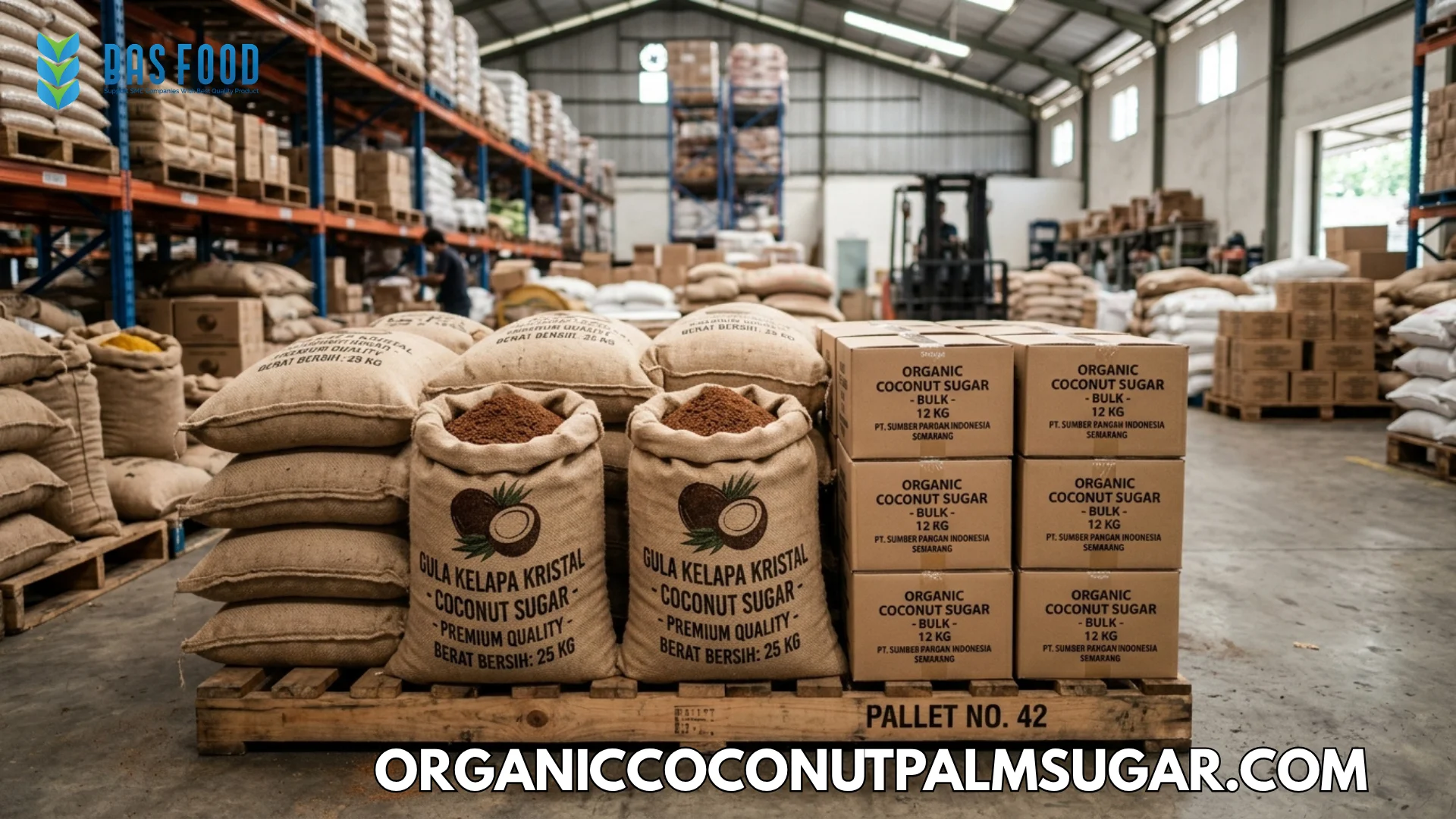
What Does Buying Coconut Sugar Granules in Bulk Mean?
To buy coconut sugar granules in bulk means purchasing coconut sugar in larger commercial quantities instead of small retail packages. The exact volume can vary depending on the supplier, buyer requirements, packaging format, product specifications, destination, and production schedule.
Bulk purchasing is common among food manufacturers, ingredient distributors, beverage producers, bakeries, confectionery companies, restaurants, and retailers. These businesses often need a steady supply that fits their production process rather than a small quantity intended for household use.
The granule format is particularly useful because it can be handled like other dry granular sweeteners. Manufacturers can weigh it during formulation, mix it with other dry ingredients, or use it as part of a customized recipe. As a result, buyers can integrate coconut sugar granules into different production systems.
However, bulk sourcing does not simply mean ordering more bags. A professional purchasing process should consider the complete supply chain. Product specifications, packaging, storage, transportation, documentation, and communication all influence the success of a bulk order.
Why Businesses Choose Coconut Sugar Granules for Bulk Sourcing
One major reason businesses choose coconut sugar granules is convenience. Compared with moulded or block formats, granules are easy to weigh and distribute during production. This can make them suitable for food applications where accurate ingredient handling is important.
Coconut sugar granules can also be used across different product categories. Depending on the formulation and specification, manufacturers may use them in bakery products, beverages, snacks, cereals, desserts, sauces, confectionery, and other food products. The actual application should always be tested against the buyer’s recipe and processing conditions.
Another important consideration is procurement efficiency. When a business regularly uses coconut sugar, purchasing in larger quantities can help create a more organized supply plan. Instead of repeatedly sourcing small amounts, the buyer can discuss a longer-term supply arrangement with a suitable coconut sugar supplier.
At the same time, buyers should not assume that larger orders automatically provide better value. The total cost can depend on product specifications, packaging, shipping method, destination, customs requirements, and order frequency. Therefore, buyers should compare the complete supply arrangement rather than looking only at the price per kilogram.
Why Indonesia Is an Important Sourcing Market
Indonesia has a large coconut-producing sector, making the country an important origin for coconut-based products. Coconut sap can be processed into coconut sugar, which is then prepared into different forms, including granules, moulded products, and syrup.
For international buyers, sourcing from an Indonesia supplier can create an opportunity to connect directly with producers and exporters closer to the raw material source. However, geographical proximity to the raw material does not automatically guarantee consistent product quality. The supplier’s processing practices and quality control still matter.
When evaluating an Indonesian supplier, buyers should ask where the raw material comes from and how the product moves through the production process. They can also request information about processing, product specifications, packaging, quality checks, and export experience.
Furthermore, international buyers should evaluate whether the supplier understands export requirements. A supplier serving domestic customers and a supplier experienced in international shipments may have different capabilities. Export orders require coordination between production, packaging, documentation, freight, customs, and destination requirements.
This is why selecting an Indonesia supplier should involve more than checking a product catalogue. Buyers should assess the supplier as a complete business partner.
Understanding Wholesale Coconut Sugar Before Ordering
The term wholesale coconut sugar generally refers to coconut sugar supplied in commercial quantities for businesses rather than individual consumers. However, wholesale supply can take several forms depending on the buyer’s needs.
For example, a distributor may purchase coconut sugar in standard bulk packaging and then distribute it to smaller customers. Meanwhile, a food manufacturer may require a particular particle size, packaging format, or specification that fits its production process.
Because of these differences, buyers should prepare a clear product requirement before contacting suppliers. The specification can include product form, particle size, color, flavor profile, moisture requirements, packaging, estimated order volume, destination country, and intended application.
This makes supplier communication much easier. Instead of asking only for a price, buyers can provide a structured purchasing request. The supplier can then respond with information that is more relevant to the actual project.
Price is still important, of course. Nevertheless, the lowest quotation may not represent the lowest overall cost. A cheaper product can become more expensive if it causes production problems, requires unsuitable packaging, arrives inconsistently, or creates additional handling requirements.
Key Specifications to Check Before Buying Coconut Sugar Granules
Before deciding to buy coconut sugar granules in bulk, buyers should understand which specifications matter to their application. One of the first specifications to review is particle size.
Particle size affects how the granules behave during weighing, mixing, dissolving, and processing. A manufacturer producing dry food products may have different requirements from a beverage producer. Therefore, buyers should explain the intended application and ask the supplier which available granule specification fits the process.
Moisture is another important consideration. Coconut sugar is hygroscopic, which means it can interact with moisture from the surrounding environment. Excess moisture exposure can affect handling and may contribute to clumping. Therefore, buyers should discuss moisture specifications and packaging protection with the supplier.
Color and flavor can also influence the final product. Coconut sugar commonly has a characteristic brown color and caramel-like taste, but the exact profile can vary depending on raw material and processing. For applications where flavor or color consistency matters, buyers should evaluate samples before approving larger orders.
Other information may include microbiological parameters, food safety requirements, packaging specifications, storage conditions, and other product-specific quality criteria. The exact requirements should be agreed between buyer and supplier based on the destination market and intended application.
How to Evaluate a Coconut Sugar Supplier
Choosing a coconut sugar supplier should be treated as a business evaluation rather than a simple price comparison. A reliable supplier should be able to communicate clearly about the product and respond to technical questions.
Start by checking whether the supplier can provide a clear product specification. The document should help the buyer understand what is being purchased. If the product specification is vague, the buyer may have difficulty comparing it with competing products.
Next, ask about samples. A sample allows the buyer to examine characteristics such as granule appearance, color, aroma, taste, particle size, and handling behavior. For manufacturers, the sample can also be tested in the actual production formula.
Packaging deserves attention as well. Bulk coconut sugar needs protection during storage and transportation. Buyers should discuss packaging material, inner protection, sealing, outer bags or containers, palletization where applicable, labeling, and shipping conditions.
Finally, consider communication. A supplier that responds clearly and understands commercial requirements can make the sourcing process much easier. This becomes particularly important when the buyer needs customized specifications or regular shipments.
The Role of CV Bonafide Anugerah Sentosa in Bulk Coconut Sugar Sourcing
For international buyers exploring Indonesian supply, CV Bonafide Anugerah Sentosa can be considered as part of the supplier evaluation process. The company operates in the Indonesian commodity export sector and supplies coconut sugar and other coconut-derived products.
For buyers looking to buy coconut sugar granules in bulk, the key discussion should focus on the actual requirements of the order. These may include product form, specifications, packaging, quantity, destination, and intended application.
Rather than treating every buyer as having the same needs, a B2B sourcing process works better when the supplier understands the customer’s purchasing requirements. For example, a food manufacturer may need granules suitable for a particular production process, while a distributor may focus more heavily on packaging and commercial quantities.
Buyers can therefore use the initial inquiry to discuss their expected volume, application, preferred specifications, packaging requirements, and destination. This gives both sides a clearer starting point for quotation and product evaluation.
Bulk Sourcing: From Sample Testing to Commercial Orders
A successful bulk sourcing process usually begins with a sample rather than an immediate large purchase. Samples give buyers the opportunity to evaluate the product before committing to a larger commercial order.
During sample evaluation, buyers can compare the product against their internal specifications. For food manufacturers, testing the ingredient in the actual formulation can be especially useful. A product that looks suitable on paper may behave differently when mixed, heated, dissolved, baked, or combined with other ingredients.
After the sample stage, the buyer can discuss commercial specifications. At this point, both parties should have a clearer understanding of the required product, packaging, quantity, and delivery arrangement.
It is also useful to establish a consistent specification for repeat orders. If a business plans to purchase regularly, documenting the agreed product characteristics can make future purchasing easier. Consistency becomes especially important when coconut sugar is used as a regular production ingredient.
Packaging Matters When You Buy Coconut Sugar Granules in Bulk
Bulk packaging serves more than one purpose. It protects the product, supports transportation, simplifies handling, and helps maintain product condition during storage.
Because coconut sugar can absorb environmental moisture, packaging should provide suitable protection against moisture exposure. Proper sealing is also important, especially during long-distance transportation where the product may experience changes in temperature and humidity.
Buyers should discuss packaging options directly with the supplier. Depending on the order and destination, packaging may be available in different commercial formats. The most suitable option depends on the buyer’s warehouse, handling equipment, production process, and logistics plan.
Labeling should also be considered. Export shipments may require product identification, batch information, net weight, origin information, and other details according to the buyer’s requirements and destination regulations. These requirements should be confirmed before production and shipment.
International Shipping and Export Considerations
When purchasing coconut sugar internationally, product quality is only one part of the transaction. The buyer also needs to consider export logistics.
A typical international supply chain may involve factory handling, inland transportation, port procedures, ocean freight, customs clearance, and delivery to the destination warehouse. Each stage can affect the final delivery schedule and cost.
For this reason, buyers should provide the supplier with the destination country or port as early as possible. This allows the parties to discuss the appropriate shipping arrangement and commercial terms.
Documentation is another important area. Depending on the transaction and destination, buyers may require commercial invoices, packing lists, certificates, product specifications, shipping documents, and other export-related documents. The exact requirements can differ by market and product.
A professional coconut sugar exporter supplier should be able to communicate clearly about the documents available for the shipment and coordinate the export process with the buyer and logistics partners.
How to Compare Coconut Sugar Exporter Suppliers
When comparing a coconut sugar exporter supplier, create a simple checklist instead of focusing on one factor. This helps buyers make a more balanced procurement decision.
First, compare the product specification. Make sure the products being compared are actually equivalent. Differences in particle size, moisture, packaging, or other specifications can make price comparisons misleading.
Second, compare the commercial conditions. Consider the order quantity, packaging, payment terms, shipping arrangement, destination, and other costs that may affect the final landed cost.
Third, evaluate communication and responsiveness. International purchasing often involves questions about documentation, logistics, production schedules, and specifications. Clear communication can reduce misunderstandings.
Finally, consider long-term supply potential. If coconut sugar becomes an important ingredient in your product line, it can be useful to work with a supplier that can support repeat orders and maintain agreed specifications.
Building a Long-Term Coconut Sugar Supply Strategy
Bulk purchasing works best when it becomes part of a broader sourcing strategy. Instead of treating every order as a separate transaction, businesses can develop a repeatable procurement process.
Start by identifying the actual consumption level of the business. A manufacturer should understand how much coconut sugar it uses per month or production cycle. This information can help the purchasing team plan orders more effectively.
Next, establish communication with the supplier about expected purchasing schedules. Buyers do not necessarily need to commit to a fixed arrangement immediately. However, sharing approximate demand can help both sides understand future requirements.
Quality consistency should also remain a priority. Once a product has been approved, future orders should follow the agreed specification as closely as possible. If the buyer needs a change, the new specification should be discussed before production.
A long-term relationship can therefore benefit both parties. The buyer gets a clearer sourcing process, while the supplier gains a better understanding of the customer’s expectations.
Conclusion: Making Bulk Coconut Sugar Sourcing More Efficient
To buy coconut sugar granules in bulk successfully, businesses should look beyond the product price. A good sourcing process starts with clear specifications and continues through sampling, quality evaluation, packaging, logistics, documentation, and storage.
Indonesia offers an important sourcing market for coconut-based products. However, buyers should carefully evaluate each Indonesia supplier based on product consistency, commercial capability, export experience, and communication.
Whether you are a food manufacturer, distributor, wholesaler, retailer, or ingredient buyer, a structured sourcing process can make bulk purchasing easier. Start with a clear specification, test the product, confirm the packaging and commercial terms, and discuss the complete delivery arrangement before placing a larger order.
With the right approach, bulk sourcing can become a more organized part of your procurement strategy and support a reliable supply of coconut sugar for your business.