Coconut sugar syrup is becoming an interesting ingredient for food manufacturers, beverage producers, bakeries, and international distributors. Its rich sweetness, caramel-like flavor, and liquid form make it suitable for various applications, including sauces, desserts, bakery products, beverages, and confectionery. However, product quality does not depend on production alone. Packaging also plays an important role in protecting the syrup during storage, handling, and transportation. The right container helps prevent leakage, reduce contamination risks, and maintain product condition from the production facility to the buyer’s warehouse.
For importers and food manufacturers, understanding coconut sugar syrup packaging is essential when selecting a supplier. Packaging must match the product’s physical properties, order volume, storage conditions, transportation method, and intended use.
In this guide, we explore common packaging options, food safety considerations, bulk liquid packaging, export preparation, and practical questions buyers should ask before placing an order.
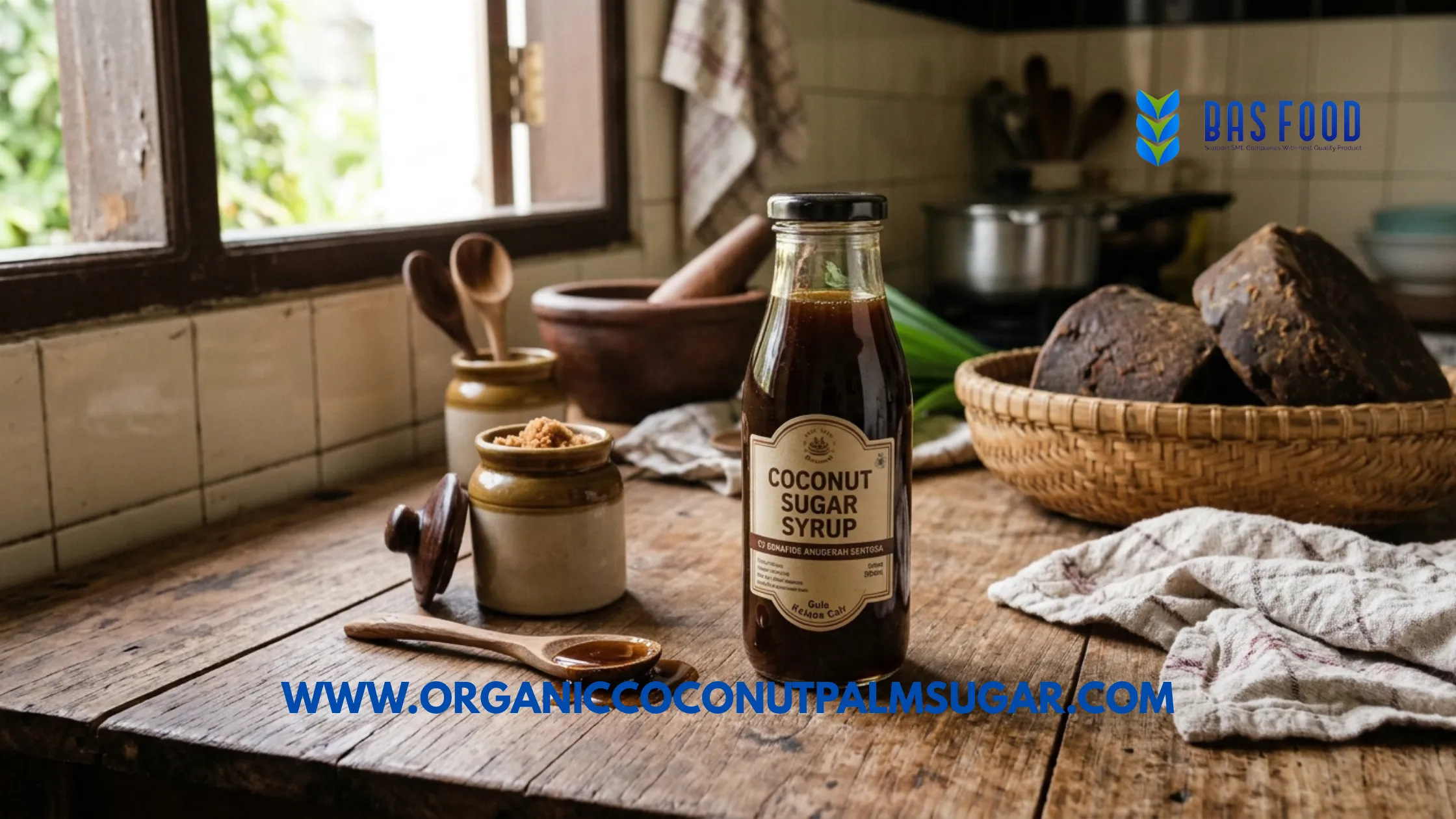
Why Coconut Sugar Syrup Packaging Matters
Packaging is more than a container for holding a product. It forms an important part of the supply chain and helps protect coconut sugar syrup from external conditions during storage and transportation.
Because coconut sugar syrup is a liquid sweetener, its packaging must prevent leakage and provide a suitable barrier against contamination. A damaged cap, weak seal, or unsuitable container can create problems during handling. In international shipments, even a small leak may affect surrounding cartons or other cargo.
Good packaging also makes storage and distribution easier. Manufacturers may prefer containers that fit their production equipment, while distributors may need packaging that is easy to handle, stack, and store. Therefore, the best option depends on how the buyer plans to use and distribute the product.
In addition, packaging supports product identification and traceability. Labels can provide important information such as product name, net weight, batch number, production date, storage instructions, and supplier details, subject to applicable labeling requirements.
For B2B buyers, packaging should be discussed before an order is confirmed. This helps the supplier understand the buyer’s requirements and reduces the risk of receiving a product in an unsuitable format.
Understanding Coconut Sugar Syrup as a Liquid Product
Before choosing packaging, buyers should understand the basic characteristics of coconut sugar syrup. It is generally produced by concentrating sap collected from coconut palm flowers. Heating reduces the water content and creates a sweet liquid with a characteristic caramel-like flavor.
Its consistency can vary depending on concentration, temperature, and production conditions. Some syrups flow more easily, while others are thicker and more viscous. This difference affects how easily the product can be filled, poured, pumped, and transferred between containers.
Temperature is another important factor. Syrup viscosity generally changes with temperature, becoming thicker as it cools and thinner as it warms. Packaging and filling systems should therefore suit the product’s actual handling conditions.
Buyers should request product-specific information before selecting a container. Useful details may include:
- Brix or soluble-solids concentration.
- Viscosity under defined conditions.
- Product temperature during filling.
- Net weight or volume per container.
- Recommended storage conditions.
- Expected storage and transportation conditions.
Brix provides an indication of soluble-solids concentration, but it does not directly measure water activity or establish product shelf life. These properties require separate evaluation where relevant.
Understanding these characteristics helps buyers choose packaging that works with the syrup rather than creating additional handling problems.
Food Grade Containers: The Foundation of Safe Packaging
One of the most important requirements for coconut sugar syrup packaging is the use of suitable food grade containers. These containers must be designed for food contact and appropriate for the syrup’s composition, temperature, and storage conditions.
Food-grade plastic containers are commonly used for liquid food ingredients because they can be lightweight and practical to handle. However, not all plastics have the same properties. Buyers should confirm the material type, food-contact suitability, closure system, and compatibility with the product.
Food-grade drums and pails may be suitable for medium or larger quantities. Their capacity and design can make them useful for food factories, distributors, and ingredient warehouses. Nevertheless, the container must have sufficient strength and a reliable closure to prevent leakage during handling.
For smaller quantities, bottles or jerry cans may be more practical. These formats can support easier storage, portioning, and transfer into production equipment. They may also suit buyers who need to test the product before purchasing larger volumes.
Regardless of container type, buyers should check that all parts in contact with the syrup are suitable for food use. This includes the container body, lid, inner seal, gasket, and any dispensing components.
A food-grade claim should also be supported by appropriate documentation when required. Importers may request material declarations or food-contact compliance documents to meet their internal quality systems and destination-market requirements.
Common Coconut Sugar Syrup Packaging Options
Different businesses have different purchasing needs. A small food manufacturer may prefer manageable containers, while a large industrial buyer may require drums or other bulk formats.
Choosing the right packaging depends on order size, storage facilities, transport arrangements, and production requirements. The following formats are commonly considered for liquid food ingredients.
Bottles
Bottles are suitable for smaller quantities and sample orders. They are easy to handle and can be useful for product development, laboratory testing, and small-scale food production.
However, bottles may not be the most economical choice for large-volume purchasing. They also require appropriate secondary packaging to protect them during transport.
Jerry Cans
Jerry cans are practical for medium-volume liquid products. Their handles make them easier to lift and pour, while their shape can support efficient storage.
Buyers should check the container’s material, wall strength, closure design, and compatibility with the syrup. The cap and seal should provide reliable protection against leakage.
Food-Grade Pails
Pails can be useful for food manufacturers that need regular access to the syrup during production. Their wider openings may make it easier to transfer thick liquids, depending on the design.
However, buyers should consider how the product will be removed and whether the container can be resealed properly after opening. Repeated opening may increase contamination risks if handling practices are poor.
Food-Grade Drums
Drums are often considered for larger commercial orders. They can reduce the number of individual containers needed and may be suitable for distributors and industrial food producers.
The drum material, closure, filling method, and handling equipment must all be appropriate for the product. Buyers should also confirm the gross weight and dimensions to plan warehouse storage and transport.
Intermediate Bulk Containers
Intermediate bulk containers, or IBCs, may be considered for high-volume liquid ingredient supply. Their larger capacity can support industrial operations with suitable storage and transfer systems.
However, an IBC is not automatically suitable for every syrup. Buyers should confirm the food-contact status, internal cleanliness, valve design, material compatibility, and handling requirements before choosing this option.
| Packaging format | Typical buyer requirement | Main consideration |
|---|---|---|
| Bottle | Samples and small orders | Secondary protection |
| Jerry can | Medium-volume supply | Handling and closure |
| Food-grade pail | Regular factory use | Resealing and dispensing |
| Food-grade drum | Bulk purchasing | Strength and transport |
| IBC | Large industrial volumes | Equipment and food-contact suitability |
The available formats should always be confirmed with the supplier rather than assumed.
Bulk Liquid Packaging for Industrial Buyers
For large food manufacturers, bulk liquid packaging can help simplify ingredient purchasing and warehouse operations. Instead of receiving many small containers, buyers can receive larger units that suit their production volume.
Bulk packaging may reduce the amount of individual packaging material used per kilogram of product. It can also make inventory management easier when the factory has suitable storage and liquid transfer equipment.
However, bulk purchasing requires careful planning. Buyers must consider container dimensions, gross weight, pallet requirements, unloading equipment, storage space, and the method used to transfer syrup into production tanks.
The syrup’s viscosity is particularly important. A thick product may require a suitable pump or controlled warming process to move efficiently. Any warming method must follow the supplier’s product-handling guidance and should not compromise product quality or packaging integrity.
Before choosing bulk packaging, manufacturers should discuss:
- The required quantity per container.
- Product viscosity and filling temperature.
- Container material and food-contact documentation.
- Closure and sealing system.
- Pallet configuration and stacking limits.
- Unloading and transfer equipment.
- Storage conditions and handling instructions.
A well-planned bulk packaging arrangement can support smoother production operations. However, the container must suit both the syrup and the buyer’s facilities.
Export Packaging: Preparing Syrup for International Shipping
International shipping creates additional packaging challenges. Products may pass through several handling stages, including factory loading, port operations, container transport, customs inspection, and warehouse unloading.
For this reason, export packaging should protect coconut sugar syrup throughout the expected logistics process. The container must remain closed and stable under normal handling and transport conditions.
Secondary packaging can provide additional protection. Depending on the primary container, this may include cartons, protective wrapping, dividers, pallets, or other suitable materials. The aim is to reduce movement, impact damage, and leakage during transit.
Palletization also requires attention. Containers should be arranged securely, with weight distributed appropriately. Buyers and suppliers should agree on pallet dimensions, stacking limits, wrapping methods, and handling requirements before shipment.
For international shipments, the packaging should also comply with applicable transport and destination-market requirements. For example, wooden pallets used in international trade may need to meet relevant wood-packaging treatment standards. Buyers should confirm the requirements for their route and shipping arrangement.
In addition, the supplier should use clear shipment identification. Labels and shipping marks can help warehouse teams identify the product, batch, quantity, and handling instructions.
Packaging Materials: Plastic, Metal, and Other Options
Packaging materials affect product protection, handling, cost, and transport efficiency. Therefore, buyers should compare materials based on their actual requirements rather than choosing only by appearance or price.
Food-Grade Plastic
Food-grade plastic containers are widely considered for liquid food products because they can be lightweight and resistant to breakage. Their suitability depends on the exact resin, container design, and intended use.
Buyers should ask for information about food-contact compliance, chemical compatibility, temperature limits, and closure performance. They should not assume that every plastic drum or jerry can is suitable for coconut sugar syrup.
Metal Drums
Metal drums may be suitable for certain bulk liquid applications when their internal surfaces and coatings are compatible with the product. The condition of the lining is particularly important because direct contact with unsuitable metal surfaces may affect product quality.
Buyers should request details about the internal coating, food-contact suitability, and any restrictions on filling or storage temperature.
Flexible Packaging
Flexible packaging may be an option for certain liquid food products, depending on the filling system and required protection. However, not every flexible material is suitable for thick syrup or long-distance transport.
The packaging structure, sealing method, barrier properties, and handling conditions should be evaluated before use.
Ultimately, the best material is the one that protects the product, meets food-contact requirements, and fits the buyer’s logistics and production systems.
Sealing, Leakage Prevention, and Contamination Control
A suitable container can still fail if its closure system is poor. Caps, lids, seals, and gaskets all help protect coconut sugar syrup during storage and transport.
Before filling, containers should be clean and suitable for food contact. The filling area should follow appropriate hygiene procedures, and operators should avoid introducing foreign materials during the process.
After filling, the closure should be applied according to the container manufacturer’s instructions. A seal that is too loose may allow leakage, while incorrect closure handling can damage the cap or container.
Suppliers should also consider tamper-evident features where appropriate. These can help buyers identify whether a container has been opened or interfered with before delivery.
For export shipments, a practical inspection process should include checking container condition, cap tightness, seal integrity, external cleanliness, and label accuracy. These simple checks can help reduce avoidable problems during distribution.
Storage and Handling After Delivery
Packaging protects coconut sugar syrup, but correct storage remains essential after the product reaches its destination. Buyers should follow the supplier’s product-specific storage instructions rather than assuming that all syrup products have the same requirements.
Containers should generally be stored in a clean, suitable area away from contamination and conditions that may damage the packaging. Direct sunlight, excessive heat, and unsuitable temperature changes may affect the container or product, depending on its material and composition.
Once a container has been opened, handling becomes especially important. Workers should use clean dispensing equipment and avoid introducing water, dirt, or other foreign materials into the syrup.
The closure should be replaced securely after use. If the product is transferred into another container, that container should also be suitable for food contact, clean, and properly identified.
Manufacturers should also use appropriate stock rotation procedures. First-in, first-out or another suitable inventory system can help manage stock according to the supplier’s stated shelf life and the buyer’s internal quality procedures.
Remember that packaging alone does not establish shelf life or microbiological safety. Those factors depend on the syrup’s composition, processing, water activity, hygiene, packaging system, and storage conditions.
How to Choose the Right Coconut Sugar Supplier
Selecting a reliable coconut sugar supplier involves more than comparing product prices. Buyers should assess the supplier’s ability to provide suitable product specifications, packaging information, and export support.
Start by explaining your intended application and purchasing volume. A beverage manufacturer, for example, may need a different container and dispensing system from a distributor selling smaller quantities.
Next, ask for available product specifications and packaging details. These should identify the container material, capacity, closure type, filling conditions, and storage recommendations. Where required, request supporting food-contact documentation.
It is also useful to ask whether samples are available. Samples help buyers assess the syrup’s flavor, viscosity, and suitability for their production process. They also provide an opportunity to evaluate the packaging and closure system.
Finally, discuss export arrangements. Confirm lead times, pallet configuration, shipment terms, required documents, and destination-market requirements. Clear communication helps prevent delays and unexpected costs.
A dependable coconut sugar exporter supplier should be able to discuss these points openly and provide information that matches the actual product and packaging offered.
Sourcing Coconut Sugar Syrup from Indonesia with CV Bonafide Anugerah Sentosa
Indonesia is an established origin for coconut-based products, supported by coconut-growing communities and local processing experience. International food manufacturers and distributors may consider Indonesian suppliers when sourcing coconut sugar and related ingredients.
However, every buyer should confirm the product’s identity, specifications, and available packaging before placing an order. Packaging formats, container materials, and shipment arrangements can vary according to the product and supplier.
CV Bonafide Anugerah Sentosa is an Indonesian exporter and supplier of coconut sugar and other coconut-derived products. The company works with international buyers seeking Indonesian food ingredients for manufacturing and distribution.
Businesses interested in coconut sugar syrup can contact CV Bonafide Anugerah Sentosa to discuss their product and packaging requirements. Buyers should provide the intended application, required quantity, preferred container size, and destination country.
It is also helpful to request available specifications, packaging details, and samples before confirming a commercial order. This allows both parties to check whether the product and packaging meet the buyer’s technical and logistical needs.
Conclusion: Protecting Product Quality from Packing to Delivery
Choosing the right coconut sugar syrup packaging is an important part of successful B2B sourcing. Suitable food-grade containers, reliable closures, secure bulk liquid packaging, and proper export preparation help protect the syrup during storage and transportation.
However, no single packaging format works for every buyer. Manufacturers and importers should consider product viscosity, order volume, storage facilities, handling equipment, and destination-market requirements before making a decision.
If your business is looking for an Indonesian coconut sugar supplier or coconut sugar exporter supplier, CV Bonafide Anugerah Sentosa can be contacted to discuss coconut sugar products and sourcing requirements. Share your preferred packaging format, order volume, and destination to begin evaluating a suitable supply arrangement.