Choosing the right liquid sweetener can shape the flavor, texture, and overall quality of a food product. For food manufacturers, beverage brands, bakeries, and ingredient distributors, the choice often comes down to more than sweetness alone. Cost, availability, processing behavior, product positioning, and customer expectations all play important roles. That is why understanding coconut sugar syrup vs maple syrup can help businesses make smarter ingredient decisions. Both sweeteners offer natural sweetness and distinctive flavor profiles, but they come from different sources and have different production methods. Coconut sugar syrup is made from coconut sap, while maple syrup comes from the sap of maple trees.
Although both can work in selected recipes, they are not always interchangeable. Their flavor, composition, color, viscosity, and moisture contribution can affect the final product. In this guide, we explore the key differences, practical applications, sourcing considerations, and factors B2B buyers should evaluate before choosing a sweetener.
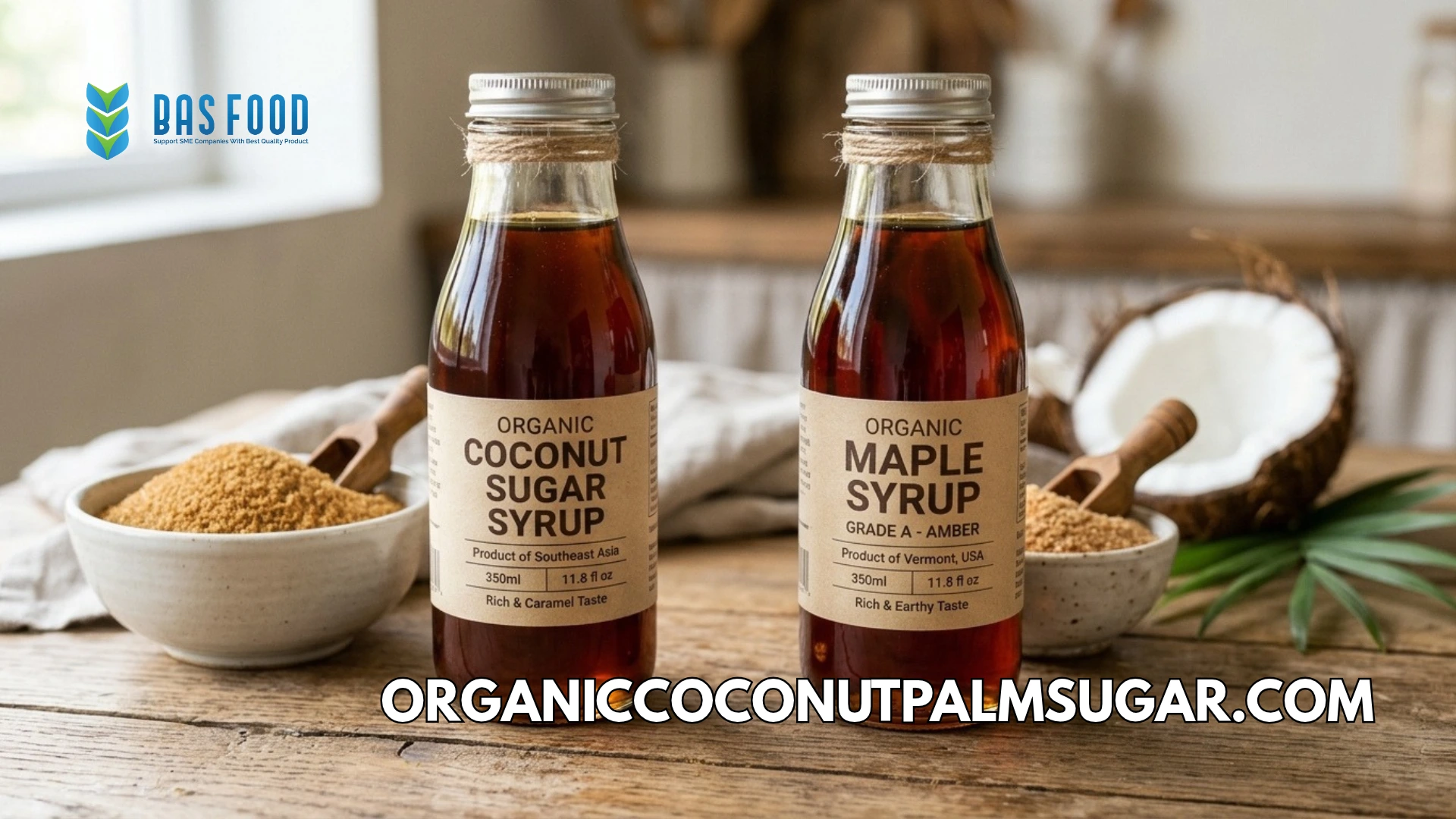
What Is Coconut Sugar Syrup?
Coconut sugar syrup is a liquid sweetener produced by concentrating sap collected from coconut flower stalks. Producers typically heat the sap to remove water and develop the desired concentration. Depending on the manufacturing process, they may also use filtration and other processing steps to achieve suitable product characteristics.
The finished syrup often has a sweet, caramel-like flavor, although its exact taste and appearance depend on the raw material and processing conditions. Some products may have a lighter profile, while others may deliver deeper caramel notes. For food manufacturers, reviewing the supplier’s specification is essential because coconut sugar syrups do not all have identical properties.
How Is Coconut Sugar Syrup Used?
Because it comes in liquid form, coconut sugar syrup can be convenient for applications where manufacturers need to blend a sweetener into liquids or moist mixtures. Beverage producers, sauce manufacturers, and dessert brands may find it useful when developing products that benefit from its characteristic flavor.
For example, a business might test coconut sugar syrup in coffee drinks, dessert toppings, sauces, marinades, or specialty beverages. However, the best application depends on the syrup’s solids content, viscosity, flavor intensity, and the other ingredients in the recipe.
Another important factor is moisture. Coconut sugar syrup introduces water along with dissolved sugars and other soluble components. Therefore, manufacturers may need to adjust the formulation to achieve the intended sweetness, texture, and stability.
What Is Maple Syrup?
Maple syrup is a liquid sweetener made from the sap of maple trees. Producers collect the sap and heat it to evaporate water, concentrating its sugars and developing the flavor associated with maple syrup.
Maple syrup is strongly associated with North American food traditions, particularly in Canada and parts of the United States. Its flavor can range from relatively delicate to rich and robust, depending on the product and production characteristics. Color and flavor classifications vary by market, so buyers should check the applicable grading system when sourcing commercial quantities.
Why Do Consumers and Manufacturers Choose Maple Syrup?
Maple syrup has a recognizable flavor that works well in pancakes, waffles, baked goods, desserts, sauces, and selected beverages. Its distinctive taste can help brands create products with a familiar maple identity.
For manufacturers, this flavor can be an advantage when it supports the intended recipe. For example, a maple-flavored snack or breakfast product may rely on maple syrup to deliver a recognizable taste and support the product’s positioning.
However, maple syrup is not always the best choice for every formulation. Its flavor may dominate delicate recipes, and sourcing costs or availability may influence purchasing decisions. Businesses should evaluate these factors alongside the product’s technical requirements.
Coconut Sugar Syrup vs Maple Syrup: Key Differences
When comparing coconut sugar syrup vs maple syrup, the first difference is the source. Coconut sugar syrup comes from coconut sap, while maple syrup comes from maple tree sap. These different raw materials create distinct flavor profiles and can affect the composition of the finished sweetener.
Their production methods also influence the final product. Both typically involve concentrating sap through heating, but the raw material, processing conditions, and product specifications can vary. As a result, buyers should not assume that the two syrups have the same sugar composition, solids content, or performance in food manufacturing.
A Quick Comparison for B2B Buyers
| Factor | Coconut sugar syrup | Maple syrup |
|---|---|---|
| Source | Coconut flower sap | Maple tree sap |
| Typical flavor | Sweet, often caramel-like | Distinctive maple flavor, ranging from delicate to robust |
| Color | Varies by product and process | Varies by grade and product |
| Physical form | Liquid | Liquid |
| Common uses | Beverages, sauces, desserts, and selected baked goods | Breakfast foods, desserts, sauces, beverages, and baked goods |
| Main flavor consideration | May add caramel-like notes | Adds recognizable maple notes |
| Formulation consideration | Check solids content, moisture, and viscosity | Check solids content, moisture, and viscosity |
| Sourcing considerations | Supplier location, production capacity, and specifications | Origin, grade, availability, and specifications |
| Best choice | Depends on the recipe and intended flavor | Depends on the recipe and intended flavor |
This comparison provides a general overview. Individual products can differ significantly, so buyers should always review technical documentation before making a final decision.
Flavor Profile: Which Syrup Works Better in Recipes?
Flavor is one of the most important factors in a liquid sweetener comparison. Even when two syrups provide a similar level of sweetness, they may produce very different results in the finished food.
Coconut sugar syrup often contributes caramel-like notes that can complement coffee, chocolate, baked goods, and rich desserts. Maple syrup, meanwhile, provides a distinctive maple flavor that may be especially desirable in breakfast products, confectionery, and recipes designed around that taste.
Can Coconut Sugar Syrup Replace Maple Syrup?
Coconut sugar syrup can be a maple syrup alternative in some recipes, but the result will not necessarily taste the same. If the original recipe relies heavily on maple flavor, replacing maple syrup with coconut sugar syrup will change the finished product’s character.
However, substitution may work well when the goal is to add sweetness and a complementary flavor rather than preserve a specific maple profile. For example, a manufacturer developing a caramel-style beverage or dessert topping may find coconut sugar syrup worth testing.
Before changing ingredients in a commercial recipe, run controlled trials. Evaluate sweetness, aroma, color, aftertaste, viscosity, and the overall consumer experience. This helps determine whether the alternative meets the product’s quality standards.
How to Compare Sweetness Fairly
A spoonful of one syrup does not necessarily provide the same amount of sugar or sweetness as a spoonful of another. Water content and soluble solids can differ, so volume-based substitution may produce inconsistent results.
For a more reliable comparison, measure both products by weight and review their specifications. If the application requires precise formulation, compare them at a controlled solids level or through an appropriate sweetness evaluation.
Also, remember that perceived sweetness depends on more than sugar concentration. Acidity, temperature, aroma, and other ingredients can change how sweet a product tastes. Testing in the actual formulation is therefore more useful than relying on a simple one-to-one substitution.
Nutritional and Ingredient Considerations
Food manufacturers increasingly review the full ingredient profile when selecting sweeteners. However, the fact that a syrup comes from a plant does not automatically make it low in sugar or suitable for every dietary requirement.
Both coconut sugar syrup and maple syrup contain sugars. Their exact composition and concentration depend on the product, so businesses should consult reliable product specifications and, where appropriate, laboratory analysis. Buyers should avoid assuming that either syrup has a particular nutritional advantage without supporting evidence.
Does Coconut Sugar Syrup Contain Less Sugar Than Maple Syrup?
There is no universal answer. A concentrated syrup may contain more sugar solids per gram than a less concentrated product, while water content can affect the values reported per serving or per 100 grams.
To compare products accurately, check the nutrition information or analytical data for each specific syrup. Pay attention to serving size, total sugars, total carbohydrates, and any other information relevant to the intended market.
If you manufacture packaged foods, use verified data when preparing nutrition labels and product claims. Requirements vary by destination market, so the final label should comply with the rules that apply to the product being sold.
What About Minerals and Health Claims?
Maple syrup and coconut-derived sweeteners may contain small amounts of minerals, but the levels can vary. These amounts should not be used to imply that either product is a major source of nutrients unless the product’s analysis and applicable labeling rules support that claim.
For B2B businesses, a more reliable strategy is to focus on documented ingredient properties, flavor, functionality, and suitability for the intended recipe. Avoid making claims such as “healthy,” “diabetic-friendly,” or “low glycemic” without appropriate evidence and regulatory review.
Which Sweetener Is Better for Food Manufacturing?
The right syrup depends on the production process and the final product. Manufacturers should consider the sweetener’s flavor, solids content, viscosity, color, moisture contribution, and compatibility with processing equipment.
For liquid products, a syrup that blends easily into the formulation may simplify ingredient handling. Nevertheless, manufacturers should confirm whether the product needs heating, dilution, or other adjustments before mixing. The syrup’s properties may also influence pumping, dosing, and filling operations.
Applications for Coconut Sugar Syrup
Coconut sugar syrup may be worth evaluating for:
- Coffee and specialty beverages.
- Dessert sauces and toppings.
- Glazes and marinades.
- Sweetened drinks and concentrates.
- Baked goods that benefit from caramel-like notes.
- Food products designed around coconut-derived ingredients.
These are potential applications, not a guarantee that every syrup will perform well in every recipe. A product intended for a beverage, for example, may require different specifications from one used in a thick sauce.
Applications for Maple Syrup
Maple syrup can be a strong choice for products where its distinctive flavor is central to the recipe. Potential applications include breakfast toppings, maple-flavored confectionery, sauces, baked goods, and specialty drinks.
It may be less suitable when a manufacturer wants a neutral sweetener or a flavor profile that emphasizes caramel rather than maple. In those cases, coconut sugar syrup or another sweetener may be worth testing.
Ultimately, the decision should be based on the product brief. If maple flavor is essential, choose a syrup that delivers it. If the goal is to explore a caramel-like profile or a different ingredient origin, test coconut sugar syrup against your technical and sensory criteria.
Storage, Shelf Life, and Handling
Storage is another factor to consider when comparing liquid sweeteners. Both products require suitable packaging and storage conditions, but their stability depends on their composition, processing, and the manufacturer’s validated instructions.
Keep syrup containers properly sealed and follow the supplier’s recommendations for temperature, storage, and handling after opening. Clean handling practices are important because contamination can affect product safety and quality. Avoid relying on appearance alone to determine whether an opened syrup remains safe to use.
How to Evaluate Shelf Life
There is no single shelf-life period that applies to all coconut sugar syrups or maple syrups. Shelf life depends on factors such as soluble solids, water activity, pH, processing, packaging, storage conditions, and the validation data for the specific product.
A high soluble-solids reading alone does not prove that a syrup is safe or stable under every condition. Manufacturers should use product-specific information and follow established food-safety procedures.
When purchasing in bulk, ask the supplier for the stated shelf life, storage instructions, batch identification, and recommendations for handling opened containers. If the product will be used in a commercial manufacturing line, make sure the storage plan fits your facility’s procedures.
Cost, Availability, and Sourcing for Bulk Buyers
For importers and food manufacturers, the best sweetener is not always the one with the lowest price per kilogram. Buyers need to consider product concentration, packaging, freight, storage, handling, and the quantity required to achieve the desired result in the final recipe.
A fair cost comparison should use the same measurement basis. If the two syrups have different solids content, compare the amount needed to deliver equivalent formulation performance rather than relying only on their quoted price per kilogram.
Availability also matters. Maple syrup and coconut sugar syrup may come from different supply networks and production regions. The practical sourcing decision depends on supplier capability, order size, delivery schedule, destination market, and the buyer’s documentation requirements.
Working with CV Bonafide Anugerah Sentosa
Businesses exploring Indonesian coconut-derived ingredients can contact CV Bonafide Anugerah Sentosa to discuss coconut sugar sourcing requirements and ask about currently available products. The company operates in the commodity supply and export sector, including coconut-derived products.
If you are considering coconut sugar syrup as an alternative to maple syrup, explain the intended application and desired flavor profile. You should also share the expected order volume, destination country, preferred packaging, and any technical requirements. These details help establish whether the available product and commercial terms fit your needs.
Buyers should confirm current availability, specifications, packaging, and export arrangements directly with the company. Do not assume that a particular syrup concentration, certification, minimum order quantity, or shipment schedule is available without written confirmation.
Why Product-Specific Documentation Matters
A supplier’s experience with one coconut-derived product does not automatically confirm that every other product is available or suitable for your application. Request separate specifications for each ingredient and evaluate them against your own quality requirements.
For example, a manufacturer may need a specific solids level for a beverage or a defined flavor profile for a dessert topping. A sample and technical review can help the buyer determine whether the product performs as expected before committing to a larger order.
Clear communication at this stage helps reduce avoidable misunderstandings and supports a more informed sourcing decision.
Coconut Sugar Syrup vs Maple Syrup: How to Make the Final Choice
When comparing coconut sugar syrup vs maple syrup, start with the purpose of your product. If the recipe depends on recognizable maple flavor, maple syrup may be the more suitable choice. If you want to explore a sweetener with caramel-like notes from coconut sap, coconut sugar syrup may be worth testing.
Next, evaluate the technical factors. Compare solids content, viscosity, moisture contribution, color, storage needs, packaging, and the cost of achieving the required sweetness. These details can influence manufacturing efficiency as much as flavor does.
Finally, test both products where practical. A controlled trial can reveal differences that a specification sheet alone may not capture, particularly when heating, blending, or other processing steps change the finished product.
Conclusion: Choose the Sweetener That Fits Your Product
Coconut sugar syrup and maple syrup both offer useful qualities, but they serve different ingredient needs. Coconut sugar syrup often brings caramel-like flavor and may suit beverages, sauces, desserts, and other formulations. Maple syrup offers a distinctive maple profile that can be central to breakfast foods, confectionery, and specialty products.
Neither sweetener is automatically healthier, cheaper, or more suitable for every application. The right choice depends on your formulation, customer expectations, technical requirements, and sourcing priorities.
For B2B buyers, a thoughtful liquid sweetener comparison should include product specifications, sample testing, storage guidance, packaging, and total landed cost. If you are exploring coconut-derived sweeteners from Indonesia, CV Bonafide Anugerah Sentosa can be contacted to discuss current product availability and sourcing needs.
By evaluating each syrup against clear requirements, your business can select the ingredient that delivers the right flavor, functionality, and value for its market.