Indonesia has a long tradition of producing coconut-based ingredients. Among these products, coconut sugar granules have gained attention from food manufacturers, distributors, retailers, and ingredient buyers in international markets. Their practical format makes them suitable for many applications, from bakery and beverages to cereals, snacks, sauces, and other processed foods. However, sourcing coconut sugar for commercial production is not simply about finding a product with an attractive price. Buyers also need to consider particle size, moisture, color, flavor, packaging, production consistency, communication, and export handling. That is why choosing the right indonesia coconut sugar granule supplier can make a meaningful difference in a long-term B2B supply relationship.
For international buyers, Indonesia offers access to coconut-growing regions, traditional processing knowledge, and an established agricultural supply chain. Nevertheless, every supplier operates differently. A professional sourcing process should therefore look beyond the product itself and examine how the supplier manages quality, specifications, documentation, packaging, and customer requirements.
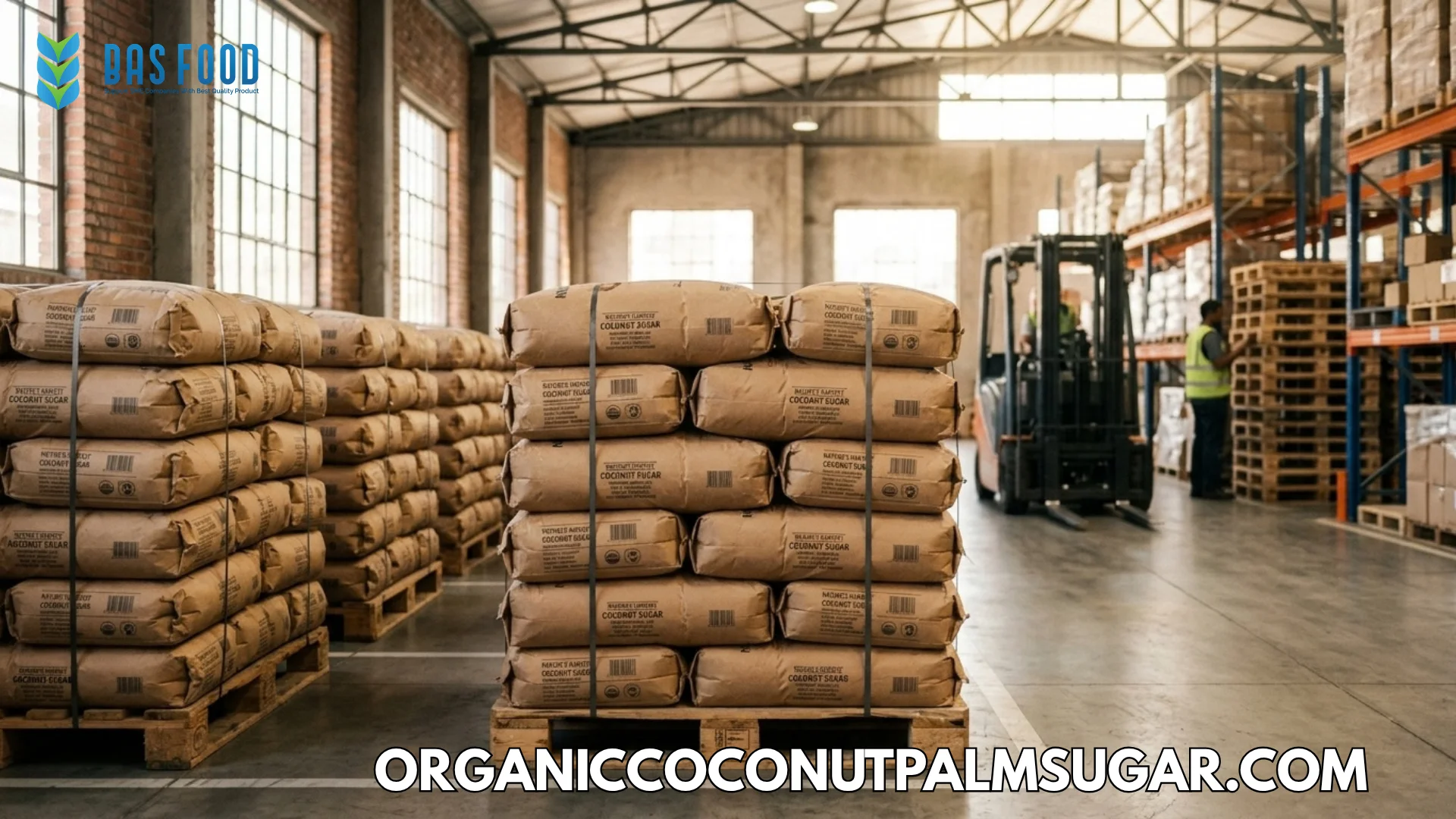
What Are Coconut Sugar Granules?
Coconut sugar granules are a granular form of coconut sugar produced from coconut palm sap. After collection, the sap undergoes processing to reduce its liquid content and concentrate its natural sugars. The resulting material can then be processed into granules with a particle size suitable for different applications.
Compared with larger moulded forms, granules are convenient for weighing, mixing, dissolving, and incorporating into food formulations. For this reason, food manufacturers often consider granulated coconut sugar when they need a dry sweetening ingredient that can be handled efficiently during production.
The physical characteristics of the granules can vary depending on the production process. Particle size, moisture level, color, texture, and aroma can all influence how the ingredient behaves in a finished product. Therefore, B2B buyers should define their requirements before selecting a supplier.
In addition, coconut sugar granules are not necessarily identical from one supplier to another. Even when two products are both called coconut sugar granules, their specifications and processing methods may differ. A detailed product specification is therefore an important part of professional sourcing.
Why Source Coconut Sugar Granules From Indonesia?
Indonesia is one of the world’s major coconut-producing countries. Coconut farming supports many rural communities, while coconut-derived ingredients have become part of the country’s agricultural and export industries.
For international buyers, working with an Indonesian supplier can provide access to a supply chain connected to local coconut-producing areas. This can be useful for businesses that want to develop a stable source of coconut-based ingredients while maintaining a direct relationship with an exporter or manufacturer.
Another important factor is the traditional knowledge surrounding coconut sap processing. Many producing communities have experience working with coconut products over generations. When traditional knowledge is combined with controlled production practices, it can support a consistent ingredient supply.
However, buyers should not assume that every Indonesian supplier provides the same level of service. Instead, businesses should evaluate suppliers based on documented specifications, production capabilities, communication, packaging, and export experience.
That distinction is especially important for international B2B procurement. A supplier may have an attractive product, but commercial buyers also need dependable communication and clear procedures from inquiry through shipment.
What Makes a Reliable Indonesia Coconut Sugar Granule Supplier?
A reliable supplier should be able to explain its product clearly. This includes information about the available granule format, product characteristics, packaging options, and general handling requirements.
For example, a professional food ingredient supplier should understand that a manufacturer may require more than a product name. The buyer may need particle size information, moisture specifications, color descriptions, flavor characteristics, packaging details, and other product requirements.
Clear communication is another important factor. International transactions often involve several steps, including product inquiry, quotation, sample discussion, specification confirmation, order processing, production, packing, documentation, and shipping. Good communication helps reduce misunderstandings throughout this process.
A reliable industrial supplier should also understand that different industries have different requirements. A bakery manufacturer may focus on particle size and flavor, while a beverage producer may be more concerned with solubility and formulation behavior.
Therefore, supplier selection should focus on compatibility rather than simply comparing prices. The right supplier is one that can understand the buyer’s application and communicate clearly about what can and cannot be supplied.
Understanding Coconut Sugar Granule Specifications
Specifications are one of the most important parts of B2B ingredient sourcing. They provide a common reference between the buyer and supplier and help ensure that both parties understand the product being discussed.
For coconut sugar granules, buyers may consider several characteristics. Particle size is one of them. Granules can be produced in different sizes, and the appropriate format depends on the intended application.
Moisture is another consideration. Coconut sugar is hygroscopic, which means it can absorb moisture from its surrounding environment. Excess moisture exposure may affect texture, flowability, and storage behavior. Therefore, proper processing, packaging, sealing, and storage are important.
Color can also matter. Coconut sugar typically has a characteristic brown to golden-brown appearance, but the exact shade can vary. Buyers should communicate their acceptable color range when appearance is important to the finished product.
Flavor and aroma are also relevant. Coconut sugar generally has a characteristic caramel-like and coconut-derived flavor profile. However, buyers should evaluate actual samples rather than relying only on general descriptions.
For commercial procurement, it is useful to create a product specification sheet covering the characteristics that matter most to the application. This makes supplier comparisons more practical and helps establish clear expectations before an order is confirmed.
Coconut Sugar Granules for Food Manufacturing
Coconut sugar granules can be used across many food manufacturing categories. Their dry granular form makes them practical for blending with other dry ingredients and incorporating into various formulations.
In bakery production, manufacturers may use coconut sugar granules in cookies, cakes, muffins, brownies, granola, and other products. The ingredient can contribute sweetness while also bringing its characteristic color and flavor.
In beverage production, coconut sugar can be used in dry mixes or formulations where a granular sweetener is appropriate. Manufacturers should evaluate dissolution and formulation behavior based on their specific process.
Cereal and snack manufacturers may also consider coconut sugar granules for granola, breakfast cereals, snack bars, and related products. Here, particle size and mixing behavior can become especially important because the sweetener needs to integrate effectively with other ingredients.
Food manufacturers should therefore avoid choosing a coconut sugar supplier solely based on the general product name. Instead, they should assess whether the product’s physical and sensory characteristics fit their manufacturing process.
Choosing Between Fine and Coarse Granules
Particle size can affect how coconut sugar performs during production. Fine granules may be useful when a formulation requires faster integration or a more uniform distribution. Coarser granules may be suitable for applications where a different texture or handling characteristic is preferred.
There is no single particle size that works for every product. For example, a manufacturer producing a dry beverage mix may have different requirements from a company producing granola or baked goods.
Consequently, buyers should discuss particle size with their supplier before placing a commercial order. If possible, testing samples in the actual formulation can provide more useful information than evaluating the ingredient in isolation.
A professional B2B supplier should be prepared to discuss these requirements. Instead of simply saying that a product is available, the supplier should help the buyer understand the available specifications and determine which format is appropriate for the intended application.
Packaging Matters in International Coconut Sugar Supply
Packaging is an important part of coconut sugar procurement, particularly when the product will travel internationally. Coconut sugar granules need protection from moisture and environmental exposure throughout storage, handling, transportation, and warehousing.
The appropriate packaging structure depends on the product, order size, transportation method, buyer requirements, and destination. Bulk industrial buyers may have different needs from distributors purchasing smaller quantities.
Proper sealing is especially important because moisture exposure can affect granular products. Packaging should therefore be selected with consideration for the expected storage and transportation conditions.
Export packaging also needs practical handling considerations. Palletization, outer protection, labeling, batch identification, and documentation can all contribute to smoother logistics.
For this reason, buyers should discuss packaging during the quotation and specification stage rather than treating it as a final detail after the product has been ordered.
From Sample Testing to Commercial Orders
A sample is one of the most useful tools for evaluating a potential supplier. It allows buyers to inspect the product before committing to a larger commercial purchase.
During sample evaluation, buyers can check factors such as appearance, aroma, flavor, particle size, texture, flowability, and performance in the intended formulation.
For food manufacturers, application testing is particularly useful. A sample may look suitable when viewed on its own but behave differently when mixed with flour, cereals, beverages, sauces, or other ingredients.
Therefore, procurement teams should establish a simple evaluation process. First, confirm the required specification. Next, test the sample. Then, compare the results with the production requirement.
This approach makes supplier selection more systematic. It also gives both sides an opportunity to discuss potential adjustments before moving toward larger orders.
Why Work With a Coconut Sugar Exporter Supplier?
International buyers often benefit from working directly with a coconut sugar exporter supplier rather than relying on multiple intermediaries. A direct supplier can simplify communication about product specifications, packaging, documentation, and shipment planning.
For importers, this can also make it easier to discuss customized requirements. For example, buyers may have specific packaging formats, labeling needs, granule sizes, or order schedules.
However, buyers should still conduct proper supplier verification. Export experience should be considered alongside product quality, communication, documentation, production capacity, and consistency.
A strong supplier relationship develops over time. Clear expectations at the beginning can help both parties create a more efficient procurement process.
CV Bonafide Anugerah Sentosa as a Coconut Sugar Supplier
CV Bonafide Anugerah Sentosa serves customers looking for Indonesian coconut-based ingredients and export supply solutions. As a coconut sugar supplier, the company can support buyers who are exploring Indonesian coconut sugar for food manufacturing, distribution, and other B2B applications.
For international procurement, the relationship between product and supply service is important. Buyers need to communicate their target specifications, application, packaging requirements, and commercial needs so that the supplier can understand the project properly.
As a coconut sugar exporter supplier, CV Bonafide Anugerah Sentosa can be considered by businesses looking to source coconut sugar from Indonesia for international markets.
As with any B2B sourcing project, buyers should discuss their specific requirements directly with the supplier. Product specifications, available formats, packaging, order quantities, and shipping arrangements should be confirmed before commercial purchasing.
How to Evaluate an Indonesia Coconut Sugar Granule Supplier
Choosing a supplier becomes easier when buyers use a structured checklist. Instead of focusing only on price, consider several factors together.
First, examine the product specification. Does the supplier provide clear information about particle size, moisture, color, flavor, packaging, and other relevant characteristics?
Second, evaluate communication. Does the supplier respond clearly to technical and commercial questions? Can the supplier explain the production and packing process in a way that is easy to understand?
Third, review sample quality. Whenever possible, test the actual product in the intended application.
Fourth, discuss packaging. Ask how the product will be packed for storage and international transportation and whether the proposed packaging matches your requirements.
Fifth, clarify commercial details. These can include order quantity, production schedule, payment terms, shipping arrangements, documentation, and other transaction requirements.
Finally, consider long-term consistency. A supplier relationship should not depend only on one successful sample. Commercial buyers need to know whether the supplier can maintain agreed specifications across future orders.
Building a Long-Term Coconut Sugar Supply Partnership
A long-term supplier relationship begins with clear communication. Buyers should explain their application, target market, required specifications, packaging preferences, and expected purchasing pattern.
At the same time, suppliers should communicate their available product formats and commercial capabilities honestly. This creates a stronger foundation for future cooperation.
Over time, both sides can develop a more efficient procurement process. Repeated orders can become easier when product specifications, packaging requirements, documentation, and logistics procedures are already clearly established.
For international businesses, this type of relationship can be especially valuable. Instead of treating every purchase as a separate transaction, buyers and suppliers can work toward a predictable supply process.
Ultimately, selecting an indonesia coconut sugar granule supplier is about more than finding coconut sugar at a competitive price. It is about finding a supplier whose product specifications, communication, packaging, quality approach, and export process match the buyer’s commercial requirements.
Final Thoughts
Indonesia provides international buyers with access to a well-established coconut-based agricultural supply chain. Coconut sugar granules can serve a wide range of food manufacturing and commercial applications, making them an interesting ingredient for businesses looking for alternative sweetening formats.
Still, successful sourcing requires more than finding a supplier online. Buyers should evaluate specifications, samples, particle size, moisture protection, packaging, communication, and export processes before placing commercial orders.
For companies searching for an indonesia coconut sugar granule supplier, a structured procurement approach can make the process clearer. By defining requirements early and communicating them directly with the supplier, buyers can build a stronger foundation for consistent B2B cooperation.