Buying coconut sugar granules in bulk sounds simple. However, for an importer, food manufacturer, distributor, or private-label brand, choosing the right product involves much more than comparing prices. An important consideration is understanding coconut sugar granule quality parameters. The real question is: What makes one coconut sugar granule better or more suitable than another?
This is where coconut sugar granule quality parameters become important. These parameters give buyers a clear way to evaluate product quality before placing a large order. They also help suppliers understand exactly what the buyer expects.
For international B2B trade, a good quality discussion should cover physical characteristics, moisture, color, aroma, taste, cleanliness, food safety, packaging, and batch consistency. At the same time, buyers should consider whether the supplier can maintain the agreed quality from one shipment to the next.
In this guide, we will explore the most important quality parameters for coconut sugar granules and explain how B2B buyers can use them when selecting an Indonesian supplier.
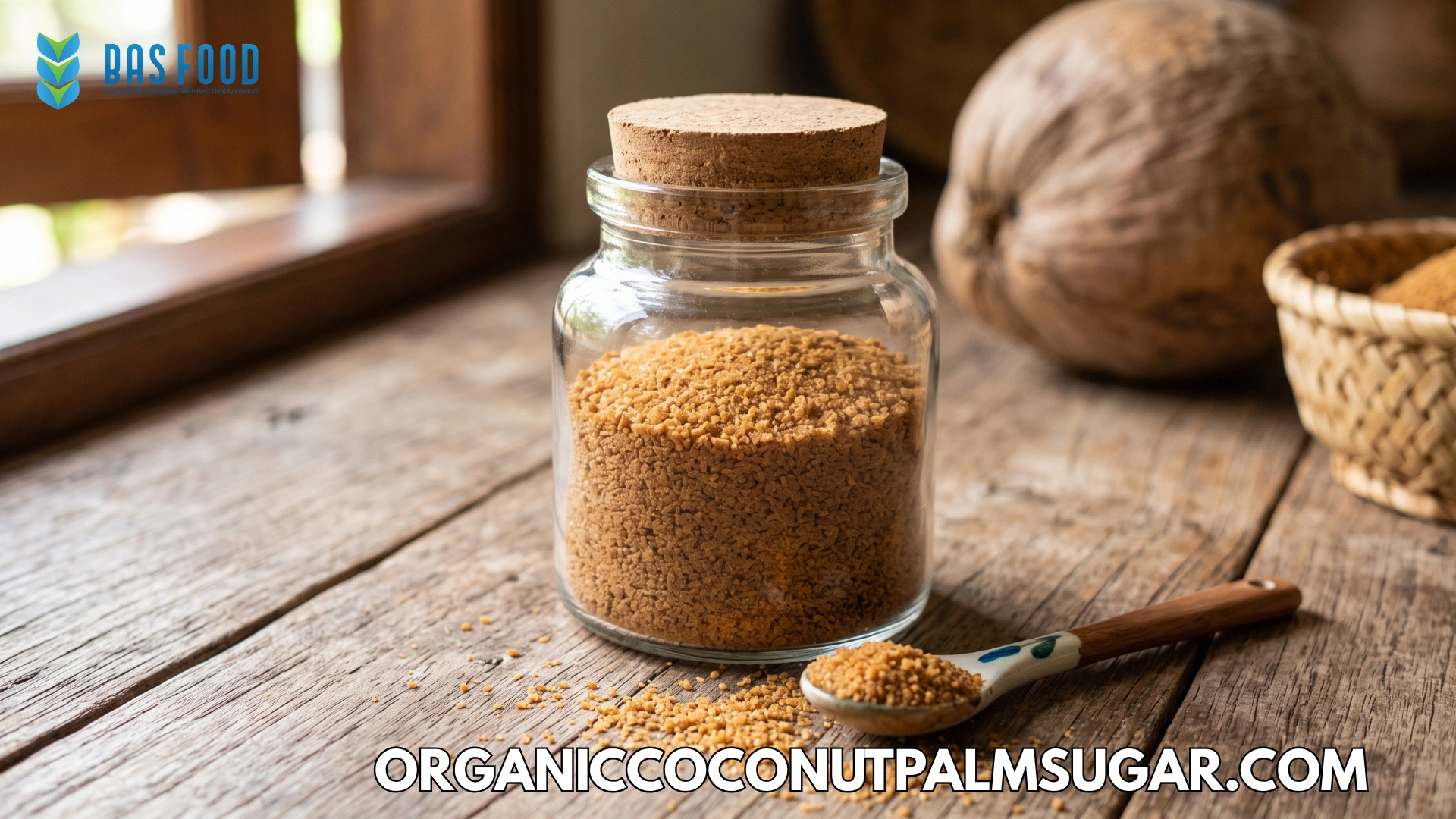
Understanding Coconut Sugar Granule Quality Parameters
Coconut sugar granule quality parameters are the characteristics used to describe, evaluate, and control the quality of granulated coconut sugar. They can include physical, sensory, chemical, microbiological, and packaging-related characteristics.
For a B2B buyer, these parameters are useful because they turn a general idea such as “high-quality coconut sugar” into measurable or clearly described requirements. Instead of relying only on appearance, buyers can compare suppliers using the same points.
For example, a buyer may require a particular granule size, moisture level, color range, packaging format, and food-safety standard. Another buyer may have different requirements because the sugar will be used for beverages, bakery products, confectionery, foodservice, or retail.
Therefore, there is no single quality profile that automatically fits every application. The right specification depends on how the coconut sugar will be processed, packed, distributed, and sold.
Why Quality Parameters Matter in B2B Purchasing
In retail purchasing, a small variation may not always create a major problem. In industrial production, however, consistency can be much more important.
A food manufacturer may use coconut sugar in hundreds or thousands of batches. If the granule size, moisture, or sensory profile changes significantly between shipments, the production process or final product can also change.
That is why professional buyers should agree on quality parameters before regular supply begins. A clear specification gives both parties a common reference.
Particle Size: A Key Parameter for Granulated Coconut Sugar
Particle size is one of the most important coconut sugar granule quality parameters to discuss with a supplier. It describes how large or small the individual sugar particles are.
Coconut sugar granules can be produced in different sizes. Some applications may require relatively fine particles, while others may work better with medium or coarser granules.
For example, a beverage manufacturer may have different requirements from a bakery ingredient distributor. Likewise, a retail brand may choose a particle size based on how consumers are expected to use the product.
Because terminology can differ between suppliers, buyers should not assume that “fine,” “medium,” or “coarse” means exactly the same thing everywhere.
Mesh Size and Particle Distribution
Some suppliers describe granule size using mesh. Others may use millimeters, screening specifications, or particle-size ranges.
A buyer should therefore ask how the supplier defines the requested size. This is especially important when comparing samples from different producers.
Particle-size distribution can also be useful. A product with a relatively consistent particle size may behave differently from one containing a wide mixture of very small and large particles.
For industrial buyers, the best approach is to define the desired particle size in the purchasing specification and confirm it through an approved sample or appropriate testing method.
Moisture: A Parameter Buyers Should Never Ignore
Moisture is another important factor when evaluating coconut sugar granules. Coconut sugar can interact with moisture in its surrounding environment, so storage and packaging conditions matter.
Excess moisture can contribute to clumping and may make granules more difficult to handle. It can also affect the product during transportation, especially when shipments move through areas with different temperature and humidity conditions.
For this reason, buyers should ask their coconut sugar supplier for the applicable moisture specification before ordering.
The exact acceptable range should be based on the agreed product specification rather than assuming that one number applies to every coconut sugar product.
Moisture and International Shipping
Export shipments can spend considerable time in warehouses, containers, ports, and distribution facilities. During this journey, environmental conditions can change.
Consequently, product protection does not stop at production. Packaging plays an important role in helping maintain the agreed product condition.
Buyers should discuss packaging material, inner liners, sealing, storage recommendations, and container loading with the supplier. These details are particularly relevant for bulk shipments.
Color and Appearance Can Tell Buyers a Lot
Coconut sugar is generally associated with brown or golden-brown shades, but the actual appearance can vary.
Color may be influenced by the raw material and production process. Therefore, buyers should establish an acceptable appearance based on a product specification or approved reference sample.
This is especially important for manufacturers that use coconut sugar in products where appearance matters. A noticeable difference in sugar color could influence the appearance of beverages, bakery products, sauces, desserts, or other finished foods.
However, color should never be the only quality indicator. A visually attractive product still needs to meet the buyer’s other requirements.
Why an Approved Sample Helps
A reference sample can make quality discussions much easier. Both buyer and supplier can refer to the same physical product when discussing appearance, granule characteristics, aroma, and taste.
For repeat orders, the sample can support communication when reviewing future batches. It does not replace formal specifications or testing, but it provides a useful practical reference.
This simple step can reduce misunderstandings, particularly when the buyer and supplier are working across different countries.
Aroma and Taste: Important Sensory Characteristics
Coconut sugar has a distinctive sensory character that can be relevant to food manufacturers and brands.
Depending on the product and production process, buyers may notice sweet, caramel-like, or molasses-like notes. However, sensory characteristics can vary, so buyers should evaluate samples rather than relying solely on a general product description.
For a food manufacturer, the important question is whether the sensory profile fits the intended formulation.
For example, a brand producing beverages may want a specific flavor profile, while a bakery manufacturer may use coconut sugar as part of a larger recipe where other ingredients dominate the taste.
Sensory Evaluation Before Bulk Orders
A sample evaluation gives buyers the opportunity to check the product before committing to a large shipment.
The evaluation can include color, aroma, taste, granule appearance, texture, and behavior in the intended application.
Where possible, the buyer should document the approved sample and agreed specification. This creates a useful reference for future purchasing.
Food Grade and Cleanliness Requirements
For food manufacturers, food grade status is an important part of supplier evaluation.
Coconut sugar intended for food production should be manufactured, handled, packed, and stored under suitable food-safety controls. The specific requirements may vary depending on the destination market and intended application.
B2B buyers should therefore discuss food-safety requirements with the supplier before ordering. They can also ask what product documentation is available.
Depending on the buyer’s needs, documentation may include a product specification, Certificate of Analysis, microbiological test results, allergen information, ingredient information, or other documents required for the target market.
Physical Cleanliness
Physical cleanliness is also an important quality consideration.
Buyers generally want a product that is free from unwanted foreign materials and excessive impurities. Suitable production controls, screening, inspection, handling, and packaging procedures can help support this requirement.
Rather than relying on a general statement that the product is “clean,” buyers should define their expectations in the product specification wherever possible.
Microbiological Quality and Testing
Microbiological quality can be part of the quality assessment for coconut sugar intended for food applications.
Depending on the destination country, customer requirements, and intended use, buyers may request testing for specific microbiological parameters. The exact criteria should be agreed between the buyer and supplier and aligned with applicable requirements.
This is one reason why B2B buyers should communicate their destination market early in the sourcing process.
A supplier may be able to provide certain test reports or arrange testing based on the agreed specification. However, buyers should confirm the available documentation before placing an order.
Product Specification vs. Certificate of Analysis
These two documents are often confused.
A product specification describes what the product is expected to meet. It can include characteristics such as particle size, moisture, appearance, and other agreed requirements.
A Certificate of Analysis, or COA, generally provides test results for a particular batch.
In simple terms, the specification describes the target, while the COA provides batch-specific test information.
For B2B sourcing, both can be valuable because they provide different types of quality information.
Raw Material Handling Affects Finished Product Quality
Quality control begins before the coconut sugar becomes a granule.
Coconut sugar is produced from coconut flower sap. Therefore, raw material collection and handling can influence the final product.
The production chain can involve sap collection, filtering, heating, concentration, drying or crystallization, granulation, screening, and packaging. Each stage needs appropriate controls if the supplier wants to maintain consistent results.
This is why supplier quality is broader than final-product inspection.
A buyer should consider how the supplier manages raw materials, production, quality checks, storage, and packing. Understanding the complete process can provide a better picture of the supplier’s ability to deliver consistent products.
Batch Consistency Matters More Than One Good Sample
One of the biggest mistakes a B2B buyer can make is evaluating only one sample.
A sample tells you what the product looks like at one point in time. It does not automatically prove that every future shipment will have identical characteristics.
For long-term sourcing, buyers need to know whether the supplier can maintain the agreed parameters from batch to batch.
Building a Consistent Supply Program
A practical approach is to establish a product specification before regular production.
The buyer and supplier can agree on important parameters such as:
- Product format
- Particle size
- Moisture
- Appearance
- Sensory characteristics
- Food-safety requirements
- Packaging
- Labeling
- Storage conditions
- Documentation
Once these points are clear, both sides have a stronger basis for evaluating future shipments.
Packaging Is Part of Product Quality
Packaging does more than make a product look attractive. For coconut sugar granules, suitable packaging can help protect the product during storage and transportation.
B2B buyers should consider whether they need bulk packaging, retail-ready packaging, or private-label packaging.
The choice may depend on the destination market, distribution channel, production process, and final customer.
For example, an industrial food manufacturer may need large food-grade bags, while a retail brand may require smaller consumer packs with customized labels.
Export Packaging Considerations
When discussing packaging with a supplier, buyers should consider:
- Bag or package size
- Food-contact suitability
- Inner liner
- Sealing method
- Outer packaging
- Pallet requirements
- Label information
- Container loading
- Storage instructions
- Private-label requirements
Packaging specifications should be confirmed before production so that both parties understand the final requirements.
The Role of CV Bonafide Anugerah Sentosa in B2B Sourcing
For importers looking for Indonesian coconut sugar, CV Bonafide Anugerah Sentosa can be evaluated as a potential supplier based on the buyer’s required product specification and sourcing needs.
The most effective starting point is a clear discussion about the product. Buyers can provide their desired granule characteristics, application, packaging requirements, order volume, destination, and documentation needs.
From there, the supplier and buyer can discuss sample evaluation and the applicable product specification.
This approach is more useful than assuming that every customer requires exactly the same coconut sugar. B2B sourcing works best when both parties understand the product requirements from the beginning.
Final Thoughts on Coconut Sugar Granule Quality Parameters
Understanding coconut sugar granule quality parameters gives B2B buyers a practical way to evaluate products before making a purchasing decision.
Particle size, moisture, appearance, aroma, taste, cleanliness, food-grade requirements, microbiological quality, packaging, and batch consistency all deserve attention.
However, buyers should remember that quality is not simply about finding the product with the best appearance. It is about finding a product that consistently meets the requirements of the intended application.
That is why a strong sourcing process starts with a clear specification, continues with sample approval, and develops into regular quality monitoring.
For importers, distributors, manufacturers, and private-label brands, choosing the right coconut sugar supplier can make a significant difference to long-term supply reliability.
Whether you need granulated coconut sugar or are also exploring moulded formats with a coconut sugar mould supplier, the same principle applies: define the requirements clearly, evaluate the product carefully, and choose a supplier that can support those requirements consistently.
For Indonesian coconut sugar sourcing, buyers can discuss their requirements directly with CV Bonafide Anugerah Sentosa and begin the process with product specifications, samples, packaging requirements, and intended applications.