Coconut sugar has become an interesting ingredient for food manufacturers, distributors, retailers, and ingredient buyers around the world. Its natural caramel-like taste, distinctive aroma, and versatility make it suitable for beverages, bakery products, confectionery, sauces, snacks, and many other applications. However, one physical characteristic deserves special attention during purchasing and handling: its ability to interact with moisture. This characteristic is known as coconut sugar hygroscopicity. In simple terms, coconut sugar can attract and hold moisture from the surrounding environment. This is important because moisture can affect the texture, flow, storage stability, packaging, and overall handling of the product.
For B2B buyers, understanding hygroscopicity is more than a technical exercise. It can help prevent common problems such as sticky sugar, clumping, hardening, or changes in texture during storage and transportation. A buyer who understands how moisture behaves can also choose more suitable packaging and storage conditions.
In this guide, we will explain what coconut sugar hygroscopicity means, why coconut sugar absorbs moisture, how humidity affects the product, and what buyers can do to manage it. We will also look at practical considerations when working with a coconut sugar supplier or coconut sugar mould supplier.
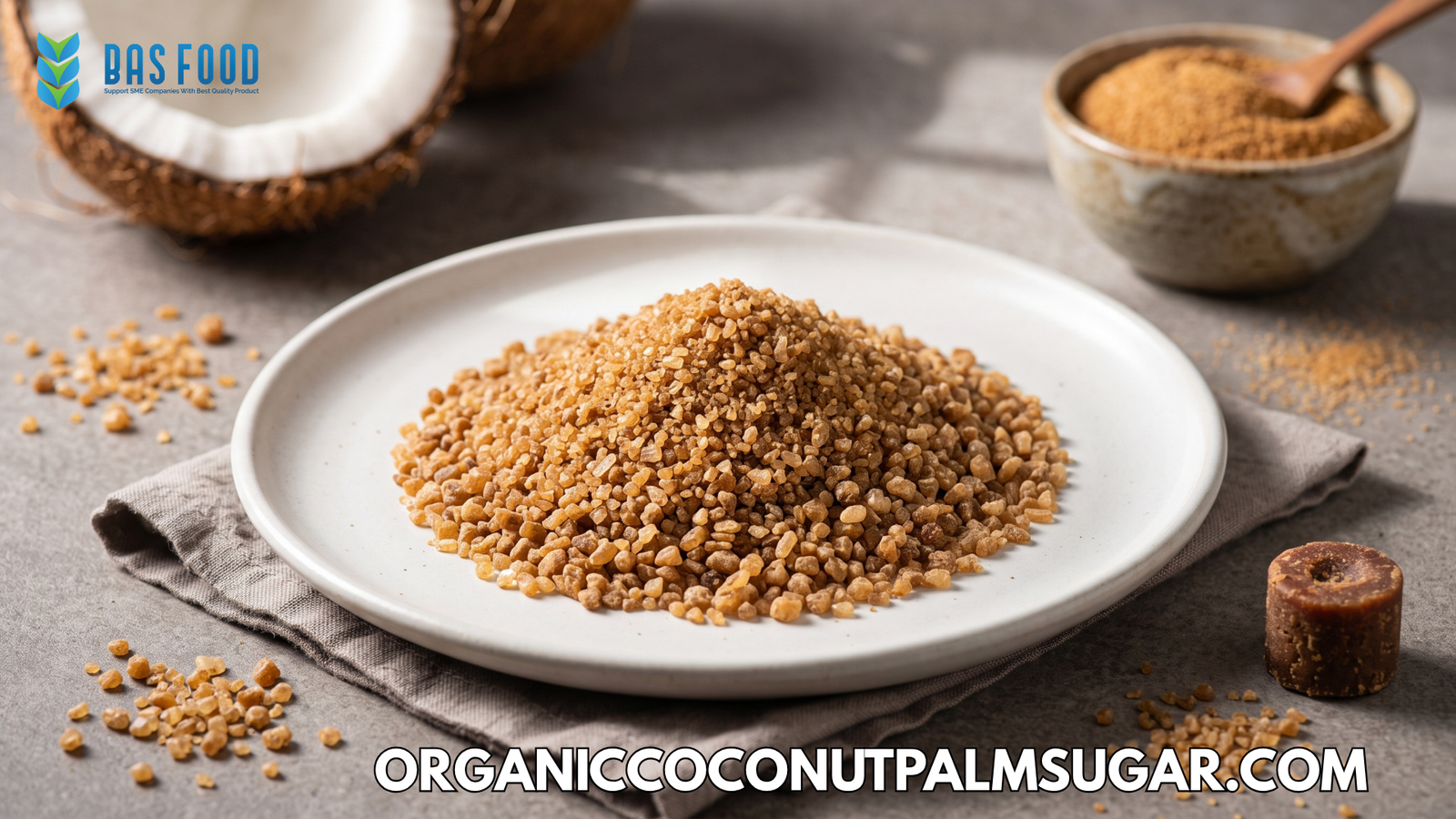
What Is Coconut Sugar Hygroscopicity?
The term coconut sugar hygroscopicity describes the tendency of coconut sugar to absorb or attract water vapor from the surrounding air. Coconut sugar is not simply a dry material that remains completely unchanged in every environment. Like many powdered and granular food ingredients, it can interact with humidity.
When the surrounding air contains more moisture, coconut sugar may take up some of that moisture. The effect can become more noticeable when the product remains exposed to humid air for an extended period. This is especially relevant in tropical climates, warehouses with poor environmental control, and during repeated opening and closing of packages.
The word “hygroscopic” is useful because it describes the behavior of a material rather than automatically describing it as a quality problem. Hygroscopic sugar can still be a good-quality food ingredient. The key is to control the conditions around it.
For B2B buyers, this distinction matters. Moisture absorption does not necessarily mean the product is defective. Instead, it means the product requires suitable packaging, handling, and storage conditions to maintain its intended characteristics.
Why Does Coconut Sugar Absorb Moisture?
Coconut sugar contains natural sugars and other components that can interact with water. Its physical structure also creates opportunities for moisture to move into the product. As a result, exposure to humid air can gradually change its physical condition.
The risk becomes particularly noticeable with smaller particles. A granulated product has many individual particles and a relatively large surface area compared with a solid block. Therefore, environmental humidity can have a greater practical impact when the sugar is exposed to air.
This does not mean granulated coconut sugar is unsuitable for commercial use. In fact, granulated coconut sugar is highly useful for food manufacturing because it can be measured and mixed easily. However, buyers and manufacturers need to manage the product appropriately after opening the packaging.
Temperature also plays a role in warehouse conditions. Warm air can carry significant amounts of water vapor, while temperature changes can contribute to condensation in poorly managed storage environments. Therefore, moisture control should be considered as part of the complete supply chain rather than only at the factory.
Moisture Absorption and Its Effect on Coconut Sugar
One of the most visible consequences of moisture absorption is a change in texture. Loose coconut sugar granules may begin to stick together when they take up enough moisture. Over time, individual particles can form small clusters or larger lumps.
This can make the product more difficult to handle. A food manufacturer may need to break up clumps before weighing or mixing the sugar. In automated production systems, changes in flow behavior can also create additional handling challenges.
Moisture can also affect how easily sugar moves through equipment. Dry granules generally flow more freely than partially damp material. When particles begin sticking together, the product may no longer behave in the same way as it did when first packed.
For this reason, moisture management is especially important for businesses purchasing coconut sugar in bulk. A supplier can produce and pack the product correctly, but storage conditions after delivery can still influence its physical condition.
Why Granulated Coconut Sugar Needs Careful Moisture Control
Granulated coconut sugar is popular among commercial food manufacturers because its small particles are convenient for weighing, blending, and processing. However, the same physical characteristics that make granules practical can also make them more sensitive to environmental exposure.
When a bag or container is opened, the product comes into contact with the surrounding air. If the air has high relative humidity, the sugar may begin taking up moisture. Repeated exposure can increase the chance of clumping and texture changes.
Therefore, buyers should consider how quickly the product will be consumed after opening. A factory that uses an entire bag within a short production period may face fewer issues than a facility that opens one package and stores the remainder for several weeks.
Production planning can help. If possible, businesses should match package size with their normal consumption rate. Smaller working quantities can reduce the amount of time that an opened package remains exposed to the environment.
At the same time, the packaging should remain properly sealed when the product is not being used. Good handling practices can significantly reduce unnecessary moisture exposure.
Coconut Sugar Hygroscopicity and Packaging
Packaging is one of the most important tools for managing coconut sugar hygroscopicity. A suitable package acts as a barrier between the sugar and the surrounding environment. The exact packaging structure should depend on the product format, shipment size, storage period, and destination.
For commercial quantities, buyers may use sealed inner packaging combined with stronger outer packaging. The purpose is not simply to make the product look attractive. Packaging needs to protect the ingredient throughout handling, transportation, warehousing, and production.
Packaging requirements can also differ between granulated and moulded products. Granules need protection against moisture entering the package and causing clumping. Moulded coconut sugar also benefits from suitable packaging because excessive moisture can affect its surface and texture.
This is why buyers should discuss packaging specifications with their coconut sugar supplier before placing an order. Instead of treating packaging as an afterthought, it should form part of the product specification.
Storage Conditions Matter More Than Many Buyers Expect
Even well-packed coconut sugar can be affected by poor storage. Once the product reaches the buyer’s warehouse, environmental conditions become an important part of quality management.
Ideally, coconut sugar should be kept in a clean, dry area away from direct water exposure. The storage area should also be protected from unnecessary humidity and large temperature changes. Packages should remain closed until the product is needed.
It is also good practice to keep food ingredients away from strong-smelling materials. Coconut sugar has its own natural aroma, and proper storage helps protect its intended sensory characteristics.
Packages should be placed on suitable pallets or shelving rather than directly on a potentially damp floor. This creates a physical barrier and also makes warehouse cleaning and inspection easier.
In addition, the warehouse should have enough ventilation to avoid creating areas where moisture accumulates. However, ventilation should not mean leaving packaging open to humid outdoor air. The goal is controlled, clean, and dry storage.
Humidity and the Risk of Sugar Clumping
Clumping is one of the most common practical concerns associated with moisture-sensitive sugar products. When particles absorb moisture, their surfaces can become slightly sticky. Neighboring particles then have a greater tendency to adhere to each other.
Initially, the change may be small. A few granules may stick together, and the product can still flow normally. However, continued exposure may produce larger clusters that become harder to separate.
This is particularly important for food manufacturers using automated weighing or dosing equipment. Equipment is generally designed to handle a product with relatively predictable flow characteristics. If the material becomes more cohesive, the feeding process can become less consistent.
Therefore, controlling moisture absorption from the beginning is usually easier than trying to correct severe clumping later. Good packaging, proper warehouse conditions, and disciplined handling work together to protect the product.
Coconut Sugar Moisture During Transportation
International transportation introduces another challenge because the product may pass through several environments before reaching the final warehouse. A shipment can experience changes in temperature and humidity during loading, transit, unloading, and storage.
For exporters and importers, the container environment deserves attention. Cargo can encounter temperature fluctuations, especially when containers move between different climates. Poor loading practices or damaged packaging can also increase the risk of moisture exposure.
That is why export packaging should be selected based on the expected supply chain. The package should be strong enough for handling while providing an appropriate barrier for the product.
Buyers should also inspect incoming shipments. Check the external condition of the packages and look for signs of damage, water exposure, or unusual changes in the product. Early inspection makes it easier to identify potential problems before the product enters regular production.
How Buyers Can Evaluate Coconut Sugar Moisture
Moisture should be treated as a measurable quality characteristic rather than judged only by appearance. A professional buyer can request the supplier’s product specification and applicable quality documentation.
The appropriate moisture specification depends on the product type, processing method, customer requirements, and intended application. Therefore, buyers should avoid assuming that one universal number applies to every coconut sugar product.
Instead, discuss the required specification with the supplier. If the buyer has an internal standard, the supplier should know it before production. If the buyer is developing a new product, the supplier can help explain the characteristics of the available coconut sugar format.
Laboratory testing can also support quality control. Depending on the purchasing agreement, moisture may be included among the parameters checked for each batch or according to an agreed testing plan.
The important point is consistency. A buyer needs a product that performs predictably, especially when coconut sugar becomes an ingredient in a larger commercial formula.
The Difference Between Product Quality and Storage Problems
A common mistake is to blame the supplier immediately when coconut sugar becomes sticky or develops clumps. While production and packaging quality are important, storage conditions after delivery can also have a major effect.
For example, a properly packed shipment may arrive in good condition. If the package is opened and left in a humid production room for an extended period, the sugar can absorb moisture from the air. The resulting clumping may therefore be related to handling rather than the original production batch.
This is why buyers should look at the entire chain. Evaluate the product specification, packaging, transportation, receiving process, warehouse, and production environment.
Good traceability makes this easier. Batch numbers, receiving records, storage conditions, and internal inspection results can help a business determine where a change occurred.
A reliable coconut sugar supplier should also be willing to discuss these issues with buyers. Open communication can help identify the cause and prevent the same problem from happening again.
Choosing a Coconut Sugar Supplier With Quality in Mind
Selecting a supplier involves more than comparing prices. Buyers should evaluate whether the supplier understands the physical characteristics of coconut sugar and can provide consistent product information.
Ask for a clear specification sheet. It should explain relevant product characteristics and packaging. If moisture is important to your application, discuss the moisture requirement before placing the order.
Buyers should also ask how the supplier handles quality control. The exact process will vary between producers, but the supplier should be able to explain how it maintains product consistency from production through packing.
For businesses sourcing moulded products, the same principle applies when evaluating a coconut sugar mould supplier. The supplier should understand how mould dimensions, cooling, handling, packaging, and storage can affect the final product.
For Indonesian buyers and international importers considering CV Bonafide Anugerah Sentosa, these factors can form part of the normal supplier evaluation process. Buyers should confirm the latest product specifications, packaging formats, testing requirements, minimum order quantities, and commercial terms directly before ordering.
Practical Moisture Control for B2B Warehouses
A good warehouse does not need to be complicated. Start by keeping coconut sugar away from water, damp surfaces, and uncontrolled humidity. Keep packages sealed until the product is required.
Use clean pallets or shelving and leave enough space for inspection and handling. Avoid placing food ingredient packages directly against areas where condensation or water leakage could occur.
Once a package is opened, close it properly after each use. Do not leave the bag or liner open while production workers perform other tasks. Even short periods of exposure can add unnecessary moisture risk in a humid environment.
Businesses can also train warehouse and production staff about the basic behavior of hygroscopic sugar. Employees do not need advanced technical knowledge. They simply need to understand why keeping the product sealed and dry matters.
What Coconut Sugar Buyers Should Ask Their Supplier
Before purchasing, buyers can ask several direct questions about coconut sugar hygroscopicity. About the product’s specified moisture range? What packaging is recommended for international shipments? and What storage conditions does the supplier recommend?
It is also useful to ask about the product format. Granulated coconut sugar and moulded coconut sugar can behave differently because of their physical structure. A supplier should be able to explain the appropriate handling approach for each format.
If the buyer has a specific production environment, share that information. For example, a beverage factory, bakery, confectionery producer, and retail distributor may have different requirements.
Clear communication at the beginning can prevent problems later. Instead of asking only for a price per kilogram, buyers should explain the complete application and quality expectations.
This gives the supplier a better opportunity to recommend a suitable product and packaging format.
The Bigger Picture: Managing Coconut Sugar From Factory to Warehouse
Coconut sugar quality does not depend on one stage alone. The production process, packaging, transportation, warehouse, and final handling all contribute to the condition of the product.
At the production stage, the supplier needs to control processing and packing. During transportation, the packaging needs to protect the product from the external environment. Once the shipment reaches the buyer, proper storage becomes equally important.
This is particularly relevant for international B2B supply chains. A product may travel thousands of kilometers before it reaches the factory where it will be used. Every stage creates another opportunity for exposure to heat, humidity, physical damage, or poor handling.
Therefore, moisture management should be viewed as a supply-chain responsibility shared by both supplier and buyer.
Final Thoughts on Coconut Sugar Hygroscopicity
Understanding coconut sugar hygroscopicity helps B2B buyers make better purchasing and storage decisions. Coconut sugar can absorb moisture from its environment, and this natural behavior can influence flow, texture, clumping, and handling.
The solution is not to avoid coconut sugar. Instead, businesses should manage the conditions around it. Suitable packaging, controlled storage, proper handling, and clear product specifications can all reduce unnecessary moisture exposure.
For buyers, the most important step is to discuss moisture requirements with the supplier before placing an order. Ask about product specifications, packaging, recommended storage, and quality control. Then make sure the warehouse and production teams follow appropriate handling practices after delivery.
For businesses sourcing from Indonesia, CV Bonafide Anugerah Sentosa can be considered as part of a wider supplier evaluation process. Whether you need granulated or moulded coconut sugar, always confirm the current specifications and commercial requirements directly with the supplier.
In the end, managing moisture is about protecting the value of the ingredient. When buyers understand how hygroscopic sugar behaves, they can reduce avoidable clumping, maintain better product consistency, and create a more reliable coconut sugar supply chain.