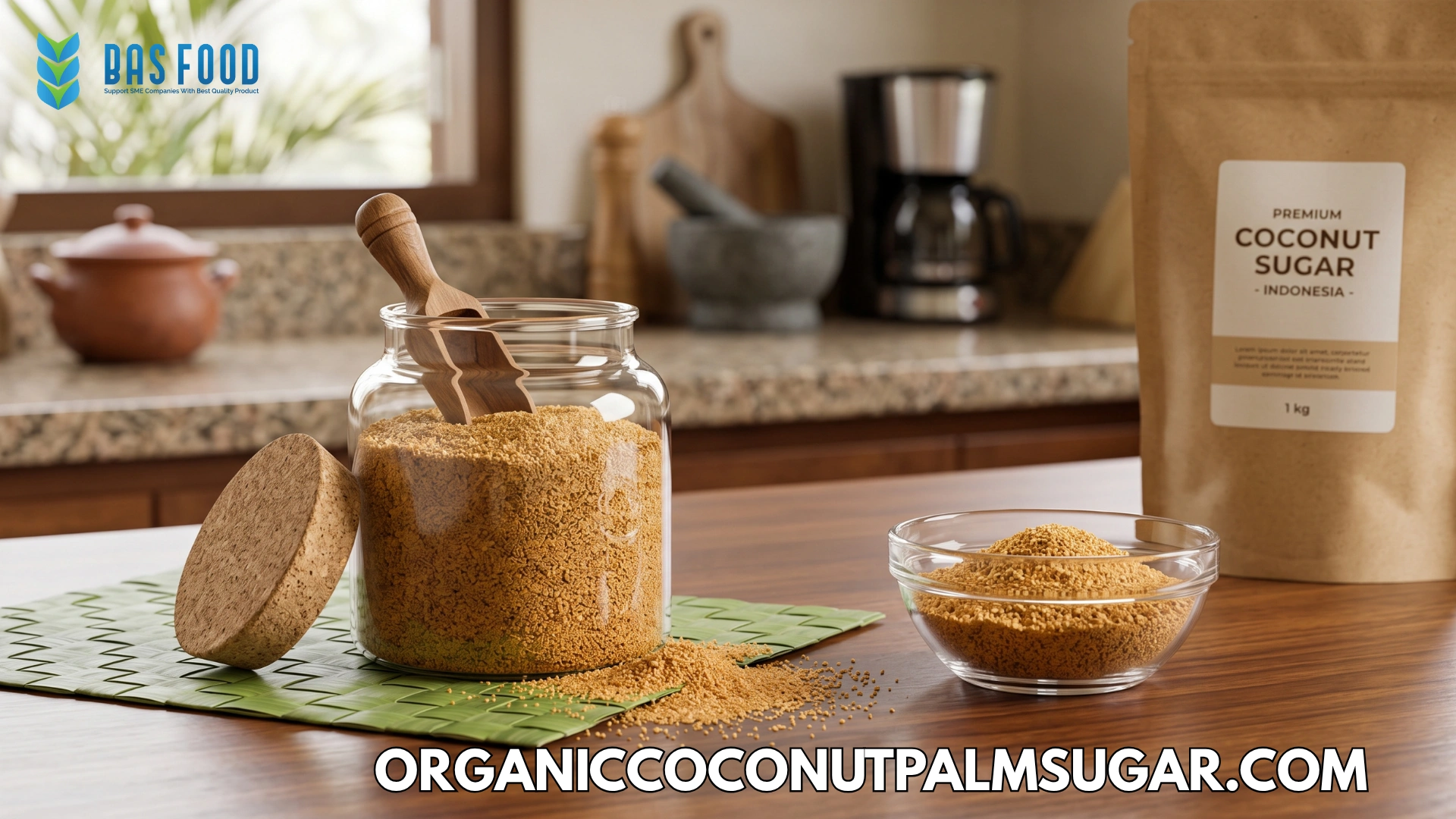
Coconut sugar granules look simple. They are small, dry-looking particles that can be used in beverages, bakery products, confectionery, sauces, desserts, and many other food applications. However, behind that simple appearance is one important quality factor that B2B buyers should never ignore: coconut sugar granule moisture.
Moisture can affect much more than the feel of the product. It can influence flowability, storage stability, particle separation, packaging performance, and the tendency of granules to form lumps. For manufacturers and importers, controlling moisture is therefore an important part of maintaining consistent product quality.
When coconut sugar granules absorb moisture from the surrounding environment, the particles can become sticky. Over time, individual granules may attach to one another and form hard or soft lumps. This condition is commonly known as clumping, and it can make the product harder to handle and process.
The good news is that moisture-related problems can be managed through proper processing, packaging, storage, and quality control. By understanding how moisture behaves, buyers can make better sourcing decisions and communicate more clearly with a coconut sugar supplier.
What Is Coconut Sugar Granule Moisture?
Coconut sugar granule moisture refers to the amount of water present in coconut sugar granules. It can come from the original coconut sap, the processing environment, or moisture absorbed by the finished product during storage and transportation.
Coconut sugar starts as fresh coconut sap. During production, the sap is heated to remove water and concentrate its natural sugars. The concentrated material is then processed into the desired form, including granules.
The final moisture level depends on several factors. These include raw material characteristics, cooking conditions, granulation methods, cooling, environmental humidity, packaging, and storage.
For B2B buyers, it is important to understand that moisture is not simply a number on a laboratory report. It can affect how the product behaves during real-world handling.
A product with suitable moisture content should remain reasonably stable under the agreed storage conditions. However, even a well-processed product can absorb moisture if it is exposed to humid air or inadequate packaging.
Why Moisture Matters in Coconut Sugar Granules
Moisture plays an important role in the physical stability of granulated coconut sugar. When the product remains sufficiently dry and is protected from environmental humidity, the particles are more likely to remain separate and flow properly.
On the other hand, excessive moisture can change the surface of the granules. The particles may become less free-flowing and begin sticking together.
This is particularly important for food manufacturers. Many production systems require ingredients to flow from bags, containers, hoppers, or dosing equipment.
If coconut sugar becomes heavily clumped, workers may need to break the lumps manually before production. In an automated process, excessive clumping can create even bigger handling challenges.
Therefore, controlling moisture supports sugar stability and helps maintain the practical performance of the ingredient.
How Coconut Sap Influences Final Moisture
The story of moisture begins with coconut sap. This raw material naturally contains a large amount of water along with sugars and other naturally occurring components.
During processing, producers heat the sap to evaporate water. The objective is to concentrate the material until it reaches a condition suitable for producing coconut sugar.
The quality of the starting sap can vary depending on harvesting, handling, freshness, and environmental conditions. Consequently, producers need to manage the raw material carefully.
Fresh sap also needs proper handling because it can undergo natural changes after collection. Good production practices help ensure that the sap enters the processing stage in suitable condition.
For B2B buyers, understanding the raw material stage helps explain why coconut sugar production requires process control from the beginning rather than only at the final packaging stage.
Coconut Sugar Processing and Moisture Control
Coconut sugar processing has a direct relationship with final moisture. Heating reduces water content, while the way producers manage temperature and processing time can affect the final product.
If the product is not sufficiently concentrated, it may retain more moisture than desired. However, excessive heating can also affect other product characteristics, such as color, aroma, texture, and flavor.
Therefore, producers need to find an appropriate balance. The goal is not simply to remove as much moisture as possible.
Instead, the producer should achieve a product that meets the agreed specifications while maintaining desirable sensory and physical characteristics.
After cooking, the product also needs to be cooled and processed properly. Moisture control continues beyond the cooking stage because the product can absorb moisture from the surrounding environment.
From Concentrated Sugar to Granules
After the coconut sugar mass reaches the appropriate condition, producers can process it into granules.
Granulation creates smaller particles that are easier to measure, mix, distribute, and use in many food applications.
However, smaller particles can also have a larger total surface area compared with a solid block. This can influence how the product interacts with humidity.
Because of this, the granulation stage needs good process control. The producer needs to create the desired particle size while protecting the product from unnecessary moisture exposure.
This is particularly relevant when producing fine granules or powder-like particles. Smaller particles may require more careful packaging and storage management.
Moisture Content and Granule Stability
Moisture content is one of the key parameters that buyers can discuss with their suppliers. However, buyers should not view moisture as an isolated number.
The same moisture level may behave differently depending on particle size, packaging, temperature, relative humidity, and product composition.
For example, a product stored in a dry warehouse with suitable packaging may remain stable for a long period. The same product can experience quality changes if it is exposed to high humidity after opening.
This is why sugar stability depends on both product characteristics and environmental conditions.
A good quality program should therefore consider moisture measurement together with packaging integrity, storage conditions, and handling practices.
The Connection Between Moisture and Clumping
One of the most common moisture-related concerns in granulated coconut sugar is clumping.
Clumping occurs when individual particles begin sticking together. Moisture can create conditions that make particle surfaces more likely to bond.
Initially, the product may only develop a few soft lumps. If exposure continues, these lumps can become larger and harder.
For industrial users, clumping can create additional work. Employees may need to break the product apart manually before weighing or mixing.
In severe cases, clumping can affect the consistency of dosing and make automated processing more difficult.
This is why controlling coconut sugar granule moisture from production through storage is essential for maintaining a free-flowing product.
Does Fine Coconut Sugar Absorb More Moisture?
Particle size can influence moisture behavior. Fine granules generally have more surface area relative to their mass than larger particles.
As a result, fine coconut sugar may respond differently to environmental humidity compared with coarse granules.
However, particle size is only one factor. Packaging, storage temperature, relative humidity, initial moisture, and exposure time also matter.
For this reason, buyers should not automatically assume that fine granules are poor in moisture stability. Instead, they should evaluate the complete product specification and packaging system.
If a buyer requires fine granules for a particular application, the supplier should be able to discuss appropriate packaging and storage recommendations.
Moisture and Coconut Sugar Packaging
Packaging is one of the most important defenses against environmental moisture.
Even if a producer achieves suitable moisture during processing, the product can still absorb water after production if the packaging does not provide enough protection.
Food-grade bags, inner liners, laminated materials, and other barrier packaging can be selected depending on the product, market, transportation conditions, and buyer requirements.
For bulk export, packaging must also withstand handling and transportation. Damaged packaging can expose the sugar to humid air.
Packaging specifications should therefore be discussed as part of the product specification rather than treated as a separate issue.
A B2B buyer should ask what packaging is recommended for the intended destination and storage period.
Storage Conditions and Sugar Stability
Storage conditions have a major influence on sugar stability. Coconut sugar granules should generally be protected from excessive humidity, water, direct exposure to unfavorable environmental conditions, and damaged packaging.
A cool, dry, clean storage area is preferable. Products should also be kept away from direct contact with floors or walls when appropriate warehouse practices require it.
Temperature changes can also affect condensation and the surrounding environment. Therefore, warehouse management should consider both temperature and humidity.
Once a package is opened, moisture protection becomes even more important. If the product is repeatedly exposed to humid air, it may gradually absorb moisture.
For industrial users, using appropriate containers and resealing opened packaging can help reduce unnecessary exposure.
Moisture During International Transportation
International shipping creates another challenge. Coconut sugar may travel for days or weeks before reaching its final destination.
During transportation, the product can experience changes in temperature, humidity, handling conditions, and storage environments.
This is why export packaging needs to be selected carefully. The packaging should protect the product from moisture while remaining suitable for the expected transportation conditions.
Buyers should also consider the climate of the destination country. A shipment going to a humid tropical environment may require different handling considerations from one going to a dry climate.
For exporters and importers, moisture management should therefore be considered from the factory all the way to the buyer’s warehouse.
How Suppliers Measure Moisture Content
A professional coconut sugar supplier should have a method for monitoring moisture as part of its quality control system.
Moisture can be evaluated using appropriate laboratory or production testing methods. The exact method can vary depending on the supplier’s quality system and applicable customer requirements.
For B2B purchasing, the important point is consistency. The supplier should have a defined method and use it consistently when checking production batches.
Buyers may request product specifications or quality documentation depending on their purchasing requirements.
If moisture is a critical parameter for a food manufacturing process, buyers should communicate the required specification before production rather than trying to resolve it after shipment.
Coconut Sugar Granule Moisture and Product Consistency
For international buyers, product consistency is often more valuable than simply receiving a good sample.
Imagine receiving a sample that flows well and has an attractive texture, but later receiving a shipment with significant clumping. The difference can create problems for production and inventory.
Consistent moisture control can help reduce this risk, especially when combined with consistent particle size, proper packaging, and controlled storage.
However, buyers should remember that moisture alone does not define quality. Color, aroma, taste, particle size, cleanliness, packaging, and other specifications also matter.
The best approach is to establish a complete product specification before regular purchasing begins.
How Clumping Can Affect Food Manufacturing
Clumping may seem like a cosmetic problem, but it can become a practical production issue.
Food manufacturers often need to weigh ingredients accurately. If granules form hard lumps, the ingredient may not flow evenly from storage containers.
Clumps can also slow down manual weighing and mixing. In automated systems, irregular flow may interfere with dosing equipment.
For beverage manufacturers, quick dissolution or dispersion may also be important. Large lumps can take longer to break apart than individual particles.
Therefore, controlling coconut sugar granule moisture helps preserve the physical properties that make granulated sugar convenient for industrial use.
Moisture and Shelf-Life Management
Shelf life depends on several factors, including the product’s moisture characteristics, packaging, storage environment, and handling.
A well-sealed package can protect the product from external humidity. However, once the packaging is opened, storage conditions become increasingly important.
B2B buyers should therefore distinguish between the product’s initial condition and its condition after repeated exposure to the environment.
A supplier may provide storage recommendations based on the product and packaging configuration. Buyers should follow these recommendations and adapt them to their own warehouse environment.
Good inventory rotation also helps. Businesses should manage stock according to their purchasing and storage systems rather than keeping products exposed for unnecessary periods.
The Role of a Coconut Sugar Mould Supplier
Although granulated coconut sugar does not use the same final form as moulded blocks, the broader production system can still involve moulding equipment and related processing knowledge.
A coconut sugar mould supplier can support producers that manufacture moulded coconut sugar and may work with manufacturers on shapes, dimensions, and production tools.
This matters when a business handles multiple coconut sugar formats. A supplier may need to manage both moulded products and granulated products while maintaining separate specifications.
For B2B sourcing, it is useful to work with partners that understand how processing equipment, product format, moisture control, and packaging interact.
Working With a Reliable Coconut Sugar Supplier
Selecting a reliable coconut sugar supplier should involve more than comparing prices.
Start by checking product specifications. Ask for information about moisture, particle size, color, aroma, packaging, and other characteristics relevant to your application.
Next, examine quality control. Ask how the supplier monitors moisture and how it manages products that do not meet specifications.
Communication is also important. International buyers often need clear information about lead times, minimum order quantities, packaging, shipping documents, and repeat-order consistency.
For buyers sourcing from Indonesia, CV Bonafide Anugerah Sentosa can be included in the supplier evaluation process when looking for coconut-derived products. As with any B2B supplier, buyers should confirm current specifications, production capabilities, certifications, packaging options, and commercial terms directly before placing an order.
Final Thoughts: Moisture Is Small in Number but Big in Impact
Coconut sugar granule moisture is one of those quality factors that may not be visible at first glance, yet it can have a major effect on the way a product performs.
Suitable moisture control supports sugar stability, reduces the risk of clumping, and helps maintain the free-flowing characteristics expected from granulated coconut sugar.
However, moisture management does not stop at the factory. Processing, cooling, packaging, transportation, warehouse conditions, and handling all play a role.
For B2B buyers, the best strategy is simple: define the required moisture content, discuss testing methods with the supplier, choose suitable packaging, and maintain proper storage conditions.
When these elements work together, coconut sugar granules can remain more stable and easier to handle throughout the supply chain.