As the demand for natural sweeteners continues to grow, coconut sugar has become a preferred ingredient for food manufacturers, importers, wholesalers, and retailers worldwide. It offers a pleasant caramel-like sweetness, is minimally processed, and fits well into a wide variety of food and beverage products. One of the key decisions you may face is understanding coconut sugar powder vs granulated, which is a common consideration for product sourcing. However, one important question often arises during product sourcing: Should you choose coconut sugar powder or granulated coconut sugar?
Understanding the difference between these two forms is essential because each one performs differently during food production. The right choice can improve mixing, texture, appearance, and manufacturing efficiency. Choosing the wrong specification may affect product consistency or even increase production costs.
When discussing coconut sugar powder vs granulated, there is no single answer that works for every application. The best option depends on your production process, target market, and product requirements. Some manufacturers need fast-dissolving ingredients, while others require larger granules for texture and visual appeal.
In this guide, we will compare powdered coconut sugar and granulated coconut sugar, explain their production methods, explore their advantages, and help global buyers choose the most suitable option for their business.
What Is Coconut Sugar?
Before comparing different forms, it is helpful to understand how coconut sugar is produced.
Coconut sugar is made from the fresh sap collected from coconut blossom flowers. Farmers carefully harvest the sap before it is filtered and slowly heated to remove water. As the liquid thickens, natural sugar crystals begin to form.
Once crystallization is complete, the sugar is dried under controlled conditions to achieve the desired moisture level. At this point, manufacturers can process the crystals into different particle sizes depending on customer requirements.
Some buyers prefer traditional granules, while others require finer particles for specialized food production. Both products originate from the same raw material and share similar natural sweetness, aroma, and nutritional characteristics.
The primary difference lies in particle size and how each form performs during manufacturing.
Understanding Coconut Sugar Powder vs Granulated
The comparison between coconut sugar powder vs granulated mainly focuses on texture and particle size.
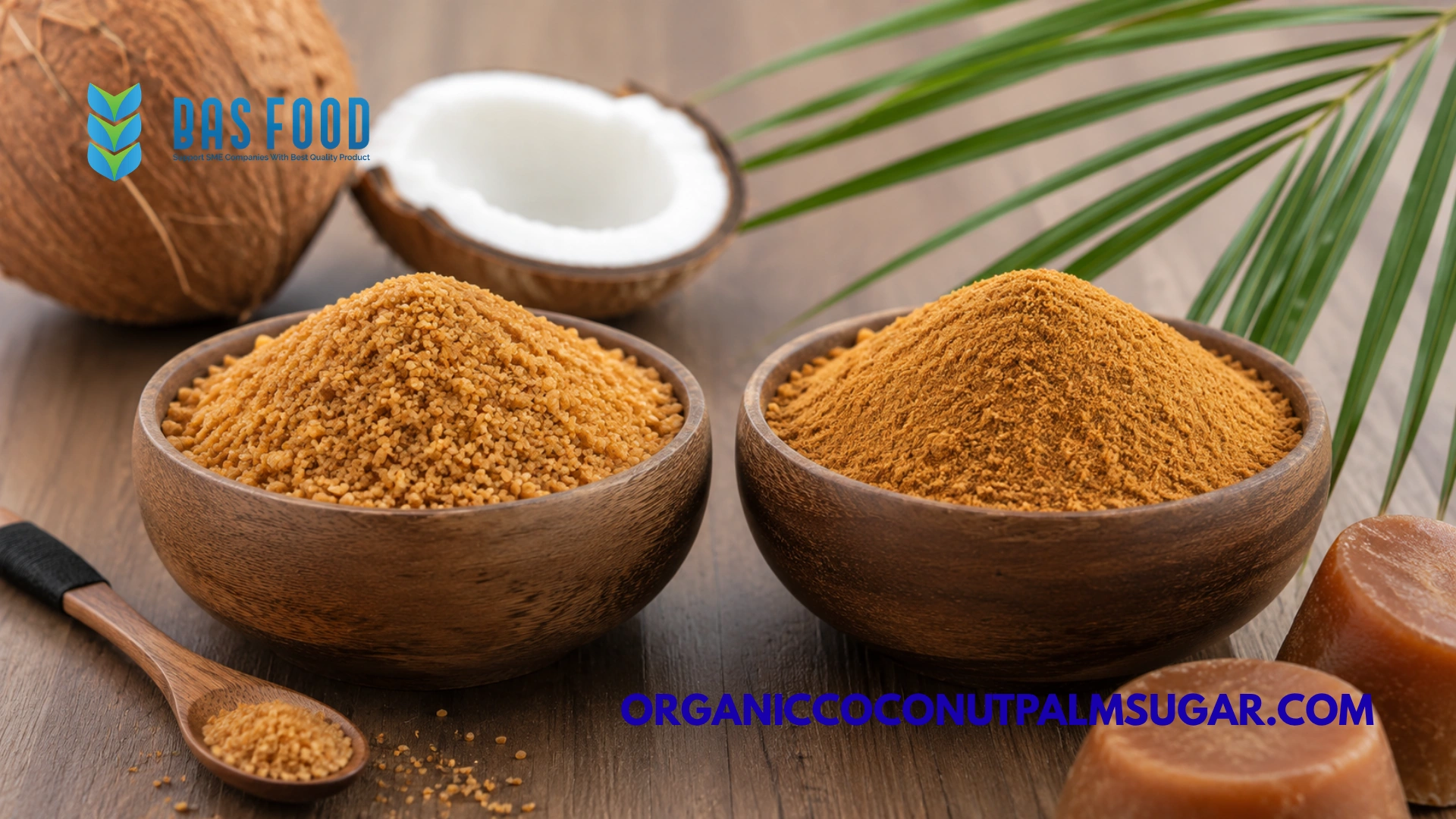
Powdered coconut sugar is produced by grinding granulated coconut sugar into very fine particles. This finer texture increases the surface area, allowing the sugar to dissolve more quickly.
In contrast, granulated coconut sugar retains larger crystals that flow easily and maintain their shape during handling. Granulated products are available in different particle sizes, from fine granules to coarse crystals, depending on customer specifications.
Although both products have the same natural origin, their physical characteristics make them suitable for different manufacturing processes.
Understanding these differences allows buyers to optimize production efficiency while achieving consistent product quality.
What Is Powdered Coconut Sugar?
Powdered coconut sugar has an extremely fine texture that resembles conventional powdered sugar.
Its greatest advantage is rapid dissolution. Because the particles are much smaller, they blend quickly into liquids and dry ingredient mixtures.
Many food manufacturers choose powdered coconut sugar for products where a smooth texture is essential.
Common applications include:
- Instant beverage mixes
- Coffee powders
- Tea blends
- Protein supplements
- Nutritional powders
- Seasoning mixes
- Dry beverage concentrates
- Health drink formulations
Powdered coconut sugar also distributes evenly throughout recipes, reducing the risk of uneven sweetness.
However, because the particles are very fine, the product may generate more dust during handling if packaging and storage are not properly managed.
What Is Granulated Coconut Sugar?
Granulated coconut sugar consists of visible sugar crystals that are larger than powdered forms.
This version is one of the most widely traded coconut sugar products because it offers excellent versatility.
Granulated coconut sugar works well in both industrial manufacturing and retail markets.
Popular applications include:
- Bakery products
- Cookies
- Cakes
- Muffins
- Bread
- Breakfast cereals
- Granola
- Chocolate
- Sauces
- Marinades
- Retail cooking ingredients
Granulated sugar also flows well through automated filling and packaging systems, making it attractive for high-volume food production.
Because the crystals remain intact, manufacturers can better control product texture in finished foods.
Comparing Solubility and Mixing Performance
One of the biggest differences in coconut sugar powder vs granulated is how quickly each product dissolves.
Powdered coconut sugar dissolves rapidly because of its fine particle size. This makes it especially useful in products that require fast preparation or complete ingredient blending.
Manufacturers producing powdered beverages often select powdered coconut sugar because it reduces mixing time while improving product consistency.
Granulated coconut sugar dissolves more slowly, but this is not necessarily a disadvantage.
For bakery products and cooking applications, gradual dissolution can contribute to texture development and controlled sweetness distribution.
The ideal choice depends on how the product will be manufactured and consumed.
Texture and Appearance in Finished Products
Texture plays an important role in food quality.
Powdered coconut sugar creates smooth finishes because the tiny particles become almost invisible after mixing.
This makes it suitable for beverages, powdered supplements, and products requiring a uniform appearance.
Granulated coconut sugar produces a more noticeable texture.
In cookies, granola, and baked goods, visible granules may contribute to both product appearance and eating experience.
Some manufacturers intentionally select granulated coconut sugar because it creates a more natural, handcrafted appearance.
Choosing between the two forms depends on the desired consumer experience.
Packaging Considerations for Different Product Forms
Packaging requirements vary according to product type.
Because powdered coconut sugar contains finer particles, moisture protection becomes especially important.
Manufacturers typically use moisture-resistant packaging materials combined with food-grade liners to maintain product quality during storage and transportation.
Granulated coconut sugar is generally easier to handle because larger crystals reduce dust generation and improve flowability.
Both forms can be supplied in:
- Retail pouches
- Stand-up bags
- Kraft paper bags
- Bulk sacks
- Industrial packaging
- OEM packaging
- Private label packaging
Professional exporters customize packaging according to customer specifications and destination market requirements.
Quality Standards Buyers Should Evaluate
Regardless of product form, quality remains the highest priority.
Professional exporters evaluate several quality characteristics before shipment.
These commonly include:
- Moisture content
- Particle size consistency
- Color uniformity
- Aroma
- Taste
- Product cleanliness
- Food safety
- Packaging quality
When purchasing powdered coconut sugar, buyers should pay particular attention to particle size specifications because consistency influences mixing performance.
For granulated coconut sugar, granule size distribution should also remain uniform to support predictable production results.
Reliable manufacturers maintain standardized quality control throughout every production stage.
How to Choose Between Powdered and Granulated Coconut Sugar
The best choice depends entirely on your production goals.
Choose powdered coconut sugar if your products require:
- Rapid dissolution
- Smooth texture
- Instant mixing
- Fine ingredient blending
- Powder-based formulations
Choose granulated coconut sugar if your products require:
- Visible sugar crystals
- Controlled dissolution
- Improved texture
- Easy handling
- Retail presentation
- Bakery performance
Discussing your production process with an experienced supplier helps ensure you receive the correct product specification before manufacturing begins.
Why Importers Trust Indonesian Coconut Sugar Suppliers
Indonesia has become one of the world’s leading exporters of coconut sugar because of its abundant coconut resources and long history of traditional production.
Experienced Indonesian manufacturers combine skilled craftsmanship with modern quality management systems to produce coconut sugar that meets international market expectations.
Export-oriented suppliers also provide customized particle sizes, flexible packaging, OEM production, and private label services for customers worldwide.
By working with a reliable Indonesian exporter, buyers gain access to consistent product quality, dependable production capacity, and professional export support tailored to their business needs.
Tips for Building a Long-Term Supply Partnership
Choosing the right coconut sugar form is only one part of successful sourcing.
Strong partnerships with experienced suppliers help businesses maintain stable product quality and reliable deliveries over time.
Before placing commercial orders, request product samples, technical specifications, particle size information, packaging options, and production lead times.
Regular communication also helps suppliers recommend the most suitable coconut sugar specification as your product portfolio expands.
A long-term partnership creates greater efficiency, better planning, and stronger customer satisfaction.
Conclusion
Understanding the differences between coconut sugar powder vs granulated helps importers, manufacturers, and distributors choose the best ingredient for their products. Although both forms originate from the same fresh coconut blossom sap, they perform differently in food production because of their particle size.
Powdered coconut sugar offers rapid dissolution and smooth blending, making it ideal for beverages, nutritional products, and powdered formulations. Granulated coconut sugar, on the other hand, provides excellent versatility, attractive texture, and consistent performance in bakery products, cereals, sauces, and retail applications.
By partnering with an experienced Indonesian exporter, businesses can source the right coconut sugar specification with customized particle sizes, flexible packaging options, dependable quality control, and reliable international supply. Selecting the appropriate product today will help improve manufacturing efficiency and support long-term business success.