A great sauce does more than add flavor to a dish. It brings ingredients together, balances acidity, creates texture, and gives every bite a more memorable taste. For food manufacturers and professional kitchens, choosing the right sweetener is an important part of achieving that balance. One ingredient attracting interest in modern food production is coconut sugar syrup for sauces. Made by concentrating sap collected from coconut palm flowers, this liquid sweetener offers a distinctive caramel-like flavor that works well in many sweet and savory applications.
Unlike dry sweeteners, coconut sugar syrup arrives in liquid form. This makes it convenient for mixing into sauces, marinades, glazes, and selected dressings. It can also contribute color, sweetness, and body to a formulation.
However, using coconut sugar syrup successfully requires more than simply replacing white sugar in a recipe. Food manufacturers need to consider its concentration, moisture content, viscosity, flavor, and interaction with other sauce ingredients.
In this guide, we explore how coconut sugar syrup works in commercial sauce production, how to use it in dressing formulation, and what buyers should consider when sourcing it from a reliable coconut sugar supplier.
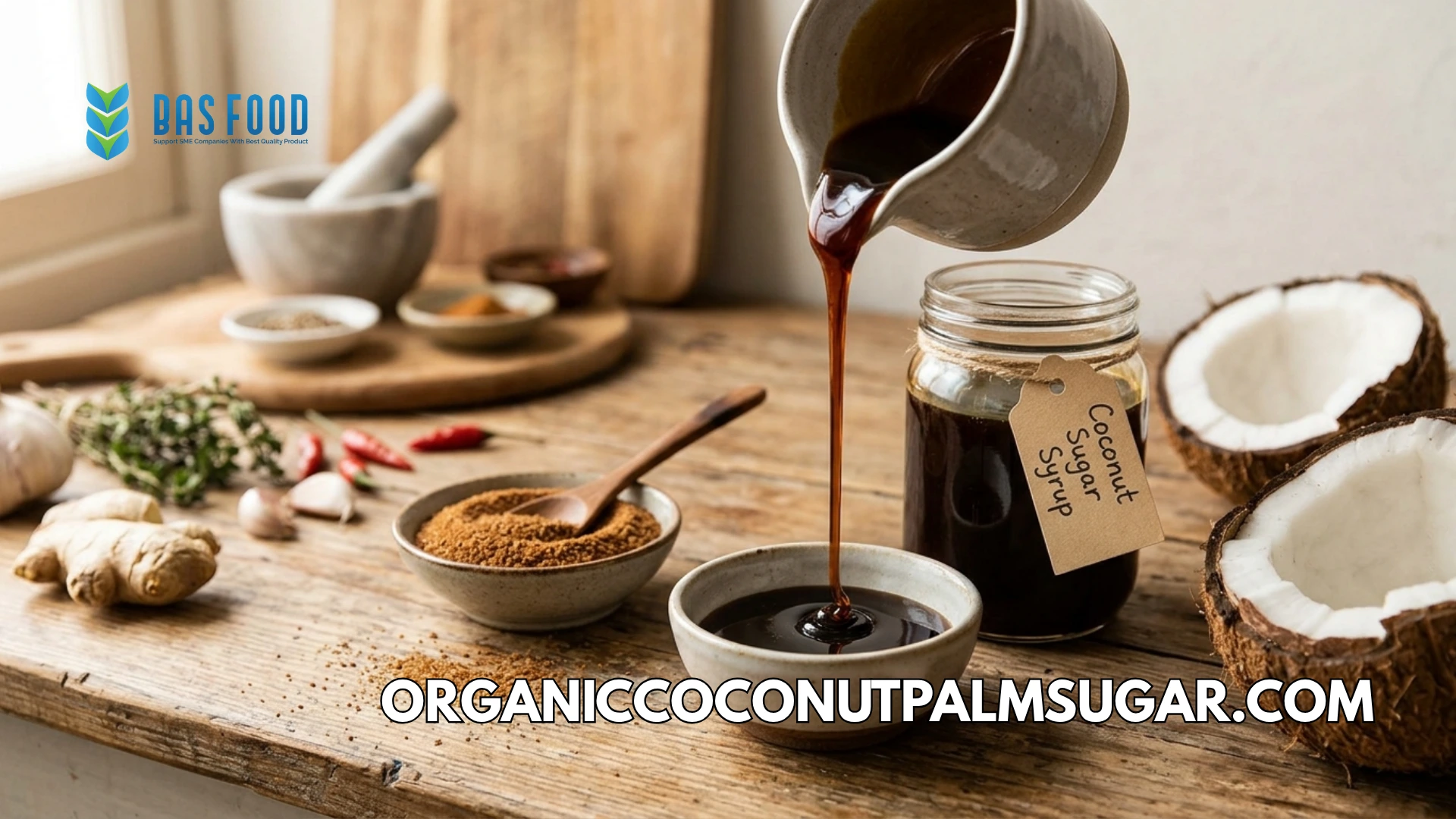
What Makes Coconut Sugar Syrup an Interesting Sauce Ingredient?
Coconut sugar syrup is a concentrated liquid sweetener produced from coconut palm sap. During processing, manufacturers heat the sap to reduce its water content and create a thicker, sweeter liquid.
The finished syrup typically has a characteristic caramel-like flavor. Depending on the raw material and production process, its color, aroma, sweetness, and consistency may vary.
These characteristics make it an interesting option for sauce developers who want sweetness with more flavor complexity than ordinary refined sugar can provide.
A sweetener with a distinctive flavor
Traditional refined sugar mainly contributes sweetness. Coconut sugar syrup can contribute additional flavor notes that may complement ingredients such as soy sauce, vinegar, chili, garlic, ginger, and spices.
For example, a small amount in a barbecue-style sauce can help balance smoky and acidic flavors. In a sweet chili sauce, it can support the sweet-and-spicy profile.
However, coconut sugar syrup does not taste identical to every other sweetener. Product developers should test it in the actual recipe before making a full production change.
Why the liquid form matters
Because coconut sugar syrup is already liquid, manufacturers can add it directly to many sauce formulations.
This can reduce the need to dissolve dry sugar separately. It may also simplify ingredient handling in processes where liquid ingredients are already measured and mixed.
Nevertheless, the syrup introduces water as well as dissolved sugars. Formulators must account for both when adjusting a recipe.
How Coconut Sugar Syrup Works in Different Types of Sauces
The versatility of coconut sugar syrup for sauces comes from its ability to contribute sweetness while adding its own flavor profile.
It can be considered for several sauce categories, although the best results depend on the recipe and product specifications.
Barbecue and grilling sauces
Barbecue sauces often combine sweet, sour, smoky, and savory flavors.
Coconut sugar syrup can contribute sweetness and caramel-like notes that complement tomato, vinegar, smoked spices, and other ingredients.
It may also contribute to the color and body of the finished sauce.
However, sauce developers should control heating carefully. Sugars can participate in browning reactions during cooking, which may affect the final color and flavor.
Sweet chili and dipping sauces
Sweet chili sauces need a balance between sweetness, heat, and acidity.
Coconut sugar syrup can help round out the sharpness of vinegar and the heat of chili.
Its liquid form also makes it convenient to incorporate during mixing.
The amount used should be adjusted through formulation trials because its sweetness and concentration may differ from those of standard sugar syrups.
Marinades and savory glazes
Marinades often contain several ingredients, including salt, acids, herbs, spices, and sweeteners.
Coconut sugar syrup can contribute sweetness and help balance salty or acidic notes.
In glazes, it may also support a glossy appearance, depending on the complete formulation and cooking conditions.
For products that undergo heating, manufacturers should test the finished glaze for color, flavor, and consistency.
The Role of Coconut Sugar Syrup in Sauce Formulation
Developing a commercial sauce requires careful control of ingredient ratios.
Even a small change in sweetener concentration can affect the final product’s flavor, texture, and processing behavior.
Therefore, manufacturers should evaluate coconut sugar syrup as a functional ingredient rather than treating it as a simple one-to-one replacement for dry sugar.
Balancing sweetness and acidity
Many sauces contain acidic ingredients such as vinegar, citrus juice, or tomato products.
Sweeteners help balance these sharp flavors.
Coconut sugar syrup can provide sweetness while contributing its own flavor notes.
However, the ideal amount depends on the acidity, salt level, spice intensity, and intended taste profile.
Product developers should make controlled adjustments and conduct sensory testing.
Managing water content
One important difference between dry sugar and coconut sugar syrup is moisture.
When a manufacturer replaces part of the dry sugar in a recipe with syrup, the formulation receives additional water.
This may affect thickness, solids concentration, and the final sauce yield.
For example, a sauce that was previously thick enough for bottling may become thinner if the syrup’s water contribution is not considered.
To manage this change, formulators should review the syrup’s Brix or soluble solids specification and adjust the overall liquid balance.
Controlling viscosity
Viscosity describes how easily a sauce flows.
Coconut sugar syrup can contribute dissolved solids and influence the viscosity of a finished product.
However, the final texture also depends on other ingredients, including starches, gums, oils, proteins, and suspended particles.
Therefore, manufacturers should measure viscosity under consistent conditions rather than predicting the final texture from syrup concentration alone.
Coconut Sugar Syrup in Dressing Formulation
Salad dressings and vinaigrettes require a different approach from thick barbecue or dipping sauces.
They often combine oil, water, vinegar, seasonings, and sweeteners.
In this setting, coconut sugar syrup can help balance acidity and contribute flavor.
Vinaigrettes and acidic dressings
Vinaigrettes typically contain oil and an acidic ingredient such as vinegar or citrus juice.
A small amount of liquid sweetener can soften the sharpness of the acid.
Coconut sugar syrup may provide a distinctive sweetness that works with ingredients such as mustard, herbs, garlic, and citrus.
However, its darker color and caramel-like flavor may influence the appearance and taste of a light dressing.
Therefore, it is important to test the syrup with the intended ingredients.
Creamy dressings
Creamy dressings may contain mayonnaise, dairy ingredients, plant-based alternatives, or other emulsifying components.
Coconut sugar syrup can contribute sweetness and help create a more balanced flavor.
However, manufacturers should assess its effect on color, viscosity, and overall formulation.
The syrup itself does not guarantee emulsion stability. That depends on the emulsifier system, oil-to-water ratio, mixing process, and other formulation factors.
Maintaining dressing consistency
Commercial dressing production requires consistent ingredient measurements.
Variations in syrup concentration can affect sweetness and the amount of water introduced into each batch.
For this reason, buyers should request clear product specifications and establish acceptable limits for relevant parameters.
Consistency is especially important for manufacturers producing the same dressing across multiple production facilities.
Does Coconut Sugar Syrup Help Create a Better Sauce Texture?
Texture is a major part of sauce quality.
Consumers expect barbecue sauce to coat food, dipping sauce to cling to snacks, and salad dressing to pour easily.
Coconut sugar syrup can influence these characteristics, but it is not a thickener in the same way as starch or certain hydrocolloids.
Contribution to body and mouthfeel
The dissolved solids in coconut sugar syrup can contribute to the body of a sauce.
A more concentrated syrup may add more solids per unit of weight than a less concentrated one.
This can influence thickness and mouthfeel.
However, the result depends on the complete recipe.
A sauce containing large amounts of water, vinegar, or other liquids may behave very differently from a concentrated glaze.
Working with thickening agents
Many commercial sauces use starches, gums, or other ingredients to achieve their target texture.
Coconut sugar syrup can be included alongside these ingredients.
However, formulators should evaluate how the syrup affects hydration, mixing, heating, and final viscosity.
A practical production trial is often the best way to identify the right combination.
Texture after storage
Sauce texture can change during storage because of factors such as ingredient interactions, temperature, and physical instability.
For example, some formulations may experience separation, thickening, or changes in suspended particles.
Coconut sugar syrup does not prevent these issues by itself.
Manufacturers should test the finished sauce throughout its intended shelf life.
Flavor Pairings: Ingredients That Work Well with Coconut Sugar Syrup
The caramel-like flavor of coconut sugar syrup can complement a wide range of savory and sweet ingredients.
Still, successful flavor pairing depends on the intended sauce profile.
The goal is to create balance rather than allowing the sweetener to dominate.
Savory and umami ingredients
Soy sauce, fermented bean products, garlic, onion, mushrooms, and certain spices can work well with a sweet component.
Coconut sugar syrup may help balance their salty or savory characteristics.
This makes it worth testing in selected Asian-style glazes, marinades, and dipping sauces.
Acidic ingredients
Vinegar, tamarind, lime, lemon, and tomato can bring acidity to sauces.
Sweetness helps balance that acidity.
Coconut sugar syrup can be used to adjust the overall flavor profile, but the correct amount depends on the acidity level and intended taste.
Spices and herbs
Chili, ginger, black pepper, cinnamon, paprika, and other spices may complement the syrup’s flavor.
For example, a ginger-chili glaze can combine heat, acidity, and sweetness.
Meanwhile, selected fruit-based sauces may benefit from the syrup’s caramel-like notes.
Sensory trials should guide the final formulation.
How to Use Coconut Sugar Syrup in Commercial Sauce Production
Moving from a kitchen recipe to industrial manufacturing requires more controlled procedures.
A recipe that works in a small bowl may behave differently in a large mixing tank.
Therefore, manufacturers should test coconut sugar syrup under realistic production conditions.
Step 1: Review the product specification
Before starting a formulation trial, review the syrup’s technical information.
Important details may include:
- Brix or soluble solids concentration
- Moisture content, if specified
- Viscosity and testing temperature
- Color and flavor characteristics
- Microbiological specifications
- Recommended storage conditions
- Packaging format
These details help manufacturers understand how the ingredient may behave in the sauce.
Step 2: Conduct small-scale trials
Start with a small batch and replace only part of the existing sweetener.
Record the syrup quantity and all other ingredient adjustments.
Then evaluate sweetness, acidity, color, aroma, and viscosity.
Compare the result with the original formulation.
This approach makes it easier to identify which changes improve or reduce product quality.
Step 3: Test industrial processing conditions
Once the formulation works at a small scale, test it using the intended mixing and heating process.
Consider the order of ingredient addition, mixing speed, heating time, and filling temperature.
These factors may influence the finished sauce.
For example, adding syrup at a different stage can affect how it mixes with other ingredients.
Step 4: Validate the finished product
Before commercial release, evaluate the finished sauce against its product specifications.
Testing may include pH, viscosity, soluble solids, microbiological quality, packaging integrity, and shelf-life performance.
The exact test plan depends on the product and applicable food safety requirements.
Packaging and Storage Considerations for Sauce Manufacturers
Coconut sugar syrup should be stored according to the supplier’s recommendations before it enters the sauce production process.
Packaging should protect it from contamination and maintain product quality during storage and handling.
Food manufacturers should inspect containers for leaks, damage, and compromised closures before use.
Choosing suitable packaging
Packaging options may include food-grade drums, pails, or other commercial containers, depending on product availability and order requirements.
The best option depends on purchasing volume, warehouse capacity, dispensing equipment, and production needs.
Buyers should confirm packaging compatibility and handling instructions with the supplier.
Storage before production
Follow the product’s specified storage temperature and shelf-life conditions.
Avoid unnecessary exposure to contamination during dispensing.
Once a container is opened, use clean equipment and suitable handling procedures.
If the product requires refrigeration after opening, follow that instruction.
Planning inventory
For manufacturers using coconut sugar syrup regularly, inventory planning can reduce waste.
FIFO and FEFO systems help ensure that older or earlier-expiring stock is used appropriately.
Clear batch identification also helps connect raw material records with finished sauce production batches.
Common Formulation Challenges and How to Solve Them
Using coconut sugar syrup may require adjustments when replacing another sweetener.
Understanding common challenges can help manufacturers reduce trial-and-error during product development.
The sauce becomes too thin
If the syrup adds more water than the original sweetener, the finished sauce may become thinner.
Review the syrup’s soluble solids concentration and moisture contribution.
Then adjust the overall liquid balance or thickening system through controlled trials.
Avoid adding large amounts of thickener without checking the effect on texture and processing.
The sauce becomes too dark
Coconut sugar syrup naturally has color that may influence the final sauce.
This may be desirable in barbecue sauces or dark glazes but less suitable for light dressings.
Formulators should test different inclusion levels and review the color of the finished product.
The flavor becomes too strong
Coconut sugar syrup contributes its own flavor profile.
If too much is added, it may overpower delicate herbs, fruit notes, or other ingredients.
Gradual substitution and sensory testing can help identify a suitable level.
The sauce separates during storage
Separation can result from an unstable emulsion or other formulation issues.
Coconut sugar syrup does not automatically prevent separation.
Review the emulsifier system, mixing conditions, ingredient compatibility, and storage stability.
Choosing a Reliable Coconut Sugar Supplier for Sauce Production
For commercial food production, supplier selection is an important part of ingredient management.
A suitable coconut sugar supplier should be able to provide clear information about product characteristics, available packaging, and quality documentation.
This is particularly important when the syrup will become part of a standardized sauce recipe.
What buyers should ask
Before placing an order, consider asking:
- What Brix range does the syrup meet?
- Are moisture and viscosity specifications available?
- Can the supplier provide a technical data sheet?
- Is a batch-specific Certificate of Analysis available?
- What packaging options are offered?
- What are the recommended storage conditions?
- Can product samples be provided for formulation trials?
- What are the available order quantities and lead times?
These questions help buyers assess whether the syrup matches their manufacturing requirements.
Working with CV Bonafide Anugerah Sentosa
CV Bonafide Anugerah Sentosa is an Indonesian supplier and exporter associated with coconut-derived products and other commodities.
Businesses interested in sourcing coconut sweeteners from Indonesia can contact the company to discuss current product offerings and export requirements.
As a potential coconut sugar exporter supplier, the company can be approached for information about coconut sugar products and sourcing arrangements.
For buyers interested in coconut sugar syrup for sauces, it is important to confirm current availability, Brix specifications, packaging options, and quality documentation for the specific product.
Sharing the intended application, such as barbecue sauce, dressing, marinade, or glaze, can also help clarify the required product characteristics.
For more information, visit CV Bonafide Anugerah Sentosa.
Conclusion: A Flexible Sweetener for Modern Sauce Development
Coconut sugar syrup for sauces offers food manufacturers an interesting way to introduce sweetness and caramel-like flavor into a wide range of savory and sweet products.
It can be considered for barbecue sauces, sweet chili sauces, marinades, glazes, vinaigrettes, and selected creamy dressings.
However, successful use depends on understanding its concentration, water content, viscosity, and flavor.
For reliable results, manufacturers should review product specifications, conduct formulation trials, and validate the finished sauce under actual processing and storage conditions.
A dependable liquid sweetener supply also matters. Consistent ingredient quality helps manufacturers maintain the flavor and texture expected by their customers.
Businesses looking for a coconut sugar exporter supplier in Indonesia can contact CV Bonafide Anugerah Sentosa to discuss current product availability and sourcing requirements.
With suitable product selection and careful formulation, coconut sugar syrup can become a useful ingredient in developing distinctive, consistent, and commercially practical sauces.