In modern food production, a sweetener must do more than deliver a pleasant taste. It also needs to mix well, spread evenly, and perform consistently in different recipes. For manufacturers working with beverages, sauces, bakery products, and confectionery, coconut sugar syrup solubility is an important factor when choosing ingredients and developing reliable formulations.
Coconut sugar syrup is a liquid sweetener commonly produced by concentrating the sap of coconut palm flowers. It offers a sweet taste with caramel-like notes that can complement many food and beverage applications. However, its performance depends on more than sweetness alone. Temperature, concentration, viscosity, and the composition of the syrup can influence how it blends with other ingredients.
Understanding these factors helps food manufacturers improve liquid sweetener mixing, reduce preparation problems, and maintain consistent product quality. It also helps purchasing teams evaluate whether a syrup suits their manufacturing process before placing bulk orders.
For businesses sourcing ingredients internationally, working with a reliable coconut sugar supplier can make this process easier. A supplier should be able to provide relevant product specifications and help buyers understand how the syrup may perform in their intended applications.
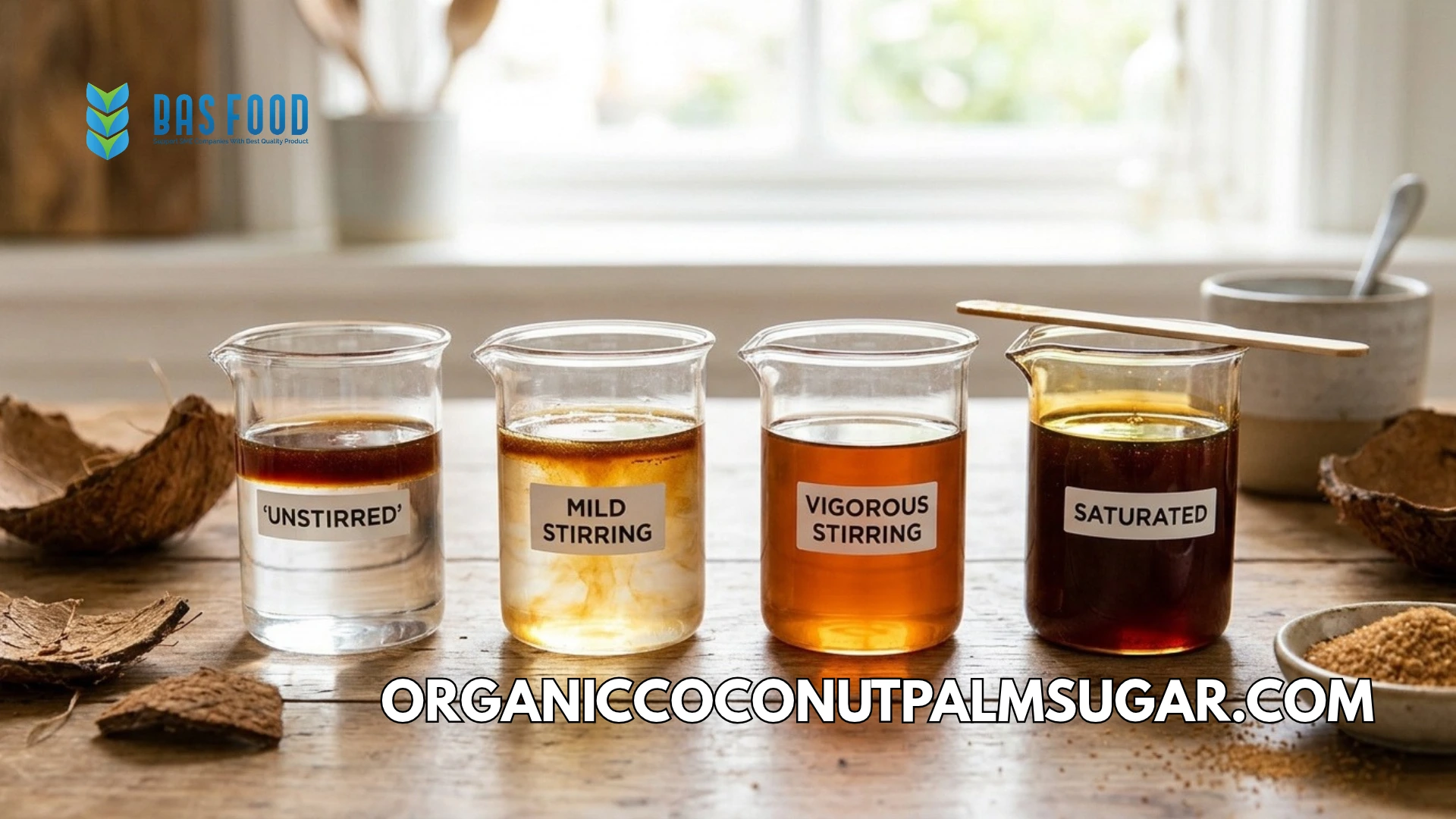
What Is Coconut Sugar Syrup Solubility?
Solubility describes the ability of a substance to dissolve in a liquid and form a uniform mixture. In food production, the term is often used when discussing how sugars behave in water, milk, coffee, juice, and other liquid ingredients.
However, coconut sugar syrup requires a slightly different explanation from dry sugar. Unlike granulated coconut sugar, syrup already contains dissolved sugars and water. Therefore, when manufacturers discuss coconut sugar syrup solubility, they often mean how readily the syrup blends into another liquid, whether it disperses evenly, and whether it remains uniform during preparation and storage.
For example, a beverage manufacturer may add coconut sugar syrup to iced coffee. The syrup needs to spread through the coffee without leaving concentrated sweet spots at the bottom of the cup. Similarly, a sauce producer may need the sweetener to blend smoothly with water, vinegar, spices, or other liquid ingredients.
Several properties influence this behavior. These include the syrup’s sugar concentration, viscosity, temperature, and the characteristics of the receiving liquid. A syrup that blends quickly into warm water may behave differently in a cold, thick, or fat-rich formulation.
It is also important to distinguish solubility from miscibility and dispersion. Solubility concerns a substance dissolving in another substance. Miscibility describes whether liquids can mix into a single phase, while dispersion refers to how evenly one material spreads through another. These concepts overlap in practical food production, but they do not mean exactly the same thing.
What Influences Coconut Sugar Syrup Solubility?
Sugar concentration and Brix
Sugar concentration is one of the main factors affecting syrup behavior. Manufacturers often use degrees Brix as an indicator of soluble solids concentration. A refractometer can provide a useful Brix reading, although the reading in a complex syrup is an estimate based on refractive index rather than a complete analysis of every dissolved compound.
A more concentrated syrup generally contains less water relative to its soluble solids. This can increase viscosity and make the syrup flow more slowly. As a result, the syrup may take longer to disperse through a beverage or other liquid if the mixing process remains unchanged.
Nevertheless, higher Brix does not automatically mean that a syrup has poor solubility. Because the sugar is already dissolved, the main practical issue may be how quickly the syrup mixes and how easily the equipment handles it. Manufacturers should evaluate concentration alongside viscosity, temperature, and the characteristics of the final product.
Temperature and mixing conditions
Temperature can strongly affect how coconut sugar syrup behaves during production. In general, warming a syrup reduces its viscosity, allowing it to flow and mix more easily. This is one reason warm syrup may blend more quickly into suitable beverage bases or food formulations.
However, heating is not always necessary or appropriate. Some products must remain cold, while others contain ingredients that are sensitive to heat. Excessive heating may also affect flavor, color, or product stability. Manufacturers should therefore choose a mixing temperature that suits both the syrup and the complete formulation.
Mixing equipment matters as well. A suitable agitator can help distribute syrup throughout a liquid, while an inefficient process may create areas with different sweetness levels. The correct mixing speed, duration, and addition method depend on batch size, vessel design, and ingredient viscosity.
Viscosity and natural variation
Viscosity describes a liquid’s resistance to flow. Thick syrups tend to move more slowly than thin syrups, which can affect pumping, pouring, dosing, and mixing time.
Coconut sugar syrup viscosity may vary because of differences in concentration, processing conditions, and storage temperature. Even products with similar Brix readings can show different flow behavior because Brix does not describe every aspect of a syrup’s composition.
For manufacturers, this means that solubility and mixing performance should not be judged by appearance alone. A practical evaluation should consider flow behavior, measured concentration, mixing time, and the final product’s uniformity.
Composition and receiving liquid
Coconut sugar syrup contains sugars and may contain other naturally occurring soluble components from coconut sap, depending on the production process. These components can influence its color, aroma, and overall behavior.
The liquid receiving the syrup also makes a difference. Water-based beverages are generally straightforward to evaluate, while milk drinks, acidic sauces, concentrated fruit preparations, and fat-containing formulations may require more careful testing. A syrup that blends easily into water may not behave identically in a complex food matrix.
For this reason, manufacturers should test coconut sugar syrup in the actual recipe rather than relying only on a general statement about solubility.
Coconut Sugar Syrup Solubility in Different Food Applications
Beverages and ready-to-drink products
Beverage manufacturers often use liquid sweeteners because they can simplify dosing and reduce the need to dissolve dry sugar during production. Coconut sugar syrup can be considered for coffee, tea, specialty drinks, smoothies, and selected ready-to-drink beverages, depending on the intended flavor profile and product specifications.
For cold beverages, the key consideration is how quickly the syrup distributes through the drink. Although the syrup already contains dissolved sugars, a thick product may still require effective stirring or mechanical mixing. Simply pouring it into a cold drink does not guarantee immediate uniformity.
Manufacturers should assess sweetness distribution, visible separation, flavor balance, and the time required to achieve a consistent drink. If the product is intended for commercial bottling, the team should also evaluate stability under the planned storage conditions.
Bakery and dessert manufacturing
In bakery products, coconut sugar syrup can contribute sweetness, moisture, color, and flavor. It may be useful in selected cakes, fillings, dessert sauces, and other formulations where a liquid sweetener fits the recipe.
However, liquid syrup does not behave exactly like granulated sugar. Replacing dry sugar with syrup changes the amount of water introduced into the formulation. This can affect batter thickness, baking time, texture, and the balance of other ingredients.
Therefore, recipe developers should adjust formulations rather than replacing sugar on a one-to-one weight basis without testing. They should also check whether the syrup distributes evenly through the mixture and whether its flavor and color suit the finished product.
Sauces, dressings, and marinades
Coconut sugar syrup may be considered for sauces, glazes, marinades, and dressings that benefit from a liquid sweetener. Its ability to mix with water-based ingredients can help simplify processing, but the complete recipe determines the final result.
Acidity, salt concentration, oil content, and other ingredients may affect the formulation’s physical stability. For example, a dressing containing both oil and water may require emulsification, not simply sugar dissolution. Adding syrup will not automatically solve separation between those phases.
Food manufacturers should therefore evaluate sweetness, flow, appearance, and stability together. A successful formulation must perform well throughout production and during the intended shelf life.
Confectionery and other processed foods
In confectionery, coconut sugar syrup may be suitable for selected fillings, coatings, dessert preparations, and sweet sauces. Its use depends on the required sweetness, flavor, color, moisture content, and processing conditions.
Manufacturers should pay particular attention to the formulation’s target solids content and water activity when product stability matters. Brix can help monitor concentration, but it cannot independently confirm microbial safety or establish shelf life. Appropriate testing and a validated food safety process remain essential.
The best approach is to run a small-scale trial before moving to full production. This allows the technical team to identify mixing issues and adjust the recipe or process before committing to a larger batch.
Practical Techniques for Better Liquid Sweetener Mixing
Good liquid sweetener mixing starts with understanding the syrup’s specifications. Before production, check the available information on Brix, viscosity, storage conditions, and any recommended handling instructions. If these details are missing, ask the supplier which measurements are available.
Next, define the mixing conditions. For small batches, gradual addition with steady stirring may be enough. Larger industrial batches may need an appropriate agitator, pump, or inline mixing system. The right choice depends on the syrup’s flow behavior, batch volume, and equipment design.
The order of ingredient addition can also influence performance. Adding syrup gradually to a moving liquid may help it spread more evenly than adding the entire quantity to one spot. However, the best method depends on the receiving liquid and the mixing equipment, so manufacturers should validate the process under realistic operating conditions.
Temperature control is another practical consideration. If the syrup becomes thicker during cool storage, allowing it to reach an appropriate handling temperature may improve pumping and dosing. Follow the supplier’s instructions and avoid unnecessary heating, especially when the formulation is sensitive to changes in flavor or color.
Finally, measure the result instead of relying on visual judgment alone. Depending on the application, useful checks may include mixing time, sweetness uniformity, Brix, viscosity, appearance, and stability after storage. Record the process settings so the team can repeat successful batches.
Understanding Syrup Dispersion and Food Ingredient Solubility
Syrup dispersion describes how evenly a syrup spreads throughout another ingredient or mixture. In industrial food production, good dispersion helps reduce local differences in sweetness and supports consistent product quality from one batch to another.
A syrup may appear to mix well at first but still create problems if the process is too short or the mixing equipment cannot circulate the entire batch. For example, poorly mixed beverage concentrate may contain areas with different sweetness levels. In a sauce, uneven distribution may change the taste of individual portions.
To evaluate dispersion, manufacturers can collect samples from different locations in a mixing vessel or at different points during production. They can then compare relevant measurements, such as soluble solids or sweetness-related analytical results, where suitable methods are available. The sampling method should reflect the equipment and production process.
Food ingredient solubility is especially important when a formulation contains several ingredients with different physical properties. A liquid sweetener may blend well with the water phase, but that does not mean it will resolve problems involving oil separation, suspended particles, or other sources of instability.
For example, a smoothie containing fruit pulp needs a process that manages suspended solids as well as dissolved sugars. Likewise, a creamy beverage may need separate attention to fat distribution and emulsion stability. Solubility is only one part of the formulation challenge.
Manufacturers can improve results by identifying the actual problem before changing the recipe. If the issue is slow flow, viscosity may be the main concern. If the sweetness varies across samples, mixing or dispersion may be responsible. If the product separates during storage, the team may need to investigate the full formulation and its stability.
How to Evaluate Coconut Sugar Syrup Quality Before Buying
For B2B buyers, selecting a coconut sugar syrup is not just about price or appearance. The product must suit the intended application, production equipment, and quality requirements. A clear specification helps purchasing and technical teams compare suppliers more effectively.
Start by requesting the available product data. Depending on the supplier and product, relevant details may include Brix, viscosity or flow behavior, color, flavor profile, ingredient information, packaging, storage instructions, and batch identification. Buyers should confirm which measurements are available and whether they are supported by documented test methods.
It is also useful to explain the intended application. A syrup for iced beverages may have different handling requirements from one intended for bakery fillings or industrial sauces. Sharing the expected mixing temperature, target concentration, production method, and final product requirements can help the supplier assess suitability.
If possible, test a representative sample before approving a bulk order. Use the intended recipe and equipment, then document mixing time, sweetness uniformity, flavor, appearance, and any changes during storage. A successful trial provides stronger evidence of suitability than a general claim that a syrup mixes easily.
Working with CV Bonafide Anugerah Sentosa for B2B Sourcing
For businesses exploring Indonesian sweetener ingredients, CV Bonafide Anugerah Sentosa is a relevant company to contact regarding its current coconut sugar product range and export capabilities. Buyers can discuss their intended application, technical requirements, and purchasing needs to determine whether a suitable product is available.
When evaluating a coconut sugar exporter supplier, importers should look beyond the product description. Clear communication, consistent documentation, practical technical information, and transparent commercial terms can all support a more reliable sourcing relationship.
For coconut sugar syrup, buyers should specifically ask about concentration, flow behavior, packaging, storage, and the availability of samples or product specifications. These details help the technical team determine whether the syrup can meet the requirements of a particular beverage, bakery, sauce, or other food manufacturing process.
A reliable coconut sugar supplier should help buyers understand the product they are purchasing without making unsupported promises about performance. Final suitability still depends on testing the syrup in the buyer’s own formulation and confirming the agreed specifications before shipment.
If you are considering CV Bonafide Anugerah Sentosa for your sourcing needs, contact the company directly to confirm current product availability, specifications, packaging options, minimum order quantities, and export terms. This step helps align product expectations with real production and procurement requirements.
Conclusion: Turn Solubility Knowledge into Better Production
Coconut sugar syrup solubility is an important consideration for manufacturers who need a liquid sweetener that blends consistently into their products. Although coconut sugar syrup already contains dissolved sugars, its viscosity, concentration, temperature, and interaction with other ingredients can influence how easily it disperses during production.
By understanding these factors, food manufacturers can improve liquid sweetener mixing, achieve more uniform syrup dispersion, and make better decisions about food ingredient solubility. Practical testing, clear specifications, suitable mixing equipment, and consistent process records all help reduce avoidable production problems.
For B2B buyers, the next step is to evaluate the syrup against the requirements of the intended application. Request relevant specifications, test representative samples when available, and confirm commercial terms before placing an order.
Working with an experienced sourcing partner can also make procurement more straightforward. Contact CV Bonafide Anugerah Sentosa to discuss current product availability and determine whether its coconut sugar offerings match your business requirements.