Coconut sugar has become an interesting ingredient for food manufacturers, distributors, retailers, and foodservice businesses looking for alternatives to conventional sweeteners. Made from the sap of coconut flower buds, it offers a distinctive caramel-like flavor and a natural brown color that work well in many recipes. While granulated coconut sugar is popular for easy measuring and mixing, moulded coconut sugar offers a different format that suits traditional markets, specialty food retailers, and specific culinary applications.
For businesses that purchase sugar in large quantities, finding a reliable bulk moulded coconut sugar supplier is an important part of the sourcing process. The right supplier should do more than offer an attractive price. Buyers also need consistent product quality, suitable packaging, clear specifications, dependable communication, and export arrangements that match their requirements. These factors help businesses manage inventory, control costs, and maintain customer satisfaction.
However, not every supplier offers the same product formats or production capabilities. Some focus on granulated coconut sugar, while others may supply moulded blocks or customized shapes. Therefore, importers should confirm product availability and specifications before placing an order. This simple step helps prevent misunderstandings and makes the procurement process more efficient.
For international buyers, working with an experienced Indonesian coconut sugar supplier can also provide access to a well-established coconut-producing region. Indonesia has a long tradition of collecting and processing coconut sap. Nevertheless, buyers should evaluate each supplier individually instead of assuming that every exporter offers identical quality, documentation, or services.
What Is Moulded Coconut Sugar?
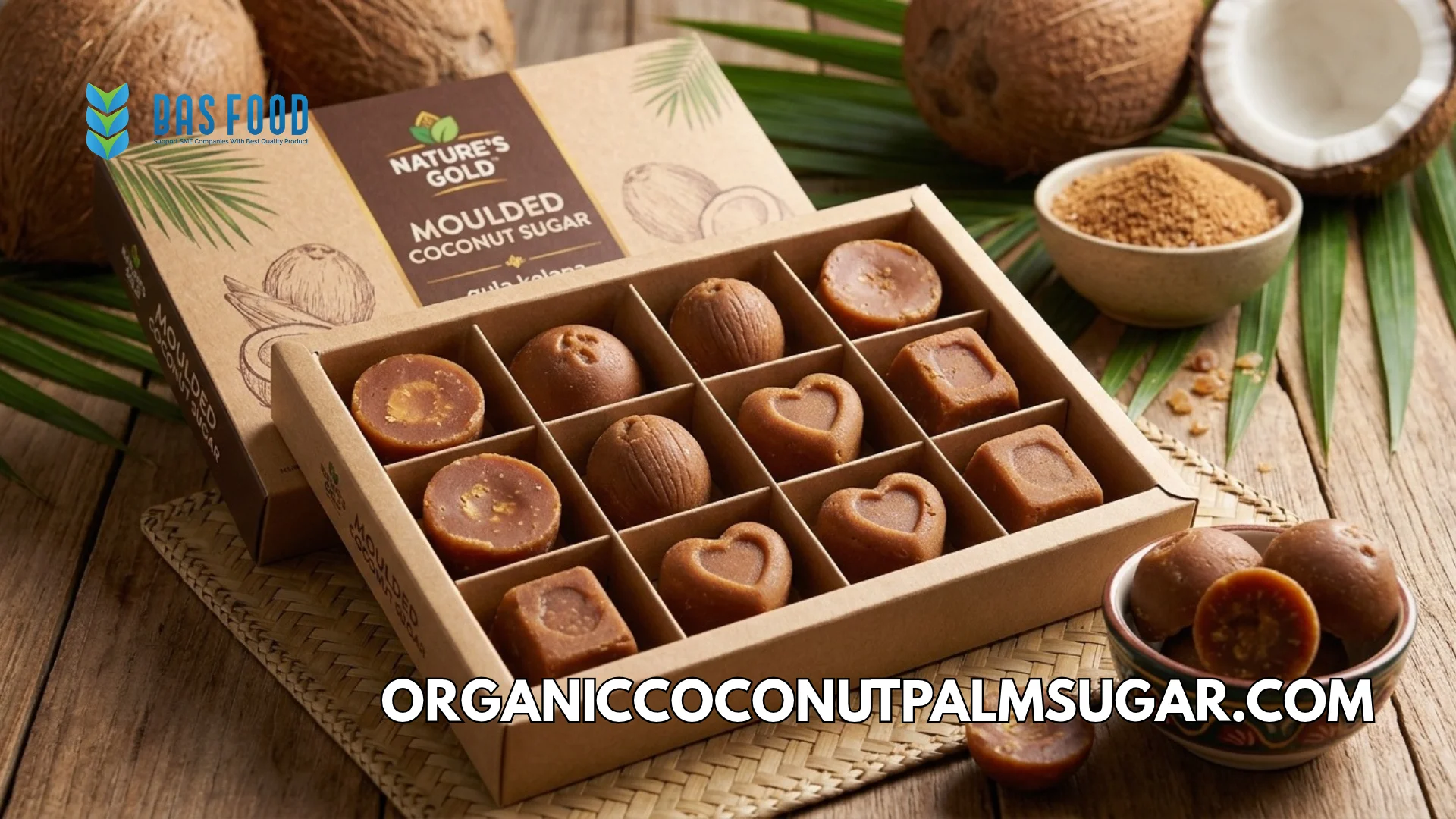
Moulded coconut sugar is coconut sugar formed into a solid shape, such as a block, cake, disc, or other moulded piece. Producers generally make it by heating coconut sap until enough water evaporates and the concentrated liquid develops the desired consistency. The product is then shaped and allowed to cool or set.
The final shape, size, color, firmness, and texture can vary according to the production method, the characteristics of the sap, and the way the sugar is processed. Some products are designed for traditional cooking, while others are intended for retail packaging or foodservice use. As a result, buyers should not assume that all moulded coconut sugar products have the same dimensions or performance.
Moulded coconut sugar is especially useful in markets where consumers are familiar with solid traditional sweeteners. It can be broken, shaved, grated, or dissolved into liquids depending on the product’s hardness and intended application. For example, a foodservice operator may use it in sauces and traditional beverages, while a retailer may sell individually packaged pieces to consumers.
It is also important to distinguish moulded coconut sugar from palm sugar made from other palm species. Although these products can look similar, their raw materials and flavor profiles may differ. When sourcing coconut sugar, ask the supplier to confirm that the product is made from coconut sap and that its specifications meet your business needs.
Who Needs a Wholesale Moulded Coconut Sugar Supplier?
A wholesale moulded coconut sugar supplier can serve several types of businesses. Importers and distributors may purchase large shipments to supply regional wholesalers, supermarkets, specialty food stores, and independent retailers. They usually need reliable product descriptions, consistent packaging, and clear order terms to distribute the product efficiently.
Food manufacturers may also buy moulded coconut sugar for applications that require a solid sweetener. Depending on the recipe and product format, they may break down or dissolve the sugar before blending it with other ingredients. Manufacturers should test the product in their own processes because hardness, moisture, and particle size after breaking can affect preparation time and consistency.
Foodservice companies, restaurants, catering businesses, and traditional food producers may use moulded coconut sugar in beverages, sauces, desserts, and local recipes. For these buyers, flavor and ease of handling can be just as important as price. They should consider whether the product dissolves at an acceptable rate and whether staff can portion it consistently.
Private-label brands may also be interested in moulded coconut sugar for specialty retail products. However, private-label packaging, custom shapes, and branding services are not automatically included in a wholesale offer. Buyers should ask whether these options are available, what minimum order quantities apply, and whether additional development costs are required.
What to Check Before Choosing a Bulk Supplier
Choosing a supplier based only on the lowest quoted price can create problems later. A product that arrives with inconsistent sizes, unsuitable packaging, or unclear specifications may increase handling costs and complicate distribution. Therefore, buyers should assess several factors before confirming an order.
Product specifications and consistency
Start by requesting a product specification sheet. Depending on the intended use, relevant details may include:
- Raw material and product description
- Shape, dimensions, and approximate weight per piece
- Color, aroma, taste, and texture
- Moisture content, where measured and specified
- Foreign matter controls and applicable quality criteria
- Food safety and microbiological requirements
- Packaging type and net weight
- Recommended storage conditions and shelf life, supported by product information
Not every buyer needs every parameter. A distributor selling consumer products may focus on appearance, packaging, and shelf life, while an industrial customer may need more detailed quality data. The important point is to agree on the specifications before production and shipment.
Packaging and product protection
Packaging protects moulded coconut sugar during storage, handling, and transportation. Since sugar can absorb moisture from its surroundings, unsuitable packaging or poor storage conditions may affect its texture and handling properties. Buyers should discuss the packaging material, inner protection, outer cartons or bags, and suitability for the expected shipping conditions.
For bulk orders, packaging should also support efficient loading, unloading, and warehouse management. Ask about the net weight per package, package dimensions, units per carton, pallet options if applicable, and shipping marks. Confirm these details in writing so that your warehouse team can prepare for the shipment.
Communication and commercial reliability
A professional supplier should be able to explain the product, clarify its specifications, and respond to questions about order requirements. Clear communication is especially important when the buyer and supplier operate in different countries and time zones.
Before placing a large order, discuss lead time, payment terms, order confirmation procedures, quality claims, and the process for addressing damaged or nonconforming goods. These details help both parties understand their responsibilities and reduce the risk of disputes.
How to Compare Bulk Moulded Coconut Sugar Suppliers
When comparing suppliers, use the same checklist for each quotation. This approach makes it easier to evaluate the full cost and value of an offer rather than focusing on the unit price alone. Two suppliers may quote different prices because their product specifications, packaging, order quantities, and delivery terms are not the same.
First, compare the product itself. Confirm the raw material, shape, weight, appearance, and quality requirements. If you need a specific mould size or a particular packaging format, state that clearly. Otherwise, the supplier may quote a standard product that does not fit your market.
Next, compare commercial terms. Check the minimum order quantity, production lead time, payment schedule, quotation validity, and shipping arrangements. Also clarify whether the quoted price includes packaging, inland transportation, export documentation, or freight. Do not assume that every quotation covers the same services.
Finally, consider how the supplier manages quality and communication. Ask whether samples are available, how product specifications are approved, and what procedures apply if a shipment does not meet the agreed requirements. A supplier who explains these processes clearly can be easier to work with over the long term.
A practical supplier comparison may look like this:
| Evaluation factor | Questions to ask |
|---|---|
| Product quality | Are specifications documented and agreed upon? |
| Product format | Are the shape, size, and weight suitable for your market? |
| Packaging | Does it protect the product during storage and transport? |
| Minimum order | Can the order quantity fit your purchasing plan? |
| Lead time | When can production and shipment reasonably take place? |
| Export documentation | Which documents can the supplier provide? |
| Communication | Are questions answered clearly and promptly? |
| Claims process | How are quality issues reviewed and resolved? |
| Total landed cost | What are the complete costs up to the destination? |
This comparison helps importers make a more informed decision and identify the supplier that best fits their business model.
Why Samples Matter Before a Bulk Purchase
A sample gives buyers the opportunity to evaluate a product before committing to a large shipment. Photographs and written specifications are useful, but they cannot fully show the product’s texture, aroma, flavor, or behavior during preparation. For this reason, requesting a sample can be an important step in the procurement process.
When assessing a moulded coconut sugar sample, examine its shape, dimensions, color, aroma, and surface condition. Check whether the pieces are sufficiently uniform for your intended application. If your business sells the product directly to consumers, appearance and ease of handling may be particularly important.
You should also test the sample in the actual recipe or production process where possible. For example, dissolve a measured quantity in a beverage or sauce and observe how easily it breaks down. Record any differences in flavor, color, or preparation time. These practical checks help determine whether the product suits your needs.
Before requesting samples, clarify the sample cost, shipping charges, dispatch time, and whether the sample represents the product that would be supplied in a bulk order. If the product passes your evaluation, document the approved specifications so that both parties have a clear reference for future orders.
Understanding Minimum Order Quantities and Lead Times
Minimum order quantity, commonly called MOQ, is the smallest order a supplier is willing to accept under particular commercial conditions. For a bulk buyer, MOQ affects inventory planning, working capital, and the cost per unit. However, there is no universal MOQ for moulded coconut sugar. It can depend on the supplier, packaging format, production arrangement, and destination market.
Instead of asking only, “What is your MOQ?”, provide a realistic estimate of your expected purchasing volume. Explain whether you plan to place a trial order, purchase regularly, or distribute the product to multiple customers. This information helps the supplier assess the most suitable ordering arrangement.
Lead time is another important factor. The total period may include order confirmation, raw material preparation, production, quality checks, packaging, and export arrangements. Shipping time is separate and depends on the route, carrier, destination, and logistics conditions. Therefore, buyers should ask for an estimated production schedule and a separate shipping estimate.
For businesses with seasonal demand, ordering too late may lead to stock shortages. On the other hand, ordering too much can tie up cash and increase storage requirements. A balanced purchasing plan should consider sales forecasts, current inventory, supplier lead time, and the time needed for international transportation.
Export Packaging, Shipping, and Documentation
International bulk purchases require careful coordination between the supplier, buyer, freight forwarder, and other parties involved in the shipment. Before confirming an order, agree on the packaging configuration, shipment quantity, shipping marks, and delivery terms. This is particularly important if the product will be repacked or distributed to different customers after arrival.
Packaging should suit both the product and the shipping method. Buyers should discuss how the supplier protects the sugar against moisture, contamination, crushing, and unnecessary handling. If the shipment involves long transit times or multiple transfers, the parties should consider whether the proposed packaging is suitable for those conditions.
Export documentation depends on the origin, destination, product classification, and applicable regulations. Depending on the shipment, documents may include a commercial invoice, packing list, transport document, certificate of origin, or other certificates required by the importing country. Food import requirements can vary, so buyers should confirm the current rules with their customs broker and relevant authorities.
It is equally important to agree on the delivery term and responsibility for costs. Incoterms® rules, when correctly incorporated into a sales contract, help define key responsibilities between the seller and buyer. Ask for clarification about which party arranges freight, insurance where applicable, export clearance, and import clearance. Clear terms make it easier to estimate the total landed cost.
Quality Control and Food Safety for Bulk Buyers
Quality control helps ensure that a shipment matches the product agreed upon by the buyer and supplier. For moulded coconut sugar, buyers may need to evaluate appearance, flavor, aroma, texture, packaging integrity, and relevant analytical parameters. The required checks should reflect the intended market and the product’s specifications.
Food safety deserves equal attention. Importers should ask what controls are used to prevent contamination during processing, handling, storage, and packing. Depending on the buyer’s requirements, it may be appropriate to request relevant laboratory results, food safety documents, traceability information, or details of the supplier’s quality management procedures. Any certification should be verified for its validity and scope rather than assumed.
The buyer and supplier should also agree on how conformity will be assessed. For example, the purchase contract may specify product characteristics, sampling procedures, acceptable tolerances, and the method for reporting a problem. A clear inspection plan can prevent disagreements caused by different expectations.
After receiving a shipment, inspect the packaging and product according to the agreed procedure. Keep records of lot or batch details, inspection results, and any issues found. Good records support traceability and help both parties investigate quality concerns more efficiently.
How CV Bonafide Anugerah Sentosa Fits into Your Sourcing Research
For buyers exploring Indonesian coconut products, CV Bonafide Anugerah Sentosa is a company to consider when researching potential suppliers. Buyers should begin by identifying the exact product they need and then confirm the company’s current product range, specifications, and export arrangements directly with the business.
If you are evaluating CV Bonafide Anugerah Sentosa as a potential coconut sugar supplier, prepare a clear inquiry. Include the product format, estimated order quantity, destination country, packaging preference, and any special quality requirements. If you specifically need moulded coconut sugar, state this clearly rather than requesting coconut sugar in general. That helps the supplier determine whether it can meet your particular needs.
You can also ask about sample availability, product documentation, production lead time, and shipping arrangements. If your business requires a particular mould shape, retail pack, or private-label format, ask whether that service is available and what conditions apply. These options should be confirmed directly instead of assumed from a general supplier description.
For international procurement, a coconut sugar exporter supplier should be evaluated according to its ability to meet your actual product and commercial requirements. A good match is not simply a company with an attractive website or a low initial quotation. It is a supplier whose product, communication, documentation, and order terms align with your business objectives.
Final Checklist: Choosing the Right Bulk Moulded Coconut Sugar Supplier
Finding a suitable bulk moulded coconut sugar supplier starts with understanding your market. Consider whether you are buying for wholesale distribution, food manufacturing, foodservice, or retail. Each business model may require a different product shape, package size, quality standard, and order quantity.
Next, request the relevant product information and evaluate samples where available. Confirm the raw material, specifications, packaging, quality checks, MOQ, lead time, and export documentation. Ask clear questions and compare offers on an equivalent basis instead of choosing solely by price.
Before making a commitment, put the important commercial and technical details in writing. Make sure that both parties understand the product, quantity, price, delivery terms, payment conditions, and process for handling quality concerns. These steps can reduce uncertainty and help protect your purchasing investment.
For businesses sourcing from Indonesia, CV Bonafide Anugerah Sentosa may be included in the supplier research process. Contact the company directly to confirm whether moulded coconut sugar is currently available and whether its specifications and commercial terms match your needs. The right sourcing decision comes from verified information, practical product evaluation, and clear communication.
Ultimately, choosing a bulk moulded coconut sugar supplier is about finding a partner whose product and service fit your business. With careful evaluation and a well-defined purchasing process, importers, distributors, and manufacturers can make more confident decisions and build a stronger supply chain for their markets.