The demand for coconut-based ingredients continues to create opportunities for food manufacturers, distributors, retailers, and importers around the world. Among these ingredients, coconut sugar granules have become an interesting option for businesses looking for a versatile sweetener in a convenient dry format. However, finding the right coconut sugar granule wholesale partner involves more than finding a supplier with a competitive price. Wholesale buyers need to consider product specifications, consistency, packaging, order quantities, quality control, shipping, documentation, and communication.
For importers, the sourcing process can feel even more complex. The supplier may be located in another country, while the product must travel through several stages before reaching the buyer’s warehouse. Therefore, choosing an experienced wholesale supplier can make the procurement process much easier.
Indonesia is one of the sourcing markets that international buyers can explore when looking for coconut sugar products. With its coconut-producing regions and established agricultural supply chains, the country provides opportunities for businesses interested in Indonesian coconut sugar.
This guide explains what buyers should know about coconut sugar granule wholesale, how wholesale sourcing works, what to ask a supplier, and how to build a more reliable supply relationship.
What Is Coconut Sugar Granule Wholesale?
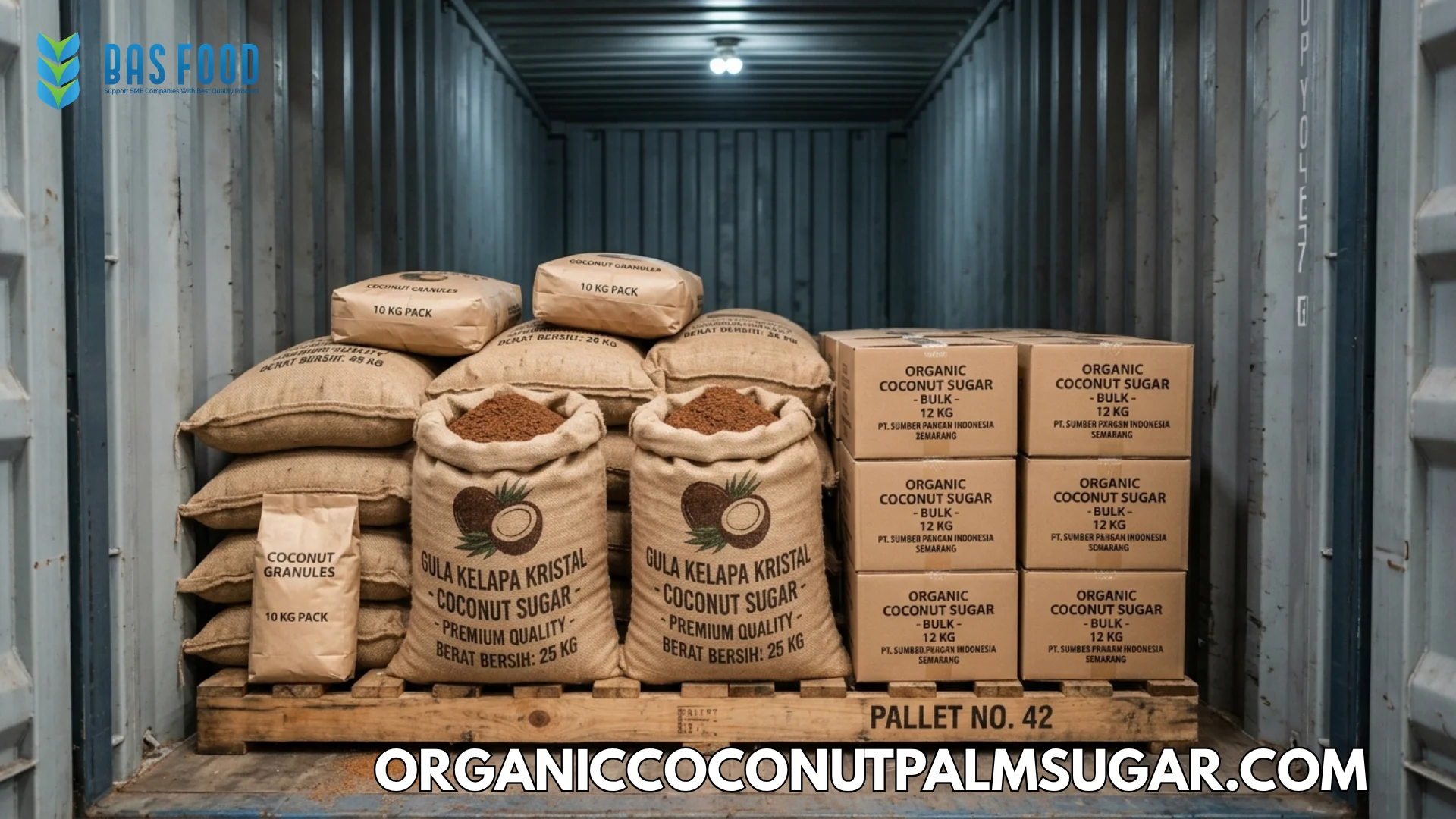
Coconut sugar granule wholesale refers to the commercial supply of coconut sugar in granulated form for businesses rather than individual consumers. Wholesale products are generally intended for companies that need larger quantities for manufacturing, distribution, foodservice, retail, or other commercial applications.
Unlike retail coconut sugar, wholesale products need to meet the practical requirements of business operations. Buyers may need specific granule sizes, packaging formats, product specifications, labeling, and shipping arrangements. Therefore, wholesale purchasing requires more detailed communication between the buyer and supplier.
Coconut sugar granules are produced from coconut sap that is processed and concentrated before being converted into a granulated form. The final product can have a characteristic brown color and caramel-like flavor. However, characteristics can vary depending on raw materials, processing methods, and product specifications.
For that reason, buyers should avoid treating all coconut sugar granules as exactly the same. Two products may have similar names but behave differently in production. This is why professional wholesale sourcing should begin with a clear specification.
Why Businesses Buy Coconut Sugar Granules Wholesale
One of the main reasons businesses choose wholesale purchasing is supply efficiency. A company that regularly uses coconut sugar does not want to repeatedly purchase small consumer packs. Instead, it can work with a supplier to obtain commercial quantities that match its production or distribution needs.
Bulk purchasing can also simplify procurement. Instead of placing many small orders, businesses can establish a purchasing schedule with their supplier. This approach may help purchasing teams manage inventory and plan production more effectively.
Coconut sugar granules can also serve different industries. Food manufacturers may use them in bakery products, snacks, cereals, beverages, desserts, confectionery, sauces, and other formulations. Distributors can supply them to smaller food businesses, while retailers can purchase wholesale quantities for repacking or resale where permitted and properly managed.
Nevertheless, buyers should consider their actual consumption before ordering. Buying too little may create frequent replenishment needs, while buying too much may increase storage pressure. The right wholesale volume depends on consumption, warehouse capacity, production schedules, and expected sales.
Why Wholesale Buyers Look to Indonesia
Indonesia is an important origin for coconut products because coconut farming is widespread across the country. Coconut sap can be processed into coconut sugar, creating opportunities for local producers and exporters to supply international markets.
For international buyers, working with an Indonesian supplier can provide access to products closer to the agricultural source. However, location alone does not determine supplier quality. Buyers still need to examine processing, product specifications, packaging, quality control, and export capabilities.
This is especially important for importers. An importer does not simply need a product. The importer needs a supplier that can coordinate an international transaction and provide the information required for shipping and receiving the goods.
Therefore, when evaluating a supplier from Indonesia, buyers should look at the complete business process. Product quality, communication, export documentation, logistics coordination, and consistency should all be considered.
A professional wholesale supplier should also understand that international buyers can have different requirements from domestic customers. Export orders may involve different packaging, labeling, documentation, and shipping arrangements.
Understanding the Needs of Wholesale Buyers
Every wholesale buyer has a different business model. A food manufacturer may focus on particle size and product performance, while a distributor may focus on packaging, commercial quantity, and resale requirements.
Because of these differences, buyers should clearly communicate their needs before requesting a quotation. A useful inquiry can include the desired product, estimated quantity, intended application, packaging preference, destination, and any known quality requirements.
This information gives the supplier a better understanding of the project. As a result, the supplier can provide a more relevant product option and commercial quotation.
For example, a buyer producing dry snack products may need a particular granule size that mixes well with other dry ingredients. Meanwhile, a beverage producer may have different requirements because the ingredient may need to dissolve or disperse during processing.
Therefore, the phrase coconut sugar granule wholesale does not describe one universal product specification. Wholesale supply should be matched to the buyer’s actual application.
Important Coconut Sugar Granule Specifications
Before placing a wholesale order, buyers should understand the specifications that may influence product performance. Particle size is one of the most important factors because it affects how the granules behave during handling and production.
Some applications may work better with finer granules, while others may require a different particle size. The right choice depends on the production process, formulation, mixing method, and final product.
Moisture is another important consideration. Coconut sugar can absorb moisture from its environment. When exposed to unsuitable humidity, granules may become more difficult to handle and may develop clumping.
Therefore, buyers should ask for the relevant moisture specification and discuss packaging protection with the supplier. Proper packaging and storage can help protect the product during transportation and warehousing.
Color and flavor may also matter. Coconut sugar usually has a recognizable brown appearance and characteristic taste, but the exact profile can vary. If the ingredient will become a noticeable part of the final food product, buyers should test samples before approving a commercial order.
How to Choose the Right Wholesale Supplier
Choosing the right wholesale supplier should involve several factors. Price is important, but it should not be the only consideration.
Start by checking whether the supplier can provide clear product information. A useful specification should explain the product characteristics that matter to the buyer. This makes it easier to compare different suppliers.
Next, ask about samples. A sample provides an opportunity to inspect the product before placing a larger order. Buyers can check the appearance, aroma, flavor, particle size, and handling characteristics.
For manufacturers, sample testing can go one step further. The product can be tested in the actual formulation to see how it behaves during mixing, heating, baking, dissolving, or other processes.
Packaging should also be discussed early. Wholesale coconut sugar may travel long distances before reaching the buyer. Packaging therefore needs to provide suitable protection during handling, transportation, and storage.
Finally, evaluate communication. A supplier that provides clear answers can make international purchasing more efficient. This becomes especially important when the buyer needs custom specifications or recurring shipments.
The Role of CV Bonafide Anugerah Sentosa
For businesses exploring Indonesian supply, CV Bonafide Anugerah Sentosa is a potential supplier to include in the sourcing process. The company operates in the Indonesian commodity export sector and supplies coconut sugar and other coconut-derived products.
For buyers interested in coconut sugar granule wholesale, the most useful starting point is to provide clear purchasing information. This can include the desired product specification, estimated quantity, packaging requirements, intended application, and destination.
A detailed inquiry allows both sides to understand whether the product and commercial requirements are suitable. It also creates a better foundation for discussing samples, quotations, packaging, and shipping.
For international buyers, supplier communication should be treated as part of the procurement process rather than a simple price request. Clear information at the beginning can reduce unnecessary questions later.
If a buyer expects recurring purchases, the discussion can also cover potential supply planning. This helps both sides understand the expected purchasing pattern without assuming that every buyer has the same requirements.
Bulk Purchasing: What Buyers Should Consider
Bulk purchasing requires careful planning because the buyer is committing to a larger quantity. Before placing an order, businesses should consider how much product they actually need and how quickly they can consume it.
Warehouse capacity is one important factor. Coconut sugar should be stored in suitable conditions and protected from excessive moisture. Therefore, the buyer needs enough appropriate storage space for the ordered quantity.
Production schedules also matter. A manufacturer should estimate its expected consumption based on actual production plans. This can help the purchasing team decide whether to order periodically or establish a more regular supply schedule.
Another consideration is the relationship between order quantity and logistics. Larger commercial orders may involve different transportation arrangements from small shipments. The final cost can therefore depend on packaging, freight, destination, and other logistics factors.
Instead of focusing only on the unit price, buyers should consider the overall landed cost and operational impact of the purchase.
Packaging for Wholesale Coconut Sugar Granules
Packaging plays an important role in wholesale supply because coconut sugar needs protection throughout the supply chain. The product may move from the production facility to inland transport, port handling, ocean freight, customs clearance, and finally the buyer’s warehouse.
During this journey, the product can be exposed to changing environmental conditions. Proper packaging and sealing can help reduce unwanted moisture exposure and protect the product during handling.
Buyers should discuss available packaging options with their supplier. The right packaging depends on the order size, warehouse conditions, handling method, destination, and buyer requirements.
Labeling is another consideration. Depending on the destination market and transaction, the shipment may require specific product identification and other information. Buyers should confirm the relevant requirements before production begins.
For private-label or customized wholesale orders, packaging discussions may also include artwork, labels, bag sizes, and other commercial details. These requirements should be agreed in advance because customization can affect production planning.
Coconut Sugar Wholesale for Importers
For importers, purchasing coconut sugar from another country involves more than finding a product and paying for it. The importer must consider the entire international supply chain.
The first step is usually supplier verification and product evaluation. Importers can request product information, samples, company details, packaging information, and export experience.
Once the product is approved, the buyer and supplier can discuss commercial terms. The destination country or port should be communicated clearly because shipping arrangements can vary depending on the destination.
Documentation is also important. Depending on the destination and transaction, importers may need commercial invoices, packing lists, shipping documents, product specifications, and other relevant documents.
Importers should also understand their own country’s import requirements. Food products can be subject to destination-specific rules, so the buyer should verify applicable requirements with the relevant authorities or customs and food regulatory professionals.
How to Compare Coconut Sugar Supplier Offers
When comparing a coconut sugar supplier with another supplier, make sure the quotations refer to comparable products.
For example, one supplier may offer a different granule size or packaging format from another. In that case, comparing only the price per kilogram may not provide a useful picture.
Create a simple comparison based on product specification, packaging, quantity, commercial terms, shipping arrangement, documentation, and communication.
Sample approval is another useful checkpoint. If possible, compare physical samples before making a final purchasing decision. This can help buyers identify differences that are not obvious from written specifications.
Buyers should also consider the supplier’s ability to support repeat orders. A supplier may be suitable for one small transaction but less suitable for a business that requires regular commercial supply.
Long-term sourcing requires consistency, communication, and clear expectations on both sides.
Building a Long-Term Wholesale Supply Relationship
A successful wholesale relationship does not end after the first shipment. For businesses that use coconut sugar regularly, supplier communication should become part of the long-term purchasing strategy.
The buyer can share expected consumption levels or purchasing patterns with the supplier. This does not necessarily mean committing to a fixed volume. Instead, it gives both parties a better understanding of future needs.
Quality consistency should remain a priority. Once a product has been approved, repeat orders should follow the agreed specifications. If the buyer wants to change the specification, the change should be communicated before production.
Regular communication can also help address packaging, shipping, and documentation requirements. Over time, both sides can develop a smoother workflow.
For this reason, choosing a coconut sugar exporter supplier should involve both product evaluation and relationship evaluation. A reliable commercial relationship can simplify future transactions.
Conclusion: Creating a Better Coconut Sugar Wholesale Strategy
Finding the right coconut sugar granule wholesale partner requires a structured approach. Buyers should evaluate the product, specifications, packaging, samples, commercial terms, logistics, documentation, and supplier communication.
For businesses sourcing from Indonesia, an experienced coconut sugar supplier can help connect international buyers with Indonesian coconut sugar products. However, buyers should still conduct their own product evaluation and confirm that the supplier’s offering matches their specific requirements.
CV Bonafide Anugerah Sentosa can be considered by businesses looking for an Indonesian coconut sugar exporter supplier. A clear inquiry covering product requirements, estimated quantity, packaging, application, and destination can make the initial sourcing conversation more productive.
Ultimately, successful wholesale purchasing is about creating a supply process that works for both sides. By starting with clear specifications, testing samples, reviewing packaging, and planning logistics carefully, businesses can build a more organized approach to coconut sugar procurement.