Coconut sugar granules have become an interesting ingredient for food businesses looking for a practical, versatile sweetener. Their granular form makes them easy to measure, blend, pack, and use across many food applications. From bakery products and cereals to beverages and snacks, coconut sugar granules can fit into different manufacturing processes. However, sourcing coconut sugar internationally involves more than finding a product and requesting a price. Importers and food manufacturers also need to consider product specifications, particle size, moisture, packaging, documentation, logistics, communication, and supply consistency.
That is where a reliable coconut sugar granule exporter becomes important. An experienced exporter can help international buyers navigate the process from product inquiry and sample evaluation to commercial orders and international shipment.
Indonesia is one of the important origins for coconut-based products. Its large agricultural base and long experience with coconut processing create opportunities for international buyers looking for Indonesian coconut sugar. Still, not every supplier has the same production capabilities or export process.
For that reason, buyers should understand what makes a suitable exporter and what questions to ask before starting a long-term supply relationship.
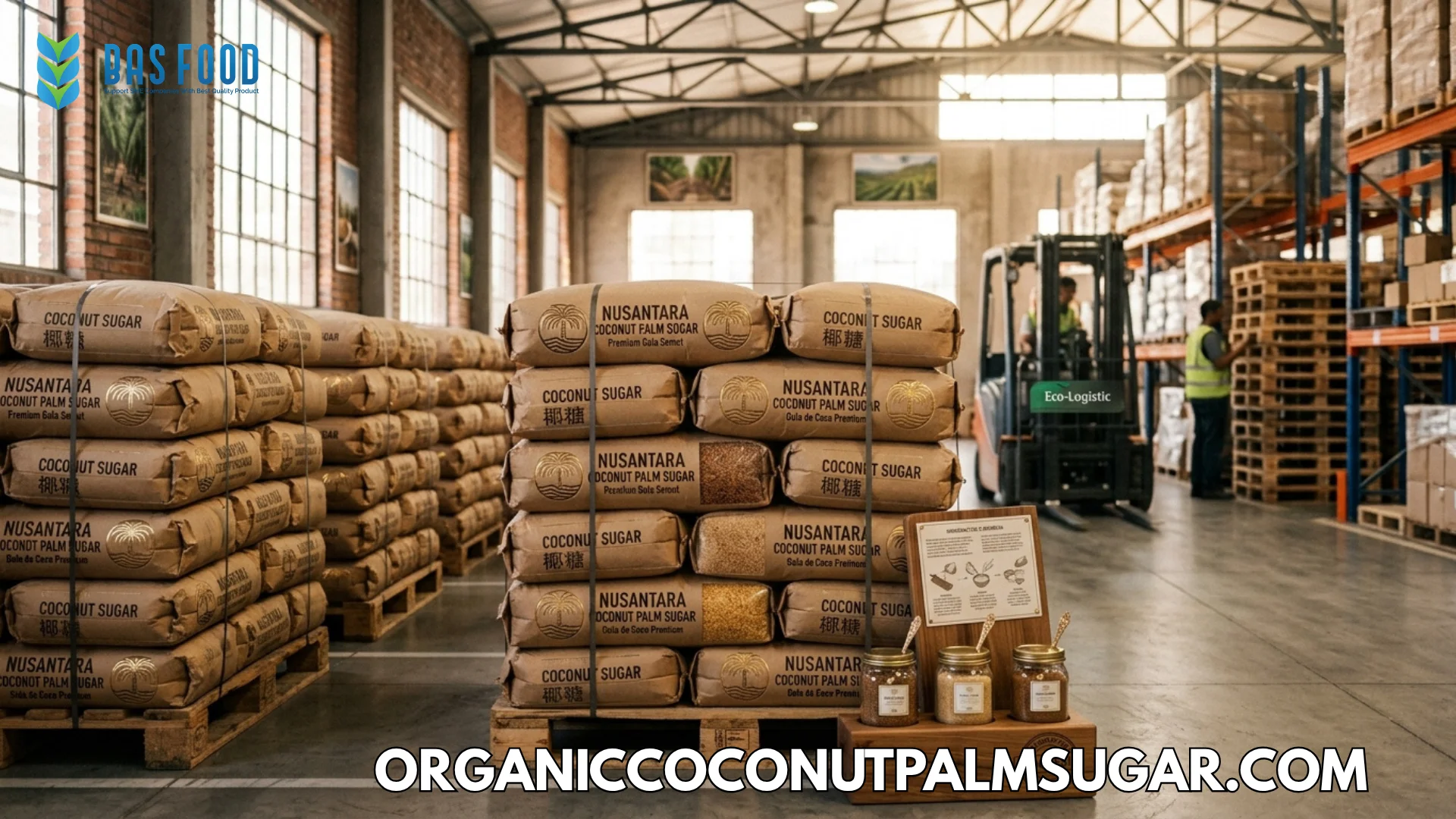
What Is a Coconut Sugar Granule Exporter?
A coconut sugar granule exporter is a business that supplies coconut sugar in granular form to customers in international markets. Depending on its business model, the exporter may work directly with production facilities, local suppliers, farmers, or a combination of these sources.
The exporter’s role can go beyond simply selling the ingredient. International orders usually involve several stages, including product selection, specification confirmation, sampling, packaging, production planning, documentation, logistics coordination, and shipment.
This makes the exporter an important link between the origin country and the overseas buyer. A food manufacturer in Europe, for example, may have specific requirements that need to be communicated clearly to an Indonesian supplier before production begins.
A professional exporter should therefore understand both sides of the transaction. The supplier needs knowledge of the product, while also understanding the practical needs of international buyers.
For buyers, this distinction matters. A company may offer coconut sugar locally, but international sourcing requires additional capabilities related to export documentation, packaging, communication, and shipping coordination.
Why Choose Indonesia for Coconut Sugar Granules?
Indonesia has a strong connection with coconut agriculture. Coconut trees are cultivated in many parts of the country, supporting farmers and communities involved in coconut-based production.
This agricultural background provides an important foundation for coconut sugar production. Coconut sap can be collected and processed into coconut sugar, which can then be prepared in different forms, including granules.
For international buyers, sourcing from Indonesia can provide direct access to an origin with established coconut production. It can also create opportunities to work with exporters that understand local supply chains and international customer requirements.
However, country of origin alone does not guarantee product consistency. Buyers should still evaluate individual exporters based on product specifications, processing practices, quality management, packaging, communication, and export experience.
Therefore, when searching for a coconut sugar exporter Indonesia, buyers should look beyond the phrase itself. The real question is whether the supplier can provide the product and service required for the buyer’s specific application and market.
What Makes a Reliable Coconut Sugar Granule Exporter?
A reliable exporter should begin with clear product information. Buyers need to know what they are purchasing and whether the product fits their manufacturing or distribution requirements.
Important information can include particle size, moisture, color, flavor, texture, packaging, available order formats, and other specifications relevant to the intended application.
Communication also plays a major role. International purchasing often involves different time zones, languages, currencies, logistics systems, and regulatory expectations. Clear communication can prevent confusion before it becomes a costly problem.
An experienced international supplier should be able to discuss these points in a practical way. Instead of simply sending a price, the supplier should understand what the buyer needs and clarify which specifications can be offered.
Export experience is another factor to consider. A supplier familiar with international transactions may have a better understanding of the steps involved in preparing commercial shipments, although buyers should still verify the specific capabilities and documentation available for each order.
Understanding Coconut Sugar Granule Specifications
Before placing a commercial order, buyers should define the required product specification. This creates a clear reference for both parties and makes sample evaluation easier.
Particle size is one of the main specifications to discuss. Coconut sugar granules can vary in size, and different applications may require different physical characteristics.
For example, a food manufacturer producing a dry beverage mix may want a different granule size from a company manufacturing granola or bakery products. Therefore, buyers should describe the intended application instead of simply asking for “coconut sugar.”
Moisture is another important consideration. Coconut sugar is hygroscopic, meaning it can absorb moisture from its environment. Moisture exposure can affect texture, flowability, and storage behavior.
Color and flavor may also matter depending on the finished product. Coconut sugar generally has a characteristic brown color and a distinctive sweet flavor profile, but actual characteristics can vary according to processing and product specifications.
For this reason, professional buyers should request a specification sheet and, when appropriate, evaluate a product sample before moving to a larger order.
Coconut Sugar Granules for International Food Manufacturing
One reason coconut sugar granules attract B2B interest is their versatility. Food manufacturers can explore their use across several product categories.
In bakery production, coconut sugar granules may be used in cookies, cakes, muffins, brownies, granola, and other baked products. Manufacturers can assess how the ingredient affects sweetness, color, flavor, and texture within their own recipes.
Cereal and snack producers can also explore coconut sugar granules for granola, breakfast cereals, snack bars, and similar products. In these applications, particle size and mixing characteristics can become especially relevant.
Beverage manufacturers may also consider coconut sugar as a sweetening ingredient for selected formulations. However, the actual performance should be tested according to the product’s processing method.
Food manufacturers should always conduct their own formulation trials. A supplier can provide product specifications and samples, but the buyer’s technical team ultimately needs to determine whether the ingredient works effectively in the finished product.
Fine, Medium, or Coarse: Why Granule Size Matters
Granule size can influence how coconut sugar behaves during production. Smaller particles may integrate differently from larger particles, particularly when manufacturers blend the sweetener with other dry ingredients.
The preferred size depends on the application. A manufacturer may prioritize quick mixing for one product while another may want a specific texture or physical appearance.
Therefore, it is useful to discuss particle size at the beginning of the sourcing process. Buyers can explain their manufacturing process, while the exporter can identify the available product format.
Sample testing is particularly useful here. Instead of relying only on a specification sheet, buyers can test the granules in their actual formulation.
This approach also helps reduce misunderstandings between buyer and supplier. Once both parties agree on the required characteristics, the same specification can become a reference for future commercial orders.
Packaging and Moisture Protection for Export
International transportation can expose food ingredients to different environmental conditions. For coconut sugar granules, moisture management is especially important because the product can absorb moisture when exposed to humid conditions.
Therefore, export packaging should provide appropriate protection during handling, transportation, and storage. The packaging structure and size should be discussed based on the product, order volume, shipping method, destination, and buyer requirements.
Sealing is also important. Poorly sealed packaging can increase the risk of moisture exposure during transportation or warehousing.
Export buyers should also consider outer packaging, palletization, labeling, batch identification, and handling requirements. These details can make a difference when goods move through warehouses, ports, customs processes, and distribution facilities.
A professional coconut sugar exporter supplier should be able to discuss packaging options before the order is finalized. Buyers should communicate their packaging requirements early rather than waiting until production is almost complete.
From Sample to Commercial Shipment
A successful export relationship often begins with a sample. Sampling allows the buyer to inspect the actual product before making a larger purchasing decision.
During sample testing, buyers can evaluate appearance, aroma, flavor, granule size, texture, flowability, and suitability for their intended application.
For manufacturers, application testing can provide even more useful information. The ingredient can be mixed into the actual recipe to see how it behaves under real production conditions.
Once the sample meets the buyer’s requirements, both parties can move toward commercial discussions. At this stage, the buyer and exporter should confirm the agreed product specification, packaging, quantity, price, production schedule, documentation, and shipping arrangements.
This step-by-step process is generally more practical than selecting a supplier based only on an online product description.
What International Buyers Should Ask an Exporter
International buyers should prepare a clear list of questions before selecting a supplier. This can make supplier comparisons easier and reduce misunderstandings.
First, ask about product specifications. Buyers should understand the available granule sizes and relevant product characteristics.
Second, ask about samples. A sample can help the buyer evaluate whether the product fits the intended application.
Third, discuss packaging. Ask how the coconut sugar will be packed for international transportation and whether customized packaging or labeling requirements can be discussed.
Fourth, clarify commercial conditions. These may include order quantity, production lead time, payment terms, shipping terms, and documentation.
Finally, ask about communication and after-sales support. International supply relationships often continue beyond the first shipment, so reliable communication can be valuable throughout the relationship.
The goal is not to ask hundreds of questions. Instead, buyers should focus on the information that directly affects product quality, production, logistics, and commercial risk.
CV Bonafide Anugerah Sentosa as a Coconut Sugar Exporter
CV Bonafide Anugerah Sentosa is an Indonesian supplier and exporter serving businesses looking for coconut-based products for international markets.
For buyers exploring Indonesian coconut sugar, the company can be considered as a potential coconut sugar supplier and export partner. Its role in the supply chain can be discussed according to the buyer’s product requirements, packaging needs, and intended market.
As with any B2B sourcing relationship, buyers should communicate their exact requirements before placing an order. Product specifications, available formats, packaging, quantities, documentation, and shipping arrangements should be confirmed directly.
For importers, distributors, and food manufacturers, this process creates a clearer starting point. Instead of selecting a product based only on its name, the buyer and exporter can establish a shared understanding of the required product.
A clear specification also provides a useful reference for future orders. This can support smoother communication when the buyer moves from initial samples to recurring commercial purchases.
How to Select a Coconut Sugar Granule Exporter
Supplier selection should begin with the product itself. Buyers should confirm whether the available coconut sugar granules match their required specifications.
Next, consider the supplier’s ability to communicate clearly. A supplier that responds accurately to questions can make international procurement easier, especially when specifications or packaging requirements change.
The next step is sample evaluation. Whenever possible, buyers should test the actual product rather than relying entirely on photographs or descriptions.
Packaging should then be reviewed. Buyers should understand how the product will be protected during storage and transportation.
Finally, discuss the complete commercial process. This includes order quantities, production planning, documentation, payment conditions, shipping arrangements, and other transaction details.
It is useful to evaluate suppliers using the same checklist. This allows procurement teams to compare information consistently without focusing only on the initial price.
Common Mistakes When Sourcing From an Exporter
One common mistake is focusing entirely on price. Price is important, but it should be evaluated together with product quality, packaging, service, logistics, and commercial terms.
Another mistake is failing to define the desired granule size. If the buyer simply asks for “coconut sugar granules,” the supplier may not know the exact particle size required.
Ignoring moisture protection is another issue. Coconut sugar can absorb moisture, so packaging and storage should receive appropriate attention throughout the supply chain.
Some buyers also skip application testing. While a sample may look good, its actual performance in a food formulation can be different. Testing helps identify potential issues before a larger order is placed.
Finally, buyers sometimes fail to communicate future requirements. If the product is intended for recurring purchases, it is useful to discuss expected order patterns and specifications early in the relationship.
Building a Long-Term Export Partnership
A long-term relationship requires clear expectations from both sides. Buyers should communicate their product requirements, target application, packaging preferences, and purchasing needs.
The exporter, meanwhile, should communicate available product formats, specifications, production considerations, and export procedures clearly.
Once both sides understand the requirements, future transactions can become more straightforward. The agreed specification can serve as a reference for subsequent orders.
Consistency is particularly important for manufacturers. A change in particle size, moisture, color, or other characteristics can affect a production process. Therefore, buyers should communicate which specifications are critical to their products.
At the same time, suppliers should be transparent about available options and any changes that may affect future orders. Good communication creates a stronger foundation for international cooperation.
Final Thoughts: Turning Coconut Sugar Into a Global Supply Opportunity
The international market for coconut-based ingredients creates opportunities for Indonesian suppliers and overseas food businesses alike. Coconut sugar granules offer a practical format that can be explored across many food applications.
However, successful international sourcing requires a structured approach. Buyers should look at product specifications, particle size, moisture management, packaging, samples, documentation, communication, and export processes.
A reliable coconut sugar granule exporter should therefore be more than a company that offers a product. The exporter should be able to communicate clearly, understand international B2B requirements, and work with buyers to establish specifications that fit their application.
For businesses searching for a coconut sugar exporter Indonesia, starting with clear product requirements can make the sourcing process much easier. From the first sample to recurring commercial shipments, good communication and well-defined specifications can help create a stronger supply relationship.
For buyers considering CV Bonafide Anugerah Sentosa, the next step is to communicate the required product format, application, packaging preferences, order requirements, and destination market so that the appropriate supply options can be discussed.