Coconut sugar syrup is becoming an interesting ingredient for food manufacturers, beverage companies, bakeries, and ingredient distributors. Its rich caramel-like taste and liquid form make it useful in many applications, from coffee drinks and sauces to desserts and packaged foods. However, before placing a bulk order, buyers need to understand more than the product’s flavor. They also need clear technical details.
That is where coconut sugar syrup specifications become important. Specifications help buyers understand the product’s concentration, thickness, appearance, moisture-related properties, and other quality indicators. They also help manufacturers decide whether a syrup will work in their recipes and production equipment.
In this guide, we explain the main specifications buyers should review, including Brix specification, viscosity requirements, product parameters, packaging, storage, and quality documentation. Whether you are an importer, distributor, or food manufacturer, understanding these details can make sourcing decisions more accurate.
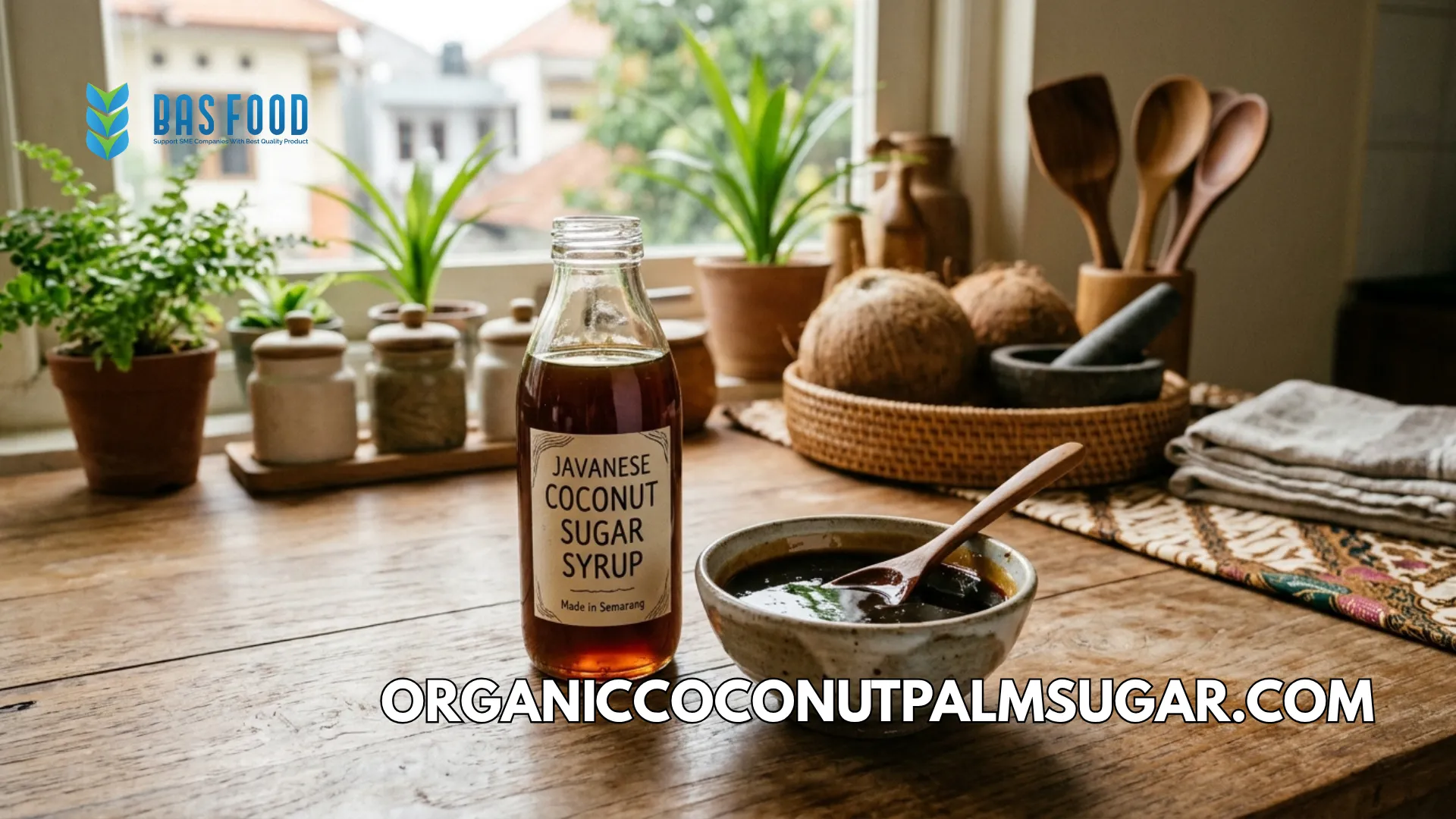
What Are Coconut Sugar Syrup Specifications?
Coconut sugar syrup specifications are the technical details that describe a syrup’s physical, chemical, and sensory properties. They help buyers understand what they are purchasing and whether the product meets their production requirements.
A typical specification sheet may include product name, ingredients, appearance, color, aroma, flavor, Brix, viscosity, pH, moisture-related information, packaging, shelf life, and storage conditions. However, not every supplier uses the same specification format. The exact parameters depend on the manufacturing process, intended application, and buyer’s requirements.
For B2B purchasing, specifications are more than product descriptions. They provide a reference for communication between suppliers and buyers. For example, a beverage manufacturer may focus on Brix and viscosity, while a sauce producer may pay closer attention to flavor, color, and consistency.
Most importantly, buyers should not assume that all coconut sugar syrups have identical properties. Raw materials, concentration methods, filtration, processing conditions, and storage can create differences between products. Therefore, always request a current specification sheet for the specific product you intend to purchase.
Brix Specification: Understanding Sugar Concentration
One of the most important parameters in coconut sugar syrup is the Brix specification. Brix is commonly used to measure the concentration of soluble solids in a liquid. A refractometer can measure the refractive index of a syrup and display the result as degrees Brix (°Bx).
In simple terms, a higher Brix reading generally indicates a higher concentration of soluble solids. This information helps manufacturers estimate how concentrated a syrup is and how much liquid it may contribute to a formulation.
However, Brix needs careful interpretation. It is based on a sucrose reference scale. Coconut sugar syrup contains a mixture of sugars and other soluble substances, so its Brix reading does not represent an exact measurement of total sugar content. It also does not directly confirm product safety, purity, or shelf life.
Why Brix Matters to Food Manufacturers
Brix can influence several aspects of product development and manufacturing:
- Recipe formulation: Helps food technologists calculate how much syrup to add.
- Sweetness consistency: Supports more consistent results when used alongside sensory testing.
- Batch comparison: Helps buyers compare concentration between production batches.
- Process control: Allows manufacturers to monitor concentration during production.
- Cost calculation: Helps businesses understand the amount of syrup needed to achieve a target formulation.
For example, a beverage manufacturer may need a syrup with a defined concentration to maintain the same sweetness and solids level in every production batch. A consistent Brix range can make formulation adjustments easier.
How Should Buyers Specify Brix?
Instead of asking only for a high Brix value, buyers should define an acceptable range that suits their application. They should also confirm the measurement method and testing conditions.
Temperature can affect refractometer readings, so the supplier and buyer should agree on appropriate measurement procedures and temperature compensation. If a specification lists a target Brix, the batch test results should use a consistent method.
Viscosity Requirements: How Thick Should the Syrup Be?
Another important part of coconut sugar syrup specifications is viscosity. Viscosity describes a liquid’s resistance to flow. In everyday language, it tells us how thick or thin the syrup feels and how easily it moves.
A thinner syrup may flow quickly from a bottle or through a production pipe. A thicker syrup may pour slowly and cling more strongly to a spoon or mixing surface. Neither condition is automatically better. The right viscosity depends on the product’s intended use and the equipment used by the buyer.
Why Viscosity Matters in Production
Viscosity affects how manufacturers handle, pump, mix, fill, and package coconut sugar syrup. For example, a beverage producer may prefer a syrup that dissolves and blends easily. Meanwhile, a sauce or topping manufacturer may need a thicker consistency that gives the finished product a richer texture.
Viscosity can also affect production speed. If the syrup is too thick for a particular pumping system, the manufacturer may need to adjust the temperature or equipment settings. If it is too thin, the finished product may not achieve the desired texture.
What Influences Syrup Viscosity?
Several factors can change viscosity:
- Soluble solids concentration: Higher concentration often increases thickness.
- Temperature: Many syrups become thinner when warmed and thicker when cooled.
- Sugar composition: Different sugars and dissolved solids can influence flow behavior.
- Processing conditions: Heating and concentration methods may affect the final consistency.
- Storage conditions: Changes during storage can influence physical properties.
Because viscosity depends on temperature and test conditions, buyers should avoid comparing measurements taken under different conditions. A useful specification should state the measurement method, temperature, and unit. For example, dynamic viscosity may be reported in millipascal-seconds (mPa·s) or centipoise (cP).
Product Parameters Beyond Brix and Viscosity
Although Brix and viscosity receive significant attention, they are not the only product parameters buyers should review. A complete specification should cover other characteristics that influence product performance, quality, and suitability.
The following parameters are worth discussing with a supplier.
Appearance and Color
Coconut sugar syrup commonly has a brown to dark brown appearance, although the exact shade can vary. Raw material characteristics and processing conditions can influence the final color.
For manufacturers, color consistency may be important because it affects the appearance of beverages, desserts, sauces, and bakery products. Buyers should define the preferred color range or approve a reference sample when visual consistency matters.
Aroma and Flavor
Coconut sugar syrup is commonly associated with a sweet, caramel-like flavor and a distinctive aroma. However, the intensity can vary depending on the raw materials and production process.
Buyers should evaluate whether the flavor complements their finished product. A strong caramel note may work well in coffee beverages and desserts, while a more delicate formulation may require a milder profile.
pH
The pH value indicates how acidic or alkaline a product is. It is an important parameter to monitor, but it does not independently determine whether a syrup is microbiologically safe or stable.
Manufacturers should consider pH alongside other factors, including water activity, processing, packaging, and microbiological testing. Buyers should request the supplier’s actual pH result and agree on an acceptable range based on the intended use.
Moisture and Water Activity
Moisture content describes the amount of water present in a product. Water activity, on the other hand, indicates how much water is available to support chemical reactions and microbial growth.
These measurements are related, but they are not interchangeable. Two syrups with similar moisture content may have different water activity values.
For products intended for long-term storage, buyers should discuss both parameters where relevant. They should also ask for evidence supporting the stated shelf life rather than assuming that a particular Brix level guarantees stability.
Impurities and Filtration
A syrup should meet the agreed requirements for foreign particles and insoluble material. Filtration can help remove unwanted particles and improve product appearance.
Buyers should clarify whether the product is filtered, what visual standard applies, and whether the supplier performs additional checks for foreign matter.
How to Read a Coconut Sugar Syrup Specification Sheet
A specification sheet should make product information easy to understand. It should identify the product clearly and list the relevant parameters, units, test methods, and acceptable limits.
For example, a Brix result without a measurement method or acceptance range may not provide enough information for a manufacturer’s quality team. Similarly, a viscosity result without a test temperature can be difficult to compare with another supplier’s product.
A useful specification sheet should ideally include:
| Parameter | What It Describes | Why It Matters |
|---|---|---|
| Product name | Product identity | Confirms the ingredient being purchased |
| Ingredients | Product composition | Supports formulation and labeling review |
| Appearance | Visual condition | Helps assess product consistency |
| Color | Color profile | Supports finished-product appearance |
| Aroma and flavor | Sensory properties | Helps determine application suitability |
| Brix | Soluble solids concentration | Supports formulation and batch comparison |
| Viscosity | Resistance to flow | Helps with pumping, mixing, and filling |
| pH | Acidity or alkalinity | Supports process and quality assessment |
| Moisture | Water content | Helps assess product composition |
| Water activity | Available water | Supports stability evaluation |
| Microbiological criteria | Microbial quality | Helps verify suitability for the intended market |
| Packaging | Container and format | Supports handling and transportation |
| Shelf life | Stated storage period | Supports inventory planning |
Not every product will have every parameter listed in the same way. The supplier and buyer should agree on which tests are relevant to the application and destination market.
Specification Sheet vs Certificate of Analysis
A specification sheet and a certificate of analysis (COA) serve different purposes.
A specification sheet describes the product’s agreed characteristics and acceptable limits. A COA reports the test results for a particular batch or lot. In other words, the specification explains what the product should meet, while the COA shows the measured results for the tested batch.
For larger orders, buyers should request both documents. This helps them compare the product requirements with the actual batch results before shipment or acceptance.
Matching Coconut Sugar Syrup Specifications to Different Applications
The best coconut sugar syrup specification depends on how a business plans to use the ingredient. A syrup that works well in a beverage may not be ideal for a bakery filling or sauce.
Therefore, buyers should begin with the final product rather than choosing specifications without a clear purpose.
Beverages and Coffee Products
For coffee, tea, and ready-to-drink beverages, Brix and viscosity are particularly useful. They influence how much syrup is required and how easily it blends into the liquid.
A beverage manufacturer may also need a consistent flavor and color profile. Pilot testing can help determine whether the syrup produces the desired sweetness and sensory result.
Bakery and Dessert Manufacturing
In bakery products, coconut sugar syrup can contribute sweetness, moisture, color, and flavor. However, its performance depends on the recipe and baking conditions.
Manufacturers should test the syrup in the actual formulation. They may need to consider its water contribution, concentration, and effect on texture.
Sauces, Dressings, and Toppings
Sauce and topping producers may focus more closely on viscosity, color, and flavor. A thicker syrup may help create a desired texture, while a consistent flavor profile supports repeatable product results.
The syrup should also work with other ingredients in the formulation. Acidity, salt, stabilizers, and processing temperatures may affect the final product.
Food Ingredient Distribution
Distributors and importers need specifications that are clear enough to share with their customers. Consistent documentation makes it easier to answer technical questions and compare products from different suppliers.
If a distributor serves several industries, it may be useful to define more than one product requirement. For example, a beverage customer and a bakery customer may need different viscosity ranges.
Processing Factors That Influence Coconut Sugar Syrup Quality
Coconut sugar syrup is generally produced by collecting coconut sap and concentrating it through controlled heating or other suitable processing methods. The process converts liquid sap into a thicker sweetener.
The final product depends on several stages, starting with sap collection. Freshness and handling conditions can influence the quality of the raw material. Clean equipment and suitable processing practices also help reduce contamination risks.
During concentration, heat removes water and increases soluble solids. This stage affects Brix, viscosity, color, and flavor. Excessive or poorly controlled heating may create a darker color or stronger cooked notes than the buyer expects.
After concentration, the syrup may undergo filtration, cooling, and packaging. Each stage requires suitable process control to help maintain the agreed specifications.
For B2B buyers, understanding these factors is useful when discussing product consistency with suppliers. However, the exact process should be confirmed directly rather than assumed from the product name.
Packaging, Storage, and Shelf Life
Packaging is an important part of coconut sugar syrup procurement. The container should be suitable for food contact and compatible with the syrup’s physical properties. It should also protect the product during storage and transportation.
Depending on the supplier’s available options and the buyer’s requirements, syrup may be packed in different container sizes and formats. Buyers should confirm the packaging material, net weight, closure system, labeling information, and suitability for export handling.
Storage conditions also influence product quality. Excessive heat, direct sunlight, damaged seals, and poor handling can affect the product during distribution. Buyers should follow the supplier’s stated storage instructions and avoid making assumptions based only on the syrup’s thickness or Brix value.
Shelf life must be supported by appropriate product data. It can depend on concentration, pH, water activity, processing hygiene, packaging integrity, and storage conditions. A high Brix reading alone does not prove that a syrup is shelf-stable.
For commercial orders, ask the supplier for the stated shelf life, recommended storage temperature, handling instructions, and any relevant supporting test information.
Choosing a Coconut Sugar Syrup Supplier for Bulk Orders
Finding the right supplier involves more than comparing prices. Importers and food manufacturers need a business partner that can communicate clearly, provide relevant product information, and understand export requirements.
Start by requesting a current specification sheet. Check whether it includes Brix, viscosity, appearance, pH, moisture-related information, and other parameters relevant to your application. Then ask for a recent COA and a representative sample.
Next, discuss commercial details. These may include available order quantities, packaging options, lead times, shipping arrangements, Incoterms, and export documentation. Confirm all details before issuing a purchase order.
Working with CV Bonafide Anugerah Sentosa
Businesses looking for Indonesian coconut-based ingredients can contact CV Bonafide Anugerah Sentosa to discuss sourcing inquiries. Buyers interested in coconut sugar syrup should confirm current product availability, technical specifications, samples, packaging options, and export arrangements directly with the company.
For importers sourcing multiple ingredients, the company may also be relevant to broader inquiries about a coconut sugar supplier or coconut sugar exporter supplier. However, buyers should verify the availability and specifications of each product separately.
A good purchasing process starts with clear technical requirements. Share your target Brix, viscosity needs, intended application, packaging preferences, and destination market. This gives the supplier a clearer understanding of what your business needs.
Conclusion: Make Specifications Part of Every Sourcing Decision
Understanding coconut sugar syrup specifications helps importers, distributors, and food manufacturers choose a product that fits their technical and commercial needs. Brix specification, viscosity requirements, and other product parameters provide a useful foundation for evaluating syrup concentration, flow behavior, appearance, and consistency.
However, specifications should always reflect the intended application. A beverage manufacturer may prioritize blending and concentration, while a sauce producer may need a particular thickness and flavor profile. Laboratory results, samples, and clear documentation help turn those requirements into a reliable purchasing decision.
Before placing a bulk order, define your target parameters, review the supplier’s specification sheet, request a batch COA, and test a sample. This practical approach can help your business source coconut sugar syrup with greater confidence.