Imagine opening a container of coconut sugar syrup and discovering tiny sugar crystals at the bottom. The syrup may still smell sweet and look appealing, but its texture has changed. For a household consumer, this might seem like a small inconvenience. However, understanding coconut sugar syrup crystallization is crucial because, for a beverage manufacturer, bakery producer, or international food importer, unexpected crystallization can become a serious production challenge.
This is why understanding coconut sugar syrup crystallization is important for businesses that use natural liquid sweeteners.
Coconut sugar syrup is produced by concentrating sap collected from coconut palm flowers. It offers a characteristic sweetness with caramel-like flavor notes, making it suitable for evaluation in beverages, sauces, desserts, bakery products, and other food applications.
However, like other concentrated sugar solutions, coconut sugar syrup can experience physical changes during processing and storage. Under certain conditions, dissolved sugars may begin forming solid crystals, affecting the syrup’s appearance, texture, and handling performance.
The good news is that understanding the science behind sugar crystallization can help manufacturers manage these changes more effectively.
In this guide, we will explore why coconut sugar syrup crystallization occurs, what influences crystal formation, and how food manufacturers can improve syrup stability through appropriate processing, storage, and quality control.
What Is Coconut Sugar Syrup Crystallization?
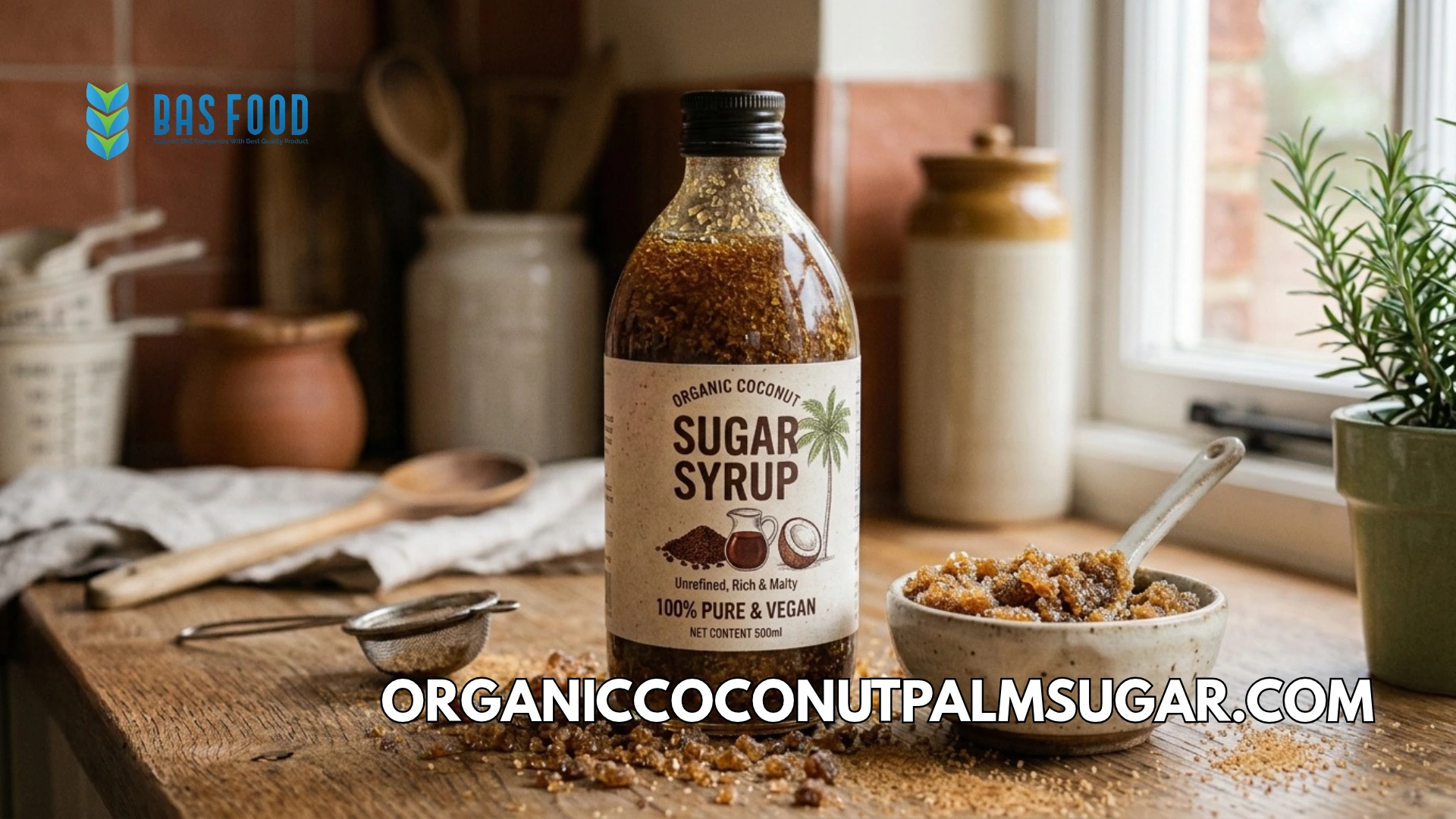
Coconut sugar syrup crystallization occurs when dissolved sugars form solid crystals within the liquid syrup. This process may happen when the concentration, temperature, and composition of the syrup create conditions that favor crystal formation.
In a properly dissolved sugar solution, sugar molecules are distributed throughout the liquid. However, when the solution becomes supersaturated with respect to a particular sugar, the dissolved molecules may begin organizing into a solid crystalline structure.
Over time, these crystals can grow and become visible.
For example, a syrup may initially appear smooth and uniform. After storage, small particles may develop along the container walls or collect at the bottom. If crystallization continues, the syrup may become grainy or more difficult to pour.
However, not every visible particle in coconut sugar syrup is necessarily a sugar crystal. Sediment, undissolved material, or other physical changes can produce similar appearances.
Therefore, manufacturers should identify the cause before deciding how to handle the product.
Is crystallization always a quality defect?
Crystallization is primarily a physical phenomenon. It does not automatically indicate contamination, spoilage, or a food safety problem.
Nevertheless, unwanted crystals may make the product unsuitable for applications that require a smooth, consistent liquid.
For example, a beverage producer may need syrup that flows evenly through dosing equipment. Crystals could interfere with accurate measurement or create inconsistent sweetness distribution.
In contrast, some food products intentionally use controlled sugar crystallization to achieve a particular texture.
The important question is whether crystal formation is expected and acceptable for the intended application.
The Science Behind Sugar Crystallization
To understand coconut sugar syrup crystallization, it helps to understand how sugars behave in concentrated solutions.
Coconut sugar syrup contains dissolved sugars, commonly including sucrose along with varying amounts of glucose and fructose. Its exact composition depends on the coconut sap and processing conditions.
These sugars do not all behave identically in water.
Sucrose can form well-defined crystals under suitable conditions, while glucose and fructose can influence the overall crystallization behavior of a mixed sugar solution.
As a result, the balance of sugars plays an important role in determining whether a syrup remains smooth or develops crystals.
What is supersaturation?
Supersaturation occurs when a solution contains more dissolved material than would normally remain dissolved at equilibrium under the same conditions.
For example, heating may allow a concentrated sugar solution to maintain a particular dissolved sugar concentration. As the solution cools, its equilibrium solubility may decrease.
If the solution becomes supersaturated, crystals may eventually form.
However, crystallization does not always begin immediately. A supersaturated syrup can sometimes remain visually clear for a period before crystal formation starts.
This delay depends on factors such as sugar composition, impurities, temperature, and the presence of crystal nuclei.
Nucleation and crystal growth
Sugar crystallization generally involves two important stages: nucleation and crystal growth.
Nucleation is the formation of tiny initial crystal structures. Once these structures exist, additional sugar molecules may attach to them, allowing the crystals to grow.
Small existing crystals, particles, or contact surfaces can sometimes encourage nucleation.
Meanwhile, the rate of crystal growth depends on the syrup’s composition, temperature, concentration, and molecular movement.
For food manufacturers, understanding these stages helps explain why a syrup may remain smooth during production but develop visible crystals later in storage.
What Causes Coconut Sugar Syrup Crystallization?
Several factors can influence whether coconut sugar syrup develops crystals.
The most important considerations include sugar concentration, temperature changes, sugar composition, processing conditions, and storage practices.
These factors often interact, so crystallization rarely depends on just one variable.
High sugar concentration
Concentrated syrups contain relatively little water compared with their dissolved solids.
As water is removed during processing, the concentration of sugars increases.
If the concentration becomes sufficiently high, the solution may approach or exceed the solubility limit of certain sugars under the relevant conditions.
This can increase the possibility of crystallization.
However, a high Brix reading does not automatically mean that crystallization will occur.
Brix provides an indication of soluble solids concentration, while crystallization also depends on the types of sugars present and their interactions.
Temperature fluctuations
Temperature changes can affect sugar solubility and crystallization behavior.
For example, a syrup may be processed at an elevated temperature and then cooled before packaging.
If cooling changes the solubility balance, crystal formation may become more favorable.
Repeated temperature fluctuations during transportation or storage may also influence the behavior of a concentrated syrup.
However, the effect depends on the syrup’s specific composition and concentration.
Therefore, manufacturers should evaluate temperature sensitivity through practical testing rather than assuming that every coconut sugar syrup responds identically.
Sugar composition
The ratio of sucrose, glucose, fructose, and other soluble components can affect crystal formation.
Sucrose-rich systems may crystallize under suitable conditions, while other sugars can interfere with sucrose crystal growth.
However, the relationship is complex.
The presence of glucose or fructose does not guarantee that a syrup will remain crystal-free under every storage condition.
For consistent results, manufacturers may need to evaluate the sugar profile of the product alongside its concentration and temperature behavior.
Processing and handling conditions
Production methods can influence crystallization.
For example, excessive concentration may increase supersaturation, while uncontrolled cooling can affect crystal formation.
In addition, existing sugar crystals or certain particles may provide sites where crystallization begins.
Manufacturers should therefore manage concentration, mixing, filtration, and cooling according to validated processing procedures.
Good process control can help reduce unexpected variation between batches.
How Crystallization Affects Syrup Stability
Syrup stability describes the ability of a syrup to maintain its intended characteristics during processing, storage, and use.
For coconut sugar syrup, physical stability may involve appearance, viscosity, uniformity, and resistance to unwanted crystal formation.
A stable syrup should perform consistently under the storage and handling conditions specified for the product.
However, physical stability is only one part of overall product quality.
Changes in texture and appearance
One of the most noticeable effects of crystallization is a change in texture.
A smooth syrup may become grainy as crystals develop.
Depending on the amount and size of the crystals, the syrup may also appear cloudy or contain visible deposits.
These changes can affect customer expectations, particularly when the product is intended for clear beverages, smooth sauces, or premium dessert applications.
For industrial buyers, visual consistency may be an important part of the agreed product specification.
Effects on viscosity and flow
Crystallization can also influence how syrup flows.
As solid crystals form, the product may become less uniform and more difficult to pump or dispense.
In some cases, crystals may settle or accumulate in areas of the container.
This can create problems for automated dosing equipment, pipelines, or filling systems.
Manufacturers should therefore consider crystallization risk when selecting syrup for applications requiring precise and consistent liquid handling.
Does crystallization affect food safety?
Crystallization alone does not prove that syrup is unsafe.
However, the absence of crystals also does not guarantee safety.
Microbial quality depends on factors such as water activity, processing hygiene, packaging, storage conditions, and potential contamination.
A syrup may remain physically smooth while still requiring appropriate food safety controls.
For this reason, manufacturers should evaluate physical stability and microbial safety separately.
How to Reduce Unwanted Crystal Formation During Production
Managing crystal formation begins with consistent manufacturing practices.
Because coconut sugar syrup is produced by concentrating coconut sap, controlling the concentration process is particularly important.
Manufacturers should establish suitable processing parameters based on the desired syrup specification.
Control syrup concentration
Monitoring soluble solids concentration helps manufacturers understand how much water remains in the syrup.
A refractometer can provide a Brix reading, which is useful for process control.
However, Brix alone cannot predict every crystallization outcome.
For better evaluation, manufacturers may combine concentration measurements with sugar composition data, viscosity testing, and storage trials.
The goal is to identify a concentration range that supports the desired texture and product performance.
Manage heating and cooling
Temperature control is another important consideration.
During heating, manufacturers should avoid unnecessary concentration beyond the intended specification.
After processing, cooling conditions should be appropriate for the syrup and packaging system.
Rapid or slow cooling may influence crystallization differently depending on the formulation.
Therefore, manufacturers should validate cooling procedures rather than relying on a universal rule.
Maintain clean processing equipment
Clean equipment supports good manufacturing practices and helps prevent contamination.
It can also reduce the introduction of unwanted residues or particles that may influence crystal nucleation.
However, equipment cleaning alone cannot eliminate crystallization caused by supersaturation.
Manufacturers must manage both formulation conditions and processing hygiene.
Use consistent production records
Production records help identify the causes of batch variation.
Useful information may include heating conditions, concentration measurements, cooling procedures, and packaging details.
If one batch develops crystals while another remains smooth, these records can support a structured investigation.
Over time, consistent documentation helps manufacturers improve process control.
Storage Temperature and Coconut Sugar Syrup Crystallization
Storage conditions can influence the physical stability of concentrated sugar syrups.
Temperature is particularly important because it affects solubility, viscosity, and molecular movement.
However, there is no single storage temperature that guarantees every coconut sugar syrup will remain free from crystals.
The appropriate storage conditions depend on the product’s composition, concentration, packaging, and validated shelf-life requirements.
What happens during cold storage?
When syrup temperature decreases, its viscosity generally increases.
Cooling can also change the equilibrium solubility of certain sugars.
Under suitable conditions, this may contribute to supersaturation and crystal formation.
However, a cooler temperature can also slow molecular movement, meaning crystallization behavior may not be immediate or straightforward.
Manufacturers should therefore test the syrup under realistic storage conditions.
What happens during warm storage?
Warmer conditions may reduce viscosity and influence the solubility of sugars.
However, excessive heat can also contribute to changes in color, flavor, and other quality characteristics.
Therefore, warming should not be treated as a universal solution for preventing crystallization.
Storage recommendations should balance physical stability with the syrup’s overall quality and food safety requirements.
Packaging considerations
Packaging can influence how the syrup responds to its storage environment.
Suitable food-contact containers should protect the product from contamination and unintended moisture changes.
Container size, closure integrity, and transportation conditions may also affect handling.
For international shipments, buyers should confirm the supplier’s recommended storage and transportation conditions before placing an order.
Coconut Sugar Syrup Crystallization in Beverage Manufacturing
Beverage manufacturers often require sweeteners that mix easily and deliver consistent sweetness.
Coconut sugar syrup may be considered for coffee, tea, specialty beverages, and selected ready-to-drink products.
However, visible crystals can create challenges during dispensing and mixing.
Coffee and tea applications
In coffee and tea preparation, syrup should distribute evenly throughout the beverage.
If crystals are present, they may dissolve during mixing under suitable conditions, particularly in warm liquids.
However, dissolution speed depends on temperature, crystal size, concentration, and mixing.
For commercial operations, relying on crystals to dissolve during preparation may produce inconsistent results.
Therefore, manufacturers should evaluate the syrup’s physical condition before use.
Cold beverage applications
Cold beverages can present additional challenges.
Lower temperatures may slow crystal dissolution and increase syrup viscosity.
If a syrup contains visible crystals, achieving uniform sweetness may require more mixing than expected.
For bottled beverages, manufacturers should also consider whether crystals could form after filling.
A stability trial under the intended storage conditions can help identify potential problems before commercial production.
Crystallization in Bakery, Sauces, and Dessert Applications
Coconut sugar syrup may also be used in selected bakery products, sauces, glazes, and dessert formulations.
In these applications, crystallization can affect texture and appearance.
However, the impact depends on the final product.
Bakery and fillings
In bakery production, coconut sugar syrup may contribute sweetness, moisture, and flavor.
If crystals form before the syrup is added, they may influence mixing or ingredient distribution.
During baking, temperature and moisture changes can further affect the sugar system.
Manufacturers should therefore evaluate the syrup within the complete recipe.
Replacing another sweetener with coconut sugar syrup may require adjustments to water content and processing conditions.
Sauces and glazes
Smooth sauces and glazes often require a consistent texture.
Unwanted crystals may create a grainy mouthfeel or affect visual appearance.
For manufacturers producing premium sauces, this can reduce product consistency.
A controlled formulation and suitable storage conditions can help manage the risk.
However, crystallization should be evaluated alongside other stability factors, including separation, viscosity changes, and microbial safety.
Dessert applications
Desserts may use coconut sugar syrup for sweetness and caramel-like flavor.
In some formulations, a smooth syrup is essential for the intended texture.
In others, controlled crystallization may be acceptable or even desirable.
The key is to define the target texture and test the syrup under realistic processing conditions.
Can Crystallized Coconut Sugar Syrup Be Returned to Liquid Form?
In some cases, sugar crystals may dissolve again when the syrup is warmed and mixed under suitable conditions.
However, the effectiveness of this approach depends on the syrup’s composition, concentration, and the nature of the crystals.
Manufacturers should not assume that every crystallized syrup can be restored simply by heating.
If the syrup contains contamination, has undergone significant quality deterioration, or falls outside the agreed specification, warming will not necessarily make it acceptable.
Why controlled handling matters
Excessive heating may alter flavor, darken color, or create other unwanted changes.
Therefore, any reconditioning procedure should be validated for the specific product.
Food manufacturers should also consider whether reheating is permitted within their quality management procedures.
If crystallization occurs repeatedly, the better long-term solution is to investigate the formulation, concentration, production process, or storage conditions.
Addressing the underlying cause is generally more reliable than repeatedly correcting the finished syrup.
Choosing a Coconut Sugar Supplier for Better Syrup Consistency
For international buyers, choosing a reliable coconut sugar supplier involves more than comparing product prices.
The supplier should be able to communicate relevant specifications and provide information about product consistency.
When crystallization risk matters, buyers should request details about soluble solids concentration, storage recommendations, and available stability information.
Working with CV Bonafide Anugerah Sentosa
CV Bonafide Anugerah Sentosa is an Indonesian supplier and exporter associated with coconut-derived products and other commodities.
Businesses seeking coconut sweeteners from Indonesia can contact the company to discuss current product availability and sourcing requirements.
As a potential coconut sugar exporter supplier, the company can be approached regarding coconut sugar products, specifications, and commercial arrangements.
For coconut sugar syrup inquiries, buyers should specifically confirm product availability, sample options, packaging, quality documentation, and export terms.
When syrup stability is important, clearly explain the intended application and storage conditions so the supplier can assess whether a suitable product is available.
Conclusion: Better Crystallization Control, Better Syrup Performance
Understanding coconut sugar syrup crystallization helps manufacturers manage one of the important physical stability challenges associated with concentrated liquid sweeteners.
Crystal formation depends on several interacting factors, including sugar concentration, composition, temperature, processing conditions, and storage practices.
For beverage manufacturers, unwanted crystals can affect mixing and dosing. For bakery and dessert producers, they may influence texture and appearance. Meanwhile, international buyers need confidence that the syrup will maintain its intended characteristics throughout transportation and storage.
By monitoring concentration, evaluating sugar composition, controlling processing conditions, and conducting suitable stability trials, businesses can better understand and manage crystallization risk.
However, no single measurement or processing adjustment can guarantee that every coconut sugar syrup will remain crystal-free under all conditions.
For B2B sourcing, clear product specifications and representative sample testing remain essential.
Businesses exploring coconut sweeteners from Indonesia can contact CV Bonafide Anugerah Sentosa to discuss current product offerings, technical requirements, and export arrangements.
Ultimately, successful syrup stability management begins with understanding the product, validating its performance, and choosing ingredients that match the needs of the final application.