When buying coconut sugar granules for commercial use, price is only one part of the purchasing decision. Importers, distributors, food manufacturers, and wholesalers also need to understand how much product they need to order at one time. This is where coconut sugar granule MOQ becomes an important part of supplier discussions.
MOQ stands for minimum order quantity. It refers to the smallest quantity that a supplier is prepared to accept for a particular product or order arrangement. For coconut sugar granules, the MOQ can depend on factors such as packaging, product specifications, production capacity, customization, destination, and shipping requirements.
For a small food business, a large MOQ may create unnecessary inventory. On the other hand, an established importer may find a higher MOQ more suitable because it can support regular distribution and reduce the need for frequent orders.
Therefore, understanding MOQ before requesting a quotation can make the purchasing process much smoother. It also helps buyers compare suppliers based on their actual business needs rather than simply comparing the price per kilogram.
What Does Coconut Sugar Granule MOQ Mean?
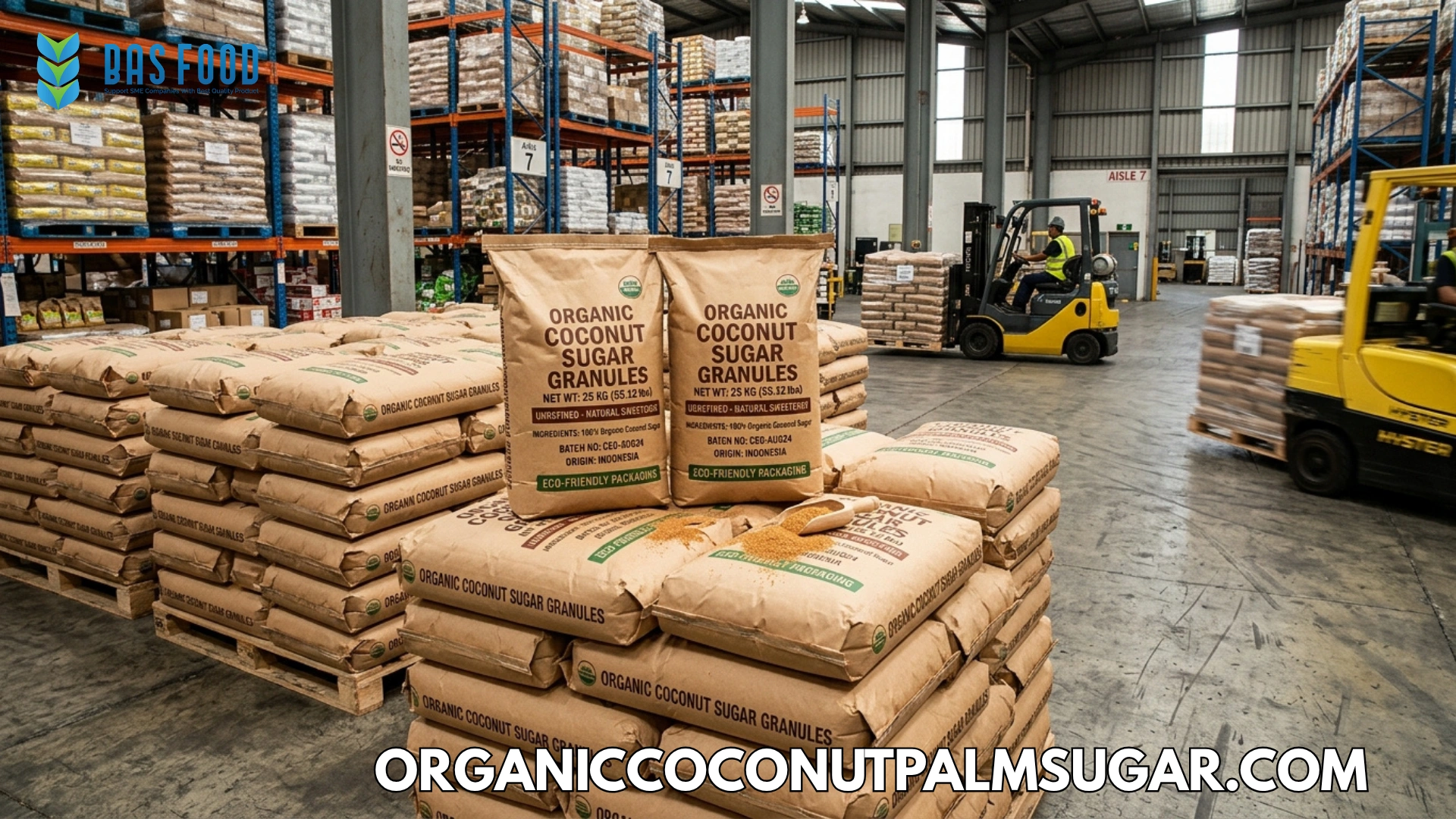
The term coconut sugar granule MOQ refers to the minimum amount of coconut sugar granules that a supplier will accept for a particular commercial order. The MOQ may be expressed in kilograms, bags, cartons, pallets, or another shipment unit.
However, MOQ is not always a universal number for every buyer. A supplier may have different MOQs depending on the product format, packaging, particle size, private-label requirements, or destination market.
For example, a buyer ordering standard bulk coconut sugar granules may have different requirements from a buyer requesting customized packaging. Custom packaging can involve additional preparation, printed materials, labels, or production arrangements. Therefore, the supplier may establish a different MOQ for that order.
This is why buyers should ask for the MOQ that applies specifically to their desired product and packaging instead of assuming that one MOQ applies to every coconut sugar product.
Why MOQ Matters to B2B Coconut Sugar Buyers
MOQ matters because it affects inventory, cash flow, storage space, and shipping planning. A buyer who understands the supplier’s minimum order quantity can calculate whether the purchase fits the company’s current needs.
For example, imagine a small food manufacturer uses only a few hundred kilograms of coconut sugar per month. Ordering several tons at once could create a large inventory that takes many months to consume.
In contrast, a distributor supplying several food businesses may need a much larger volume. For that buyer, a larger order may fit naturally into its distribution model.
Therefore, MOQ should be evaluated against actual consumption. The right question is not simply, “What is the lowest MOQ?” Instead, buyers should ask, “What order quantity makes sense for our business?”
This approach allows buyers to balance purchasing efficiency with inventory management.
What Determines Coconut Sugar Granule MOQ?
Several factors can influence coconut sugar granule MOQ. The first is the product itself. Standard products that a supplier already produces regularly may have different order requirements from highly customized products.
Packaging is another important factor. Standard bulk bags may be easier for a supplier to prepare than specially printed retail packaging. Customized bags can involve minimum printing quantities and additional setup.
Particle size can also influence production planning. Buyers looking for a particular granule specification may need to meet a different quantity requirement if the product requires a dedicated production run.
Destination can matter as well. Export orders often involve logistics planning, palletization, documentation, and transportation arrangements. The supplier may therefore establish an MOQ that fits the expected shipment structure.
Finally, the supplier’s production system matters. Each manufacturer has its own production capacity, scheduling, packaging process, and commercial policies.
Standard MOQ vs Customized MOQ
It is useful to distinguish between standard and customized orders. A standard order typically uses an existing product specification and packaging format.
Because the supplier already has the product and packaging system in place, the purchasing process may be more straightforward. The MOQ can therefore be based mainly on production and logistics considerations.
A customized order can be more complex. For example, a buyer may request a particular granule size, special packaging, private labeling, or a specific bag configuration.
In this situation, the supplier needs to consider additional materials and production steps. The minimum order quantity may therefore be higher.
Buyers should communicate their requirements as early as possible. Clear information about the desired product and packaging helps the supplier determine the appropriate MOQ.
How Bulk Orders Can Affect MOQ
A bulk order generally involves purchasing coconut sugar granules in larger quantities for manufacturing, distribution, or wholesale use.
Bulk purchasing can make sense when a business has predictable demand. Instead of ordering small amounts repeatedly, the buyer can plan larger shipments based on expected consumption.
However, larger orders also require more storage capacity. Buyers should make sure they have sufficient warehouse space and suitable storage conditions before placing a bulk order.
Inventory turnover is another important consideration. If the product moves slowly, a large order may remain in storage for an extended period. Therefore, purchasing volume should reflect realistic demand rather than simply aiming for the largest possible order.
For experienced importers, bulk purchasing can become part of a regular supply schedule. Buyers may work with their supplier to plan orders around monthly or quarterly consumption.
MOQ and Wholesale Coconut Sugar Supply
For wholesale buyers, MOQ can be closely connected with distribution strategy. A wholesaler may purchase coconut sugar granules from an exporter and then distribute them to restaurants, bakeries, retailers, food manufacturers, or other businesses.
In this situation, the buyer needs to calculate expected sales volume before confirming an order. The larger the customer network, the easier it may be to distribute a larger shipment.
However, wholesale buyers should still consider packaging and product specifications. A distributor serving multiple customers may require different package sizes or formats.
It can be useful to separate the purchasing decision into two questions: how much product should be purchased and how should that product be packaged?
The answers will help determine whether a particular MOQ is practical for the wholesale operation.
MOQ and Packaging Requirements
Packaging can have a direct relationship with MOQ. Standard bulk packaging may allow suppliers to process orders more efficiently because the packaging materials are already available.
Customized packaging can work differently. Printed bags, private-label packaging, or specially designed labels may require a minimum quantity from the packaging manufacturer.
For example, a buyer may want a small quantity of coconut sugar but also request custom-printed retail bags. The product quantity may be small, but the packaging supplier may require a much larger printing run.
This is why buyers should ask whether the quoted MOQ applies to the coconut sugar itself, the packaging, or the complete finished product.
Understanding this distinction can prevent unexpected costs during the ordering process.
MOQ and Private Label Coconut Sugar
Private-label products can introduce additional MOQ considerations. A buyer may want coconut sugar granules packed under its own brand name.
In addition to the sugar itself, private-label production can involve packaging design, printed materials, labels, artwork approval, and production scheduling.
Consequently, the MOQ for private-label coconut sugar may differ from the MOQ for standard bulk coconut sugar.
Businesses considering private labeling should provide their packaging requirements early. The supplier can then assess the practical production quantity and explain which components affect the MOQ.
For a new brand, this is especially important. Ordering too much packaging before understanding actual market demand can create unnecessary inventory.
MOQ and Product Specifications
Not all coconut sugar granules are identical. Buyers may have requirements related to particle size, color, flavor, moisture, packaging, or other product characteristics.
A standard product may be available on a more flexible basis because the supplier already produces it regularly.
On the other hand, a highly specific specification may require dedicated production planning. If the supplier needs to adjust production for the order, the MOQ may be different.
Therefore, buyers should define their specifications before discussing MOQ. A supplier cannot provide a meaningful MOQ recommendation without understanding what product is required.
A good specification should be clear but practical. Buyers should identify which characteristics are essential and which can remain flexible.
How to Calculate the Right Order Quantity
Finding the right order quantity starts with understanding consumption. Buyers should estimate how much coconut sugar their business uses over a typical month.
For example, a manufacturer using 1,000 kilograms per month may evaluate whether ordering 2,000, 3,000, or more kilograms makes operational sense.
The buyer should then consider lead time. If production and international shipping take several weeks, the business may need enough inventory to cover consumption during the replenishment period.
Safety stock can also be considered. However, the appropriate level depends on the buyer’s supply chain and internal inventory policy.
The goal is to find a practical balance between purchasing efficiency and inventory risk.
MOQ and Shipping Costs
Shipping can influence the economics of an order. For international buyers, transportation costs may represent a significant part of the total landed cost.
A very small shipment may result in a relatively high transportation cost per kilogram. A larger shipment can sometimes distribute transportation costs across more product.
However, buyers should not automatically increase their order simply to reduce the shipping cost per kilogram. The additional inventory must still be practical to store and sell.
Instead, buyers should calculate the total landed cost, including product price, packaging, transportation, import-related costs, storage, and other relevant expenses.
This gives a more realistic view of the financial impact of MOQ.
MOQ and Inventory Management
Inventory management becomes particularly important when ordering coconut sugar in bulk. Buyers need to know how quickly the product is consumed or sold.
A simple inventory forecast can help. Estimate monthly demand, current stock, expected delivery time, and the desired safety stock.
For example:
Expected order quantity = projected demand during the supply period + safety stock – existing usable inventory
This simple calculation can help prevent unnecessary over-ordering.
Businesses should also consider seasonal demand. Some food manufacturers may experience higher coconut sugar consumption during particular periods of the year.
Planning around these demand patterns can help buyers place larger orders when appropriate without creating excessive stock during slower periods.
Questions to Ask a Coconut Sugar Supplier About MOQ
Before requesting a quotation, buyers should prepare a clear list of questions. This makes supplier communication faster and reduces misunderstandings.
Ask whether the MOQ is based on kilograms, bags, pallets, or containers. Also ask whether the MOQ changes depending on packaging or product specifications.
Useful questions include:
- What is the current coconut sugar granule MOQ?
- Is the MOQ different for standard and customized packaging?
- Does the MOQ apply per product or per shipment?
- Is there a different MOQ for private-label orders?
- What granule sizes are available?
- What packaging sizes are available?
- Can buyers combine different products in one shipment?
- Does the MOQ change for repeat orders?
- What is the estimated production lead time?
- What is the recommended order quantity for regular supply?
- Can the supplier provide samples before a bulk order?
- What information is needed to prepare a formal quotation?
These questions help buyers understand the commercial structure before making a purchasing commitment.
Can Buyers Negotiate MOQ?
MOQ can sometimes be discussed with suppliers, although the outcome depends on the supplier’s production system and order requirements.
For example, a supplier may be more flexible when the buyer uses standard packaging and an existing product specification. Repeat orders may also provide a different commercial context because the supplier can better understand the customer’s purchasing pattern.
Buyers can also discuss a trial order before committing to a larger long-term arrangement. This can be useful when the customer needs to test the product in its manufacturing process.
However, buyers should not assume that every supplier can reduce MOQ. Production, packaging, and logistics costs can make certain minimum quantities necessary.
A productive discussion focuses on finding a practical order structure rather than simply asking for the lowest possible quantity.
Trial Orders Before Large Commercial Purchases
A trial order can be useful for new buyers. It allows a company to evaluate product quality, packaging, logistics, and supplier communication before moving to a larger order.
During the trial, manufacturers can test the coconut sugar in their own applications. They may evaluate flavor, color, particle size, flowability, mixing behavior, and other relevant characteristics.
The buyer can also assess the packaging after transportation. This is especially useful for international customers who need to understand how the product arrives after export shipping.
If the trial performs well, the buyer can then discuss a regular purchasing schedule and potentially a larger bulk order.
This approach can reduce uncertainty when establishing a new supply relationship.
Choosing a Coconut Sugar Exporter Supplier
A good coconut sugar exporter supplier should provide clear information about product specifications, packaging, MOQ, lead times, and shipment preparation.
For international buyers, communication is especially important. The supplier needs to understand the destination country, desired quantity, packaging requirements, and intended application.
CV Bonafide Anugerah Sentosa can serve businesses looking for coconut-derived ingredients from Indonesia. Buyers can discuss coconut sugar granule specifications, packaging, commercial quantities, and export requirements based on their individual needs.
Rather than choosing a supplier based solely on the lowest MOQ, buyers should consider whether the supplier can support their expected purchasing volume and product requirements over time.
A supplier that understands the buyer’s business can make future orders easier to plan.
Building a Long-Term Coconut Sugar Purchasing Plan
For businesses that use coconut sugar regularly, it can be helpful to create a purchasing plan rather than ordering only when inventory becomes low.
The plan can include monthly consumption, expected demand growth, lead time, safety stock, preferred packaging, and shipment frequency.
A buyer might initially start with a smaller commercial order and increase the volume after confirming actual demand. This allows purchasing decisions to develop alongside the business.
As demand becomes more predictable, the buyer can discuss regular wholesale or bulk supply arrangements with the supplier.
Long-term planning can also improve communication. Instead of negotiating every shipment from scratch, the buyer and supplier can establish a more predictable purchasing routine.
Final Thoughts: Finding an MOQ That Fits Your Business
Understanding coconut sugar granule MOQ is an important part of international sourcing. MOQ affects purchasing volume, inventory, packaging, shipping, storage, and overall supply-chain planning.
There is no universal order quantity that works for every buyer. A small manufacturer, wholesaler, distributor, and large food factory can have very different requirements.
The best approach is to calculate your actual demand, understand your storage capacity, define your product specifications, and discuss packaging requirements before requesting a quotation.
For buyers working with a coconut sugar exporter supplier, clear communication is essential. Explain your expected quantity, destination, packaging preference, and intended application. This allows the supplier to determine an appropriate commercial structure.
CV Bonafide Anugerah Sentosa can support B2B customers looking for coconut sugar from Indonesia, with purchasing discussions based on product specifications, packaging, order quantities, and export requirements.
Ultimately, MOQ should not be viewed simply as a supplier restriction. It is a commercial factor that buyers can use to plan a more efficient sourcing strategy. When the order quantity matches actual demand, businesses can manage inventory more effectively while building a more predictable coconut sugar supply chain.