Coconut sugar syrup is gaining attention as a natural liquid sweetener for beverages, bakery products, sauces, desserts, and food manufacturing. Its caramel-like flavor and convenient liquid form make it an interesting ingredient for businesses looking to diversify their sweetener options. However, when purchasing coconut sugar syrup in bulk, one important question often comes first: How long can coconut sugar syrup last without losing its quality?
The answer depends on several factors, including sugar concentration, water activity, processing methods, packaging, and storage conditions.
Understanding coconut sugar syrup shelf life is especially important for food manufacturers, international importers, distributors, and private-label brands. These businesses need ingredients that maintain consistent quality throughout transportation, warehousing, and production.
Poor storage practices may affect flavor, color, viscosity, and microbial quality. Meanwhile, suitable processing and packaging can help protect the product during its intended storage period.
In this guide, we will explore the science behind coconut sugar syrup shelf life, the importance of syrup storage, the factors affecting shelf stability, and practical approaches to product preservation.
Whether you are developing a new beverage or sourcing coconut sugar syrup from Indonesia, this article will help you make more informed purchasing and storage decisions.
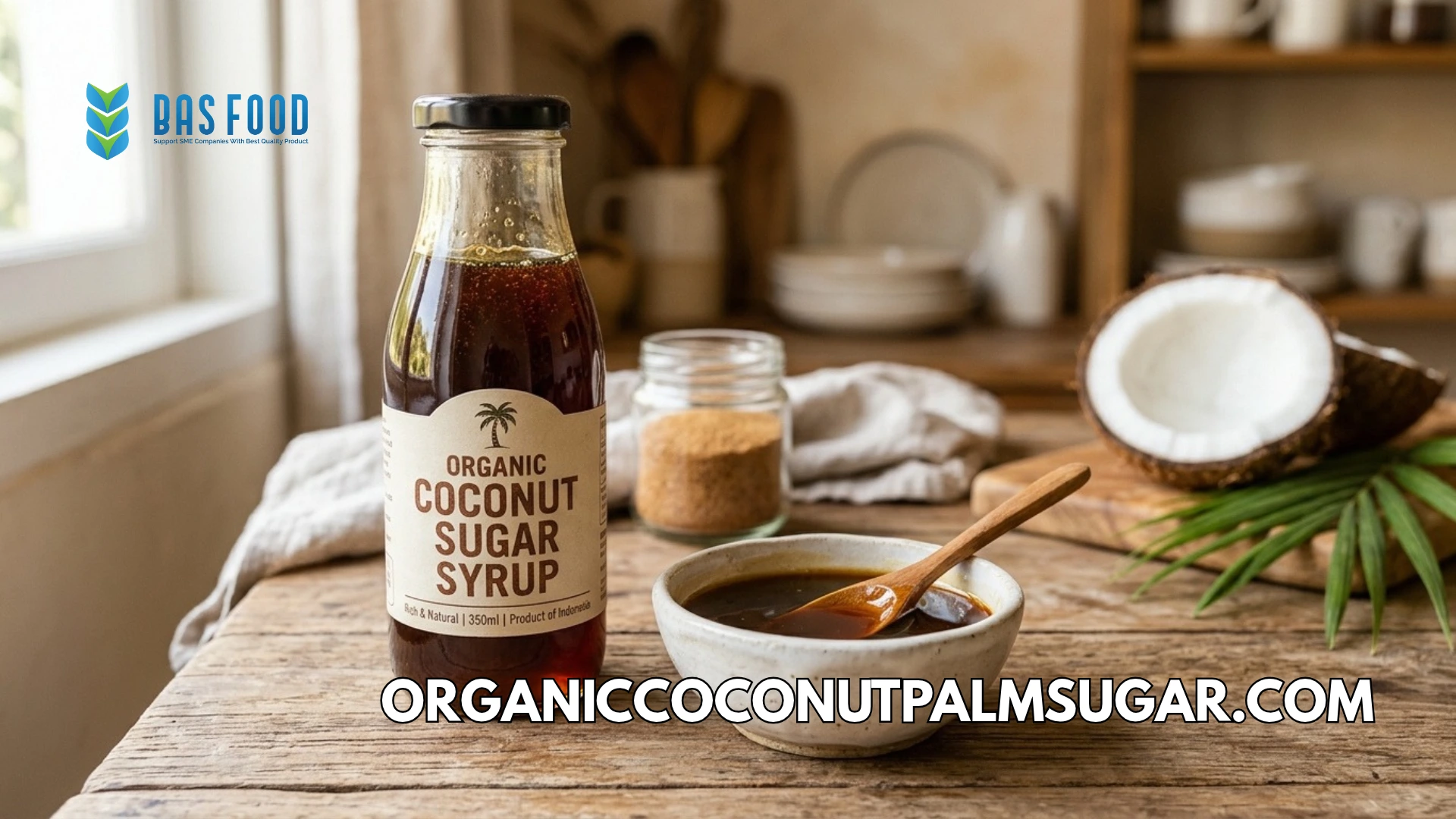
What Is Coconut Sugar Syrup Shelf Life?
Coconut sugar syrup shelf life refers to the period during which the syrup maintains its intended safety and quality characteristics under specified storage conditions.
During this period, the product should continue to meet its relevant specifications, including appearance, flavor, texture, and microbiological requirements.
However, shelf life is not the same for every coconut sugar syrup product.
Different manufacturers may use different concentration processes, packaging systems, and quality controls. These differences can influence how the syrup behaves during storage.
Shelf life versus expiration date
Shelf life is a technical concept established through product evaluation and testing.
A best-before date generally relates to expected quality under specified storage conditions, while a use-by or expiration date may carry different legal or safety implications depending on the country and product.
Therefore, importers should understand the meaning of the date printed on the packaging.
They should also follow the manufacturer’s instructions and applicable local food labeling regulations.
Is coconut sugar syrup naturally shelf-stable?
Concentrated sugar solutions can have reduced water activity, which may limit the growth of certain microorganisms.
However, this does not mean every coconut sugar syrup is automatically shelf-stable.
Some microorganisms, including certain yeasts and molds, can tolerate relatively concentrated sugar environments.
Therefore, shelf stability must be demonstrated through appropriate processing controls, packaging, and product-specific testing.
How Coconut Sugar Syrup Is Made and Why Processing Matters
Coconut sugar syrup is produced by concentrating sap collected from coconut palm flowers.
Fresh coconut sap contains water, sugars, and other naturally occurring components.
During production, manufacturers reduce the water content to create a concentrated liquid sweetener.
This process changes the syrup’s soluble solids concentration, viscosity, flavor, and other characteristics.
Concentration and evaporation
Heating is commonly used to remove water from coconut sap.
As water evaporates, the concentration of dissolved sugars increases.
This can influence the syrup’s water activity and physical properties.
However, the final concentration alone does not determine shelf life.
Manufacturers must also consider hygiene, microbial quality, packaging, and storage conditions.
Why processing hygiene matters
Fresh coconut sap can undergo microbial changes if it is not handled appropriately.
Therefore, hygienic collection, timely processing, and suitable equipment sanitation are important.
Contamination introduced during processing or packaging may affect the finished syrup.
For this reason, good manufacturing practices are essential to reliable product preservation.
Consistency between production batches
Batch consistency also supports predictable shelf-life performance.
If processing conditions vary significantly, the finished syrup may have different concentrations or microbial characteristics.
Manufacturers should therefore monitor relevant production parameters and maintain suitable quality records.
Consistent production helps buyers evaluate the syrup more reliably.
Water Activity: A Key Factor Behind Shelf Stability
Water activity is one of the most important concepts in understanding food shelf stability.
It describes the availability of water for microbial growth and other processes.
Water activity is commonly represented by the symbol aw.
However, water activity is different from total moisture content.
Water activity versus moisture content
Moisture content describes the amount of water in a product.
Water activity describes how available that water is within the food system.
Two syrups with similar moisture content may have different water activity values because of differences in sugar composition and other dissolved substances.
Therefore, moisture percentage alone cannot reliably establish microbial stability.
Why low water activity matters
Many microorganisms require sufficient available water to grow.
Concentrated sugar solutions can reduce water activity and limit the growth of some microorganisms.
However, certain osmophilic yeasts and xerophilic molds can grow under conditions that inhibit many other organisms.
Therefore, low water activity should be considered one part of a broader food safety strategy.
Does high Brix guarantee a long shelf life?
No.
Brix is useful for measuring apparent soluble solids concentration, but it does not directly measure microbial safety.
A high Brix reading does not automatically prove that a syrup is safe for extended ambient storage.
Manufacturers should evaluate Brix alongside water activity, microbial testing, processing conditions, and packaging integrity.
The Main Factors Affecting Coconut Sugar Syrup Shelf Life
Several factors influence how long coconut sugar syrup can maintain its intended quality.
These factors often interact, meaning that changing one condition may affect others.
For example, temperature can influence chemical reactions, viscosity, and microbial behavior.
Therefore, manufacturers should evaluate the complete product system rather than relying on a single measurement.
Sugar concentration
Sugar concentration influences water activity and physical properties.
A more concentrated syrup may have less available water, depending on its composition.
However, excessive concentration can also increase viscosity or encourage crystallization under certain conditions.
Therefore, manufacturers should identify a suitable concentration range for the intended product.
Storage temperature
Temperature affects many quality-related processes.
Warmer storage conditions may accelerate certain chemical changes, including color and flavor development.
Cooler conditions may increase viscosity and influence crystallization behavior.
However, the ideal storage temperature depends on the syrup’s formulation and validated shelf-life requirements.
Packaging quality
Packaging helps protect syrup from contamination, moisture exchange, and other environmental influences.
Suitable food-contact materials and secure closures are important.
Damaged packaging may compromise the product even when the syrup was manufactured correctly.
Therefore, packaging integrity should be part of the quality control process.
Oxygen exposure
Oxygen exposure may contribute to certain quality changes, depending on the syrup’s composition and storage conditions.
Repeated opening or poor closure integrity can increase exposure to the surrounding environment.
However, the importance of oxygen should be evaluated alongside other stability factors.
Appropriate packaging can help maintain the intended product characteristics.
Coconut Sugar Syrup Storage: Best Practices for Quality Protection
Proper syrup storage helps maintain quality during warehousing and distribution.
For international buyers, storage conditions should be considered before the shipment arrives.
The most appropriate storage procedure depends on the manufacturer’s validated recommendations.
Therefore, businesses should not assume that every coconut sugar syrup can be stored under identical conditions.
Store in suitable conditions
Follow the supplier’s specified storage temperature and environmental requirements.
Avoid unnecessary exposure to extreme temperatures.
Temperature fluctuations may influence viscosity, crystallization, and other physical characteristics.
Warehouses should also maintain appropriate cleanliness and pest-control practices.
Protect containers from damage
Inspect containers before storage.
Check for damaged closures, leaks, swelling, or other unusual conditions.
Any damaged or suspicious packaging should be evaluated according to the company’s food safety procedures.
Do not automatically release affected product for manufacturing.
Use proper stock rotation
First-in, first-out (FIFO) and first-expired, first-out (FEFO) systems can support inventory management.
FEFO is particularly useful when different batches have different remaining shelf lives.
Clear batch identification helps warehouse teams select the correct stock.
This reduces the risk of using products beyond their specified dates.
Does Coconut Sugar Syrup Need Refrigeration?
One common question about coconut sugar syrup shelf life is whether the product requires refrigeration.
The answer depends on the syrup’s formulation, processing, packaging, and validated storage instructions.
Some commercially processed syrups may be suitable for unopened ambient storage.
Others may require refrigeration or additional controls.
Therefore, refrigeration requirements should never be assumed without reviewing the product specification.
Unopened coconut sugar syrup
For unopened containers, the supplier should provide recommended storage conditions.
These recommendations should reflect appropriate shelf-life evaluation.
If the product is labeled for ambient storage, buyers should still follow the stated temperature limits and handling instructions.
After opening the container
Opening a container introduces new contamination risks.
Utensils, dispensing equipment, air exposure, and repeated handling can affect the product.
Therefore, the usable life after opening may be shorter than the unopened shelf life.
Manufacturers should follow the supplier’s instructions and establish suitable handling procedures.
If no validated after-opening guidance is available, buyers should request clarification rather than assume that the original shelf-life date still applies.
How Crystallization Can Affect Syrup Quality During Storage
Crystallization is a physical process in which dissolved sugars form solid crystals.
It can occur when the syrup’s composition, concentration, and storage conditions favor crystal formation.
Although crystallization does not automatically indicate spoilage, it can affect product appearance and handling performance.
Why crystals form
Concentrated sugar solutions may become supersaturated under certain conditions.
When this happens, dissolved sugar molecules can begin forming crystals.
Temperature changes, sugar composition, and existing crystal particles may influence the process.
However, crystallization behavior varies between formulations.
Does crystallization shorten shelf life?
Not necessarily.
Crystallization is primarily a physical quality issue.
However, it may make the product unsuitable for applications requiring a smooth liquid.
For example, beverage manufacturers may experience dosing or mixing difficulties if crystals develop.
Therefore, physical stability should be included in shelf-life evaluation when relevant.
Can crystallized syrup be used?
That depends on the product’s condition and intended application.
If crystallization is the only change, controlled reconditioning may be possible under a validated procedure.
However, heating should not be used to make contaminated or deteriorated syrup acceptable.
Any unusual product changes should be investigated before use.
How Shelf Life Affects Beverage Manufacturing
Coconut sugar syrup may be considered for coffee, tea, specialty beverages, and other sweetened drink formulations.
For beverage manufacturers, consistent syrup quality is important for accurate dosing and predictable flavor.
If the syrup changes during storage, production performance may also change.
Maintaining sweetness consistency
Changes in concentration or product uniformity can influence sweetness delivery.
For example, a syrup that has developed significant crystallization may no longer behave like a uniform liquid.
This can affect automated dosing systems.
Therefore, manufacturers should inspect incoming ingredients and monitor relevant quality parameters.
Managing opened containers
Beverage facilities may repeatedly open syrup containers during production.
This creates opportunities for contamination.
Clean dispensing equipment, controlled handling, and appropriate storage are important.
Manufacturers should also establish an acceptable in-use period based on the product’s characteristics and handling conditions.
Coconut Sugar Syrup Shelf Life in Bakery and Food Manufacturing
Bakery and food manufacturers often purchase ingredients in quantities that support continuous production.
For these businesses, ingredient shelf life influences inventory planning, purchasing schedules, and production efficiency.
Coconut sugar syrup may contribute sweetness, moisture, and caramel-like flavor to selected formulations.
However, its quality must remain suitable throughout the intended storage period.
Bakery applications
In bakery production, changes in syrup viscosity or concentration may affect mixing and formulation consistency.
For example, a syrup that becomes unusually thick may require different handling conditions.
However, manufacturers should avoid making uncontrolled adjustments to compensate for unexpected ingredient changes.
Instead, they should verify whether the syrup remains within specification.
Sauces and dessert products
Sauces, glazes, and dessert fillings often require consistent texture and flavor.
Changes in syrup color, aroma, or crystallization behavior may affect the finished product.
Therefore, manufacturers should evaluate the syrup before use.
Incoming inspection and appropriate storage can help reduce quality variation.
How Manufacturers Determine Coconut Sugar Syrup Shelf Life
Reliable shelf-life claims should be supported by product-specific evaluation.
Manufacturers cannot determine a universal shelf life simply by measuring sugar concentration.
Instead, they should consider microbial safety, physical stability, chemical changes, packaging, and expected storage conditions.
Real-time shelf-life studies
Real-time studies involve storing representative product samples under defined conditions and evaluating them over time.
Testing may include appearance, color, flavor, viscosity, water activity, and microbiological characteristics.
The exact testing program depends on the product and its intended use.
These studies provide evidence of how the syrup behaves under the selected conditions.
Accelerated shelf-life testing
Accelerated testing uses controlled conditions to investigate certain changes more quickly.
For example, elevated temperatures may help researchers study some chemical or physical deterioration processes.
However, accelerated results cannot always be translated directly into real-world shelf life.
Microbial behavior and crystallization may respond differently under accelerated conditions.
Therefore, accelerated studies should be appropriately designed and interpreted.
Packaging validation
Shelf-life testing should use packaging representative of the commercial product.
Different packaging materials and closure systems can influence product protection.
For example, a syrup tested in a sealed laboratory container may behave differently from the same product stored in its commercial packaging.
Therefore, packaging should be included in the validation process.
How to Recognize Possible Syrup Deterioration
Food manufacturers should establish procedures for identifying products that may no longer meet quality or safety requirements.
Visible changes can provide useful warning signs.
However, not every safety issue produces an obvious visual or sensory change.
Therefore, appearance and smell should not be the only criteria used to determine product safety.
Unusual odor or appearance
Unexpected fermentation-like odors, visible mold, gas formation, leaking containers, or other abnormal changes may indicate a quality or safety problem.
Affected products should be isolated and evaluated.
Do not taste suspicious syrup to determine whether it is safe.
Changes in texture
Unexpected separation, unusual thickening, or significant crystallization may indicate physical instability.
However, these changes do not necessarily prove microbial spoilage.
The appropriate response is to investigate the cause and compare the product with its specification.
When to reject a batch
A batch should not be released for use if it fails applicable safety requirements or agreed acceptance criteria.
The buyer should document the issue and contact the supplier.
Where appropriate, laboratory testing can help determine the cause.
Clear procedures protect both manufacturing operations and product quality.
Choosing a Coconut Sugar Supplier with Reliable Shelf-Life Information
For international buyers, choosing a dependable coconut sugar supplier involves more than comparing product prices.
The supplier should provide clear information about product specifications, storage requirements, and available quality documentation.
When purchasing coconut sugar syrup in bulk, buyers should specifically ask how the shelf-life period was established.
Working with CV Bonafide Anugerah Sentosa
CV Bonafide Anugerah Sentosa is an Indonesian supplier and exporter associated with coconut-derived products and other commodities.
Businesses exploring coconut sweeteners from Indonesia can contact the company to discuss current product availability, technical specifications, and export arrangements.
As a potential coconut sugar exporter supplier, the company can be approached regarding coconut sugar products and sourcing requirements.
For coconut sugar syrup inquiries, buyers should confirm whether the requested syrup is available and ask for its current shelf-life declaration, storage recommendations, packaging details, and quality documentation.
These details should be verified for the specific product rather than assumed from general coconut sugar information.
For more information, visit CV Bonafide Anugerah Sentosa.
Conclusion: Protecting Coconut Sugar Syrup Quality from Production to Consumption
Understanding coconut sugar syrup shelf life is essential for businesses that depend on consistent liquid sweeteners.
Shelf life is influenced by sugar concentration, water activity, processing hygiene, packaging, temperature, and storage conditions.
However, no single factor can guarantee long-term stability.
Effective product preservation requires a combination of suitable manufacturing practices, validated packaging, appropriate storage, and quality monitoring.
For food manufacturers, reliable shelf stability helps support predictable production and ingredient performance.
For international importers, clear shelf-life documentation helps improve purchasing decisions and inventory planning.
Meanwhile, proper syrup storage helps protect the product after delivery.
Businesses exploring coconut sweeteners from Indonesia can contact CV Bonafide Anugerah Sentosa to discuss current product offerings and export requirements.
Before placing a bulk order, confirm the product’s declared shelf life, recommended storage conditions, packaging, and available quality documentation.
With the right information and handling practices, buyers can better protect coconut sugar syrup quality throughout the supply chain.