For food manufacturers, importers, distributors, and ingredient buyers, product quality does not end when coconut sugar granules leave the production facility. The product may spend weeks or months in warehouses, during transportation, or inside a food manufacturing facility before it is finally used. That is why coconut sugar granule shelf stability is an important consideration when sourcing this ingredient for commercial applications. Coconut sugar granules are a dry sweetener, but they are still sensitive to their surrounding environment. Moisture, temperature, packaging, storage conditions, handling, and transportation can all influence how the granules behave over time. When these factors are not managed properly, the product may become harder to pour, develop lumps, or lose some of the physical characteristics expected by the buyer.
For B2B buyers, understanding shelf stability helps create better purchasing decisions. Instead of looking only at price or appearance, buyers can evaluate the complete supply chain, from production and packaging to export shipping and final storage.
This guide explains the key factors behind coconut sugar granule shelf stability and provides practical considerations for businesses sourcing coconut sugar from Indonesia.
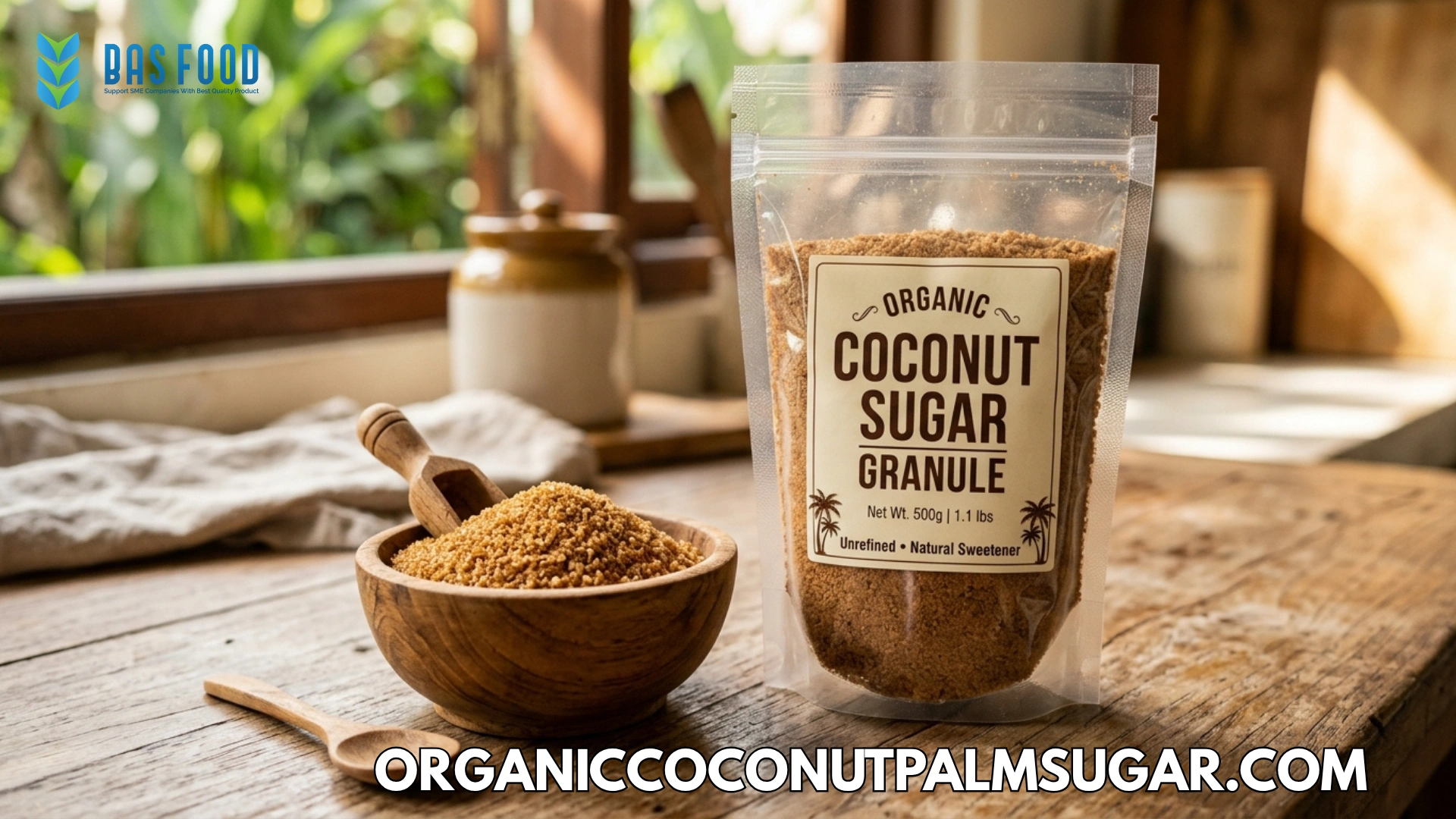
What Is Coconut Sugar Granule Shelf Stability?
Coconut sugar granule shelf stability refers to the ability of coconut sugar granules to maintain their expected quality and physical characteristics throughout their intended storage period under recommended conditions.
For a B2B buyer, stability can include several characteristics. These may include color, aroma, flavor, particle condition, flowability, moisture level, and resistance to excessive clumping. The exact quality parameters depend on the product specification agreed between the supplier and buyer.
Shelf stability does not mean that the product will remain exactly the same under every possible condition. Instead, it means the product is expected to remain within defined quality specifications when handled and stored properly.
This distinction is important because coconut sugar is a hygroscopic food ingredient. In simple terms, it can interact with moisture from its surrounding environment. Therefore, controlling exposure to moisture is one of the most important parts of maintaining product quality.
Why Moisture Is a Major Factor in Granule Stability
Moisture is one of the biggest factors affecting dry sugar ingredients. Coconut sugar granules can absorb moisture when exposed to humid air, especially if the packaging is opened or damaged.
As moisture enters the product, granules may begin to stick together. Over time, this can lead to clumping. In severe cases, the product may become harder to handle, measure, pour, or process in automated equipment.
This is why moisture control should be part of every commercial coconut sugar storage strategy. The product should remain properly sealed until it is needed, and storage areas should be suitable for dry food ingredients.
Packaging also plays a major role. A well-designed package can help reduce exposure to external humidity during transportation and storage. However, packaging should always be considered together with warehouse conditions because even good packaging can be compromised by damage or improper handling.
How Storage Conditions Affect Shelf Stability
Good storage stability depends on more than the product itself. The warehouse environment can have a major effect on how coconut sugar granules behave over time.
A dry and clean storage environment is generally more suitable for dry sugar ingredients than an area with excessive humidity. The product should also be protected from direct exposure to water and other sources of moisture.
Temperature changes may also affect storage conditions. While moisture is often the primary concern for dry granules, temperature can influence the surrounding humidity and condensation risk. Therefore, warehouses should avoid conditions that create unnecessary moisture exposure.
Proper stock rotation is another useful practice. Businesses can organize inventory according to production date or batch information so that older stock is appropriately managed before newer stock.
For importers and distributors, these simple practices can help maintain consistent product condition after the shipment arrives.
The Importance of Packaging for Coconut Sugar Granules
Packaging is one of the first barriers between coconut sugar granules and the external environment. Therefore, it plays a central role in coconut sugar granule shelf stability.
A suitable package should help protect the granules from moisture, contamination, physical damage, and unnecessary exposure during transportation and storage. The exact packaging format can vary depending on the buyer’s order volume and application.
Small packages may be suitable for retail or foodservice use, while larger bags can be more practical for food manufacturers and distributors. Bulk buyers may also have specific requirements for palletization and warehouse handling.
The package should also remain properly sealed. A damaged bag, weak seal, or poorly handled container can allow environmental moisture to reach the product.
For this reason, buyers should evaluate packaging as part of the product specification rather than treating it as a separate logistics issue.
Particle Size Can Influence Handling
Particle size is another consideration when evaluating coconut sugar granule stability. Fine and coarse granules may respond differently to environmental conditions and handling.
Fine particles have a greater surface area relative to their size. Depending on the product characteristics and storage environment, this can influence how the material interacts with moisture.
Coarse granules may have different flow characteristics and may behave differently during transportation and storage. However, particle size alone does not determine shelf stability.
The actual product formulation, moisture level, packaging, and storage environment all work together. Therefore, buyers should request the supplier’s product specification for the exact granule size they intend to purchase.
This is particularly important for food manufacturers using sieved or specified particle sizes in automated production processes.
Coconut Sugar Granules and Clumping
Clumping is one of the most common physical concerns associated with dry sugar ingredients. When coconut sugar granules absorb moisture, individual particles may begin to stick together.
A small amount of natural aggregation may be manageable, depending on the application. However, excessive clumping can make the ingredient difficult to pour or dose.
For industrial users, this can become a practical production issue. Automated feeding systems may work more efficiently when the ingredient maintains suitable flow characteristics.
To reduce unnecessary clumping, businesses should focus on moisture control throughout the supply chain. Keep packages closed when not in use and avoid storing them in humid areas.
Buyers should also discuss product expectations with their coconut sugar supplier. If free-flowing granules are important for a specific manufacturing process, this requirement should be communicated before purchasing.
How Export Shipping Can Affect Coconut Sugar Stability
International transportation can expose coconut sugar granules to changing environmental conditions. This makes export shipping an important part of shelf-stability planning.
A shipment may move from the production facility to a warehouse, then to a port, into a shipping container, through ocean transportation, and finally to the buyer’s warehouse. Each stage can involve different temperature and humidity conditions.
Physical handling also matters. Bags may be moved multiple times during loading and unloading. Packaging should therefore be strong enough for the intended logistics process and handled appropriately to avoid punctures or damaged seals.
Container loading is another consideration. Products should be arranged in a way that supports stable transportation and protects packaging from unnecessary pressure or damage.
For international buyers, it is useful to discuss the expected shipping route with the supplier before placing a bulk order. This allows both parties to consider packaging and logistics requirements early.
Humidity During International Transportation
Humidity can become particularly important when coconut sugar travels between different climates. A product leaving a tropical production region may experience different environmental conditions during transportation and after arrival.
Temperature fluctuations can also contribute to condensation under certain circumstances. If moisture reaches the product, the granules may become more prone to clumping.
Therefore, moisture protection should continue throughout the entire supply chain. Packaging should remain intact, and containers should be handled carefully.
Buyers should also avoid opening packages immediately in unsuitable environments. Once a package is opened, the granules are directly exposed to the surrounding air.
This is why warehouse teams should understand the importance of keeping dry ingredients properly sealed and protected.
Storage After the Shipment Arrives
The arrival of the shipment is not the end of shelf-stability management. In fact, proper storage at the destination is just as important as transportation.
When coconut sugar arrives, the receiving team should inspect the outer packaging. Look for signs of damage, water exposure, broken seals, or other unusual conditions.
After receiving the shipment, store the product in a suitable dry-food storage area. Packages should remain closed until the ingredient is required for production.
Businesses should also maintain batch information. This can help with inventory management and traceability if several shipments are stored at the same time.
A simple first-in, first-out inventory approach can also help businesses manage their stock efficiently.
The Role of Moisture Specifications
When purchasing coconut sugar, buyers should pay attention to the product’s moisture specification. Moisture is an important quality parameter for dry sugar ingredients because it can influence physical behavior and storage performance.
However, buyers should not use a single moisture number as a universal guarantee of shelf stability. Different products, packaging systems, and storage conditions can produce different outcomes.
Instead, the moisture specification should be evaluated together with packaging and storage requirements. A product with an appropriate specification still needs to be protected from excessive environmental moisture.
For B2B buyers, this means requesting the technical specification for the exact product being ordered. It is better to evaluate the complete product profile than to rely on a general statement about coconut sugar.
Packaging Integrity Matters During Storage
Even when a shipment arrives in good condition, packaging should continue to be monitored during storage.
Packages should not be exposed to unnecessary physical pressure or sharp objects that could puncture the material. Storage areas should also be organized so that bags are not placed in conditions where water exposure is likely.
If a package becomes damaged, the buyer should follow its internal quality procedures. Depending on the situation, the affected product may require inspection before use.
This is especially important for large warehouses handling many tons of ingredients. A small packaging problem can become a larger inventory issue if it is not identified early.
Consequently, warehouse staff should understand basic handling requirements for coconut sugar granules.
How Shelf Stability Affects Food Manufacturing
For food manufacturers, shelf stability can influence production efficiency. Coconut sugar granules are often added to bakery products, cereals, snacks, beverages, sauces, desserts, and other formulations.
If the granules remain consistent and flow properly, they may be easier to weigh, transfer, and mix. On the other hand, excessive clumping can create additional handling steps.
For automated production, consistent particle size and physical condition can be particularly useful. Manufacturers may need predictable flow behavior when ingredients pass through hoppers, feeders, or dosing equipment.
Therefore, shelf stability is not simply a warehouse concern. It can also influence the manufacturing process.
Buyers should communicate their intended application to their supplier so that the supplier can recommend a suitable product specification.
Choosing a Coconut Sugar Supplier for Stable Supply
A supplier plays an important role in maintaining product consistency. Buyers should look beyond the initial purchase price and evaluate how clearly the supplier communicates product specifications, packaging, storage, and shipping requirements.
A professional coconut sugar exporter supplier should understand the needs of international buyers. This includes product specifications, packaging formats, shipment preparation, and documentation requirements.
Buyers can request product samples before placing a large commercial order. Samples allow manufacturers to evaluate particle size, color, flavor, flow behavior, and compatibility with their production process.
It is also useful to establish clear specifications before confirming a long-term supply arrangement. This can reduce misunderstandings between buyer and supplier.
Final Thoughts: Building Stability From Factory to Warehouse
Coconut sugar granule shelf stability depends on several connected factors. Moisture, packaging, particle size, storage conditions, handling, and transportation can all influence how the product performs over time.
For international buyers, export shipping deserves particular attention because the product may pass through several logistics stages before reaching the final warehouse. Proper packaging and careful handling can help reduce unnecessary exposure to environmental conditions.
At the destination, good storage stability depends on maintaining suitable warehouse conditions and protecting the product from moisture. Buyers should also monitor packaging integrity and manage inventory systematically.
Most importantly, businesses should work with a coconut sugar supplier that can provide clear product specifications and discuss practical requirements before shipment.
When production, packaging, shipping, and storage are managed as one system, buyers can create a more predictable supply chain for coconut sugar granules. That makes the ingredient easier to store, handle, and use in commercial food production.